

Advanced Study Material for Class 12 Physics: Solids and Fluids
Access comprehensive study materials and useful resources for Solids and Fluids using the CBSE Class 12 Physics Solids and Fluids Solved Problems. Designed to align with the 2026-27 CBSE academic guidelines, these advanced resources help Class 12 Physics students reinforce core concepts beyond standard textbooks.
Practice Class 12 Physics Resources: Solids and Fluids
Navigate directly to the advanced Physics study materials using the digital viewer below. Each resource pack includes detailed conceptual summaries and solved practice questions, allowing students to instantly reinforce their learning.
CBSE Class 12 Physics Solids and Fluids Solved Problems. Please refer to the examination notes which you can use for preparing and revising for exams. These notes will help you to revise the concepts quickly and get good marks.
CBSE CLASS 12 PHYSICS SOLVED PROBLEMS
SOLIDS AND FLUIDS
SOLVED EXAMPLES
Ex.1. A light rod of length 200 cm is suspended from the ceiling horizontally by means of two vertical wires of equal length tied to its ends. One of the wires is made of steel and is of cross-section 0.1 sq cm and the other is of brass of cross-section 0.2 sq cm. Find the position along the rod at which a weight may be hung to produce (a) equal stresses in both wires and (b) equal strains in both wires. (Ybrass = 10 × 1011 dynes/cm2, Ysteel = 20 × 1011 dynes/cm2)

Answer:
(a) Equal stresses
1. Let the steel wire (A) carry tension T1 and the brass wire (B) carry tension T2. Let the weight hang at C, at distance x from end A.
2. Stress in steel = T1/0.1 and stress in brass = T2/0.2. Equal stresses give \( \frac{T_1}{0.1} = \frac{T_2}{0.2} \), so \( \frac{T_1}{T_2} = 0.5 \) ......(i)
3. Taking moments about C: T1 × x = T2 × (200 - x), so \( \frac{T_1}{T_2} = \frac{200 - x}{x} \) ......(ii)
4. From (i) and (ii), \( \frac{200 - x}{x} = 0.5 \), so 200 - x = 0.5x, which gives x = 133.3 cm from the steel end.
(b) Equal strains
5. Strain = T/(AY), so equal strains give \( \frac{T_1}{A_1 Y_1} = \frac{T_2}{A_2 Y_2} \).
6. \( \frac{T_1}{T_2} = \frac{A_1 Y_1}{A_2 Y_2} = \frac{0.1 \times 20 \times 10^{11}}{0.2 \times 10 \times 10^{11}} = 1 \), so T1 = T2.
7. Then x = 200 - x, so x = 100 cm from the steel end, which is the midpoint of the rod.
Teacher's Note:
a) Equal stress needs the ratio of forces to match the ratio of areas, so the thinner steel wire gets the smaller force.
b) Equal strain is a different condition from equal stress; the answer changes from 133.3 cm to 100 cm.
c) Take moments about the point of suspension of the weight, not about an end of the rod.
Ex.2. A steel wire of diameter 0.8 mm and length 1 m is clamped firmly at two points A and B which are 1 m apart and in the same horizontal plane. A body is hung from the middle point of the wire such that the middle point sags 1 cm lower from the original position. Calculate the mass of the body. Given Young's modulus of the material of wire = 2 × 10¹² dynes/cm2.

[Figure: The wire AB is horizontal with its midpoint C at the centre. The body hangs from C, which moves down to D by 1 cm. The two halves AD and DB make a small angle with the horizontal.]
Answer:
1. AD = √(AC² + CD²) = √(50² + 1²) = 50.01 cm.
2. Increase in length of each half = 50.01 - 50 = 0.01 cm.
3. Strain = 0.01 / 50 = 2 × 10⁻⁴.
4. Stress = Y × strain = 2 × 1012 × 2 × 10-4 = 4 × 10⁸ dynes/cm2.
5. Radius = 0.04 cm, so area = π × (0.04)² = 5.03 × 10⁻³ cm².
6. Tension T = stress × area = 4 × 108 × 5.03 × 10-3 = 2.01 × 10⁶ dynes.
7. Let θ be the angle each half makes with the horizontal, so sin θ = CD / AD = 1 / 50.01.
8. For equilibrium, mg = 2T sin θ, so m = 2T sin θ / g = 2 × 2.01 × 106 × (1/50.01) / 980 = 82 g.
9. Mass of the body = 82 g.
Teacher's Note:
a) The vertical component of tension, not the full tension, balances the weight.
b) The extension is tiny, so the sag must be converted into a strain with the original half length of 50 cm.
c) Use the diameter-to-radius conversion carefully; the radius here is 0.04 cm.
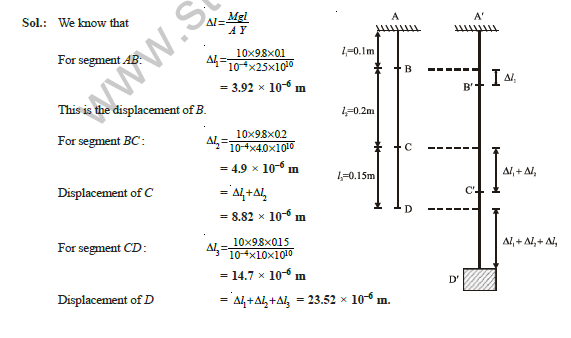
Ex.3. A rod AD, consisting of three segments AB, BC and CD joined together, is hanging vertically from a fixed support at A. The lengths of the segments are respectively 0.1 m, 0.2 m and 0.15 m. The cross-section of the rod is uniformly equal to 10-4 m2. A weight of 10 kg is hung from D. Calculate the displacements of the points B, C and D using the data on Young's moduli given below (neglect the weight of the rod). YAB = 2.5 × 10¹⁰ N/m2, YBC = 4.0 × 10¹⁰ N/m2 and YCD = 1.0 × 10¹⁰ N/m2.
Answer:
1. Since the rod's weight is neglected, every segment carries the same tension, F = mg = 10 × 9.8 = 98 N.
2. Use Δl = Fl / (AY).
3. Segment AB: Δl1 = 98 × 0.1 / (10-4 × 2.5 × 1010) = 3.92 × 10⁻⁶ m. This is the displacement of B.
4. Segment BC: Δl2 = 98 × 0.2 / (10-4 × 4.0 × 1010) = 4.9 × 10⁻⁶ m.
5. Displacement of C = Δl1 + Δl2 = 3.92 × 10⁻⁶ + 4.9 × 10-6 = 8.82 × 10⁻⁶ m.
6. Segment CD: Δl3 = 98 × 0.15 / (10-4 × 1.0 × 1010) = 14.7 × 10⁻⁶ m.
7. Displacement of D = 8.82 × 10⁻⁶ + 14.7 × 10-6 = 23.52 × 10⁻⁶ m.
8. Result: B = 3.92 μm, C = 8.82 μm and D = 23.52 μm (downwards).
Teacher's Note:
a) Displacement of a point is the sum of extensions of all the segments above it.
b) Each segment has the same load because the rod's weight is neglected.
c) Convert 10 kg into force with g before using Δl = Fl/(AY).
Ex.4. A copper wire of negligible mass, length 1 m and cross-sectional area 10-6 m2 is kept on a smooth horizontal table with one end fixed. A ball of mass 1 kg is attached to the other end. The wire and the ball are rotating with an angular velocity of 20 rad/s. If the elongation in the wire is 10-3 m, obtain the Young's modulus of copper. If on increasing the angular velocity to 100 rad/s, the wire breaks down, obtain the breaking stress.
Answer:
1. Stretching force F = mrω² = 1 × 1 × (20)² = 400 N.
2. Stress = F / A = 400 / 10-6 = 4 × 10⁸ N/m2.
3. Strain = elongation / original length = 10-3 / 1 = 10-3.
4. Y = stress / strain = 4 × 10⁸ / 10-3 = 4 × 10¹¹ N/m2.
5. At ω = 100 rad/s, F = 1 × 1 × (100)² = 104 N.
6. Breaking stress = F / A = 104 / 10-6 = 1010 N/m2.
Teacher's Note:
a) The centripetal force is supplied by the tension in the wire.
b) Stress is force per area, so the answer depends on the cross-sectional area.
c) Breaking stress is found from the force at which the wire breaks, not from the elongation.
Ex.5. A solid lead sphere of volume 0.5 m3 is taken in the ocean to a depth where the water pressure is 2 × 10⁷ N/m2. If the bulk modulus of lead is 7.7 × 10⁹ N/m2, find the fractional change in the radius of the sphere.
Answer:
1. Bulk modulus K = -ΔP / (ΔV/V), so ΔV/V = -ΔP/K.
2. ΔV/V = -(2 × 10⁷) / (7.7 × 10⁹) = -2.6 × 10⁻³.
3. For a sphere, V ∝ r³, so Δr/r = (1/3) × ΔV/V.
4. Δr/r = (1/3) × (-2.6 × 10⁻³) = -0.87 × 10⁻³.
5. The negative sign shows that the radius decreases.
Teacher's Note:
a) The fractional change in radius is one-third of the fractional change in volume.
b) A sphere under uniform pressure shrinks, so the sign is negative.
c) The bulk modulus is used because the pressure acts equally in all directions.
Ex.6. A body of mass 3.14 kg is suspended from one end of a wire of length 10.0 m. The radius of the wire is changing uniformly from 9.8 × 10⁻⁴ m at one end to 5.0 × 10⁻⁴ m at the other end. Find the change in the length of the wire. What will be the change in length if the ends are interchanged? Young's modulus of the material of the wire is 2 × 10¹¹ N/m2.
Answer:
1. Let r1 = 9.8 × 10⁻⁴ m, r2 = 5.0 × 10⁻⁴ m and L = 10 m.
2. For a small element dx at distance x, the extension is dl = Mg dx / (πr²Y).
3. Since r changes linearly, \( \frac{dr}{dx} = \frac{r_2 - r_1}{L} = k \), so dx = dr / k.
4. Total extension l = ∫ Mg dr / (πr² Y k) = \( \frac{Mg}{\pi Y k} \left( \frac{1}{r_1} - \frac{1}{r_2} \right) \).
5. Substituting k = (r2 - r1)/L gives l = \( \frac{MgL}{\pi Y r_1 r_2} \).
6. l = (3.14 × 9.8 × 10) / (3.14 × 2 × 1011 × 9.8 × 10-4 × 5 × 10-4) = 10-3 m.
7. The product r1r2 is the same when the ends are interchanged, so the extension is 10-3 m in both cases.
Teacher's Note:
a) Summing extensions of thin slices is the correct way to handle a wire whose radius varies.
b) The result depends only on r1r2, which is why interchanging the ends makes no difference.
c) Keep the 10 m length and the 3.14 kg mass in the same units as the Young's modulus.
Ex.7. A piece of copper an having internal cavity weighs 264 gm in air and 221 gm when it is completely immersed in water. Find the volume of the cavity. The density of copper is 8.8 gm/cc.
Answer:
1. Apparent loss of mass in water = 264 - 221 = 43 g.
2. Mass of water displaced = 43 g, so volume of water displaced = 43 / 1.0 = 43.0 cc.
3. Volume of copper including the cavity = 43.0 cc.
4. Volume of copper alone = mass / density = 264 / 8.8 = 30.0 cc.
5. Volume of cavity = 43.0 - 30.0 = 13.0 cc.
Teacher's Note:
a) The loss of weight in water equals the weight of water displaced.
b) The displaced volume includes the hollow part, so subtract the solid volume.
c) Use the density of copper, not the density of the whole object.
Ex.8. A cubical block of each side equal to 10 cm is made of steel of density 7.8 gm/cm3. It floats on mercury surface in a vessel with its sides vertical. The density of mercury is 13.6 gm/cm3. (a) Find the length of the block above mercury surface. (b) If water is poured on the surface of mercury, find the height of the water column when water just covers the top of the steel block.
Answer:
(a) 1. Volume of block = 10³ = 1000 cm³, so mass = 1000 × 7.8 = 7800 g.
2. Let the depth of block below mercury be h. Weight of mercury displaced = h × 100 × 13.6 g.
3. Equating to the weight of the block: h × 100 × 13.6 = 7800, so h = 5.74 cm.
4. Length of block above mercury = 10 - 5.74 = 4.26 cm.
(b) 1. Let the water column height be l2. The block's top is then at the water surface, so the part in water is l2 and the part in mercury is (10 - l2).
2. Weight of block = weight of water displaced + weight of mercury displaced: 7800 = 100 × l2 × 1.0 + 100 × (10 - l2) × 13.6.
3. 7800 = 100 l2 + 13600 - 1360 l2, so 1260 l2 = 5800.
4. l2 = 5800 / 1260 = 4.6 cm.
Teacher's Note:
a) A floating body displaces its own weight of liquid, so the answer comes from equating the two weights.
b) Water is less dense than mercury, so it stays on top and does not mix with it.
c) In part (b), the block is fully supported by both liquids, not by mercury alone.
Ex.9. A cubical block of wood of each side 10 cm long floats at the interface between oil and water with its lower surface 2 cm below the interface. The heights of oil and water column are 10 cm each. The density of oil is 0.8 g cm-3. (a) What is the mass of the block? (b) What is the pressure at the lower side of surface of block?
[Figure: Cube of side 10 cm at the interface of two liquids. The top layer is Oil, 10 cm deep above the interface. The bottom layer is Water, 10 cm deep below the interface. The block occupies 8 cm in the oil and 2 cm in the water.]
Answer:
(a) 1. Block is in the oil for 8 cm and in the water for 2 cm.
2. Buoyant force = mass of liquid displaced × g = [10 × 10 × 8 × 0.8 + 10 × 10 × 2 × 1.0] g = 840 g.
3. For floating, mass of block = 840 g.
(b) 1. Depth of lower surface of block = 10 cm of oil + 2 cm of water.
2. Pressure = ρoilghoil + ρwaterghwater = (800 × 0.10 + 1000 × 0.02) × 9.81 = 100 × 9.81 = 981 N/m2 (gauge pressure, excluding atmospheric pressure).
Teacher's Note:
a) The mass of the block equals the mass of liquid it displaces, and this is 840 g.
b) The printed key gives 98.1 N/m2; this is a factor-of-ten slip, because 10 cm of oil and 2 cm of water give 100 kg/m² × 9.81 = 981 N/m².
c) Convert every height to metres before using ρgh in SI units.
Ex.10. A massless smooth piston forces water with a velocity of 8 m/s out of a tube shaped container with radii 4.0 cm and 1.0 cm respectively as shown in the figure. Assume that the water leaving the container enters air at 1 atmospheric pressure. Find (a) The velocity of the piston. (b) Force F applied to the piston.
[Figure: A tube-shaped container. The wider section A has radius 4 cm and carries the piston, on which force F acts horizontally. The narrower outlet B has radius 1 cm, and water leaves it at 8 m/s into air at atmospheric pressure p0.]
Answer:
(a) 1. Continuity: v1 × πr1² = v2 × πr2².
2. v1 = v2 × (r2/r1)² = 8 × (1.0/4.0)² = 0.5 m/s.
(b) 1. Pressure at the piston: p1 = p0 + F/a, where a = π(0.04)² m².
2. Bernoulli's theorem between A and B: p1 + ½ρv1² = p2 + ½ρv2², with p2 = p0.
3. F/a = ½ρ(v2² - v1²) = ½ × 1000 × (64 - 0.25) = 31,875 N/m².
4. F = 31,875 × π × (0.04)² = 31,875 × 5.03 × 10-3 = 160.2 N.
Teacher's Note:
a) The speed rises as the area falls, so the outlet speed is much larger than the piston speed.
b) Bernoulli's theorem links pressure to speed along a streamline.
c) The printed key gives 160.3 N; the value from the same working is 160.2 N, which is a rounding difference.
Ex.11. A horizontal tube has different cross-sections at two points A and B. The diameter at A is 4.0 cm and that at B is 2 cm. The two manometer arms are fixed at A and B. When a liquid of density 800 Kg/m3 flows through the tube, the difference of pressure between the arms of two manometer is 8 cm. Calculate the rate of flow of the liquid.
Answer:
1. Bernoulli: p1 + ½ρv1² = p2 + ½ρv2².
2. Continuity: A1v1 = A2v2.
3. Pressure difference p1 - p2 = hρg = 0.08 × 800 × 9.8.
4. Solving, v1 = A2 √[2gh / (A1² - A2²)].
5. Volume flow rate V = A1v1 = A1A2 √[2gh / (A1² - A2²)].
6. A1 = π(0.02)² = 1.257 × 10⁻³ m², A2 = π(0.01)² = 3.142 × 10⁻⁴ m².
7. V = (1.257 × 10⁻³)(3.142 × 10⁻⁴) × √[2 × 9.8 × 0.08 / (1.579 × 10⁻⁶ - 9.87 × 10⁻⁸)] = 4.06 × 10⁻⁴ m³/s.
Teacher's Note:
a) Use radii, not diameters, when finding the areas.
b) The manometer reading gives the pressure difference, which drives the flow.
c) Keep the answer in m³/s, and convert to litres per second only if asked.
Ex.12. Two identical cylindrical vessels with their bases at the same level contain a liquid of density ρ. The height of liquid in one vessel is h1 and that in the other vessel is h2. The areas of either base is A. What is the work done by gravity in equalizing the levels when the two vessels are connected.
Answer:
1. Initial potential energy: each liquid column has its centre of gravity at half its height, so Ui = Aρg(h1²/2) + Aρg(h2²/2).
2. When the levels are equal, the common height is (h1 + h2)/2 in both vessels, with centre of gravity at (h1 + h2)/4. So Uf = 2 × Aρg × \( \frac{h_1 + h_2}{2} \) × \( \frac{h_1 + h_2}{4} \) = Aρg (h1 + h2)²/4.
3. Change in potential energy: ΔU = Uf - Ui = -Aρg (h1 - h2)²/4.
4. Work done by gravity = -ΔU = Aρg (h1 - h2)²/4, which is positive.
Teacher's Note:
a) Gravity does positive work when the liquid's potential energy decreases.
b) The printed key gives a negative sign in the final expression; the sign of the work is positive, because the potential energy falls.
c) Work done by gravity is the negative of the change in potential energy.
Ex.13. A vertical U-tube of uniform area of cross-section contains water upto a height of 60 cm. If the water (ρw = 1000 Kg/m3) is depressed on the surface and then released such that the water level moves up and down in both the limbs. Show that the up and down motion of water level is simple harmonic and find its time period. (g = 9.8 m s-2)
[Figure: Vertical U-tube with water at level AB (height 60 cm in each limb). One surface is pushed down by y to A′, and the other rises by y to B′, so the difference in levels A′B′ is 2y.]
Answer:
1. Difference in levels = 2y, so the pressure difference = 2y × ρw × g.
2. Restoring force on the liquid = -2yρwgS, where S is the cross-sectional area.
3. Mass of liquid in the tube = ρw × S × (2h), where h = 0.6 m is the column height in each limb.
4. Acceleration a = F/m = -2yρwgS / (2hρwS) = -(g/h) y.
5. Since a is proportional to -y, the motion is simple harmonic with ω² = g/h.
6. Time period T = 2π√(h/g) = 2π√(0.6 / 9.8) = 1.55 s.
Teacher's Note:
a) The restoring force comes from the extra weight of the column that is raised on one side.
b) For SHM, the acceleration must be proportional to displacement and directed towards the mean position.
c) The time period does not depend on the density of the liquid, because density cancels out.
Ex.14. A container of large uniform cross-section area A resting on a horizontal surface holds two immiscible, non-viscous and incompressible liquids of densities d and 2d, each of height H/2 as shown in the figure. The lower density liquid is open to the atmosphere having pressure P0. (a) A homogeneous solid cylinder of length L (L < H/2) and cross-section area A/5 is immersed such that, it floats with its axis vertical at the liquid-liquid interface with length L/4 in the denser liquid. Determine: (i) the density D of the solid. (ii) the total pressure at the bottom of the container. (b) The cylinder is removed and the original arrangement is restored. A tiny hole of area S (S<<A) is punched on the vertical side of the container at a height h (h < H/2). Determine: (i) the initial speed of efflux of liquid at the hole. (ii) the horizontal distance x travelled by the liquid initially. (iii) the height hm at which the hole should be punched so that the liquid travels the maximum distance xm initially. Also calculate xm. (Neglect the air-resistance in these calculations).
[Figure: Container with the lighter liquid of density d on top and the denser liquid of density 2d below, each H/2 deep. A floating solid cylinder of length L has L/4 in the denser liquid and 3L/4 in the lighter liquid. A tiny hole of area S is at height h above the bottom, with the horizontal jet of speed vB and distance x. P0 is the pressure at the open top.]
Answer:
(a)(i) 1. Weight of cylinder = L × (A/5) × D × g.
2. Buoyant force = (L/4)(A/5)(2d)g + (3L/4)(A/5)(d)g.
3. Equating: L D = (L/4)(2d) + (3L/4)d = 5dL/4, so D = 5d/4.
(a)(ii) 1. Pressure at the bottom = P0 + d g (H/2) + 2d g (H/2) = P0 + (3/2) dgH from the liquids.
2. The cylinder's weight W = L(A/5)Dg = ALdg/4 is passed on to the bottom, so the extra pressure is W/A = Ldg/4.
3. Total pressure at the bottom = P0 + dg (3H/2 + L/4).
(b)(i) 1. Apply Bernoulli between the free surface (speed ≈ 0) and the hole, where the speed is vB.
2. Pressure head: from the surface to the hole, the top layer contributes dgH/2 and the lower layer contributes 2dg(H/2 - h).
3. ½(2d)vB² = dgH/2 + 2dg(H/2 - h), so vB² = g(3H/2 - 2h).
4. vB = √[g(3H/2 - 2h)] = √[(g/2)(3H - 4h)].
(b)(ii) 1. Time to fall through height h: t = √(2h/g).
2. Horizontal distance x = vBt = √[(g/2)(3H - 4h)] × √(2h/g) = √[h(3H - 4h)].
(b)(iii) 1. Maximise x: d/dh [h(3H - 4h)] = 0, which gives 3H - 8h = 0, so hm = 3H/8.
2. Maximum distance xm = √[(3H/8)(3H - 3H/2)] = √[(3H/8)(3H/2)] = 3H/4.
Teacher's Note:
a) The hole at h = 3H/8 lies in the denser liquid, which is below H/2, so the calculation is valid.
b) The buoyant force on the cylinder is the weight of each liquid it displaces, one part at a time.
c) Use the total column height above the hole for the efflux speed, not only the height of one liquid.
Ex.15. A tube of length l and radius R carries a steady flow of fluid whose density is ρ and viscosity η. The velocity v of flow is given by v = v0(1 - r²/R²), where r is the distance of flowing fluid from the axis. Find (a) Volume of fluid, flowing across the section of the tube, in unit time. (b) Kinetic energy of the fluid within the volume of the tube. (c) The frictional force exerted on the tube by the fluid, and (d) The difference of pressures at the ends of the tube.
Answer:
(a) 1. Consider a ring of radius r and thickness dr. Its area is 2πr dr.
2. Volume per second through the ring: dV = 2πr v0(1 - r²/R²) dr.
3. Integrating from 0 to R: V = 2πv0 [R²/2 - R²/4] = πv0R²/2.
(b) 1. Mass of the ring = ρ × 2πr dr × l. Its kinetic energy = ½ × mass × v².
2. K.E. = ∫ ½ρ(2πr l dr) v0²(1 - r²/R²)² from 0 to R.
3. Substituting u = r²/R² gives K.E. = πρlv0²R²/6.
(c) 1. Viscous force on the wall: F = η × (area of wall) × |dv/dr| at r = R.
2. dv/dr = -2v0r/R², so at r = R, |dv/dr| = 2v0/R.
3. Area of wall = 2πRl, so F = η(2πRl)(2v0/R) = 4πηlv0.
(d) 1. The pressure force on the cross-section is ΔP × πR² = F.
2. ΔP = F/(πR²) = 4ηlv0/R².
Teacher's Note:
a) Parabolic velocity profile gives twice the mean speed at the centre.
b) The velocity gradient is largest at the wall, which is why the viscous force is found there.
c) The pressure difference balances the viscous drag; it does not depend on the density.
Ex.16. Water flows through a capillary tube of radius r and length l at a rate of 40 ml per second, when connected to a pressure difference of h cm of water. Another tube of the same length but radius (r/2) is connected in series with this tube and the combination is connected to the same pressure head. Calculate the pressure difference across each tube and rate of flow of water through the combination.
Answer:
1. Poiseuille's law: Q = πPr⁴ / (8ηl). For the first tube, 40 = π(ρgh)r⁴ / (8ηl).
2. In series, the same flow Q passes through both tubes: P1 = 8ηlQ/(πr⁴) and P2 = 8ηlQ/(π(r/2)⁴) = 16P1.
3. Total pressure P1 + P2 = ρgh, so 17P1 = ρgh.
4. P1 = ρgh/17 and P2 = 16ρgh/17.
5. Divide the flow equations: \( \frac{Q}{40} = \frac{P_1}{\rho g h} \), so Q = 40/17 ml/s ≈ 2.35 ml/s.
Teacher's Note:
a) The narrower tube takes most of the pressure drop, since resistance rises as r⁴ falls.
b) Series resistances add, so the total flow is far less than 40 ml/s.
c) The same pressure head drives the combination; only the split between tubes changes.
Ex.17. A conical glass capillary tube A of length 0.1 m has diameters 10-3 m and 5 × 10⁻⁴ m at the ends. When it is just immersed in a liquid at 0°C with larger radius in contact with it, the liquid rises to 8 × 10⁻² m in the tube. In another cylindrical glass capillary tube B, when immersed in the same liquid at 0°C, the liquid rises to 6 × 10⁻² m height. The rise of liquid in tube B is only 5.5 × 10⁻² m when the liquid is at 50°C. Find the rate at which the surface tension changes with temperature considering the change to be linear. The density of liquid is (1/4) × 104 kg/m³ and the angle of contact is zero. Effect of temp on the density of liquid and glass is negligible.
Answer:
1. Radius at the meniscus: the meniscus is 8 cm above the wide end, so it is 0.1 - 0.08 = 0.02 m below the narrow top end. r = r1 + (r2 - r1)(l - h)/l, with r1 = 2.5 × 10⁻⁴ m and r2 = 5.0 × 10⁻⁴ m.
2. r = 2.5 × 10⁻⁴ + (2.5 × 10⁻⁴)(0.02/0.1) = 3.0 × 10⁻⁴ m.
3. Surface tension at 0°C: T0 = rhρg/(2 cos 0°) = (3.0 × 10⁻⁴)(0.08)(2500)(9.8)/2 = 0.294 N/m.
4. For tube B, the rise is proportional to surface tension: T50/T0 = h50/h0 = 5.5/6 = 11/12.
5. T50 = (11/12) × 0.294 = 0.2695 N/m.
6. α = (T50 - T0) / (T0 × 50) = (11/12 - 1)/50 = -1/600 per °C.
Teacher's Note:
a) The temperature coefficient depends only on the ratio of rises, so the value of T0 cancels out.
b) The printed key gives T0 = 0.084 N/m, which is an arithmetic slip; the same working gives 0.294 N/m, but the final answer -1/600 per °C is unchanged.
c) The negative sign shows that surface tension falls as temperature rises.
Ex.18. Under isothermal condition two soap bubbles of radii a and b coalesce to form a single bubble of radius c. If the external pressure is p0 show that surface tension, T = p0(c³ - a³ - b³) / [4(a² + b² + c²)].
Answer:
1. A soap bubble has two surfaces, so the excess pressure is 4T/r. Pressures inside the three bubbles are pa = p0 + 4T/a, pb = p0 + 4T/b and pc = p0 + 4T/c.
2. Volumes: va = (4/3)πa³, vb = (4/3)πb³ and vc = (4/3)πc³.
3. Conservation of air (isothermal): pava + pbvb = pcvc.
4. Substituting: (p0 + 4T/a)a³ + (p0 + 4T/b)b³ = (p0 + 4T/c)c³.
5. Simplifying: 4T(a² + b² - c²) = p0(c³ - a³ - b³).
6. Hence T = p0(c³ - a³ - b³) / [4(a² + b² - c²)].
Teacher's Note:
a) The printed question has a² + b² + c² in the denominator, but the derivation gives a² + b² - c²; the second is correct.
b) A soap bubble has two free surfaces, so its excess pressure is 4T/r, not 2T/r.
c) Conservation of the amount of air is used, with the temperature constant.
Ex.19. A cylindrical vessel of area of cross-section A and filled with liquid to a height h1 has a capillary tube of length l and radius r protruding horizontally at its bottom. If the viscosity of liquid is η, density ρ and g = 9.8 m/s², find the time in which the level of water in vessel falls to h2.
Answer:
1. Let the liquid level be h at time t. The flow rate through the tube is Q = -A (dh/dt).
2. Poiseuille's law gives Q = πρghr⁴ / (8ηl).
3. Equating: -A (dh/dt) = πρghr⁴ / (8ηl).
4. Separating variables: dt = -(8ηlA / (πρgr⁴)) × dh/h.
5. Integrating from h1 to h2: t = (8ηlA / (πρgr⁴)) × ln(h1/h2).
Teacher's Note:
a) The fall is exponential-like, and the time depends on the logarithm of the height ratio.
b) The result is inversely proportional to r⁴, so a small change in radius changes the time greatly.
c) Use natural logarithms in the final expression.
Sol.: Let the body be hung from the middle point C so that it sags through 1 cm to the point D as shown in
the figure
Free study material for Physics
Free CBSE Study Guides: Class 12 Physics Solids and Fluids
Core Study Kit: Class 12 Physics Solids and Fluids
Explore essential learning tools for Class 12 Physics Solids and Fluids. This curated collection features in-depth notes and targeted practice questions built around the active 2026 curriculum to streamline your daily revision.
NCERT-Aligned Solutions for Solids and Fluids
Each resource draws directly from authorized textbooks to maintain academic accuracy. Evaluating solved examples allows Class 12 students to master the formal presentation and answer-writing standards expected in upcoming school exams.
Next Steps in Your Exam Preparation
For peak performance in upcoming evaluations, integrate official Physics sample papers directly into your study schedule. Follow up your revision by attempting online MCQ tests for Solids and Fluids to refine calculation speed and precision.
FAQs
Our advanced study package for Solids and Fluids includes detailed concepts, diagrams, Mind Maps, and explanation of complex topics to ensure Class 12 students learn as per syllabus for 2026 exams.
The Mind Maps provided for Solids and Fluids act as visual anchors which will help faster recall during high-pressure exams.
Yes, teachers use our Class 12 Physics resources for lesson planning as they are in simple language and have lot of solved examples.
Yes, You can download the complete, mobile-friendly PDF of the Physics Solids and Fluids advanced resources for free.
Yes, our subject matter experts have updated the Solids and Fluids material to align with the rationalized NCERT textbooks and have removed deleted topics and added new competency-based questions.