

Class 12 Physics Study Guide: CBSE Class 12 Physics Reflection from Curved Surface Theory and Examples
Review targeted academic resources with the CBSE Class 12 Physics Reflection from Curved Surface Theory and Examples. Built according to official CBSE standards for the 2026-27 term, these downloadable Class 12 Physics study materials support effective daily practice and deeper conceptual understanding for Reflection from Curved Surface.
Download Reflection from Curved Surface Study Material PDF
Navigate directly to the advanced Physics study materials using the digital viewer below. Each resource pack includes detailed conceptual summaries and solved practice questions, allowing students to instantly reinforce their learning.
CBSE Class 12 Physics Reflection from Curved Surface Theory and Examples. Please refer to the examination notes which you can use for preparing and revising for exams. These notes will help you to revise the concepts quickly and get good marks.
1. TYPES OF CURVED MIRRORS
1.1 A curve mirror is a smooth reflecting part (in any shape) of a symmetrical curved surface such as paraboloidal, ellipsoidal, cylindrical or spherical.
Note : Here we will discuss only on spherical mirrors.
1.2 CONCAVE MIRROR :
If the reflection takes place from the inner surface of a spherical mirror, then the mirror is called concave mirror.
1.3 CONVEX MIRROR :
If the outer surface of the spherical mirror acts as a reflector then the mirror is called convex mirror.
2. TERMS RELATED TO SPHERICAL MIRROR
2.1 CENTRE OF CURVATURE (C) :

2.5 FOCUS (F) :
When a narrow beam of rays of light , parallel to the principal axis and close to it ( known as paraxial rays ), is incident on the surface of a mirror, the reflected beam is found to converge (concave mirror) or appear to diverge (convex mirror) from a point on the principal axis. This point is called focus.
2.6 FOCAL LENGTH (F) :
It is the distance between the pole and the principal focus. For spherical mirrors, f = R/2
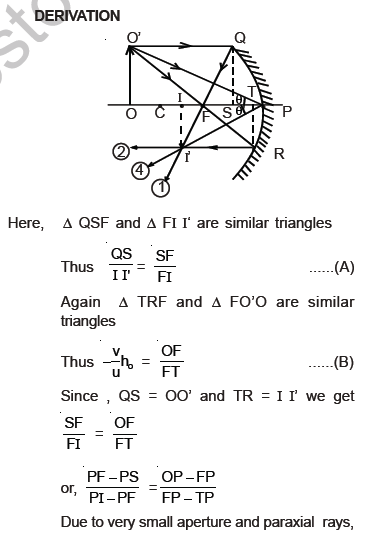
DERIVATION

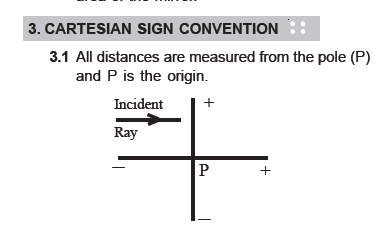
3.2 Distances measured to the right of the pole are taken as positive.
3.3 Distances above the principal axis are taken as positive.
3.4 Angles measured from the normal in the anticlockwise sense are positive.
4. MIRROR FORMULAE
4.1 In terms of Cartesian sign convention mirror formula may be expressed as
1/v +1 / u =1/ f
Where u, v and f represents object distance, image distance and focal length respectively.
4.2 Linear magnification : Linear magnification is defined as the ratio of the size of image to the size of the object
i.e. m = I/O
(i) If one dimensional object is placed perpendicular to the principal axis, linear magnificaion is called transverse or lateral magnification and for mirrors becomes m = I/O= −v/ u
m = negative, for real object-real image pair, for virtual object-virtual image pair m = positive, for real-virtual pair
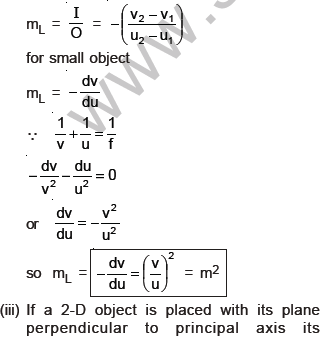
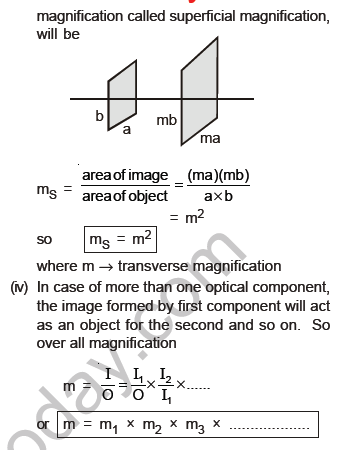
(ii) However, if one dimensional object is placed along the principal axis, the so called longitudinal magnification and becomes
Please click on below link to download pdf file for CBSE Class 12 Physics Reflection from Curved Surface Theory and Examples.
Free study material for Physics
Free CBSE Study Guides: Class 12 Physics Reflection from Curved Surface
Essential Notes for Class 12 Physics
Review targeted study resources for Reflection from Curved Surface tailored for Class 12 learners. Utilizing these structured notes and quick-revision tools ensures complete alignment with current CBSE evaluation standards.
Verified Solutions for Class 12 Physics
Each resource draws directly from authorized textbooks to maintain academic accuracy. Evaluating solved examples allows Class 12 students to master the formal presentation and answer-writing standards expected in upcoming school exams.
Enhance Accuracy with Online Tests
Wrap up your chapter revision by testing your knowledge against standard objective question formats. Explore our full library of free, up-to-date sample papers and online assessments to secure top grades in your CBSE examinations.
FAQs
Our advanced study package for Reflection from Curved Surface includes detailed concepts, diagrams, Mind Maps, and explanation of complex topics to ensure Class 12 students learn as per syllabus for 2026 exams.
The Mind Maps provided for Reflection from Curved Surface act as visual anchors which will help faster recall during high-pressure exams.
Yes, teachers use our Class 12 Physics resources for lesson planning as they are in simple language and have lot of solved examples.
Yes, You can download the complete, mobile-friendly PDF of the Physics Reflection from Curved Surface advanced resources for free.
Yes, our subject matter experts have updated the Reflection from Curved Surface material to align with the rationalized NCERT textbooks and have removed deleted topics and added new competency-based questions.