

Download CBSE Class 12 Physics Useful Resources
Explore structured advanced study materials through the CBSE Class 12 Physics Revision Questions Atoms and Nuclei. Tailored for Class 12 learners, utilizing these Physics resources ensures thorough preparation and strengthens foundational knowledge before final CBSE evaluations.
Access CBSE Study Guides and Summaries
Navigate directly to the advanced Physics study materials using the digital viewer below. Each resource pack includes detailed conceptual summaries and solved practice questions, allowing students to instantly reinforce their learning.
Question. Derive the mathematical relation between the half-life period and the decay constant of a radioactive substance.
Answer: By definition, at the half-life period \( t = T_{1/2} \), the remaining number of active nuclei is \( N = \frac{N_0}{2} \).
Using the radioactive decay law:
\( N = N_0 e^{-\lambda t} \)
Substituting these conditions:
\( \frac{N_0}{2} = N_0 e^{-\lambda T_{1/2}} \)
\( \frac{1}{2} = e^{-\lambda T_{1/2}} \)
Taking the natural logarithm on both sides:
\( \ln\left(\frac{1}{2}\right) = -\lambda T_{1/2} \implies -\ln 2 = -\lambda T_{1/2} \)
\( T_{1/2} = \frac{\ln 2}{\lambda} \approx \frac{0.693}{\lambda} \)
This represents the required relationship.
In simple words: At half-life, half of the substance has decayed. Using the exponential decay formula, this gives a half-life equal to 0.693 divided by the decay constant.
Exam Tip: Show every step of taking the natural logarithm to ensure you do not lose any step marks in a derivation question.
Question. Explain how the size of a nucleus can be estimated using the concept of the distance of closest approach for an alpha particle. Write the relevant formula.
Answer: The size of a nucleus can be approximately estimated using the concept of the distance of closest approach. When an alpha particle is fired directly at a nucleus, it slows down due to electrostatic repulsion and eventually stops. At this point, its entire kinetic energy \( E \) is converted into electrostatic potential energy. By selecting the rebounding particle, this relationship is expressed as:
\( R_0 = \frac{1}{4\pi\varepsilon_0} \frac{2Ze^2}{E} \)
Where \( R_0 \) is the distance of closest approach, \( Z \) is the atomic number of the target nucleus, and \( E \) is the initial kinetic energy of the alpha particle.
In simple words: We can estimate how big a nucleus is by seeing how close a positively charged alpha particle can get to it before the electric force stops it and pushes it backward.
Exam Tip: Clearly define what each symbol (\( R_0 \), \( Z \), \( e \), and \( E \)) stands for in the formula to secure full credit.
Question. The activity of a radioactive isotope falls to \( \frac{1}{16} \) of its original value in 30 days. Find its half-life.
Answer: Using the radioactive decay relation:
\( N = N_0 \left(\frac{1}{2}\right)^{\frac{t}{T_{1/2}}} \)
Given that \( N = \frac{1}{16} N_0 \) and the elapsed time \( t = 30 \text{ days} \):
\( \frac{1}{16} N_0 = N_0 \left(\frac{1}{2}\right)^{\frac{30}{T_{1/2}}} \)
\( \left(\frac{1}{2}\right)^4 = \left(\frac{1}{2}\right)^{\frac{30}{T_{1/2}}} \)
Equating the exponents:
\( 4 = \frac{30}{T_{1/2}} \)
\( T_{1/2} = \frac{30}{4} = 7.5 \text{ days} \)
Hence, the half-life of the isotope is 7.5 days.
In simple words: Since the activity drops to 1/16th (which requires halving the material 4 times) in 30 days, 4 half-lives must have passed. Thus, one half-life is 30 divided by 4, which is 7.5 days.
Exam Tip: Express \( \frac{1}{16} \) as \( \left(\frac{1}{2}\right)^4 \) to make the comparison of exponents simple and error-free.
Question. In a fission reaction, a \( ^{235}_{92}\text{U} \) nucleus absorbs a neutron and splits into \( ^{142}_{57}\text{La} \), a nucleus \( ^Y_Z\text{X} \), and three neutrons. Determine the mass number \( Y \) and atomic number \( Z \) of the product nucleus.
Answer: By applying the conservation of nucleon number (mass number):
\( 235 + 1 = 142 + Y + 3(1) \)
\( 236 = 145 + Y \implies Y = 90 \)
Next, applying the conservation of charge (atomic number):
\( 92 + 0 = 57 + Z + 3(0) \)
\( 92 = 57 + Z \implies Z = 35 \)
Thus, the mass number is \( Y = 90 \) and the atomic number is \( Z = 35 \).
In simple words: To find the missing values, ensure the total sum of the top numbers is equal on both sides of the reaction, and repeat the same steps for the bottom numbers.
Exam Tip: Do not forget to multiply the neutron numbers by their coefficients (e.g., \( 3 \times 1 \) for mass and \( 3 \times 0 \) for charge) when balancing nuclear reactions.
Question. You are given two nuclides \( _3\text{X}^7 \) and \( _3\text{Y}^4 \).
(i) Are they isotopes of the same element? Give a reason.
(ii) Which of the two is likely to be more stable? Give a reason.
Answer:
(i) Yes, they are isotopes of the same element because both possess the same atomic number (\( Z = 3 \)).
(ii) The nuclide \( _3\text{Y}^4 \) is expected to be more stable because its neutron-to-proton ratio is smaller and sits closer to the ideal stability range for light elements.
In simple words: (i) Yes, they are isotopes because they both have 3 protons. (ii) \( _3\text{Y}^4 \) is more stable because its ratio of neutrons to protons is lower and more balanced.
Exam Tip: For light elements, stability is achieved when the neutron-to-proton ratio is close to 1. State this rule to support your stability choices.
Question. A radioactive sample has a half-life of 30 days. Calculate its decay constant (in \( \text{s}^{-1} \)) and its average life (in days).
Answer: The decay constant \( \lambda \) is calculated as:
\( \lambda = \frac{0.693}{T_{1/2}} = \frac{0.693}{30 \times 24 \times 60 \times 60 \text{ s}} \approx 2.67 \times 10^{-7} \text{ s}^{-1} \)
The average life \( T_{\text{avg}} \) is given by:
\( T_{\text{avg}} = 1.44 \times T_{1/2} = 1.44 \times 30 = 43.2 \text{ days} \)
Thus, the decay constant is \( 2.67 \times 10^{-7} \text{ s}^{-1} \) and the average life is 43.2 days.
In simple words: To find the decay rate per second, divide 0.693 by the total seconds in 30 days. To find the average lifespan of an atom, multiply the half-life by 1.44.
Exam Tip: Pay close attention to the requested units. Convert days to seconds for the decay constant if the question specifies per-second units.
Question. A radioactive isotope has a half-life of 60 days. How many days will it take for the active nucleus count to drop to one-fourth of its initial value?
Answer: The fraction of remaining undecayed nuclei is:
\( \frac{N}{N_0} = \frac{1}{4} \)
Using the decay equation:
\( \frac{N}{N_0} = \left(\frac{1}{2}\right)^{\frac{t}{T_{1/2}}} \)
Substituting the values:
\( \frac{1}{4} = \left(\frac{1}{2}\right)^{\frac{t}{60}} \)
\( \left(\frac{1}{2}\right)^2 = \left(\frac{1}{2}\right)^{\frac{t}{60}} \)
Comparing the exponents:
\( 2 = \frac{t}{60} \implies t = 2 \times 60 = 120 \text{ days} \)
Hence, the total time required is 120 days.
In simple words: Since dropping to one-fourth requires two half-lives, and each half-life takes 60 days, the total time is 2 times 60, which equals 120 days.
Exam Tip: Verify your calculation by writing down the simple sequence: 100% -> 50% (60 days) -> 25% (120 days).
Question. In the beta decay of Neon-23: \( ^{23}\text{Ne}_{10} \rightarrow ^{23}\text{Na}_{11} + ^0\text{e}_{-1} + \overline{\nu} \), find the Q-value of the reaction. Given that the atomic mass of \( ^{23}\text{Ne} \) is \( 22.9945 \text{ u} \) and of \( ^{23}\text{Na} \) is \( 22.9898 \text{ u} \). What does this tell us about the energy range of the emitted beta particles?
Answer: First, we determine the mass defect \( \Delta m \) of the decay:
\( \Delta m = 22.9945 \text{ u} - 22.9898 \text{ u} = 0.00474 \text{ u} \)
The total energy released (\( Q \)-value) is:
\( Q = 0.00474 \times 931.5 \text{ MeV} \approx 4.4 \text{ MeV} \)
Because the decay energy is shared between the beta particle and the accompanying antineutrino, the kinetic energy of the emitted beta particle can span a continuous range from 0 to 4.4 MeV.
In simple words: The lost mass converts into 4.4 MeV of energy. Since this energy is shared with a tiny neutral particle, the beta particle's energy can be anything from 0 up to 4.4 MeV.
Exam Tip: Always explain that the continuous energy spectrum of beta particles is due to the sharing of energy with the antineutrino.
Question. The activity of a radioactive sample drops from \( 4750 \text{ disintegrations/min} \) to \( 2700 \text{ disintegrations/min} \) in 5 minutes. Calculate:
(i) the decay constant, and
(ii) the half-life of the sample.
Answer:
(i) Using the exponential decay law for activity:
\( R = R_0 e^{-\lambda t} \)
Given \( R_0 = 4750 \), \( R = 2700 \), and \( t = 5 \text{ minutes} \):
\( 2700 = 4750 e^{-5\lambda} \)
\( e^{-5\lambda} = \frac{2700}{4750} \approx 0.5684 \)
Taking the natural logarithm on both sides:
\( -5\lambda = \ln(0.5684) \approx -0.565 \)
\( \lambda = \frac{0.565}{5} \approx 0.113 \text{ min}^{-1} \)
(ii) The half-life is:
\( T_{1/2} = \frac{0.693}{\lambda} = \frac{0.693}{0.113} \approx 6.13 \text{ minutes} \)
In simple words: (i) Based on the activity drop over 5 minutes, we calculate the decay constant to be 0.113 per minute. (ii) Dividing 0.693 by this constant shows that half of the sample decays every 6.13 minutes.
Exam Tip: Do not forget to write the units (\( \text{min}^{-1} \) for decay constant and \( \text{minutes} \) for half-life) to avoid losing half a mark.
Question. Describe the changes that occur in the neutron and proton count during beta-minus decay, and explain how the neutron-to-proton ratio is affected. Write the decay equation for \( ^{210}\text{Bi}_{83} \) decaying to \( ^{210}\text{Po}_{84} \).
Answer: Inside the nucleus during \( \beta^- \) decay, a neutron is transformed into a proton:
\( \text{n} \rightarrow \text{p} + \text{e}^- + \overline{\nu} \)
Consequently, the neutron count decreases by 1, and the proton count increases by 1, which reduces the neutron-to-proton (\( n/p \)) ratio.
The equation for this decay is:
\( ^{210}_{83}\text{Bi} \rightarrow ^{210}_{84}\text{Po} + ^0_{-1}\beta + \gamma \)
Comparing the \( n/p \) ratios:
- Before the decay: \( \frac{127}{83} \approx 1.53 \)
- After the decay: \( \frac{126}{84} \approx 1.50 \)
In simple words: During beta-minus decay, a neutron turns into a proton. This reduces the number of neutrons and increases protons, making the neutron-to-proton ratio smaller.
Exam Tip: Clearly show the calculation of the \( n/p \) ratio both before and after the decay to support your answer.
Question. The half-life of a radioactive element A is equal to the mean life of another radioactive element B. Initially, both samples contain an equal number of atoms. Compare their initial decay rates.
Answer: Let the decay constants of elements A and B be \( \lambda \) and \( \lambda' \) respectively.
We are given that the half-life of A is equal to the mean life of B:
\( T_{1/2}(\text{A}) = \tau_{\text{B}} \)
\( \frac{0.693}{\lambda} = \frac{1}{\lambda'} \implies \frac{\lambda}{\lambda'} = 0.693 \)
If both samples start with \( N \) atoms, their decay rates \( R \) and \( R' \) are:
\( \frac{R}{R'} = \frac{\lambda N}{\lambda' N} = \frac{\lambda}{\lambda'} = 0.693 \)
Since \( \frac{R}{R'} = 0.693 < 1 \), it follows that \( R' > R \). Thus, element B has a higher initial disintegration rate.
In simple words: Because the half-life of A equals the average lifetime of B, B decays faster than A. If you start with the same amount of both, B will disintegrate at a higher initial rate.
Exam Tip: Express the relationship between half-life and mean life mathematically first, as this form makes the ratio calculation simple and precise.
Question. Calculate the mass defect and binding energy of a Nitrogen nucleus \( ^{14}_{7}\text{N} \). Given: mass of proton \( = 1.00783 \text{ u} \), mass of neutron \( = 1.00867 \text{ u} \), and mass of nitrogen nucleus \( = 14.003074 \text{ u} \).
Answer: A Nitrogen nucleus \( ^{14}_{7}\text{N} \) consists of 7 protons and 7 neutrons.
The mass defect \( \Delta m \) is calculated as:
\( \Delta m = [7 \times m_p + 7 \times m_n] - M_{\text{nucleus}} \)
\( \Delta m = [7(1.00783) + 7(1.00867)] - 14.003074 \text{ u} \)
\( \Delta m = [7.05481 + 7.06069] - 14.003074 \text{ u} \)
\( \Delta m = 14.1155 - 14.003074 = 0.112426 \text{ u} \)
The binding energy \( \Delta E_b \) is:
\( \Delta E_b = \Delta m \times 931.5 \text{ MeV} = 0.112426 \times 931.5 \text{ MeV} \approx 104.72 \text{ MeV} \)
In simple words: The combined mass of 7 separate protons and 7 separate neutrons is slightly larger than when they are bound together inside a Nitrogen nucleus. This mass difference is released as 104.72 MeV of binding energy.
Exam Tip: Always find the sum of individual nucleon masses first before subtracting the nuclear mass to keep your calculation steps clear.
Question. Complete the following nuclear decay equations:
(a) \( ^{226}_{88}\text{Ra} \rightarrow ^{222}_{86}\text{Rn} + \dots \)
(b) \( ^{32}_{15}\text{P} \rightarrow ^{32}_{16}\text{S} + \dots + \gamma \)
(c) \( ^{11}_{6}\text{C} \rightarrow ^{11}_{5}\text{B} + \dots + \gamma \)
Answer: The completed equations are:
(a) \( ^{226}_{88}\text{Ra} \rightarrow ^{222}_{86}\text{Rn} + ^4_2\text{He} \)
(b) \( ^{32}_{15}\text{P} \rightarrow ^{32}_{16}\text{S} + ^0_{-1}\text{e} + \gamma \)
(c) \( ^{11}_{6}\text{C} \rightarrow ^{11}_{5}\text{B} + ^0_{+1}\text{e} + \gamma \)
In simple words: The missing decay products are: (a) an alpha particle (Helium nucleus), (b) a beta-minus particle (electron), and (c) a positron (positive electron).
Exam Tip: Double-check that the sum of atomic numbers (subscripts) and mass numbers (superscripts) on the left equals the sum on the right for each equation.
Question. When a Lithium nucleus \( ^6_3\text{Li} \) is bombarded with a neutron \( ^1_0\text{n} \), it undergoes a nuclear reaction that produces a Triton nucleus \( ^3_1\text{H} \) and an alpha particle.
(i) Write the balanced nuclear equation for this reaction.
(ii) Calculate the energy \( Q \) released in this reaction. Given masses: \( m(^6_3\text{Li}) = 6.01512 \text{ u} \), \( m(^1_0\text{n}) = 1.0086654 \text{ u} \), \( m(^4_2\text{He}) = 4.0026044 \text{ u} \), and \( m(^3_1\text{H}) = 3.0100000 \text{ u} \).
Answer:
(i) The balanced reaction equation is:
\( ^6_3\text{Li} + ^1_0\text{n} \rightarrow ^3_1\text{H} + ^4_2\text{He} + Q \)
(ii) The mass defect \( \Delta m \) is:
\( \Delta m = [m(^6_3\text{Li}) + m(^1_0\text{n})] - [m(^3_1\text{H}) + m(^4_2\text{He})] \)
\( \Delta m = [6.01512 + 1.0086654] - [3.0100000 + 4.0026044] \text{ u} \)
\( \Delta m = 7.0237854 - 7.0126044 = 0.011181 \text{ u} \)
The energy released \( Q \) is:
\( Q = \Delta m \times 931.5 \text{ MeV} = 0.011181 \times 931.5 \text{ MeV} \approx 10.41 \text{ MeV} \)
In simple words: (i) Bombarding Lithium-6 with a neutron yields Tritium and Helium. (ii) Subtracting the final masses from the initial masses leaves a mass defect of 0.011181 u, which corresponds to 10.41 MeV of released energy.
Exam Tip: Keep all decimal places during your intermediate additions and subtractions to prevent minor rounding discrepancies in your final energy value.
EASY AND SCORING AREAS:‐
1. Energy of orbit of Rutherford atomic model….E=‐13.6 Ev/n2
2. Bohr model of hydrogen atom………
3. Line spectra of hydrogen atom
4. De‐broglie explanation of Bohr’s second postulate
EASY AND SCORING AREAS:‐
1. Binding Energy
2. Mass energy relation
3. Law of radioactivity
4. α-decay, β-decay, γ-decay
5. Nuclear fission reaction, nuclear fusion reaction.
QUESTIONS
Q1. Define Nuclear forces and gives their important characteristics/properties.
Ans.The nucleus of an atom has a number of protons and neutrons (nucleons) which are held together by the forces known as Nuclear forces in the tiny nucleus, inspite of strong force of repulsion between protons.
Characteristics/Properties of nuclear forces:
1. Nuclear forces are strongest forces in nature.
2. Nuclear forces are short range forces.
3. Nuclear forces are basically strong attractive forces but contain a small component of repulsive forces.
4. Nuclear forces are saturated forces.
5. Nuclear forces are charge independent
6. Nuclear forces are spin- dependent
7. Nuclear forces are exchange forces
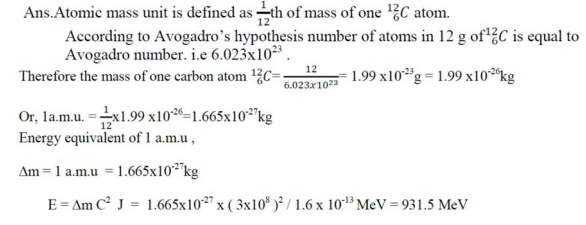
Q2.Define atomic mass unit (a.m.u.) and calculate its value in SI unit of mass. Also find energy equivalent in MeV corresponding to it.
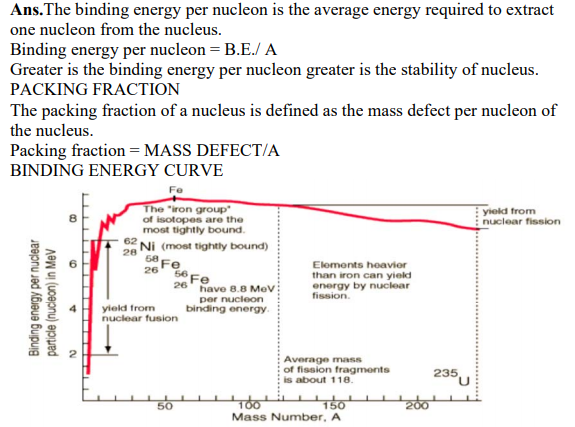
Q3. Define binding energy per nucleon and packing fraction? Draw the curve showing the variation of binding energy per nucleon with mass number (A). Discuss its conclusions and explain how nuclear fission and fusion processes are explained with its help.
PACKING FRACTION
The packing fraction of a nucleus is defined as the mass defect per nucleon of the nucleus. Packing fraction = MASS DEFECT/A
BINDING ENERGY CURVE
It is found that binding energy of 3Li7 is greater than that of 2He4, but the value of its binding energy per nucleon is lesser. However, 2He4 is found to be more stable than 3Li7. Therefore, it may be concluded that the stability of nucleus depends upon binding energy per nucleon rather than the total binding energy of nucleus. Fig. shows the graph between the binding energy per nucleon and mass number of different nuclei. From the binding energy curves the following conclusions can be drawn:
1. The binding energy per nucleon for light nuclei, such as 1H2, is very small.
2. The binding energy per nucleon increases rapidly for nuclei upto mass number 20 and the curve possesses peaks corresponding to nuclei 2He4, 6C12 and 8O16. The peaks indicate that these nuclei are more stable than those in their neighbourhood.
3. After mass number 20, binding energy per nucleon increases gradually and for mass number between 40 and 120 , the curve becomes more or less flat
4. After mass number 120, binding energy nucleon starts decreasing and drops to 7.6MeV for uranium such nuclei are unstable and are found to disintegrate.
5. The binding energy per nucleon has a low value for both very high and very heavy nuclei in order to attain very higher value of binding energy per nucleon, the lighter nuclei may unite together to form a heavier nucleus (process ofnuclear fusion ) or a heavier nucleus may split into lighter nuclei (process of nuclear fusion). In both the nuclear processes, the resulting nucleus acquires greater value of binding energy per nucleon along with the liberation of energy.
Q4. What is radioactivity? State the law of radioactive decay. Show that the radioactive decay is exponential in nature.
Ans. Radioactive decay The spontaneous emission of radiation from a radioactive element is called radioactive decay.Decay Law The number of nuclei disintegrating per second of a radioactive sample at any instant is directly proportional to the number of undecayed nuclei present in the sample at that instant.
Please click the link below to download CBSE Class 12 Physics Revision Questions Atoms & Nuclei.
Free study material for Physics
Useful Resources and Notes for Class 12 Physics Chapter 13 Nuclei
Comprehensive Study Resources for Chapter 13 Nuclei
Explore essential learning tools for Class 12 Physics Chapter 13 Nuclei. This curated collection features in-depth notes and targeted practice questions built around the active 2026 curriculum to streamline your daily revision.
Understanding Marking Schemes
Designed around the official curriculum, these study guides guarantee standard compliance. Reviewing step-by-step solutions clarifies complex sub-topics within Chapter 13 Nuclei and demystifies standard marking schemes for Physics evaluations.
Complete Revision for Physics
Maximize your grade potential by utilizing Class 12 Physics practice papers in tandem with these structured notes. All printable assignments and interactive mock tests on our platform are updated for the 2026 session and available free of charge.
FAQs
Our advanced study package for Chapter 13 Nuclei includes detailed concepts, diagrams, Mind Maps, and explanation of complex topics to ensure Class 12 students learn as per syllabus for 2026 exams.
The Mind Maps provided for Chapter 13 Nuclei act as visual anchors which will help faster recall during high-pressure exams.
Yes, teachers use our Class 12 Physics resources for lesson planning as they are in simple language and have lot of solved examples.
Yes, You can download the complete, mobile-friendly PDF of the Physics Chapter 13 Nuclei advanced resources for free.
Yes, our subject matter experts have updated the Chapter 13 Nuclei material to align with the rationalized NCERT textbooks and have removed deleted topics and added new competency-based questions.