

Download CBSE Class 12 Physics Useful Resources
Review targeted academic resources with the CBSE Class 12 Physics Electrostatics Assignment. Built according to official CBSE standards for the 2026-27 term, these downloadable Class 12 Physics study materials support effective daily practice and deeper conceptual understanding for Chapter 02 Electrostatic Potential and Capacitance.
Access CBSE Study Guides and Summaries
View or download the dedicated CBSE Class 12 Physics Electrostatics Assignment resource below. Engaging with these advanced study guides under focused conditions ensures continuous academic progress and mastery of the 2026-27 curriculum for Chapter 02 Electrostatic Potential and Capacitance.
CBSE Class 12 Physics Electrostatics Assignment. Please refer to the examination notes which you can use for preparing and revising for exams. These notes will help you to revise the concepts quickly and get good marks.
Comprehension-1
Van de Graaff generators like the one shown in figure are used to produce very high voltage. In the figure, the + signs represent positive charge and the –ve signs represent negative charge. In this common Van de Graaff generator, charge is separated by the frictional contact of the belt and the lower pulley shown. Positive charge collects on the lower pulley and an equal amount of negative charge spreads out along the inside of the belt. Electrons from the ground are attracted to the outside of the belt by the net positive charge on the lower portion of the belt-pulley system. These electrons travel up the belt and are transferred to the dome, which is a hollow metal sphere. A high negative charge density can be built up on the dome, because the electrons from the outside of the belt do not experience a repulsive force from the charge built up on the outside of the sphere.The electric potential of the dome is V = Er where E is the electric field just outside the dome and r is the radius. The charges on the surface of the dome do not affect the electricfield inside the cavity. The potential that can build up on the dome is limited by the dielectric strength of the air, which is about 30,000 V/cm for dry air. Beyond this air molecules are ionized. This enables the air to conduct electricity.
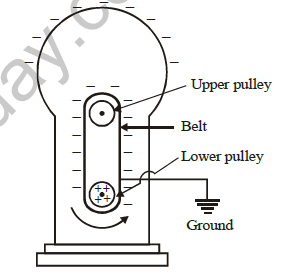
Van de Graaff generators are routinely used in college physics laboratories. When a student gets within a few inches of a Van de Graaff generator, she may draw a spark with an instantaneous current of 10A and remain uninjured. An instantaneous current is the transfer of charge within 1 μs.
1. The 660 volt rails on a subway can kill a person upon contact. A 10,000 volt Van de Graaff generator, however, will only give a mild shock. Which of the following best explains this paradox?
(a) The generator provides more energy per charge, but since it has few charges it transfers a lesser amount of energy
(b) The generator provides more energy, but since there is little energy per charge the current is small
(c) Most of the energy provided by the generator is dissipated in the air because air presents a smaller resistance than the human body
(d) Most of the energy flows directly to the ground without going through the human body since the generator is grounded
2. What is the maximum potential the dome, with a radius of 10 cm, can sustain in dry air?
(a) 3 kV (b) 5 kV (c) 300 kV (d) 500 kV
3. What is the work required to move a charge q from the top of the belt to the surface of the dome, if the amount of charge on the dome is Q and q is the only charge on the belt?
(a) 0 (b) kQq/2r (c) kQq/r (d) kq/r
4. A spherical conductor with a radius of 10 cm is given a charge of –1.0 C. It is then further charged by a current of 0.5 A for three seconds, discharged and recharged by an instantaneous current of 10 A. At what point does the sphere have the highest potential?
(a) When it has a charge of –1.0 C (b) Just after being charged by the 0.5 A current
(c) Just after being discharged (d) After being charged by the 10 A current
Comprehension-2
Each plate of a parallel plate capacitor is a square of side a. The plates are kept at a separation d (d << a), air being the dielectric medium between the plates. The capacitor is connected to a battery. A block of length a, width a and thickness y ≈ d is inserted a distance x into the capacitor as shown. Assuming dielectric constant of material is K
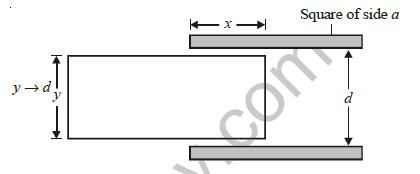
Answer the following questions.
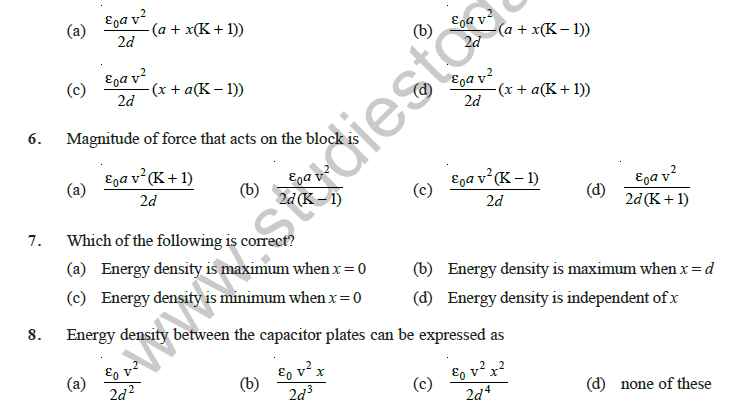
5. Electric energy stored in the capacitor, as a function of x, can be expressed as
Each of the questions given below consists of two statements, an assertion (A) and reason (R). Select the number corresponding to the appropriate alternative as follows
(a) If both A and R are true and R is the correct explanation of A
(b) If both A and R are true but R is not the correct explanation of A
(c) If A is true but R is false
(d) If A is false but R is true
Please click on below link to download pdf file for CBSE Class 12 Physics Electrostatics Assignment.
Free study material for Physics
Useful Resources and Notes for Class 12 Physics Chapter 02 Electrostatic Potential and Capacitance
Comprehensive Study Resources for Chapter 02 Electrostatic Potential and Capacitance
Review targeted study resources for Chapter 02 Electrostatic Potential and Capacitance tailored for Class 12 learners. Utilizing these structured notes and quick-revision tools ensures complete alignment with current CBSE evaluation standards.
Understanding Marking Schemes
Each resource draws directly from authorized textbooks to maintain academic accuracy. Evaluating solved examples allows Class 12 students to master the formal presentation and answer-writing standards expected in upcoming school exams.
Complete Revision for Physics
Wrap up your chapter revision by testing your knowledge against standard objective question formats. Explore our full library of free, up-to-date sample papers and online assessments to secure top grades in your CBSE examinations.
FAQs
Our advanced study package for Chapter 02 Electrostatic Potential and Capacitance includes detailed concepts, diagrams, Mind Maps, and explanation of complex topics to ensure Class 12 students learn as per syllabus for 2026 exams.
The Mind Maps provided for Chapter 02 Electrostatic Potential and Capacitance act as visual anchors which will help faster recall during high-pressure exams.
Yes, teachers use our Class 12 Physics resources for lesson planning as they are in simple language and have lot of solved examples.
Yes, You can download the complete, mobile-friendly PDF of the Physics Chapter 02 Electrostatic Potential and Capacitance advanced resources for free.
Yes, our subject matter experts have updated the Chapter 02 Electrostatic Potential and Capacitance material to align with the rationalized NCERT textbooks and have removed deleted topics and added new competency-based questions.