

Download CBSE Class 12 Physics Useful Resources
Explore structured advanced study materials through the CBSE Class 12 Physics Modern Physics Solved Examples. Tailored for Class 12 learners, utilizing these Physics resources ensures thorough preparation and strengthens foundational knowledge before final CBSE evaluations.
Access CBSE Study Guides and Summaries
Navigate directly to the advanced Physics study materials using the digital viewer below. Each resource pack includes detailed conceptual summaries and solved practice questions, allowing students to instantly reinforce their learning.
CBSE Class 12 Physics Modern Physics Solved Examples. Please refer to the examination notes which you can use for preparing and revising for exams. These notes will help you to revise the concepts quickly and get good marks.
SOLVED EXAMPLES
CLASS XII : PHYSICS
MODERN PHYSICS
Ex.1 In a head on collision between an α-particle and gold nucleus, the closed distance of approach is 41.3 fermi. Calculate the energy of α particle.

Answer:
1. Given: r₀ = 41.3 × 10⁻¹⁵ m, Z = 79 for gold, and the α-particle carries a charge of 2e.
2. Energy at the distance of closest approach: E = \( \frac{Ze \times 2e}{4\pi\varepsilon_0 r_0} \).
3. E = \( \frac{9 \times 10^{9} \times 79 \times 2 (1.6 \times 10^{-19})^{2}}{41.3 \times 10^{-15}} \) joule = 8.814 × 10⁻¹³ joule.
4. Converting to eV: E = \( \frac{8.814 \times 10^{-13}}{1.6 \times 10^{-19}} \) eV = 5.51 × 10⁶ eV.
5. Hence, the energy of the α-particle is 5.51 MeV.
Teacher's Note:
a) Convert the distance from fermi to metres first, because 1 fermi = 10⁻¹⁵ m.
b) The printed Z = 70 is a typo; gold has atomic number 79, and the working uses 79 (9 × 10⁹ × 79 × 2 × (1.6 × 10⁻¹⁹)² / 41.3 × 10⁻¹⁵ gives 8.814 × 10⁻¹³ J).
c) Divide by 1.6 × 10⁻¹⁹ to convert joules to eV, then divide by 10⁶ to get MeV.
Ex.2 Light of wave length 5000 Å falls on metallic plate with photoelectric work function = 1.90 eV. Find
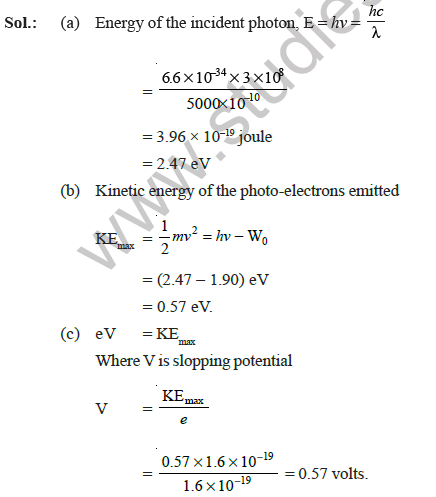
(a) energy of the photon in eV
Answer:
1. Energy of the incident photon: E = hν = \( \frac{hc}{\lambda} \) = \( \frac{6.6 \times 10^{-34} \times 3 \times 10^{8}}{5000 \times 10^{-10}} \) joule.
2. E = 3.96 × 10⁻¹⁹ joule.
3. In eV: E = \( \frac{3.96 \times 10^{-19}}{1.6 \times 10^{-19}} \) eV = 2.47 eV.
4. Hence, the energy of the photon is 2.47 eV.
Teacher's Note:
a) Photon energy in eV is found by dividing the energy in joules by 1.6 × 10⁻¹⁹.
b) Use λ in metres; 5000 Å is 5000 × 10⁻¹⁰ m.
(b) Kinetic energy of the photoelectrons emitted
Answer:
1. Maximum kinetic energy: KEmax = \( \frac{1}{2} \)mv² = hν - W₀.
2. KEmax = (2.47 - 1.90) eV.
3. KEmax = 0.57 eV.
Teacher's Note:
a) Photoelectrons leave with energies from zero up to this maximum value.
b) Subtract the work function from the photon energy, not the other way round.
c) Both photon energy and work function must be in the same unit, eV.
(c) stopping potential
Answer:
1. eV = KEmax, where V is the stopping potential.
2. V = \( \frac{KE_{max}}{e} \) = \( \frac{0.57 \times 1.6 \times 10^{-19}}{1.6 \times 10^{-19}} \) volts.
3. Hence, the stopping potential is 0.57 volts.
Teacher's Note:
a) Stopping potential is the reverse voltage that just stops the fastest photoelectrons.
b) When energy is in eV, the stopping potential in volts has the same numerical value.
Ex.3 What will be de-Broglie wavelength of an electron having kinetic energy of 500 eV.
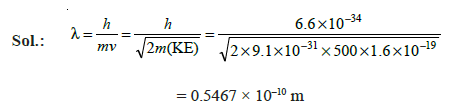
Answer:
1. de-Broglie wavelength: λ = \( \frac{h}{mv} \) = \( \frac{h}{\sqrt{2m(KE)}} \).
2. Kinetic energy in joule: 500 × 1.6 × 10⁻¹⁹ = 8.0 × 10⁻¹⁷ joule.
3. λ = \( \frac{6.6 \times 10^{-34}}{\sqrt{2 \times 9.1 \times 10^{-31} \times 500 \times 1.6 \times 10^{-19}}} \).
4. λ = \( \frac{6.6 \times 10^{-34}}{1.2067 \times 10^{-23}} \) = 0.547 × 10⁻¹⁰ m.
5. Hence, the de-Broglie wavelength is about 0.547 × 10⁻¹⁰ m, or 0.55 Å.
Teacher's Note:
a) Kinetic energy must be converted from eV to joule before it goes under the square root.
b) Use the formula with the square root for a particle given by its kinetic energy.
c) Electron wavelengths of about 1 Å are the reason electron microscopes resolve fine detail.
Ex.4 An X-ray tube produces a continuous spectrum of radiation with its short wavelength end 0.65 Å. What is the maximum energy of a photon in the radiation?
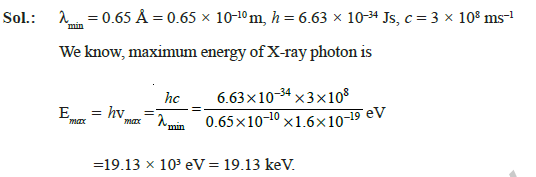
Answer:
1. Given: λmin = 0.65 Å = 0.65 × 10⁻¹⁰ m, h = 6.63 × 10⁻³⁴ Js, c = 3 × 10⁸ m/s.
2. The maximum energy corresponds to the minimum wavelength: Emax = hνmax = \( \frac{hc}{\lambda_{min}} \).
3. Emax = \( \frac{6.63 \times 10^{-34} \times 3 \times 10^{8}}{0.65 \times 10^{-10}} \) joule.
4. In eV: Emax = \( \frac{6.63 \times 10^{-34} \times 3 \times 10^{8}}{0.65 \times 10^{-10} \times 1.6 \times 10^{-19}} \) eV = 19.13 × 10³ eV.
5. Hence, the maximum photon energy is 19.13 keV.
Teacher's Note:
a) The shortest wavelength in an X-ray continuum gives the highest photon energy.
b) Keep Å in the working as 10⁻¹⁰ m, not as 10⁻¹⁰ cm.
c) The answer comes out in keV, so dividing the eV value by 1000 gives it directly.
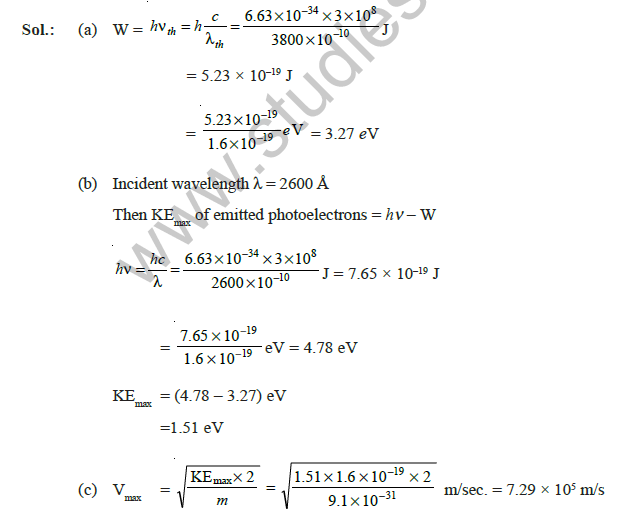
Ex.5 Threshold wavelength for photoelectric emission in metallic silver is λ = 3800 Å. Ultra-violet light of λ = 2600 Å is incident on a silver surface. Calculate
(a) work function
Answer:
1. Work function: W = hνth = \( \frac{hc}{\lambda_{th}} \) = \( \frac{6.63 \times 10^{-34} \times 3 \times 10^{8}}{3800 \times 10^{-10}} \) J.
2. W = 5.23 × 10⁻¹⁹ J.
3. In eV: W = \( \frac{5.23 \times 10^{-19}}{1.6 \times 10^{-19}} \) eV = 3.27 eV.
4. Hence, the work function of silver is 3.27 eV.
Teacher's Note:
a) The threshold wavelength gives the work function directly through W = hc/λth.
b) Longer threshold wavelength means a smaller work function.
(b) maximum kinetic energy of the emitted photoelectrons
Answer:
1. Incident wavelength λ = 2600 Å.
2. Energy of the incident photon: hν = \( \frac{hc}{\lambda} \) = \( \frac{6.63 \times 10^{-34} \times 3 \times 10^{8}}{2600 \times 10^{-10}} \) J = 7.65 × 10⁻¹⁹ J.
3. In eV: hν = \( \frac{7.65 \times 10^{-19}}{1.6 \times 10^{-19}} \) eV = 4.78 eV.
4. KEmax = hν - W = (4.78 - 3.27) eV = 1.51 eV.
Teacher's Note:
a) Photoelectric emission only happens when the incident wavelength is shorter than the threshold.
b) Use the work function from part (a) and not the threshold wavelength itself.
c) Subtraction must be done in eV, after both energies are converted.
(c) maximum velocity of the photo electrons
Answer:
1. KEmax = \( \frac{1}{2} \)mvmax², so vmax = \( \sqrt{\frac{2 \, KE_{max}}{m}} \).
2. vmax = \( \sqrt{\frac{2 \times 1.51 \times 1.6 \times 10^{-19}}{9.1 \times 10^{-31}}} \) m/s.
3. vmax = 7.29 × 10⁵ m/s.
Teacher's Note:
a) Use the kinetic energy in joule, which is 1.51 eV multiplied by 1.6 × 10⁻¹⁹.
b) The mass used is the electron mass, 9.1 × 10⁻³¹ kg.
Ex.6 A single electron orbits around a stationary nucleus of charge +Ze, where Z is a constant and e is the magnitude of the electronic charge. It requires 47.2 eV to excite the electron from the second Bohr orbit to the third Bohr orbit. Find
(a) the value of Z
Answer:
1. This atom is hydrogen-like, so En = -(Z)² \( \frac{13.6}{n^2} \) eV = \( \frac{E_1}{n^2} \), where E1 = -(Z)² × 13.6 eV.
2. Energy needed to go from n = 2 to n = 3: (Z²)(13.6) \( \left( \frac{1}{2^2} - \frac{1}{3^2} \right) \) = 47.2 eV.
3. Z² × 13.6 × \( \frac{5}{36} \) = 47.2, so Z² = \( \frac{47.2 \times 36}{13.6 \times 5} \) = 25.
4. Hence, Z = 5.
Teacher's Note:
a) For a hydrogen-like atom, every energy level is Z² times the hydrogen value.
b) Use the difference of the two (1/n²) terms, not the sum.
c) The value 5 comes out exactly, which confirms the setup.
(b) energy required to excite the electron from the third to the fourth Bohr orbit
Answer:
1. Energy difference: E4 - E3 = 13.6 Z² \( \left[ \frac{1}{3^2} - \frac{1}{4^2} \right] \) eV.
2. E4 - E3 = 13.6 × 25 × \( \frac{7}{144} \) eV.
3. E4 - E3 = 16.53 eV.
Teacher's Note:
a) The energy is the difference between the two levels, found with Z = 5.
b) Higher orbits are closer together, so this gap is smaller than the 47.2 eV in part (a).
(c) wavelength of the electromagnetic radiation required to remove the electron from the first Bohr orbit to infinity
Answer:
1. Energy needed to remove the electron from the first orbit is the ionization energy, 340 eV, since E1 = -(25)(13.6) = -340 eV.
2. \( \frac{hc}{\lambda} \) = 340 × 1.6 × 10⁻¹⁹ joule.
3. λ = \( \frac{6.6 \times 10^{-34} \times 3 \times 10^{8}}{340 \times 1.6 \times 10^{-19}} \) m = 36.40 Å.
Teacher's Note:
a) The ionization energy for a hydrogen-like atom is Z² times 13.6 eV.
b) Radiation of wavelength about 36 Å is in the soft X-ray region.
(d) kinetic energy, potential energy and angular momentum of the electron in the first Bohr orbit
Answer:
1. Kinetic energy: KE1 = -E1 = 340 eV.
2. Potential energy: PE1 = 2E1 = -680 eV.
3. Angular momentum: L = \( \frac{nh}{2\pi} \) with n = 1, so L = \( \frac{6.63 \times 10^{-34}}{2\pi} \) = 1.055 × 10⁻³⁴ kg m² s⁻¹.
Teacher's Note:
a) Total energy is negative and equal to half the potential energy, so KE is minus E1.
b) Potential energy is twice the total energy, and it is negative.
c) Angular momentum is quantised in steps of h/2π, which is why n appears in the formula.
(e) the radius of the first Bohr orbit.
(The ionization energy of hydrogen atom = 13.6 eV. Bohr radius = 5.3 × 10¹¹ m)
Answer:
1. Radius of the nth orbit of a hydrogen-like atom is \( \frac{\text{Bohr radius}}{Z} \).
2. Radius = \( \frac{5.3 \times 10^{-11}}{5} \) m = 1.06 × 10⁻¹¹ m.
3. Hence, the radius of the first Bohr orbit of this atom is 1.06 × 10⁻¹¹ m.
Teacher's Note:
a) The printed Bohr radius 5.3 × 10¹¹ m is missing the minus sign; the correct value is 5.3 × 10⁻¹¹ m, and the answer uses it.
b) Radius shrinks as Z grows, so a heavier nucleus pulls the electron closer.
Ex.7 Hydrogen atom in its ground state is excited by means of a monochromatic radiation of wavelength 975 Å.
(a) How many different lines are possible in the resulting spectrum?
Answer:
1. Energy of the ground state (n = 1) = -13.6 eV.
2. Energy of the incident photon: \( \frac{hc}{\lambda} \) = \( \frac{6.63 \times 10^{-34} \times 3 \times 10^{8}}{975 \times 10^{-10} \times 1.6 \times 10^{-19}} \) = 12.75 eV.
3. 12.75 = 13.6 \( \left( 1 - \frac{1}{n^2} \right) \), which gives n = 4.
4. Electron goes up to n = 4, and it can fall back through 4 → 3, 4 → 2, 4 → 1, 3 → 2, 3 → 1 and 2 → 1.
5. Hence, 6 different lines are possible in the spectrum.
Teacher's Note:
a) The number of lines from level n is n(n - 1)/2, which gives 6 for n = 4.
b) Find the excited level first from the photon energy, then count the downward jumps.
c) Jumps are only counted between levels that the electron can reach by moving downward, not between the same level.
(b) Calculate the longest wavelength amongst them. Given that the ionization energy for hydrogen atom is 13.6 eV
Answer:
1. The longest wavelength corresponds to the smallest energy jump, which is 4 → 3.
2. Energy of this jump: E4 - E3 = 13.6 \( \left( \frac{1}{3^2} - \frac{1}{4^2} \right) \) = 0.661 eV.
3. λmax = \( \frac{hc}{E_{min}} \) = \( \frac{6.63 \times 10^{-34} \times 3 \times 10^{8}}{0.661 \times 1.6 \times 10^{-19}} \) m = 18807 Å.
Teacher's Note:
a) Longer wavelength means lower photon energy, so pick the smallest gap.
b) The jump from n = 4 to n = 3 is the smallest among the six transitions.
Ex.8 An X-ray tube is operated at a potential difference of 40 kV, produces heat at the rate of 720 W. Assuming 0.5% of the energy of the incident electrons is converted into X-rays. Calculate
(a) the number of electrons per second striking the target
Answer:
1. Since 0.5% of the energy becomes X-rays, 99.5% becomes heat: P = 0.995 VI.
2. Current: I = \( \frac{P}{0.995 V} \) = \( \frac{720}{0.995 \times 40 \times 10^{3}} \) = 0.018 A.
3. Number of electrons per second: n = \( \frac{I}{e} \) = \( \frac{0.018}{1.6 \times 10^{-19}} \) = 1.1 × 10¹⁷ electrons per second.
Teacher's Note:
a) Most of the electron energy goes into heat, so the heat rate is 99.5% of the electrical power.
b) Current is charge per second, so dividing by the electron charge gives the number of electrons per second.
(b) the velocity of the incident electrons
Answer:
1. Kinetic energy of an electron accelerated through V: \( \frac{1}{2} \)mv² = eV.
2. v = \( \sqrt{\frac{2eV}{m}} \) = \( \sqrt{\frac{2 \times 1.6 \times 10^{-19} \times 40 \times 10^{3}}{9.1 \times 10^{-31}}} \) m/s.
3. v = 1.19 × 10⁸ m/s.
Teacher's Note:
a) The accelerating voltage is 40 kV, so use 40 × 10³ V in the formula.
b) The speed is about 40% of the speed of light.
Ex.9 One milliwatt of light of wavelength 4560 Å is incident on a Cesium surface. Calculate the photoelectric current liberated assuming a quantum efficiency of 0.5%. Given Planck's constant h = 6.62 × 10⁻³⁴ Js and velocity of light 3 × 10⁸ m/sec.
Answer:
1. Energy of each photon: E = \( \frac{hc}{\lambda} \) = \( \frac{6.62 \times 10^{-34} \times 3 \times 10^{8}}{4560 \times 10^{-10}} \) = 4.36 × 10⁻¹⁹ J.
2. Number of photons incident per second: \( \frac{\text{Power of light}}{\text{Energy of one photon}} \) = \( \frac{10^{-3}}{4.36 \times 10^{-19}} \) = 2.30 × 10¹⁵ per second.
3. Number of electrons released per second with quantum efficiency 0.5%: 2.30 × 10¹⁵ × \( \frac{0.5}{100} \) = 1.15 × 10¹³ per second.
4. Photoelectric current: I = (number of electrons per second) × e = (1.15 × 10¹³) × (1.6 × 10⁻¹⁹) A.
5. I = 1.84 × 10⁻⁶ A = 1.84 μA.
Teacher's Note:
a) Quantum efficiency is the fraction of incident photons that release an electron.
b) The printed photon energy 4.35 × 10⁻¹⁹ J and current 1.824 μA are rounding slips; the correct current with the given h is 1.84 μA.
c) Current is the charge that crosses per second, so multiply electrons per second by e.
Ex.10 A beam of light of wavelength 3650 Å and intensity 10⁻⁸ W/m² is incident on a surface having absorption coefficient 0.8 and work function 1.6 eV. Determine the time rate of number of electrons emitted per m², power absorbed per m² and the maximum kinetic energy of emitted photoelectrons.
Answer:
1. Number of photons falling per second per unit area: N = \( \frac{I \lambda}{hc} \) = \( \frac{10^{-8} \times 3650 \times 10^{-10}}{6.62 \times 10^{-34} \times 3 \times 10^{8}} \) = 1.84 × 10¹⁰ m⁻² s⁻¹.
2. Photons absorbed per second per unit area: Nab = 0.8 × 1.84 × 10¹⁰ = 1.47 × 10¹⁰ m⁻² s⁻¹.
3. Each photon ejects one electron, so the rate of electrons emitted per m² = N - Nab = (1.84 - 1.47) × 10¹⁰ = 3.7 × 10⁹ m⁻² s⁻¹.
4. Power absorbed per m² = absorption coefficient × intensity = 0.8 × 10⁻⁸ = 8 × 10⁻⁹ W/m².
5. Maximum kinetic energy: KEmax = \( \frac{hc}{\lambda} \) - W = \( \frac{6.62 \times 10^{-34} \times 3 \times 10^{8}}{3650 \times 10^{-10} \times 1.6 \times 10^{-19}} \) eV - 1.6 eV.
6. KEmax = 3.40 eV - 1.6 eV = 1.80 eV.
Teacher's Note:
a) Only the absorbed photons can eject electrons, so the absorption coefficient is used in step 3.
b) Power absorbed is the absorption coefficient times the incident intensity.
c) Do the work function subtraction in eV, after converting the photon energy to eV.
Ex.11 When a surface is irradiated with light of wavelength 4950 Å, a photocurrent appears which vanishes if a retarding potential greater than 0.6 volt is applied across the photo tube. When a different source of light is used, it is found that the stopping potential is charged to 1.1 volt. Find the work function of the emitting surface and the wavelength of second source.
Answer:
(a) Work function
1. Given: λ1 = 4950 Å, V1 = 0.6 V.
2. KEmax = \( \frac{hc}{\lambda_1} \) - W and KEmax = eV1, so W = \( \frac{hc}{\lambda_1} \) - eV1.
3. W = \( \frac{6.6 \times 10^{-34} \times 3 \times 10^{8}}{4950 \times 10^{-10} \times 1.6 \times 10^{-19}} \) eV - 0.6 eV = 2.5 eV - 0.6 eV = 1.9 eV.
4. W = 1.9 × 1.6 × 10⁻¹⁹ = 3.04 × 10⁻¹⁹ J.
(b) Wavelength of the second source
5. For the second source, \( \frac{hc}{\lambda_2} \) = W + eV2, with V2 = 1.1 V.
6. \( \frac{hc}{\lambda_2} \) = 3.04 × 10⁻¹⁹ + (1.6 × 10⁻¹⁹)(1.1) = 4.8 × 10⁻¹⁹ J.
7. λ2 = \( \frac{6.6 \times 10^{-34} \times 3 \times 10^{8}}{4.8 \times 10^{-19}} \) m = 4.125 × 10⁻⁷ m = 4125 Å.
Teacher's Note:
a) The stopping potential gives the maximum kinetic energy in eV.
b) Photon energy for the second source is the work function plus eV2, found in joules.
c) A higher stopping potential means a shorter wavelength of light.
d) Keep the two parts separate: the work function is the same for both sources.
Ex.12 Two hydrogen like atoms A and B are of different masses and each atom contains equal number of protons and neutrons. The difference in the energies between the first Balmer lines emitted by A and B is 5.667 eV. When atoms A and B, moving with the same velocity, strike a heavy target elastically the atom B imparts twice the momentum to the target than the atom A imparts. Identify the atoms A and B.
Answer:
1. Let ZA, ZB be the atomic numbers and mA, mB the mass numbers of atoms A and B.
2. Energy of the first Balmer line (n = 3 to n = 2) of a hydrogen-like atom is Z² × 13.6 \( \left( \frac{1}{2^2} - \frac{1}{3^2} \right) \) eV.
3. Difference of the two Balmer energies: (ZB² - ZA²) × 13.6 × \( \frac{5}{36} \) = 5.667 eV.
4. ZB² - ZA² = \( \frac{5.667 \times 36}{13.6 \times 5} \) = 3 ... (i)
5. If u is the velocity of each atom, an elastic collision with a heavy target gives momentum 2mu to the target.
6. Momentum imparted by A is 2mAu, and by B is 2mBu. Given that B imparts twice the momentum of A: 2mBu = 2(2mAu), so mB = 2mA ... (ii)
7. Each atom has equal protons and neutrons, so mA = 2ZA and mB = 2ZB.
8. From (ii): 2ZB = 2(2ZA), so ZB = 2ZA ... (iii)
9. Solving (i) and (iii): ZB² - ZA² = 4ZA² - ZA² = 3ZA² = 3, so ZA = 1 and ZB = 2.
10. Atom A has Z = 1 and mass number 2, so it is deuterium (₁H²). Atom B has Z = 2 and mass number 4, so it is singly ionised helium (He⁺).
Teacher's Note:
a) Balmer lines come from transitions ending at n = 2, and the energy scales with Z².
b) Equal protons and neutrons means mass number is twice the atomic number.
c) Use the momentum ratio, not the energy ratio, to get the mass relation.
d) Substituting the values back into equation (i) confirms the answer.
Ex.13 A hydrogen-like atom (atomic number Z) is in a highest excited state of quantum number n. This excited atom can make a transition to the first excited state by successively emitting two photons of energies 10.20 eV and 17.00 eV respectively. Alternatively, the atom from the same excited state can make a transition to the second excited state by successively emitting two photons of energies 4.25 eV and 5.95 eV respectively. Determine the values of n and Z. (Ionization energy of hydrogen atom = 13.6 eV)
Answer:
1. First case: the atom falls from n to n = 2, so the total energy emitted is 10.2 + 17.0 = 27.2 eV, and 27.2 = Z² × 13.6 \( \left( \frac{1}{2^2} - \frac{1}{n^2} \right) \) ... (i)
2. Second case: the atom falls from n to n = 3, so 4.25 + 5.95 = 10.2 eV, and 10.2 = Z² × 13.6 \( \left( \frac{1}{3^2} - \frac{1}{n^2} \right) \) ... (ii)
3. Dividing (i) by (ii): \( \frac{27.2}{10.2} = \frac{9(n^2 - 4)}{4(n^2 - 9)} \).
4. Solving: \( \frac{8}{3} = \frac{9(n^2 - 4)}{4(n^2 - 9)} \), so 27(n² - 4) = 32(n² - 9), which gives 5n² = 180 and n² = 36.
5. Hence, n = 6.
6. Substituting n = 6 in (i): 27.2 = Z² × 13.6 × \( \frac{2}{9} \), so Z² = 9.
7. Hence, Z = 3, and the atom is Li²⁺.
Teacher's Note:
a) Dividing the two equations removes the constant 13.6 and the Z² term.
b) The total of the photon energies equals the energy difference between the start and end levels.
c) Z = 3 gives a hydrogen-like lithium ion, which is a valid single-electron species.
d) Substitute the value of n back into one equation to get Z, and do not skip this step.
Ex.14 The disintegration rate of a certain radioactive sample initially is 4750 disintegrations per minute. Five minutes later the rate becomes 2700 disintegrations per minute. Calculate the half life of the sample
Answer:
1. Initial rate: -\( \left( \frac{dN}{dt} \right)_0 \) = λN0. After five minutes: -\( \left( \frac{dN}{dt} \right)_t \) = λN.
2. Ratio of the rates: \( \frac{N_0}{N} \) = \( \frac{4750}{2700} \) = 1.76.
3. N = N0e-λt, so λ = \( \frac{1}{t} \log_e \left( \frac{N_0}{N} \right) \) = \( \frac{2.3026}{5} \) log10(1.76) = 0.11306 per minute.
4. Half life: T1/2 = \( \frac{\log_e 2}{\lambda} \) = \( \frac{0.6931}{0.11306} \) = 6.13 minutes.
Teacher's Note:
a) Activity is proportional to the number of nuclei, so the ratio of rates gives N0/N.
b) Keep the time in minutes throughout, so the half life also comes out in minutes.
c) Half life is the time for half the nuclei to decay, found from λ and not from the rate directly.
Ex.15 Find the half-life of uranium, given that 3.32 × 10⁻⁷ g of radium is found in per gram of uranium in old minerals. The atomic weight of uranium and radium are 238 and 226 respectively and half-life of radium is 1600 years (Avogadro Number is 6.023 × 10²³/g-atom).
Answer:
1. Radioactive equilibrium exists in old minerals, so λUNU = λRNR ... (i)
2. Decay constant is inversely proportional to half life, so \( \frac{T_U}{T_R} = \frac{N_U}{N_R} \), which gives TU = TR \( \left( \frac{N_U}{N_R} \right) \) ... (ii)
3. Number of uranium atoms per gram: NU = \( \frac{6.023 \times 10^{23}}{238} \).
4. Number of radium atoms per gram of uranium: NR = \( \frac{6.023 \times 10^{23}}{226} \) × 3.32 × 10⁻⁷.
5. \( \frac{N_U}{N_R} = \frac{226}{238 \times 3.32 \times 10^{-7}} \) = 2.86 × 10⁶.
6. TU = 1600 years × 2.86 × 10⁶ = 4.58 × 10⁹ years.
Teacher's Note:
a) Radioactive equilibrium means the activities of uranium and radium are equal.
b) The printed key uses 3.23 × 10⁻⁷ and gives 4.70 × 10⁹ years; the question gives 3.32 × 10⁻⁷, so the correct answer is 4.58 × 10⁹ years.
c) Very old minerals reach this equilibrium, and the long half life of uranium is what makes the ratio large.
Ex.16 In the interior of the sun, a continuous process of 4 protons, fusing into a helium nucleus and pair of positron, is going on. Calculate.
(a) the release of energy per process
(b) rate of consumption of hydrogen to produce 1 MW power
Given
₁H¹ = 1.007825 a.m.u. (atom)
₂He⁴ = 4.002603 a.m.u. (atm)
me+ = me- = 5.5 × 10⁻⁴ a.m.u.
(Neglect the energy carried away by neutrons)
(a) the release of energy per process
Answer:
1. Fusion reaction: 4 ₁H¹ → ₂He⁴ + 2e⁺ + energy. Four hydrogen atoms hold 4 bound electrons, and the helium atom holds only 2, so 2 electrons are left over to pair with the 2 positrons.
2. Mass defect (atoms): 4(1.007825) - [4.002603 + 4 × 0.00055] = 4.031300 - 4.004803 = 0.026497 a.m.u.
3. Energy from mass defect: 0.026497 × 931 = 24.67 MeV.
4. Energy released when the two positrons annihilate with two electrons: 4 × 0.00055 × 931 = 2.05 MeV.
5. Total energy released per process = 24.67 + 2.05 = 26.72 MeV.
Teacher's Note:
a) Use atomic masses, so the electrons are already counted in each atom.
b) The printed value 24.685 MeV should be 24.67 MeV, which changes the total to 26.72 MeV.
c) Each positron annihilation adds energy, so the total is larger than the mass defect alone.
(b) rate of consumption of hydrogen to produce 1 MW power
Answer:
1. Energy from 26.72 MeV = 26.72 × 1.6 × 10⁻¹³ J = 4.28 × 10⁻¹² J.
2. This energy comes from 4(1.007825) a.m.u. of hydrogen, which is 4.0313 × 1.66 × 10⁻²⁷ kg = 6.692 × 10⁻²⁷ kg.
3. Mass of hydrogen per joule: \( \frac{6.692 \times 10^{-27}}{4.277 \times 10^{-12}} \) = 1.565 × 10⁻¹⁵ kg/J.
4. 1 MW = 10⁶ J/s, so the rate of consumption = 10⁶ × 1.565 × 10⁻¹⁵ = 1.565 × 10⁻⁹ kg/s.
Teacher's Note:
a) Power is energy per second, so 1 MW means 10⁶ J each second.
b) Convert the mass to kilograms with 1 a.m.u. = 1.66 × 10⁻²⁷ kg before dividing.
Ex.17 The mean life for alpha and beta emission from a radioactive material is 1620 years and 405 years respectively. Find the time after which the 3/4th of the radioactive material would have decayed due to simultaneous emission of α and β particles.
Answer:
1. Decay constants: λα = \( \frac{1}{1620} \) per year and λβ = \( \frac{1}{405} \) per year.
2. Combined decay constant: λ = λα + λβ = \( \frac{1}{1620} + \frac{1}{405} \) = \( \frac{5}{1620} \) = \( \frac{1}{324} \) per year.
3. Three quarters decayed means N = N0 - \( \frac{3}{4} \)N0 = \( \frac{N_0}{4} \) remains.
4. N = N0e-λt, so \( \frac{N_0}{4} \) = N0e-λt, giving t = \( \frac{\log_e 4}{\lambda} \) = 1.386 × 324.
5. Hence, t = 449.1 years.
Teacher's Note:
a) Mean life is the reciprocal of the decay constant, so add the two decay constants, not the mean lives.
b) Half of a half is a quarter, so two half lives equal the time for three quarters to decay.
Ex.18 The element curium ₉₆Cm²⁴⁸ has a mean life of 10¹³ seconds. Its primary decay modes are spontaneous fission and α-decay, the former with a probability of 8% and the latter with probability of 92%. Each fission releases 200 MeV of energy. The masses involved in α-decay are as follows: ₉₆Cm²⁴⁸ = 248.07220 u, ₉₄Pu²⁴⁴ = 244.064100 u and ₂He⁴ = 4.002603 u. Calculate the power output from a sample of 10²⁰ Cm atoms. (1 amu = 931 MeV/c²)
Answer:
1. α-decay of Cm: ₉₆Cm²⁴⁸ → ₉₄Pu²⁴⁴ + ₂He⁴.
2. Mass defect: Δm = 248.07220 - (244.064100 + 4.002603) = 0.005497 u.
3. Energy released per α-decay = 0.005497 × 931 = 5.12 MeV.
4. Average energy released per Cm transformation = 0.08 × 200 + 0.92 × 5.12 = 16 + 4.71 = 20.71 MeV.
5. Energy released by 10²⁰ atoms in one mean life = 20.71 × 10²⁰ MeV.
6. Power = \( \frac{20.71 \times 10^{20} \times 1.6 \times 10^{-13}}{10^{13}} \) joule per second = 3.31 × 10⁻⁵ W.
Teacher's Note:
a) Only the α-decay part of the mass defect is used, since the fission energy is given directly.
b) The printed mass defect 0.005517 u is an arithmetic slip; the correct value is 0.005497 u, so the power is 3.31 × 10⁻⁵ W and not 3.316 × 10⁻⁵ W.
c) Power is total energy divided by the mean life, which is why the mean life appears in the denominator.
Free study material for Physics
Physics Class 12 Exam Resources: Modern Physics
Quick Revision Material for Modern Physics
Access comprehensive study material for Modern Physics, including revision notes, concept maps, and high-probability questions. These resources are designed in alignment with the latest 2026 CBSE syllabus for Class 12 Physics to support effective exam preparation.
Expert Notes and Solved Exam Questions
Each resource draws directly from authorized textbooks to maintain academic accuracy. Evaluating solved examples allows Class 12 students to master the formal presentation and answer-writing standards expected in upcoming school exams.
Additional Study Resources for Class 12
Wrap up your chapter revision by testing your knowledge against standard objective question formats. Explore our full library of free, up-to-date sample papers and online assessments to secure top grades in your CBSE examinations.
FAQs
Our advanced study package for Modern Physics includes detailed concepts, diagrams, Mind Maps, and explanation of complex topics to ensure Class 12 students learn as per syllabus for 2026 exams.
The Mind Maps provided for Modern Physics act as visual anchors which will help faster recall during high-pressure exams.
Yes, teachers use our Class 12 Physics resources for lesson planning as they are in simple language and have lot of solved examples.
Yes, You can download the complete, mobile-friendly PDF of the Physics Modern Physics advanced resources for free.
Yes, our subject matter experts have updated the Modern Physics material to align with the rationalized NCERT textbooks and have removed deleted topics and added new competency-based questions.