

Class 12 Physics Study Guide: CBSE Class 12 Physics Electrostatics chapter notes and important questions
Explore structured advanced study materials through the CBSE Class 12 Physics Electrostatics chapter notes and important questions. Tailored for Class 12 learners, utilizing these Physics resources ensures thorough preparation and strengthens foundational knowledge before final CBSE evaluations.
Download Chapter 02 Electrostatic Potential and Capacitance Study Material PDF
Access the complete useful resource PDF for Class 12 Physics below. Regular practice with these targeted academic notes builds familiarity with complex topics and helps secure higher marks in final school evaluations.
CBSE Class 12 Physics Electrostatics chapter notes and important questions. Please refer to the examination notes which you can use for preparing and revising for exams. These notes will help you to revise the concepts quickly and get good marks.
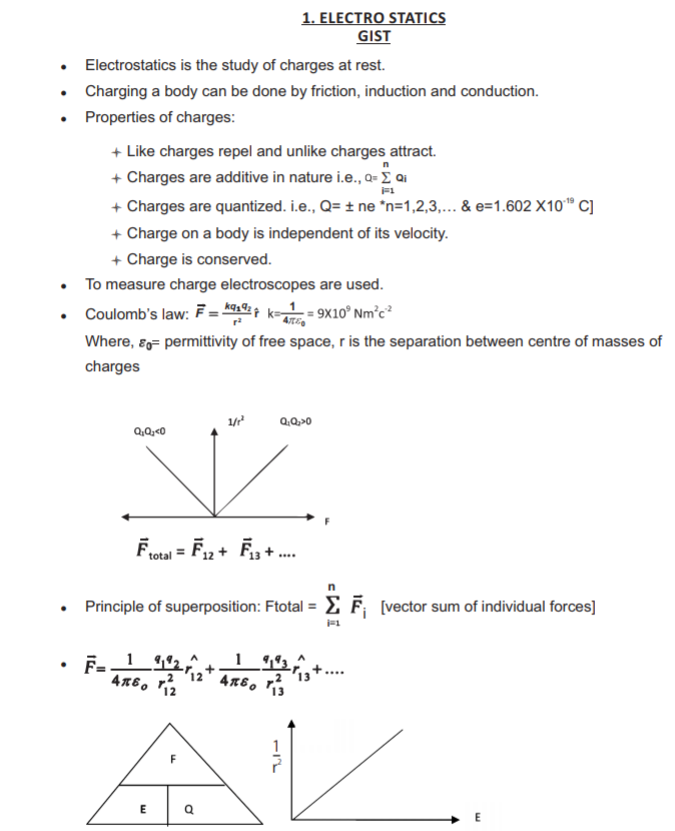
Electrostatics is the study of charges at rest. This Class 12 Physics chapter notes page gives the gist of the chapter - properties of charge, Coulomb's law, electric field, dipoles, electric flux and Gauss's theorem, electric potential, conductors, equipotential surfaces and capacitors - followed by chapter-wise very short answer, short answer and value based questions with answers and Teacher's Notes.
1. ELECTRO STATICS
GIST
CHARGES AND COULOMB'S LAW
Electrostatics is the study of charges at rest.
Charging a body can be done by friction, induction and conduction.
Properties of charges:
1. Like charges repel and unlike charges attract.
2. Charges are additive in nature, i.e., Q = Σ Qi (i = 1 to n).
3. Charges are quantized, i.e., Q = ± ne, where n = 1, 2, 3, ... and e = 1.602 × 10⁻¹⁹ C.
4. Charge on a body is independent of its velocity.
5. Charge is conserved.
To measure charge, electroscopes are used.
Coulomb's law: F = \( \frac{k q_1 q_2}{r^2} \) r̂, where k = \( \frac{1}{4π ε_0} \) = 9 × 10⁹ N m2 C-2.
Here ε0 is the permittivity of free space and r is the separation between the centres of the two charges.
[Figure: Graph of 1/r² on the vertical axis against F on the horizontal axis. When Q1Q2 is positive a straight line through the origin rises to the right; when Q1Q2 is negative a straight line through the origin rises to the left]
Ftotal = F12 + F13 + ....
Principle of superposition: Ftotal = Σ Fi (i = 1 to n) [vector sum of the individual forces].
F = \( \frac{1}{4π ε_0} \)\( \frac{q_1 q_2}{r_{12}^2} \) r̂12 + \( \frac{1}{4π ε_0} \)\( \frac{q_1 q_3}{r_{13}^2} \) r̂13 + ....
[Figure: A triangle divided into three cells with F at the top and E and Q side by side at the base; next to it a graph of 1/r² on the vertical axis against E on the horizontal axis, a straight line through the origin]
Note: In the above triangle, the quantity shown at the vertex is obtained by multiplying the two quantities shown at the base, i.e., F = E × Q. Either quantity at the base is the ratio of the vertex quantity to the other base quantity, i.e., E = F/Q or Q = F/E.
ELECTRIC FIELD AND ELECTRIC DIPOLE
Electric field: force experienced by a test charge. It is a vector. SI unit: N C-1.
E = lim (q0 → 0) \( \frac{F}{q_0} \).
Field due to a point charge: E = \( \frac{kQ}{r^2} \) r̂.
[Figure: Graph of E on the vertical axis against r² on the horizontal axis, a curve decreasing from a high value and approaching the horizontal axis]
Principle of superposition: Etotal = Σ Ei (i = 1 to n) [vector sum of the individual fields].
Dipole moment: product of the magnitude of either charge and the separation between them. It is a vector. SI unit: C m. p = Q · 2a. The direction of p is from the negative charge to the positive charge.
A dipole in a uniform electric field experiences no net force but experiences a torque:
τ = p × E, so |τ| = |p||E| sin θ n̂ (magnitude pE sin θ).
If θ = 0°, the dipole is in stable equilibrium; if θ = 180°, it is in unstable equilibrium.
Electric field due to a dipole:
At a point on the axial line: \( \frac{2kp}{r^3} \) along the direction of the dipole moment.
At a point on the equatorial line: E = \( \frac{kp}{r^3} \) opposite to the direction of the dipole moment.
ELECTRIC FLUX AND GAUSS'S THEOREM
Electric flux: φ = E · ΔS = |E||ΔS| cos θ. It is a scalar. SI unit: N C-1 m2 or V m.
Gauss's theorem in electrostatics: φtotal = \( \frac{q_{total}}{ε_0} \).
[Figure: A triangle with Q at the vertex and φ and ε0 at the base, giving Q = φε0, φ = q/ε0 and ε0 = q/φ; a graph of E or ΔS against φ drawn as a vertical line; a graph of Q against φ drawn as a straight line through the origin; the note that φ is independent of dimension]
CHARGE DISTRIBUTIONS AND ELECTRIC FIELD LINES
Uniform charge distribution:
Linear charge distribution: λ = Σ \( \frac{Δq}{Δl} \) - linear charge density, unit C m-1.
Surface charge distribution: σ = Σ \( \frac{Δq}{ΔS} \) - surface charge density, unit C m-2.
Volume charge distribution: ρ = Σ \( \frac{Δq}{ΔV} \) - volume charge density, unit C m-3.
Properties of electric field lines:
1. They start from a positive charge and end at a negative charge.
2. They are continuous but never form closed loops.
3. They never intersect.
4. The relative closeness of the field lines represents the magnitude of the field strength.
5. For a set of two like charges - lateral pressure in between.
6. For a set of two unlike charges - longitudinal contraction in between.
ELECTROSTATIC POTENTIAL
Electrostatic potential: work done per unit positive test charge to move it from infinity to that point in an electric field. It is a scalar. SI unit: J C-1 or V.
V = \( \frac{W}{q_0} \).
Electric potential for a point charge: V = \( \frac{kq}{r} \).
[Figure: Graph of V or E on the vertical axis against r on the horizontal axis with two decreasing curves, E falling faster than V; next to it a graph of 1/r against V, a straight line through the origin]
Electric field is conservative. This means that the work done is independent of the path followed and the total work done in a closed path is zero.
Potential due to a system of charges: Vtotal = Σ \( \frac{k q_i}{r_i} \) (i = 1 to n).
Potential due to a dipole at any point:
On its axial line: Vaxial = \( \frac{k|p|}{r^2} \), and at any point V = \( \frac{k|p|}{r^2} \) cos θ.
On its equatorial line: Veq = 0.
Potential difference: VA - VB = kq \( \left[ \frac{1}{r_A} - \frac{1}{r_B} \right] \).
Potential energy of two charges: U = \( \frac{k q_1 q_2}{r} \).
Potential energy of a dipole: U = -p · E = -pE cos θ. Work done in rotating a dipole from θ0 to θ1: W = pE [cos θ0 - cos θ1].
ELECTROSTATICS OF CONDUCTORS AND EQUIPOTENTIAL SURFACES
Electrostatics of conductors:
(i) Inside a conductor the electrostatic field is zero.
(ii) On the surface, E is always normal to dS.
(iii) There is no charge inside the conductor; the charge gets distributed on the surface.
(iv) Charge distribution on the surface is uniform if the surface is smooth.
(v) Surface charge density is inversely proportional to the radius of curvature r if the surface is uneven.
(vi) Potential is constant inside and on the surface.
Equipotential surfaces: the surfaces on which the potential is the same everywhere.
1. Work done in moving a charge over an equipotential surface is zero.
2. No two equipotential surfaces intersect.
3. Electric field lines are always perpendicular to the equipotential surfaces.
As E = -\( \frac{dV}{dr} \), for a given potential difference E is inversely proportional to the separation of the surfaces, and if E is constant, the potential difference is proportional to the distance.
CAPACITORS
Capacitor: a device to store charges and electrostatic potential energy.
Capacitance, C = \( \frac{Q}{V} \), the ratio of charge and potential difference. It is a scalar. SI unit: farad (F).
[Figure: A triangle with Q at the vertex and C and V at the base, giving Q = CV, C = Q/V and V = Q/C; next to it a graph of Q against V, a straight line through the origin labelled C = constant]
Capacitance of a parallel plate capacitor: C = \( \frac{ε_0 A}{d} \).
Capacitance of a parallel plate capacitor with a dielectric medium in between:
Cm = \( \frac{ε_0 A}{d - t + \frac{t}{k}} \) (slab of thickness t).
If t = 0: C0 = \( \frac{ε_0 A}{d} \).
If t = d: C0 = \( \frac{ε_0 A}{d} \) and Cm = k C0.
[Figure: A triangle with Cm at the vertex and C0 and k at the base, giving Cm = kC0, k = Cm/C0 and C0 = Cm/k]
Combination of capacitors:
Capacitors in series: \( \frac{1}{C_s} \) = Σ \( \frac{1}{C_i} \) (i = 1 to n).
Capacitors in parallel: Cp = Σ Ci (i = 1 to n).
Energy stored in a capacitor: U = \( \frac{1}{2} \) CV2 = \( \frac{1}{2} \) QV = \( \frac{1}{2} \)\( \frac{Q^2}{C} \).
[Figure: Graph of V on the vertical axis against Q on the horizontal axis, a straight line through the origin with the triangular area under it shaded; the area shaded in the graph = U = ½QV]
Energy density: ue = \( \frac{1}{2} \) ε0E2.
On connecting two charged capacitors:
Common potential: V = \( \frac{C_1V_1 + C_2V_2}{C_1 + C_2} \).
Loss of energy: ΔU = \( \frac{1}{2} \)\( \frac{C_1 C_2}{C_1 + C_2} \) (V1 - V2)2.
QUESTIONS (VSA)
1. What is the work done in moving a test charge 'q' through a distance of 1 cm along the equatorial axis of an electric dipole? [ Hint : on equatorial line V=0 ] [1 Mark]
Answer: Zero.
Teacher's Note:
a) The equatorial line is an equipotential line with V = 0, so W = q × (Vfinal - Vinitial) = 0.
2. What is meant by electrostatic shielding? [1 Mark]
Answer: The process of protecting a certain region of space from external electric fields (electrical hazards) by enclosing it in a hollow conductor.
Teacher's Note:
a) The field inside a cavity of a conductor is zero, so instruments kept inside are shielded.
3. Why an electric dipole placed in a uniform electric field does not undergoes acceleration? [1 Mark]
Answer: Because the net force on the dipole is zero. The forces on the two charges are +qE and -qE, so Fnet = 0.
Teacher's Note:
a) Equal and opposite forces give only a torque, which rotates the dipole but does not accelerate its centre.
4. Why electric field lines
(i) Can never intersect one another?
(ii) Cannot form closed loops sometimes?
(iii) Cannot have break in between? [1 Mark]
Answer:
(i) The electric field has a unique direction at any given point, so two lines cannot cross.
(ii) Monopoles, or single isolated charges, exist unlike in magnetism; field lines of static charges do not form closed loops.
(iii) They start from positive charges and terminate at negative charges, so they are continuous.
Teacher's Note:
a) A point of intersection would give two directions of the field at one point.
b) Closed loops are possible only for non-conservative fields, such as induced electric fields.
c) Lines break only where they end on charges.
5. Show that at a point where the electric field intensity is zero, electric potential need not be zero.
Answer: E = -\( \frac{dV}{dr} \). If E = 0, then \( \frac{dV}{dr} \) = 0, so V = constant, and this constant need not be zero.
Teacher's Note:
a) Example: at the centre of a uniformly charged ring or inside a charged shell, E = 0 but V = \( \frac{kQ}{R} \) is not zero.
b) Potential depends on the reference level, while field depends only on its gradient.
6. What is the electric flux through the surface S in Vacuum?
[Figure: A closed irregular surface S with +2q and -q inside it and +3q at its lower left, outside the surface]
Answer: Electric flux = \( \frac{q}{ε_0} \) (only the charges +2q and -q inside S contribute, so the net enclosed charge is +q).
Teacher's Note:
a) By Gauss's law, flux = \( \frac{q_{enclosed}}{ε_0} \) = \( \frac{2q - q}{ε_0} \) = \( \frac{q}{ε_0} \).
b) The charge +3q lies outside S and does not contribute to the net flux.
7. Is it possible that the potential at a point is zero, while there is finite electric field intensity at that point? Give an example. [1 Mark]
Answer: Yes, at any point on the equatorial line of an electric dipole.
Teacher's Note:
a) On the equatorial line V = 0 because the potentials of +q and -q cancel.
b) The fields do not cancel; E = \( \frac{kp}{r^3} \) is not zero there.
8. Can two equipotential surfaces intersect? Justify your answer. [1 Mark]
Answer: No. Otherwise there would be two directions of the electric field (force) at the point of intersection.
Teacher's Note:
a) The field is perpendicular to the equipotential surface, so it cannot have two directions at one point.
9. Is potential gradient a vector or a scalar quantity? [1 Mark]
Answer: Vector quantity.
Teacher's Note:
a) The potential gradient \( \frac{dV}{dr} \) has a direction (the direction of the fastest change of potential) and E = -\( \frac{dV}{dr} \) is a vector; the printed answer "scalar" is not correct.
10. Write the dimensional formula of 'ε0 ' the permittivity of free space. [1 Mark]
Answer: [M-1L-3T4A2]
Teacher's Note:
a) From F = \( \frac{q_1 q_2}{4π ε_0 r^2} \), ε0 = \( \frac{q^2}{F r^2} \) = \( \frac{A^2 T^2}{M L T^{-2} L^2} \) = M-1L-3T4A2.
11. An electric dipole is placed in an electric field due to a point charge. Will there be a force and torque on the dipole? [1 Mark]
Answer: Yes, both force and torque will act, as the electric field due to a point charge is non-uniform.
Teacher's Note:
a) In a non-uniform field the forces on +q and -q are unequal, so a net force acts and a torque also acts unless the dipole is aligned with the field.
12. Draw the graph showing the variation of electric potential with distance from the centre of a uniformly charged shell. [1 Mark]
[Figure: Graph of V on the vertical axis against distance r on the horizontal axis: a horizontal straight line from the axis up to r = R, then a curve decreasing smoothly towards the horizontal axis for r greater than R]
Answer: Potential is constant, V = \( \frac{kQ}{R} \), for r ≤ R (inside and on the shell) and falls as V = \( \frac{kQ}{r} \) for r > R.
Teacher's Note:
a) The graph is a horizontal line up to r = R followed by a decreasing curve (1/r) for r > R.
13. Find the ratio of the electric field lines starting from a proton kept first in vacuum and then in amedium of dielectric constant 6. [1 Mark]
Answer: 6 : 1
Teacher's Note:
a) The number of field lines is proportional to \( \frac{q}{ε} \), so in vacuum it is \( \frac{e}{ε_0} \) and in the medium \( \frac{e}{6 ε_0} \), giving the ratio 6 : 1.
14. Calculate the electric field from the equipotential surface shown below. [1 Mark]
[Figure: Three curved equipotential surfaces marked 2V, 4V and 6V from left to right, with horizontal arrows marked 2m, 3m and 4m drawn from a common reference line towards the surfaces]
Answer: E = 2 V m-1, directed from the 6 V surface towards the 2 V surface.
Teacher's Note:
a) E = -\( \frac{dV}{dr} \), with dV = 2 V between successive surfaces and dr = 1 m, so the magnitude is 2 V m-1.
15. Sketch the electric field lines, when a positive charge is kept in the vicinity of an uncharged conducting plate. [1 Mark]
[Figure: A positive charge +q above a horizontal uncharged conducting plate with negative induced charges along its upper surface; field lines leave +q, some going straight down and some curving round to meet the plate perpendicularly, others spreading outwards to infinity]
Answer: Field lines start from the positive charge and end normally on the induced negative charges of the plate surface.
Teacher's Note:
a) The plate surface is an equipotential, so the lines meet it at right angles; the line along the perpendicular from the charge is straight.
16. Two charges are kept as shown. Find dipole moment.
-2(0,0,-2)……………. +q(0,0,2)
-15 μc +15 μc [1 Mark]
Answer: p = 6.0 × 10⁻⁷ C m, directed from the -15 μC charge to the +15 μC charge (along +z).
Teacher's Note:
a) Taking the coordinates in cm, the separation is 4 cm = 0.04 m, so p = 15 × 10-6 × 0.04 = 6.0 × 10⁻⁷ C m.
17. Compare the electric flux in a cubical surface of side 10 cm and a spherical surface of radius 10 cm, when a change of 5μC is enclosed by them. [1 Mark]
Answer: The electric flux will be the same in both cases, \( \frac{5 \times 10^{-6}}{ε_0} \) ≈ 5.65 × 10⁵ N m2 C-1.
Teacher's Note:
a) By Gauss's law the flux depends only on the enclosed charge and not on the shape or size of the closed surface.
18. A metallic sphere is placed in a uniform electric field as shown in the figure. Which path is followed by electric field lines and why? [1 Mark]
[Figure: A metallic sphere in a uniform field directed to the right, with four horizontal lines a, b, c and d: a passes straight above the sphere, b dips into the sphere top, c passes straight through the middle, and d bends to meet the sphere at right angles at the bottom and leaves it at right angles on the far side]
Answer: Path d, as electric field lines are always normal to the surface of a conductor.
Teacher's Note:
a) Field lines end on the sphere's surface perpendicularly and no field line enters the conductor.
19. Explain why the electric field inside a conductor placed in an external electric field is always zero. [1 Mark]
Answer: Charges on the surface of the conductor get redistributed due to the external electric field until the field they produce inside cancels the external field.
Teacher's Note:
a) The induced charges create an equal and opposite field inside, so the net field inside the conductor is zero in the static state.
(S A Q - I)
1. Two free protons are separated by a distance of 1 A°. if they are released, what is the kinetic energy of each proton when at infinite separation. [ Hint : at infinite distance K.E. = \( \frac{e^2}{4π ε_0 r} \) ] [2 Marks]
Answer: Kinetic energy of each proton = 1.15 × 10⁻¹⁸ J (about 7.2 eV).
1. Initial potential energy of the pair = \( \frac{e^2}{4π ε_0 r} \) = \( \frac{9 \times 10^{9} \times (1.6 \times 10^{-19})^2}{10^{-10}} \) = 2.3 × 10⁻¹⁸ J.
2. At infinite separation this appears entirely as kinetic energy of the two protons.
3. By symmetry each proton gets half, so K.E. of each = 1.15 × 10⁻¹⁸ J.
Teacher's Note:
a) The hint gives the total kinetic energy of the pair.
b) Each proton has half of it because the two have equal masses and equal speeds.
2. How does the electric flux, electric field enclosing a given charge vary when the area enclosed by the charge is doubled? [2 Marks]
Answer: (a) Electric flux (φ) remains constant. (b) Electric field is halved.
Teacher's Note:
a) (a) Flux = \( \frac{q}{ε_0} \) depends only on the enclosed charge.
b) (b) E = flux / area, so doubling the area halves the average field.
3. Write the expression for the electric field in the regions I, II, III shown in the above figure. [2 Marks]
[Figure: Two parallel plates, the left one carrying +σ and the right one carrying -σ; region I is to the left of the +σ plate, region II is between the plates and region III is to the right of the -σ plate]
Answer: EI = EIII = 0 and EII = \( \frac{σ}{ε_0} \).
Teacher's Note:
a) Outside two oppositely charged sheets the fields cancel, so EI = EIII = 0.
b) Between the sheets the fields add: \( \frac{σ}{2ε_0} \) + \( \frac{σ}{2ε_0} \) = \( \frac{σ}{ε_0} \), directed from +σ towards -σ.
4. Write the expression for the electric field, charge density for a uniformly charged thin spherical shell [2 Marks]
Answer: E = \( \frac{kQ}{r^2} \) for r ≥ R (outside) and E = 0 inside; surface charge density σ = \( \frac{Q}{4π R^2} \).
Teacher's Note:
a) Outside the shell it acts as a point charge Q at its centre, with r measured from the centre.
b) Inside the shell the enclosed charge is zero, so E = 0; here R is the radius of the shell.
5. The electric field in a certain region of space is E = 104 î NC-1 How much is the flux passing through an area 'A' if it is a part of XY plane, XZ plane, YZ plane, making an angle 30° with the axis? [2 Marks]
Answer: Flux through the XY plane = 0, through the XZ plane = 0, through the YZ plane = 104 A V m.
1. Flux = E A cos φ, where φ is the angle between E and the normal to the area.
2. XY plane: normal is along z, φ = 90°, flux = 0. XZ plane: normal is along y, φ = 90°, flux = 0.
3. YZ plane: normal is along x, φ = 0°, flux = 104 × A.
4. If the normal of the area makes 30° with the x-axis, flux = 104 A cos 30° = 8.7 × 10³ A V m.
Teacher's Note:
a) The printed key gives the non-zero flux to the XY plane, which is wrong; the field lies along x, so only the YZ plane is cut.
b) If the plane itself (not its normal) makes 30° with the x-axis, the flux is 104 A sin 30° = 5 × 10³ A.
6. An electric dipole ±4μC is kept at co-ordinate points(1,0,4) are kept at(2,-1,5), the electric field is given by E = 20 î NC-1 Calculate the torque on the dipole. [2 Marks]
Answer: |τ| = 1.13 × 10⁻⁴ N m, directed along (ĵ + k̂)/√2.
1. Separation vector 2a = (2 - 1, -1 - 0, 5 - 4) = (1, -1, 1) m, so p = q · 2a = 4 × 10-6 × (1, -1, 1) C m.
2. τ = p × E = 4 × 10-6 × 20 × [(1, -1, 1) × (1, 0, 0)].
3. The cross product (1, -1, 1) × (1, 0, 0) = (0, 1, 1), so τ = 8 × 10⁻⁵ (ĵ + k̂) N m.
4. |τ| = 8 × 10⁻⁵ × √2 = 1.13 × 10⁻⁴ N m.
Teacher's Note:
a) The printed value 13.4 N m is not consistent with these data; the charge 4 μC and p = 6.9 × 10⁻⁶ C m give a torque of the order of 10-4 N m.
b) The sign of the direction reverses if the +4 μC charge is at the other point.
7. Show diagrammatically the configuration of stable and unstable equilibrium of an electric dipole (p) placed in a uniform electric field (E). [2 Marks]
[Figure: Two boxes side by side. Box 1 (Stable, θ = 0°): the dipole moment p and the field E both drawn as arrows pointing right. Box 2 (Unstable, θ = 180°): p drawn pointing left and E drawn pointing right]
Answer: Stable equilibrium: p parallel to E (θ = 0°). Unstable equilibrium: p antiparallel to E (θ = 180°).
Teacher's Note:
a) In stable equilibrium U = -pE is minimum and the torque is zero.
b) In unstable equilibrium U = +pE is maximum and the torque is zero.
8. Plot a graph showing the variation of coulomb force F versus \( \frac{1}{r^2} \) where r is the distance between the two charges of each pair of charges: (1μC, 2μC) and (2μC, -3μC). Interpret the graphs obtained. [Hint : graph can be drawn choosing -ve axis for force only] [2 Marks]
[Figure: Graph with F on the horizontal axis and 1/r² on the vertical axis: two straight lines from the origin, one labelled 1μC, 2μC rising to the right with the smaller slope, and one labelled 2μC, -3μC on the negative force side with the larger slope]
Answer: Both graphs are straight lines through the origin, with |FB| > |FA|.
1. F = k q1q2 × \( \frac{1}{r^2} \), so F plotted against \( \frac{1}{r^2} \) is a straight line through the origin with slope k q1q2.
2. Pair A (1 μC, 2 μC): slope = 9 × 109 × 2 × 10-12 = 1.8 × 10⁻² N m2, repulsive (positive).
3. Pair B (2 μC, -3 μC): slope magnitude = 9 × 109 × 6 × 10-12 = 5.4 × 10⁻² N m2, attractive (plotted on the negative force axis).
4. The line for pair B is steeper, so |FB| > |FA| at the same distance.
Teacher's Note:
a) The sign of the slope tells whether the force is repulsive or attractive.
b) The steeper slope belongs to the pair with the larger product of charges.
9. A thin straight infinitely long conducting wire having charge density λ is enclosed by a cylindrical surface of radius r and length l, its axis coinciding with the length of the wire. Find the expression for electric flux through the surface of the cylinder [2 Marks]
Answer: Φ = \( \frac{λ l}{ε_0} \).
1. Charge enclosed by the cylinder = λ l.
2. By Gauss's law, Φ = \( \frac{q_{enclosed}}{ε_0} \) = \( \frac{λ l}{ε_0} \).
Teacher's Note:
a) The flux does not depend on the radius r of the cylinder.
b) Here λ is the charge per unit length of the wire.
10. Calculate the force between two alpha particles kept at a distance of 0.02mm in air. [2 Marks]
Answer: F = 2.3 × 10⁻¹⁸ N (repulsive).
1. Charge of each alpha particle = 2e = 3.2 × 10⁻¹⁹ C and r = 0.02 mm = 2 × 10⁻⁵ m.
2. F = 9 × 10⁹ × \( \frac{(3.2 \times 10^{-19})^2}{(2 \times 10^{-5})^2} \).
3. F = 9 × 10⁹ × \( \frac{1.024 \times 10^{-37}}{4 \times 10^{-10}} \) = 2.3 × 10⁻¹⁸ N.
Teacher's Note:
a) The printed expression uses (16 × 10-19 C) which is ten times too large for 2e, so the printed substitution gives a wrong value.
b) Air is taken as vacuum for this calculation.
11. Explain the role of earthing in house hold wiring. [2 Marks]
Answer: During a short circuit or leakage, earthing provides an easy path, an emergency way out, for the charges to flow to the ground, preventing accidents.
Teacher's Note:
a) The metal body of an appliance is connected to the earth wire, which keeps it at zero potential.
b) A leak of current then passes to the ground instead of giving a shock to the user.
12. What is the difference between charging by induction and charging by friction? [2 Marks]
Answer: * In the frictional method, transfer of charges takes place from one object to the other.
* During induction, redistribution of charges takes place within the conductor.
Teacher's Note:
a) In friction both bodies get equal and opposite charges.
b) In induction the body gets charge of the opposite sign without touching the charged body.
(S A Q - II)
1. Two electric charges 3μC, -4μC are placed at thea two corners of an isosceles right angled triangle of side 1 m as shown in the figure. What is the direction and magnitude of electric field at A due to the two charges? [3 Marks]
[Figure: A right angled triangle ABC with A at the top, B at the bottom left with charge -4μC, and C at the bottom right with charge 3μC; the base BC is marked 1m and the right angle is at B]
Answer: E ≈ 2.8 × 10⁴ N C-1, directed at about 19.8° to the line AB, pointing downwards and tilted away from C.
1. Taking A at the top, B (-4 μC) directly below A and C (3 μC) to the right of B with AB = BC = 1 m, AC = √2 m.
2. Field due to -4 μC at distance 1 m: EB = 9 × 109 × 4 × 10-6 = 3.6 × 10⁴ N C-1, directed from A towards B.
3. Field due to 3 μC at distance √2 m: EC = \( \frac{9 \times 10^{9} \times 3 \times 10^{-6}}{2} \) = 1.35 × 10⁴ N C-1, directed along C to A, giving components (-0.955, +0.955) × 104 N C-1 (x, y).
4. Resultant components: Ex = -0.955 × 10⁴, Ey = -3.6 × 10⁴ + 0.955 × 104 = -2.645 × 10⁴ N C-1.
5. E = √(0.955² + 2.645²) × 104 ≈ 2.8 × 10⁴ N C-1 and tan θ = \( \frac{0.955}{2.645} \) = 0.36, so θ ≈ 19.8° from AB.
Teacher's Note:
a) The printed key 4.5 × 10⁴ N C-1 at 36.9° is correct only if both charges are 1 m from A with the right angle at A; for the figure as drawn (right angle at B) the result is the one above.
b) Add the two field vectors by components, not by magnitudes.
c) Field points towards a negative charge and away from a positive charge.
2. A charge +Q fixed on the Y axis at a distance of 1m from the origin and another charge +2Q is fixed on the X axis at a distance of √2 m from the origin. A third charge - Q is placed at the origin. What is the angle at which it moves? [3 Marks]
Answer: The charge -Q moves at 45° to the X-axis, in the first quadrant.
1. Force due to +Q on the Y axis at 1 m: F1 = \( \frac{k Q^2}{1^2} \) = kQ2, attractive, along +Y.
2. Force due to +2Q on the X axis at √2 m: F2 = \( \frac{k (2Q)(Q)}{(\sqrt{2})^2} \) = kQ2, attractive, along +X.
3. The two forces are equal and perpendicular, so the resultant makes 45° with the X-axis, with magnitude √2 kQ2.
Teacher's Note:
a) The forces are equal, which is why the angle is exactly 45°.
b) The charge -Q is attracted by both positive charges.
c) The magnitude of the resultant force is √2 kQ2.
3. Two charges 5μC, -3μC are separated by a distance of 40 cm in air. Find the location of a point on the line joining the two charges where the electric field is zero. [3 Marks]
Answer: The field is zero at a point on the line joining the charges, outside the pair, 137.5 cm beyond the -3 μC charge (177.5 cm from the 5 μC charge).
1. Between the charges the two fields point the same way, so the null point lies outside, on the side of the smaller charge (-3 μC).
2. Let x be the distance from the 5 μC charge, so the distance from the -3 μC charge is (x - 40) cm. For zero field: k \( \frac{5 \times 10^{-6}}{x^2} \) = k \( \frac{3 \times 10^{-6}}{(x - 40)^2} \).
3. Taking the square root: \( \frac{\sqrt{5}}{x} \) = \( \frac{\sqrt{3}}{x - 40} \), so x = \( \frac{40\sqrt{5}}{\sqrt{5} - \sqrt{3}} \) = 177.5 cm.
4. Hence the point is 177.5 cm from the 5 μC charge, i.e. 137.5 cm beyond the -3 μC charge.
Teacher's Note:
a) The printed equation is correct, but its solution must be taken with x measured beyond the -3 μC charge.
b) At the point both fields have equal magnitude: 5/177.5² = 3/137.5² in these units.
c) A null point between unlike charges is not possible.
4. Deduce Coulomb's law from Gauss' law. [3 Marks]
Answer: F = \( \frac{Q q_0}{4π ε_0 r^2} \).
1. Take a point charge Q at the centre of a sphere of radius r. By symmetry E has the same magnitude at every point of the surface and is radial.
2. By Gauss's law, Φ = E · 4π r2 = \( \frac{Q}{ε_0} \).
3. So E = \( \frac{Q}{4π ε_0 r^2} \).
4. The force on a test charge q0 placed there is F = q0E = \( \frac{Q q_0}{4π ε_0 r^2} \), which is Coulomb's law.
Teacher's Note:
a) The area of the sphere is 4π r2; the printed 2π r2 in the last line is a slip.
b) Symmetry lets E be taken out of the integral.
c) Direction of F is along the line joining the charges.
5. State Gauss's law and use this law to derive the electric filed at a point from an infinitely long straight uniformly charged wire. [3 Marks]
Answer: Gauss's law: ∮ E · dS = \( \frac{q}{ε_0} \). Electric field of the wire: E = \( \frac{λ}{2π ε_0 r} \).
1. Statement: the total electric flux through a closed surface equals \( \frac{1}{ε_0} \) times the net charge enclosed by it.
2. Take a coaxial cylinder of radius r and length l as the Gaussian surface around the wire of linear charge density λ.
3. E is radial and constant on the curved surface; flux through the two end faces is zero. So flux = E × 2π r l.
4. Charge enclosed = λ l, so E × 2π r l = \( \frac{λ l}{ε_0} \).
5. Hence E = \( \frac{λ}{2π ε_0 r} \), directed radially outwards for λ > 0.
Teacher's Note:
a) E falls as 1/r for a line charge.
b) The end faces do not contribute because E is parallel to their surface.
c) Choose a Gaussian surface that matches the symmetry.
6. 27 small drops of mercury having the same radius collage to form one big drop. Find the ratio of the capacitance of the big drop to small drop. [3 Marks]
Answer: 3 : 1
1. Let the radius of a small drop be r and that of the big drop R. Volume conservation: \( \frac{4}{3} \)π R3 = 27 × \( \frac{4}{3} \)π r3, so R = 3r.
2. Capacitance of a sphere C = 4π ε0 (radius), so C is proportional to the radius.
3. \( \frac{C_{big}}{C_{small}} \) = \( \frac{R}{r} \) = 3, i.e. 3 : 1.
Teacher's Note:
a) The volumes add when drops merge, not the radii.
b) C depends only on the radius of an isolated sphere.
c) The ratio is 3 : 1.
7. A uniformly charged rod with linear charge density λ of length L is inserted into a hollow cubical structure of side 'L' with constant velocity and moves out from the opposite face. Draw the graph between flux and time. [3 Marks]
[Figure: Graph of flux φ on the vertical axis against time on the horizontal axis: a straight line rising from the origin to a peak at time L/v and then a straight line falling back to zero at time 2L/v, forming a triangle]
Answer: The flux through the cube rises linearly from zero to \( \frac{λ L}{ε_0} \) as the rod enters, then falls linearly to zero as it leaves; the graph is an isosceles triangle.
1. Flux through the cube = \( \frac{λ x}{ε_0} \), where x is the length of the rod inside the cube.
2. While entering, x = vt grows from 0 to L in time \( \frac{L}{v} \), so the flux increases linearly to its maximum \( \frac{λ L}{ε_0} \).
3. While leaving, the length inside falls from L to 0, so the flux decreases linearly to zero at time \( \frac{2L}{v} \).
Teacher's Note:
a) The flux depends only on the charge inside the cube.
b) The peak occurs at the instant the rod is fully inside.
c) The graph is symmetric about the peak.
8. Draw a graph showing the variation of potential with distance from the positive charge to negative charge of a dipole, by choosing the mid-point of the dipole as the origin. [3 Marks]
[Figure: Graph of V on the vertical axis against distance x on the horizontal axis, origin at the dipole mid-point: a curve that falls continuously from the upper left (near +q) through the origin to the lower right (near -q), steep near both ends and nearly straight near the origin]
Answer: The potential decreases steadily from a large positive value near the +q to a large negative value near the -q, passing through zero at the mid-point.
1. Place +q at x = -a and -q at x = +a with the origin at the mid-point.
2. For -a < x < a, V = kq \( \left[ \frac{1}{a + x} - \frac{1}{a - x} \right] \).
3. V → +∞ as x → -a, V = 0 at x = 0, and V → -∞ as x → +a, so V decreases all the way from the positive to the negative charge.
Teacher's Note:
a) The printed U-shaped graph touching zero at the origin is not correct; the potential changes sign at the mid-point.
b) The mid-point lies on the equatorial plane, where V = 0.
c) The curve is steep near each charge and flattest at the mid-point.
9. If E = 3î + 4ĵ - 5k̂, calculate the electric flux through a surface of area 50 units in z-x plane [3 Marks]
Answer: Flux = 200 units.
1. For a surface in the z-x plane, the area vector is along ĵ: A = 50 ĵ.
2. Flux = E · A = (3î + 4ĵ - 5k̂) · 50 ĵ = 4 × 50 = 200 units.
Teacher's Note:
a) Only the component of E along the normal (y) contributes.
b) The sign depends on the choice of the direction of the area vector.
c) Flux is a scalar.
10. Name the physical quantities whose SI units are Vm, Vm-1. Which of these are vectors? [3 Marks]
Answer: V m is the unit of electric flux, a scalar; V m-1 is the unit of electric field, a vector.
Teacher's Note:
a) Flux = E · A, so its unit is (V m-1)(m2) = V m.
b) Electric field has magnitude and direction, so it is a vector.
c) Flux has no direction, so it is a scalar.
11. How will you connect seven capacitors of 2μf each to obtain an effective capacitance of 10/11 μf. [3 Marks]
Answer: Connect 5 capacitors in parallel and then connect this combination in series with the remaining 2 capacitors.
1. Five in parallel: 5 × 2 = 10 μF.
2. In series with two capacitors of 2 μF each: \( \frac{1}{C} \) = \( \frac{1}{10} \) + \( \frac{1}{2} \) + \( \frac{1}{2} \) = \( \frac{11}{10} \).
3. So C = \( \frac{10}{11} \) μF.
Teacher's Note:
a) Parallel adds capacitances; series adds reciprocals.
b) A total of 5 + 2 = 7 capacitors is used.
c) The reciprocal of the target, 11/10, is 1/10 + 1/2 + 1/2.
12. A proton moves with a speed of 7.45 x 10⁵ m/s directly towards a free proton initially at rest. Find the distance of the closest approach for the two protons. [3 Marks]
Answer: Distance of closest approach ≈ 9.9 × 10⁻¹³ m.
1. At closest approach both protons move with the same speed v/2 (momentum conservation: mv = 2m v').
2. Loss of kinetic energy = \( \frac{1}{2} \) m v2 - \( \frac{1}{2} \) (2m) \( \frac{v^2}{4} \) = \( \frac{1}{4} \) m v2.
3. This equals the electric potential energy: \( \frac{e^2}{4π ε_0 d} \) = \( \frac{1}{4} \) m v2.
4. d = \( \frac{4 \times 9 \times 10^{9} \times (1.6 \times 10^{-19})^2}{1.67 \times 10^{-27} \times (7.45 \times 10^{5})^2} \) ≈ 9.9 × 10⁻¹³ m.
Teacher's Note:
a) The printed value 5.56 × 10⁻²³ m is not consistent with these data.
b) A common mistake is to equate the full kinetic energy to the potential energy; the other proton also moves at the closest approach.
c) Momentum conservation fixes the common speed.
13. Three point charges of 1C, 2C & 3C are placed at the corners of an equilateral triangle of side 1m. Calculate the work done to move these charges to the corners of a smaller equilateral triangle of sides [3 Marks]
[Figure: Two concentric equilateral triangles, a larger one with corners marked 2C and 3C (and 1C), and a smaller one inside it]
Answer: W = 9.9 × 10¹⁰ J.
1. Initial potential energy U1 = k \( \frac{q_1 q_2 + q_2 q_3 + q_3 q_1}{1} \) = 9 × 109 × (2 + 6 + 3) = 9.9 × 10¹⁰ J.
2. For the smaller triangle of side 0.5 m (the value in the key), U2 = \( \frac{9.9 \times 10^{10}}{0.5} \) = 1.98 × 10¹¹ J.
3. Work done = U2 - U1 = 9.9 × 10¹⁰ J.
Teacher's Note:
a) The side of the smaller triangle is not printed in the question; the printed answer corresponds to 0.5 m.
b) Work done by the external agent equals the increase in potential energy.
c) Add the energy of every pair of charges.
14. Suggest an arrangement of three point charges, +q, +q, -q separated by finite distance that has zero electric potential energy [2 Marks]
[Figure: A triangle with -q at the top apex, +q at the bottom left and +q at the bottom right; the two slanting sides are each marked 2r]
Answer: Place -q at distance 2r from each +q, with the two +q charges r apart.
1. Potential energy U = kq2 \( \left[ \frac{1}{d_{12}} - \frac{1}{d_{13}} - \frac{1}{d_{23}} \right] \), where d12 is the distance between the two +q charges.
2. For U = 0: \( \frac{1}{d_{12}} \) = \( \frac{1}{d_{13}} \) + \( \frac{1}{d_{23}} \).
3. With d13 = d23 = 2r this gives \( \frac{1}{d_{12}} \) = \( \frac{1}{r} \), so the +q charges are r apart.
Teacher's Note:
a) The two +q charges repel (positive energy) and the two attractions give negative energy; for zero they must cancel.
b) The figure shows -q at the apex with sides 2r and 2r.
15. A point charge Q is placed at point O as shown. Is the potential difference ( VA-VB) positive, negative or zero if Q is (i) positive (ii) negative [3 Marks]
[Figure: A horizontal line with Q at point O on the left, then point A, then point B further to the right]
Answer: VA - VB = \( \frac{q}{4π ε_0} \) \( \left[ \frac{1}{r} - \frac{1}{R} \right] \); (i) positive for a positive Q, (ii) negative for a negative Q.
1. A is at distance r and B at distance R from O, with r < R.
2. For Q positive, VA = \( \frac{kQ}{r} \) is greater than VB = \( \frac{kQ}{R} \), so VA - VB > 0.
3. For Q negative, VA is more negative than VB, so VA - VB < 0.
Teacher's Note:
a) It is never zero because r ≠ R.
b) Potential of a negative charge increases with distance.
c) Here q in the formula is the source charge Q.
16. What happens to the capacitance of a capacitor when a copper plate of thickness one third of the separation between the plates is introduced in the capacitor? [3 Marks]
Answer: The capacitance becomes 1.5 times C0.
1. Original capacitance C0 = \( \frac{ε_0 A}{d} \).
2. With a conducting plate of thickness t = \( \frac{d}{3} \), C = \( \frac{ε_0 A}{d - t} \) = \( \frac{ε_0 A}{2d/3} \).
3. C = 1.5 C0.
Teacher's Note:
a) A conducting slab reduces the effective separation by its thickness.
b) The position of the plate between the plates does not matter.
c) Capacitance increases.
17. A parallel plate capacitor is charged and the charging battery is then disconnected. What happens to the potential difference and the energy of the capacitor, if the plates are moved further apart using an insulating handle? [3 Marks]
Answer: Both increase.
1. The charge Q stays constant because the battery is disconnected.
2. C = \( \frac{ε_0 A}{d} \) decreases as d increases.
3. V = \( \frac{Q}{C} \) increases and U = \( \frac{Q^2}{2C} \) increases; the extra energy comes from the work done in pulling the plates apart.
Teacher's Note:
a) Charge is constant for an isolated capacitor.
b) The electric field between the plates stays the same.
c) The energy increases because work is done against the attraction of the plates.
18. Find the equivalence capacitance between X and Y. [3 Marks]
[Figure: Three 3 μF capacitors in a row between X on the left and Y on the right; a wire from X runs over the top of the first two capacitors to the junction between the second and third capacitors, and a wire from the junction between the first and second capacitors runs underneath to the right-hand end at Y]
Answer: 9 μF
1. The wire from X over the top joins the junction between the second and third capacitors to X, and the lower wire joins the junction between the first and second capacitors to Y.
2. Each of the three capacitors then has one plate at X and the other at Y, so they are in parallel.
3. Ceq = 3 + 3 + 3 = 9 μF.
Teacher's Note:
a) Redraw the circuit by marking points joined by a wire with the same name.
b) Capacitors across the same two nodes are in parallel.
c) The answer is 9 μF.
19. A pith ball of mass 0.2 g is hung by insulated thread between the plates of a capacitor of separation 8cm. Find the potential difference between the plates to cause the thread to incline at an angle 15° with the vertical, if the charge in the pith ball is equal to 10-7C. [3 Marks]
Answer: V ≈ 429 V (taking g = 10 m s-2).
1. Equilibrium of the ball: T cos θ = mg and T sin θ = qE, so qE = mg tan θ.
2. E = \( \frac{mg\tan 15°}{q} \) = \( \frac{0.2 \times 10^{-3} \times 10 \times 0.268}{10^{-7}} \) = 5.36 × 10³ V m-1.
3. V = E d = 5.36 × 103 × 0.08 ≈ 429 V.
Teacher's Note:
a) The angle is read as 15° (printed "150"); the key 429 V uses g = 10 m s-2.
b) With g = 9.8 m s-2 the value is about 420 V.
c) The thread inclines because of the electric force qE sideways.
20. Net capacitance of three identical capacitors in series is 1μf. What will be their net capacitance if connected in parallel?
Find the ratio of energy stored in the two configurations, if they are both connected to the same source. [3 Marks]
Answer: Parallel capacitance = 9 μF; ratio of energies (series : parallel) = 1 : 9.
1. Series: \( \frac{C}{3} \) = 1 μF, so each capacitor C = 3 μF.
2. In parallel: 3C = 9 μF.
3. At the same voltage U = \( \frac{1}{2} \) C V2, so \( \frac{U_s}{U_p} \) = \( \frac{1}{9} \), i.e. 1 : 9.
Teacher's Note:
a) Series of n equal capacitors gives C/n; parallel gives nC.
b) Energy is proportional to capacitance for a fixed V.
c) The ratio is the same as the ratio of the capacitances.
Find the capacitance of a system of three parallel plates each of area A m2 separated by d1 and d2 m respectively. The space between is filled with dielectrics of relative dielectric constant ε1 and ε2.
Answer: C = \( \frac{ε_0 A}{\frac{d_1}{ε_1} + \frac{d_2}{ε_2}} \) between the outer plates (the two capacitors are in series).
1. The first gap forms a capacitor C1 = \( \frac{ε_1 ε_0 A}{d_1} \) and the second C2 = \( \frac{ε_2 ε_0 A}{d_2} \).
2. With the middle plate uncharged and unconnected, the two are in series: \( \frac{1}{C} \) = \( \frac{d_1}{ε_1 ε_0 A} \) + \( \frac{d_2}{ε_2 ε_0 A} \).
3. Hence C = \( \frac{ε_0 A}{\frac{d_1}{ε_1} + \frac{d_2}{ε_2}} \).
Teacher's Note:
a) If the two outer plates are joined together and the middle plate is the other terminal, the two capacitors are in parallel and C = ε0A (ε1/d1 + ε2/d2).
b) Dielectric constants multiply the capacitance of each gap.
21. What is an equivalent capacitance of the arrangement the shown below
If 6V cell is connected across AD. Calculate the potential difference between B & C. [3 Marks]
[Figure: A capacitor of 2 μF between A and B, a bridge between B and C made of 2 μF (top left), 4 μF (top right), 4 μF (bottom left), 8 μF (bottom right) and a 5 μF capacitor connecting the two middle junctions, and a 2 μF capacitor between C and D]
Answer: Ceq = 0.8 μF and the potential difference between B and C is 1.2 V.
1. The bridge capacitors 2, 4, 4, 8 μF satisfy \( \frac{2}{4} \) = \( \frac{4}{8} \), so the bridge is balanced and the 5 μF capacitor carries no charge.
2. Upper arm: 2 and 4 in series = \( \frac{4}{3} \) μF; lower arm: 4 and 8 in series = \( \frac{8}{3} \) μF. In parallel they give 4 μF between B and C.
3. Total: 2 μF, 4 μF and 2 μF in series: \( \frac{1}{C} \) = \( \frac{1}{2} \) + \( \frac{1}{4} \) + \( \frac{1}{2} \) = \( \frac{5}{4} \), so C = 0.8 μF.
4. Charge on each series element Q = 0.8 × 6 = 4.8 μC, so the p.d. between B and C = \( \frac{4.8}{4} \) = 1.2 V.
Teacher's Note:
a) The sign of the printed answer (-1.2 V) only shows that C is at lower potential than B for the cell polarity chosen.
b) The p.d. across AB and CD is 2.4 V each, and 2.4 + 1.2 + 2.4 = 6 V.
c) In a balanced bridge the middle capacitor can be ignored.
22. A parallel plate capacitor is charged to a potential difference V by d.c. source and then disconnected. The distance between the plates is then halved. Explain with reason for the change in electric field, capacitance and energy of the capacitor. [3 Marks]
Answer: Electric field remains the same, capacitance is doubled and energy is halved.
1. Charge Q stays constant after disconnection, so the field E = \( \frac{σ}{ε_0} \) = \( \frac{Q}{ε_0 A} \) remains the same.
2. C = \( \frac{ε_0 A}{d} \) becomes 2C when d is halved.
3. U = \( \frac{Q^2}{2C} \) becomes half, since C is doubled.
Teacher's Note:
a) The potential difference also halves because V = Ed.
b) The energy decreases because the plates attract and do work as they move closer.
c) Charge is the quantity that is conserved here.
23. Derive an expression for capacitance of parallel plate capacitor, when a dielectric slab of dielectric constant k is introduced between the plates of the capacitor. [3 Marks]
Answer: C = \( \frac{k ε_0 A}{d} \) for a slab filling the gap; for a slab of thickness t, C = \( \frac{ε_0 A}{d - t + \frac{t}{k}} \).
1. Plates have charge ±Q, so σ = \( \frac{Q}{A} \) and the field in the gap without the slab is E0 = \( \frac{σ}{ε_0} \).
2. In the dielectric slab of thickness t, the field is E = \( \frac{E_0}{k} \); in the remaining air gap (d - t) it is E0.
3. Potential difference V = E0(d - t) + \( \frac{E_0 t}{k} \) = E0 \( \left( d - t + \frac{t}{k} \right) \).
4. C = \( \frac{Q}{V} \) = \( \frac{ε_0 A}{d - t + \frac{t}{k}} \). For t = d this becomes C = \( \frac{k ε_0 A}{d} \).
Teacher's Note:
a) The slab reduces the field inside it by the factor k.
b) Capacitance rises by the factor k when the dielectric fills the whole gap.
c) The same result follows from V = E0(d - t) + E t.
24. A potential difference of 1200 V is established between two parallel plates of a capacitor. The plates of the capacitor are at a distance of 2 cm apart. An electron is released from the negative plate, at the same instant, a proton is released from the +ve plate.
(a) Compare their (i) velocity (ii) Energy ,when they strike the opposite plates.
(b) How far from the positive plate will they pass each other?
Answer: (a)(i) ve : vp = √(mp/me) ≈ 43 : 1 (about 2.05 × 10⁷ m s-1 and 4.8 × 10⁵ m s-1); (ii) the energies are equal, 1.92 × 10⁻¹⁶ J (1200 eV) each. (b) They pass about 1.09 × 10⁻⁵ m from the positive plate.
1. Each particle crosses a potential difference of 1200 V, so each gains kinetic energy eV = 1.6 × 10-19 × 1200 = 1.92 × 10⁻¹⁶ J. The energies are equal (ratio 1 : 1).
2. v = √(2eV/m): ve = √(\( \frac{2 \times 1.92 \times 10^{-16}}{9.11 \times 10^{-31}} \)) ≈ 2.05 × 10⁷ m s-1, vp = √(\( \frac{2 \times 1.92 \times 10^{-16}}{1.67 \times 10^{-27}} \)) ≈ 4.8 × 10⁵ m s-1, so ve / vp ≈ 43.
3. The force eE on each is the same, so a = \( \frac{eE}{m} \) and ae / ap = \( \frac{m_p}{m_e} \) ≈ 1836.
4. They move for the same time t, so the distances are in the ratio of accelerations. Distance of the proton from the positive plate = \( \frac{d}{1 + 1836} \) = \( \frac{2 \text{ cm}}{1837} \) ≈ 1.09 × 10⁻⁵ m.
Teacher's Note:
a) The proton travels only about 0.011 mm before meeting the electron.
b) Equal charges crossing the same potential difference gain the same kinetic energy.
c) Lighter particles get greater speed and acceleration for the same force.
25. Draw a graph to show the variation of potential applied and charge stored in a capacitor. Derive the expression for energy stored in a parallel plate capacitor [3 Marks]
[Figure: Graph of q on the vertical axis against V on the horizontal axis: a straight line from the origin rising to the right, with the triangle between the line, the horizontal axis and a vertical line at the final V]
Answer: The graph of q against V is a straight line through the origin with slope C. Energy stored U = \( \frac{1}{2} \) CV2 = \( \frac{1}{2} \) QV = \( \frac{Q^2}{2C} \).
1. While charging, when the charge on the plates is q, the potential difference is V' = \( \frac{q}{C} \).
2. Work done in adding a small charge dq = V' dq = \( \frac{q}{C} \) dq.
3. Total work = U = ∫ from 0 to Q of \( \frac{q}{C} \) dq = \( \frac{Q^2}{2C} \) = \( \frac{1}{2} \) CV2, which is the area of the triangle under the V - q graph.
Teacher's Note:
a) The work done by the battery is stored as electrostatic energy in the field.
b) The area under the q - V graph, ½ QV, represents the same energy.
c) The slope of the q - V line is the capacitance C.
26. (a) Two parallel plate capacitors A and B having capacitance 1μF and 5 μF are charged separately to the same potential 100V. They are then connected such that +ve plate of A is connected to -ve plate of B. Find the charge on each capacitor and total loss of energy in the capacitors.
Answer: Final charges: A = 66.7 μC, B = 333.3 μC (common potential 66.7 V); loss of energy = \( \frac{5}{3} \) × 10-2 J ≈ 1.67 × 10⁻² J.
1. Initial charges: QA = 1 × 100 = 100 μC and QB = 5 × 100 = 500 μC.
2. With opposite plates joined, the net charge = 500 - 100 = 400 μC, which is shared across the total capacitance of 6 μF.
3. Common potential V = \( \frac{400}{6} \) = 66.7 V, so QA' = 66.7 μC and QB' = 333.3 μC.
4. Initial energy = \( \frac{1}{2} \) (6 × 10⁻⁶)(100)2 = 3 × 10⁻² J; final energy = \( \frac{1}{2} \) (6 × 10⁻⁶)(66.7)2 = 1.33 × 10⁻² J.
5. Loss of energy = 3 × 10⁻² - 1.33 × 10-2 = 1.67 × 10⁻² J.
Teacher's Note:
a) The printed 400 μC is the net charge shared, not the final charge on each capacitor; the printed energy loss is also not correct.
b) Check: ΔU = \( \frac{1}{2} \)\( \frac{C_1 C_2}{C_1 + C_2} \)(V1 + V2)2 = \( \frac{1}{2} \) × \( \frac{5}{6} \) × 10-6 × 2002 = 1.67 × 10⁻² J.
(b) Calculate the capacitance of a system having five equally spaced plates, if the area of each plate is 0.02 m2 and the separation between the neighboring are 3 mm. in case (1) and (2)
[Figure: Case (1): five horizontal plates, the top and bottom plates joined by a vertical wire on the left to the left lead, the three middle plates joined by a vertical wire on the right to the right lead. Case (2): five horizontal plates with alternate plates (1st, 3rd, 5th) joined together to one lead and the 2nd and 4th plates joined together to the other lead, the + and - signs marked alternately]
Answer: Case (1): 1.18 × 10⁻⁴ μF. Case (2): 2.36 × 10⁻⁴ μF.
1. Capacitance of one gap Cg = \( \frac{ε_0 A}{d} \) = \( \frac{8.85 \times 10^{-12} \times 0.02}{3 \times 10^{-3}} \) = 5.9 × 10⁻¹¹ F = 5.9 × 10⁻⁵ μF.
2. Case (1): the two outer plates are joined to one terminal and the three inner plates to the other, so the two gaps next to the outer plates are in parallel and the inner gaps are shorted: C = 2Cg = 1.18 × 10⁻⁴ μF.
3. Case (2): alternate plates are joined (1, 3, 5 to one terminal and 2, 4 to the other), so all four gaps are in parallel: C = 4Cg = 2.36 × 10⁻⁴ μF.
Teacher's Note:
a) Capacitors that have the same two terminals add in parallel.
b) Plates joined together are at the same potential, so no capacitance arises between them.
27. Two parallel plate capacitors X and Y have the same area of plates and the same separation between them. X has air between the plates and Y contains a dielectric medium of εr = 4. Calculate Capacitance of X and Y if equivalent capacitance of combination is 4μF.
(i) Potential Difference between the plates of X and Y
(ii) What is the ratio of electrostatic energy stored in X and Y [3 Marks]
Answer: CX = 5 μF, CY = 20 μF; (i) VX = 9.6 V and VY = 2.4 V (for a 12 V source); (ii) UX : UY = 4 : 1.
1. CY = 4CX because the dielectric multiplies the capacitance by εr = 4.
2. In series: Ceq = \( \frac{C_X \times 4C_X}{C_X + 4C_X} \) = \( \frac{4C_X}{5} \) = 4 μF, so CX = 5 μF and CY = 20 μF.
3. In series the charge is the same, so V is inversely proportional to C: VX : VY = 20 : 5 = 4 : 1; for the 12 V source of the key, VX = 9.6 V and VY = 2.4 V.
4. U = \( \frac{Q^2}{2C} \), so \( \frac{U_X}{U_Y} \) = \( \frac{C_Y}{C_X} \) = 4, i.e. 4 : 1.
Teacher's Note:
a) The question does not print the source voltage; the key assumes a 12 V source and a series connection.
b) The ratio of potential differences and energies does not depend on the source voltage.
c) Charge on each capacitor in series is the same.
28. Three charges -q, Q and -q are placed at equal distances on a straight line. If the potential energy of system of these charges is zero, then what is the ratio of Q : q. [3 Marks]
Answer: Q : q = 1 : 4
1. Let the spacing be d, with Q in the middle and -q at each end.
2. U = k \( \left[ \frac{(-q)(Q)}{d} + \frac{(Q)(-q)}{d} + \frac{(-q)(-q)}{2d} \right] \) = \( \frac{k}{d} \) \( \left[ -2qQ + \frac{q^2}{2} \right] \).
3. U = 0 gives 2qQ = \( \frac{q^2}{2} \), so Q = \( \frac{q}{4} \), i.e. Q : q = 1 : 4.
Teacher's Note:
a) The outer charges are 2d apart.
b) Include all three pairs of charges.
c) The central charge must be positive to give a zero total.
29. Two concentric metallic spherical shells of radii R and 2R are given charges Q1 and Q2 respectively. The surface charge densities on the outer surfaces of the shells are equal. Determine the ratio Q1 : Q2
Answer: Q1 : Q2 = 1 : 3
1. The outer surface of the inner shell carries Q1, so σ1 = \( \frac{Q_1}{4π R^2} \).
2. The inner surface of the outer shell carries -Q1 by induction, so the outer surface of the outer shell carries Q1 + Q2 and σ2 = \( \frac{Q_1 + Q_2}{4π (2R)^2} \).
3. σ1 = σ2 gives \( \frac{Q_1}{R^2} \) = \( \frac{Q_1 + Q_2}{4R^2} \), so 4Q1 = Q1 + Q2 and Q2 = 3Q1.
Teacher's Note:
a) The printed key 1 : 4 ignores the charge induced on the inner surface of the outer shell.
b) Charge on the outer surface of a shell equals the sum of all the charges enclosed within it plus its own charge.
30. A cube with each side 'a' is kept in an electric field given by E = Cx î, as is shown in the figure where C is a positive dimensional constant. Find out
(i) the electric flux through the cube, and
(ii) the net charge inside the cube [3 Marks]
[Figure: A cube of side a drawn in a three dimensional axes system, with its near face at a distance a from the origin along the x-axis and its far face at 2a, the field being along x]
Answer: (i) Flux = C a3 V m. (ii) Net charge = C ε0 a3 coulomb.
1. The field is along x only, so only the faces perpendicular to x contribute; the near face is at x = a and the far face at x = 2a.
2. Flux through the face at x = 2a (outward normal +x) = C(2a) × a2 = 2C a3; at x = a (outward normal -x) = -C a × a2 = -C a3.
3. Net flux = 2C a3 - C a3 = C a3.
4. By Gauss's law, q = ε0 × flux = ε0 C a3.
Teacher's Note:
a) The four faces parallel to the field carry zero flux.
b) The unit of C is V m-2.
c) The flux is positive because more field lines leave than enter.
31. A hollow cylindrical box of length 1 m and area of cross-section 25 cm2 is placed in a three dimensional coordinate system as shown in the figure. The electric field in the region is given by , E = 50 x î, where E is in NC-1 and x is in metres. Find
(i) Net flux through the cylinder.
(ii) Charge enclosed by the cylinder. [3 Marks]
[Figure: A hollow cylinder with its axis along the x-axis, its near circular face at x = 1 m from the origin O (the arrow marked 1m runs from O to the cylinder), with y and z axes drawn at the origin]
Answer: (i) Net flux = 0.125 N m2 C-1. (ii) Charge enclosed = 1.107 × 10⁻¹² C.
1. The cylinder lies along the x-axis from x = 1 m to x = 2 m, area A = 25 cm2 = 25 × 10-4 m2.
2. Flux through the face at x = 2: 50 × 2 × A = 100A; through the face at x = 1: -50 × 1 × A = -50A; the curved surface gives zero.
3. Net flux = 50A = 50 × 25 × 10-4 = 0.125 N m2 C-1.
4. q = ε0 × flux = 8.85 × 10-12 × 0.125 = 1.107 × 10⁻¹² C.
Teacher's Note:
a) The field is stronger on the far face, so more flux leaves than enters.
b) The curved surface is parallel to E and contributes nothing.
c) Convert cm2 to m2.
32. Two charges of magnitudes - 2Q and + Q are located at points (a, 0) and (4a, 0) respectively. What is the electric flux due to these charges through a sphere of radius '3a' with its centre at the origin? [3 Marks]
Answer: Flux = -\( \frac{2Q}{ε_0} \).
1. The sphere has radius 3a with centre at the origin.
2. The charge -2Q at (a, 0) is inside the sphere (distance a < 3a) and the charge +Q at (4a, 0) is outside (4a > 3a).
3. By Gauss's law flux = \( \frac{q_{enclosed}}{ε_0} \) = -\( \frac{2Q}{ε_0} \).
Teacher's Note:
a) Only the enclosed charge counts.
b) The outside charge produces equal flux in and out.
c) The negative sign indicates net inward flux.
33. Consider two hollow concentric spheres, S1 and S2, enclosing charges 2Q and 4Q respectivel as shown in the figure. (i) Find out the ratio of the electric flux through them. (ii) How will the electric flux through the sphere S1 change if a medium of dielectric constant εr is introduced in the space inside S1 in place of air? Deduce the necessary expression. [3 Marks]
[Figure: Two concentric circles, the inner one S1 enclosing a charge 2Q at its centre and the outer one S2, with a charge 4Q marked in the region between the two circles]
Answer: (i) Ratio = 1 : 3. (ii) The flux through S1 becomes \( \frac{2Q}{ε_r ε_0} \), i.e. it decreases by the factor εr.
1. S1 encloses only 2Q, so Φ1 = \( \frac{2Q}{ε_0} \). S2 encloses 2Q + 4Q = 6Q, so Φ2 = \( \frac{6Q}{ε_0} \).
2. Φ1 : Φ2 = 2 : 6 = 1 : 3.
3. In a medium of dielectric constant εr, Gauss's law becomes ∮ E · dS = \( \frac{q}{ε_r ε_0} \).
4. So Φ1 = \( \frac{2Q}{ε_r ε_0} \).
Teacher's Note:
a) The charge 4Q lies between the spheres, so it counts only for S2.
b) The medium is introduced only inside S1, so the question in (ii) concerns the flux through S1 alone.
c) Dielectric reduces the field and the flux by the factor εr.
34. A right circular cylinder of length 'a' and radius 'r' has its centre at the origin and its axis along the x-axis so that one face is at x = + a/2 and the other is at x = - a/2, as shown in the figure. A uniform electric field is acting parallel to the x-axis such that E = - E0î for x > 0 and E = E0î for x < 0.
Find out the flux (i) through the flat faces, (ii) through the curved surface of the cylinder. What is the net outward flux through the cylinder and the net charge inside the cylinder ? [3 Marks]
[Figure: A cylinder with its axis along the x-axis with its centre at the origin O; one end face at x = -a/2 and the other at x = a/2; the y-axis crossing at the centre; the field E arrows are drawn on the two sides of the cylinder along the x-axis]
Answer: (i) Flux through the two flat faces = -2π r2E0. (ii) Flux through the curved surface = 0. Net outward flux = -2π r2E0 and net charge inside = -2ε0π r2E0.
1. Flat face at x = +a/2: outward normal +î and E = -E0î, so flux = -E0 π r2.
2. Flat face at x = -a/2: outward normal -î and E = +E0î, so flux = -E0 π r2. Total through the flat faces = -2π r2E0.
3. On the curved surface E is parallel to the surface, so the flux = 0.
4. Net flux = -2π r2E0, and q = ε0 × flux = -2ε0 π r2E0.
Teacher's Note:
a) The negative flux means the field points into the cylinder on both ends, so a negative charge is enclosed.
b) If the field arrows in the figure are taken as pointing outwards on both sides, every sign reverses.
c) The result does not depend on the length a.
35. Two small identical electrical dipoles AB and CD, each of dipole moment 'p' are kept at an angle of 120° as shown in the figure. What is the resultant dipole moment of this combination?
If this system is subjected to electric field E directed along + X direction, what will be the magnitude and direction of the torque acting on this? [3 Marks]
[Figure: X and Y axes through the origin. Dipole AB lies along the Y-axis with +q at A (top) and -q at B (bottom). Dipole CD passes through the origin with -q at D (upper left) and +q at C (lower right), making an angle of 120° with the positive Y-axis measured through the positive X side]
Answer: Resultant dipole moment = p, directed at 30° above the +X axis (bisecting the two dipoles); torque = \( \frac{pE}{2} \), directed along -Z (into the plane of the figure).
1. pnet = √(p² + p² + 2p² cos 120°) = p.
2. The resultant makes 60° with each dipole, so it lies along the bisector, 30° from the X-axis (AB along +Y, CD at 120° from +Y towards +X).
3. Torque τ = p × E = pE sin 30° = \( \frac{pE}{2} \).
4. The torque turns the dipole towards the field; its direction is along -Z (clockwise rotation, into the paper).
Teacher's Note:
a) Dipole moments add as vectors.
b) The torque is zero only when the net dipole moment is parallel to E.
c) Direction of the torque follows the right hand rule.
(VALUE BASED QUESTIONS)
1. Arun had to repaint his car when he was reminded by the car company for his regular car service. He told them to do spray painting of mountain dew colour. The company also replied that they usually perform spray painting only as wastage is minimized and even painting achieved
a) What values did the car service company have?
b) If spray painting is done by electrostatic induction, how is even painting achieved?
Answer: a) Customer care, commitment, concern and truthfulness.
b) The droplets of paint are charged particles which get attracted to any metallic object by electrostatic forces.
1. a) The company showed customer care, commitment, concern for the customer and honesty in telling him about the method and its advantages.
2. b) The paint droplets carry the same charge, so they repel each other and spread out uniformly.
3. The charged droplets are attracted to the oppositely charged (induced) metallic surface, so little paint is wasted and the coating is even.
Teacher's Note:
a) The same charge on all droplets gives a fine uniform mist.
b) The sprayed paint reaches even the hidden edges because the field lines end on the whole surface.
2) In Akash's classroom the fan above the teacher was running very slowly. Due to which his teacher was sweating and was restless and tired. All his classmates wanted to rectify this. They called for an electrician who came and changed the capacitor only after which the fan started running fast.
a) What values did Akash and his classmates have?
b) What energy is stored in the capacitor and where?
Answer: a) Team work, concern, respect to teacher and responsibility.
b) Electrical (electrostatic) energy is stored in the electric field between the plates, in the dielectric of the capacitor.
Teacher's Note:
a) The capacitor stores U = \( \frac{1}{2} \) CV2, which helps the fan motor to start and run at full speed.
b) A faulty capacitor in the fan has lost capacitance, so the motor gets less torque.
3) Aswin asked his Physics teacher why are voltmeter, galvanometer and ammeter kept in a cavity inspite of its outer covering being made of an insulator..
a) What values did Aswin have?
b) Explain Faraday's cage or electrostatic shielding
Answer: a) Inquisitiveness, an urge to improve his knowledge of Physics and willingness to gain knowledge.
b) These sensitive instruments should not be disturbed by external electric fields; a hollow conductor (Faraday's cage) shields the cavity, so the field inside is zero.
Teacher's Note:
a) In electrostatic shielding the charges on a hollow conductor rearrange so that E = 0 inside the cavity, whatever the outside field.
b) This is why instruments are placed in a metal casing and why a car acts as a shield during lightning.
Free study material for Physics
Useful Resources and Notes for Class 12 Physics Chapter 02 Electrostatic Potential and Capacitance
Core Study Kit: Class 12 Physics Chapter 02 Electrostatic Potential and Capacitance
Review targeted study resources for Chapter 02 Electrostatic Potential and Capacitance tailored for Class 12 learners. Utilizing these structured notes and quick-revision tools ensures complete alignment with current CBSE evaluation standards.
NCERT-Aligned Solutions for Chapter 02 Electrostatic Potential and Capacitance
Built using official NCERT guidelines for Class 12 Physics, these materials provide reliable academic support. Integrating past examination questions and step-by-step solutions helps students understand official CBSE grading criteria.
Next Steps in Your Exam Preparation
For peak performance in upcoming evaluations, integrate official Physics sample papers directly into your study schedule. Follow up your revision by attempting online MCQ tests for Chapter 02 Electrostatic Potential and Capacitance to refine calculation speed and precision.
FAQs
Our advanced study package for Chapter 02 Electrostatic Potential and Capacitance includes detailed concepts, diagrams, Mind Maps, and explanation of complex topics to ensure Class 12 students learn as per syllabus for 2026 exams.
The Mind Maps provided for Chapter 02 Electrostatic Potential and Capacitance act as visual anchors which will help faster recall during high-pressure exams.
Yes, teachers use our Class 12 Physics resources for lesson planning as they are in simple language and have lot of solved examples.
Yes, You can download the complete, mobile-friendly PDF of the Physics Chapter 02 Electrostatic Potential and Capacitance advanced resources for free.
Yes, our subject matter experts have updated the Chapter 02 Electrostatic Potential and Capacitance material to align with the rationalized NCERT textbooks and have removed deleted topics and added new competency-based questions.