

Official CBSE Study Materials for Class 12 Physics
Review targeted academic resources with the CBSE Class 12 Physics Rotational Motion Objective Questions. Built according to official CBSE standards for the 2026-27 term, these downloadable Class 12 Physics study materials support effective daily practice and deeper conceptual understanding for Rotational Motion.
Advanced Resources for Physics
View or download the dedicated CBSE Class 12 Physics Rotational Motion Objective Questions resource below. Engaging with these advanced study guides under focused conditions ensures continuous academic progress and mastery of the 2026-27 curriculum for Rotational Motion.
CBSE Class 12 Physics Rotational Motion Objective Questions. Please refer to the examination notes which you can use for preparing and revising for exams. These notes will help you to revise the concepts quickly and get good marks.
OBJECTIVES
1. A uniform rod PQ of length L is hinged at one end P. The rod is kept in the horizontal position by a massless string tied to point Q as shown in the figure. If the string is cut, the initial angular acceleration of the rod will be
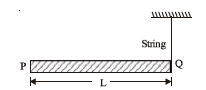
(a) g/L (b) 2g/L (c) 2g/3L (d) 3g/2L
2. A particle of mass 1 kg is projected at an angle θ with horizontal. Its co-ordinates at any instant are (5m, 5m) and it is having velocity components along X-axis and Y-axis as 8 m/s and 4 m/s respectively. Its angular momentum about origin is
(a) – 20 kˆ (b) + 20 kˆ (c) – 60 kˆ (d) + 60 kˆ
3. A uniform bar, of length 6a and mass 8m lies on a smooth horizontal table. Two point masses m and 2m, moving in the same horizontal plane with speeds 2v and v respectively, strike the bar as shown in the figure and stick to the bar after collision.

If the angular velocity about the centre of mass, total energy and velocity of centre of mass are denoted by ω, E and Vc respectively, then after collision, the following is incorrect
(a) vc = 0 (b) ω = 3v/5a (c) ω = v/5a (d) 5E= 3mv2
4. A particle of mass 5 grams is moving with a uniform speed of 3 √2 cm/s in the xy plane along the line y = x + 4. The magnitude of its angular momentum about the origin in g.cm2/s is
(a) zero (b) 30 (c) 30 2 (d) 60
5. Two points masses of 0.3 kg and 0.7 kg are fixed at the ends of a rod of length 1.4 m and of negligible mass. The rod is set rotating about an axis perpendicular to its length with a uniform angular speed. The point on the rod through which the axis should pass, in order that the work required for rotation of the rod is minimum, is located at a distance of
(a) 0.42 m from mass of 0.3 kg (b) 0.70 m from mass of 0.7 kg
(c) 0.98 m from mass of 0.3 kg (d) 0.98 m from mass of 0.7 kg
6. A solid cylinder of radius R is free to rotate about its horizontal axis. A string is wound around it and a mass m is attached to its free end. When m falls through a distance h, its speed at that instant is
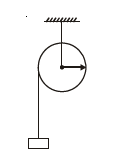
(a) proportional to R (b) proportional to 1 / R
(c) proportional to 1 / R2 (d) independent of R
7. A uniform disc of mass m and radius R is rolling up a rough inclined plane which makes an angle of 300 with the horizontal. If only gravitational and frictional forces are acting on the disc, the magnitude of the frictional force acting along the inclined plane is
(a) mg/6 upwards (b) mg/6 downwards (c) mg/4 upwards (d) mg/4 downwards
8. A tube of length L is filled completely with an incompressible liquid of mass M and closed at both the ends. The tube is then rotated in a horizontal plane about one of its ends with a uniform angular velocity ω. The force exerted by the liquid at the other end is
(a) Mω 2L/2 (b) Mω2L (c) Mω 2L/4 (d) 3Mω 2L/2
9. A solid sphere of mass 2 kg rolls on a smooth horizontal surface at 10 m/s. It then rolls up a smooth inclined plane of inclination 300 with the horizontal. The height attained by the sphere before it stops on the inclined plane is
(a) 5.0 m (b) 7.1 m (c) 8.0 m (d) 10.2 m
10. A homogeneous disc of mass M and radius R rotates about vertical axis with a uniform angular velocity ω0. If the brakes are applied with a radial force F and coefficient of friction μ, the time taken to bring the disc to rest is
(a) MRω0/4μF (b) MRω0/2μF (c) MRω0/μF (d) 2MRω0/μF
11. Two particles A and B initially at rest, move towards each other under a mutual force of attraction. At the instant when the speed of A is v and the speed of B is 2v, the speed of the centre of mass of the system is
(a) zero (b) 3 v (c) 1.5 v (d) v
12. A string is wrapped around a cylinder of mass m and radius R. The string is pulled vertically upward to prevent the centre of mass from falling as the cylinder unwinds the string. The length of the string unwound when the cylinder has reached a speed ω will be
(a) Rω/4g (b) R2ω2/4g (c) Rω/8g (d) R2ω2/8g
Please click on below link to download pdf file for CBSE Class 12 Physics Rotational Motion Objective Questions
Free study material for Physics
Useful Resources and Notes for Class 12 Physics Rotational Motion
Essential Notes for Class 12 Physics
Review targeted study resources for Rotational Motion tailored for Class 12 learners. Utilizing these structured notes and quick-revision tools ensures complete alignment with current CBSE evaluation standards.
Verified Solutions for Class 12 Physics
Each resource draws directly from authorized textbooks to maintain academic accuracy. Evaluating solved examples allows Class 12 students to master the formal presentation and answer-writing standards expected in upcoming school exams.
Enhance Accuracy with Online Tests
Wrap up your chapter revision by testing your knowledge against standard objective question formats. Explore our full library of free, up-to-date sample papers and online assessments to secure top grades in your CBSE examinations.
FAQs
Our advanced study package for Rotational Motion includes detailed concepts, diagrams, Mind Maps, and explanation of complex topics to ensure Class 12 students learn as per syllabus for 2026 exams.
The Mind Maps provided for Rotational Motion act as visual anchors which will help faster recall during high-pressure exams.
Yes, teachers use our Class 12 Physics resources for lesson planning as they are in simple language and have lot of solved examples.
Yes, You can download the complete, mobile-friendly PDF of the Physics Rotational Motion advanced resources for free.
Yes, our subject matter experts have updated the Rotational Motion material to align with the rationalized NCERT textbooks and have removed deleted topics and added new competency-based questions.