

Official CBSE Study Materials for Class 12 Physics
Review targeted academic resources with the CBSE Class 12 Physics Electrostatics Objective Questions. Built according to official CBSE standards for the 2026-27 term, these downloadable Class 12 Physics study materials support effective daily practice and deeper conceptual understanding for Chapter 02 Electrostatic Potential and Capacitance.
Advanced Resources for Physics
View or download the dedicated CBSE Class 12 Physics Electrostatics Objective Questions resource below. Engaging with these advanced study guides under focused conditions ensures continuous academic progress and mastery of the 2026-27 curriculum for Chapter 02 Electrostatic Potential and Capacitance.
CBSE Class 12 Physics Electrostatics Objective Questions. Please refer to the examination notes which you can use for preparing and revising for exams. These notes will help you to revise the concepts quickly and get good marks.
1. Two idenical rings, each of radius R, are co-axially placed. The distance between their centres is R. A charge Q is placed on each ring. The work done in moving a small charge q from the center of one ring to that of the other is

2. Two concentric hollow spheres of radii R and r (R > r) have positive charge of equal surface density σ. The electrical potential at their common centre is

3. Four charges, each equal to q, are placed at the corners of a square of side l. The electrical potential at the centre of the square is

4. An uncharged parallel plate condenser, having a dielectric constant K, is connected to a similar parallel plate condenser with air as medium in between plates and charged to a potential V. The two condensers are connected so that their common potential is V′. The dielectric constant K is
(a) V′-V / V'+V (b) V'- V/ V (c) V′ − V/ V' (d) V-V' / V'
5. The charge and potential difference across 4 μF capacitor in the given circuit is
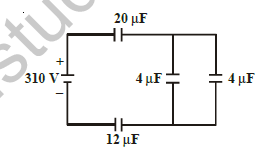
(a) 1200 μC, 310 V (b) 600 μC, 310 V (c) 1200 μC, 150 V (d) 600 μC, 150 V
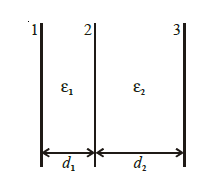
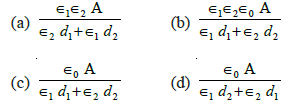
6. A system of three parallel plates, each of area A, are separated by distances d1 and d2. The space between these plates is filled with dielectrics of relative permittivity ε1 and ε2 as shown in the figure. The permittivity of free space is ∈0. The equivalent capacitance of the system is
7. Five capacitors are connected as shown. The equivalent capacitance between terminals A and B and charge on 5μF capacitor will be respectively
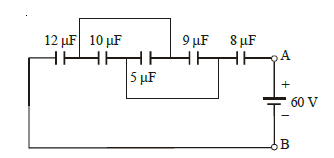
(a) 8 μF, 100 μC (b) 4 μF, 50 μC (c) 12 μF, 150 μC (d) 16 μF, 200 μC
8. A parallel plate capacitor of plate area A and separation between the plates d is charged to a potential difference V by a battery. The battery is then disconnected and a slab of dielectric constant K is then inserted between the plates of the capacitor so as to fill the space between the plates completely. The work done to insert the slab is

9. Three charges +q, +q and Q are palced at the vertices of a right-angled
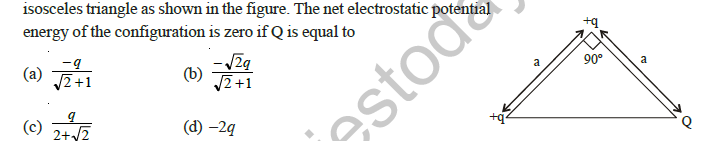
10. Two equal negative charges –q are fixed at points with coordinates (0, a) and (0, –a) on y-axis. A positive charge Q is released from rest at the point with coordinates (2a, 0) on x-axis. The charge Q will
(a) execute simple harmonic motion about the origin
(b) move to origin and remain at rest
(c) move to infinity
(d) execute oscillatory motion but not simple harmonic motion
11. A capacitor C1 is charged to a potential difference V. The charging battery is then removed and the capacitor is connected to an uncharged capacitor C2, If U is the initial energy in capacitor C1, the final energy stored in the combination is

12. The charge on the capacitor of 5 μF in the circuit given in the figure is
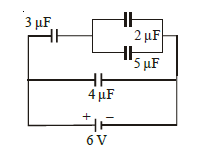
(a) 7 μC (b) 9 μC (c) 12.6 μC (d) 21 μC
Please click on below link to download pdf file for CBSE Class 12 Physics Electrostatics Objective Questions.
Free study material for Physics
CBSE Class 12 Physics Study Material: Chapter 02 Electrostatic Potential and Capacitance
Comprehensive Study Resources for Chapter 02 Electrostatic Potential and Capacitance
Review targeted study resources for Chapter 02 Electrostatic Potential and Capacitance tailored for Class 12 learners. Utilizing these structured notes and quick-revision tools ensures complete alignment with current CBSE evaluation standards.
Understanding Marking Schemes
Built using official NCERT guidelines for Class 12 Physics, these materials provide reliable academic support. Integrating past examination questions and step-by-step solutions helps students understand official CBSE grading criteria.
Complete Revision for Physics
Wrap up your chapter revision by testing your knowledge against standard objective question formats. Explore our full library of free, up-to-date sample papers and online assessments to secure top grades in your CBSE examinations.
FAQs
Our advanced study package for Chapter 02 Electrostatic Potential and Capacitance includes detailed concepts, diagrams, Mind Maps, and explanation of complex topics to ensure Class 12 students learn as per syllabus for 2026 exams.
The Mind Maps provided for Chapter 02 Electrostatic Potential and Capacitance act as visual anchors which will help faster recall during high-pressure exams.
Yes, teachers use our Class 12 Physics resources for lesson planning as they are in simple language and have lot of solved examples.
Yes, You can download the complete, mobile-friendly PDF of the Physics Chapter 02 Electrostatic Potential and Capacitance advanced resources for free.
Yes, our subject matter experts have updated the Chapter 02 Electrostatic Potential and Capacitance material to align with the rationalized NCERT textbooks and have removed deleted topics and added new competency-based questions.