

Download CBSE Class 12 Physics Useful Resources
Review targeted academic resources with the CBSE Class 12 Physics Optical Instrument Solved Examples. Built according to official CBSE standards for the 2026-27 term, these downloadable Class 12 Physics study materials support effective daily practice and deeper conceptual understanding for Chapter 09 Ray Optics and Optical Instruments.
Access CBSE Study Guides and Summaries
Access the complete useful resource PDF for Class 12 Physics below. Regular practice with these targeted academic notes builds familiarity with complex topics and helps secure higher marks in final school evaluations.
CBSE Class 12 Physics Optical Instrument Solved Examples. Please refer to the examination notes which you can use for preparing and revising for exams. These notes will help you to revise the concepts quickly and get good marks.
Optical Instruments – Solved Examples
Example 1. A 35 mm film is to be projected on a 20 m wide screen situated at a distance of 40 m from the film projector. Calculate the distance of the film from the projection lens and the focal length of the projection lens.
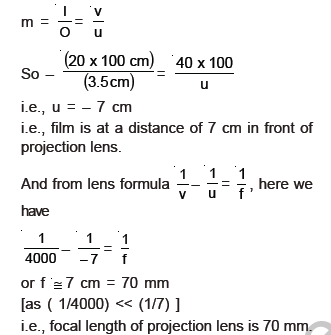
Solution. For a projector, the magnification is
\[m=\frac{I}{O}=\frac{v}{u}\]Taking the magnitudes only,
\[\frac{20\times100\ \text{cm}}{3.5\ \text{cm}}=\frac{40\times100\ \text{cm}}{u}\quad\Rightarrow\quad u=-7\ \text{cm}\]So the film is 7 cm in front of the projection lens. From the lens formula \(\frac1v-\frac1u=\frac1f\), with \(v=4000\ \text{cm}\) and \(u=-7\ \text{cm}\),
\[\frac{1}{4000}-\frac{1}{-7}=\frac1f\quad\Rightarrow\quad f\approx7\ \text{cm}=70\ \text{mm}\]because \(\frac1{4000}\ll\frac17\). So the focal length of the projection lens is 70 mm.
Example 2. A compound microscope has an objective of focal length 2 cm and an eyepiece of focal length 5 cm. If an object is placed at a distance of 2.4 cm in front of the field lens, find the magnifying power of the instrument and the length of the tube if (a) the final image is at infinity, (b) the final image is at the least distance of distinct vision (25 cm).
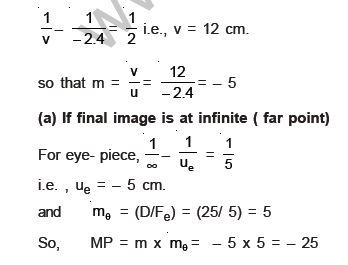
Solution. The object is 2.4 cm in front of the field lens, whose focal length is 2 cm. The field lens will form its image at a distance \(v\) given by
\[\frac1v-\frac1{-2.4}=\frac12\quad\Rightarrow\quad v=12\ \text{cm}\]so that the magnification of the objective is
\[m_o=\frac vu=\frac{12}{-2.4}=-5\](a) Final image at infinity (far point). For the eyepiece, \(\frac1\infty-\frac1{u_e}=\frac15\), so \(u_e=-5\ \text{cm}\) and
\[m_\theta=\frac{D}{f_e}=\frac{25}{5}=5\]\[\text{MP}=m_o\times m_\theta=-5\times5=-25\]The length of the tube is \(L=v+|u_e|=12+5=17\ \text{cm}\). In this situation the eye is relaxed. For a given microscope the magnifying power is minimum and the length of the tube is maximum.
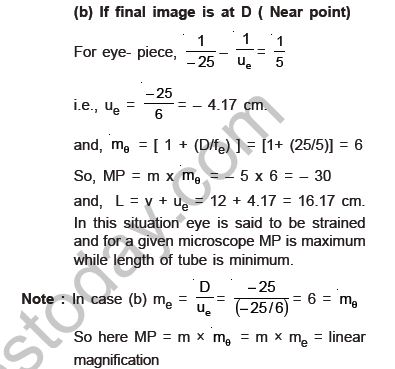
(b) Final image at the near point (D = 25 cm). For the eyepiece,
\[\frac1{-25}-\frac1{u_e}=\frac15\quad\Rightarrow\quad u_e=-\frac{25}{6}=-4.17\ \text{cm}\]\[m_\theta=1+\frac{D}{f_e}=1+\frac{25}{5}=6\]\[\text{MP}=m_o\times m_\theta=-5\times6=-30\]The length of the tube is \(L=12+4.17=16.17\ \text{cm}\). In this situation the eye is strained. For a given microscope the magnifying power is maximum and the length of the tube is minimum.
Note: in case (b), \(m_e=\frac{D}{|u_e|}=\frac{25}{25/6}=6=m_\theta\), so \(\text{MP}=m_o\times m_\theta=m_o\times m_e\) is simply the linear magnification.
Example 3. In a compound microscope the objective and the eyepiece have focal lengths of 0.95 cm and 5 cm respectively, and are kept at a distance of 20 cm. The last image is formed at a distance of 25 cm from the eyepiece. Calculate the position of the object and the total magnification.
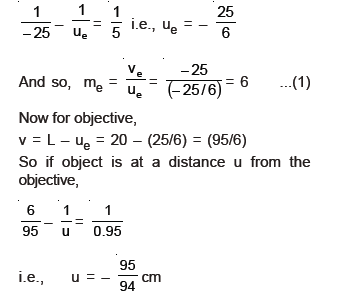

Solution. The final image is 25 cm from the eyepiece, so for the eyepiece
\[\frac1{-25}-\frac1{u_e}=\frac15\quad\Rightarrow\quad u_e=-\frac{25}{6}\ \text{cm}\]\[m_e=\frac{v_e}{u_e}=\frac{-25}{-25/6}=6\qquad\cdots(1)\]For the objective, the image distance is
\[v=L-|u_e|=20-\frac{25}{6}=\frac{95}{6}\ \text{cm}\]If the object is at a distance \(u\) from the objective,
\[\frac{6}{95}-\frac1u=\frac1{0.95}\quad\Rightarrow\quad u=-\frac{95}{94}\ \text{cm}\]So the object is at a distance \(\frac{95}{94}\) cm in front of the objective. Also
\[m_o=\frac vu=\frac{95/6}{-95/94}=-\frac{94}{6}\qquad\cdots(2)\]The total magnification is
\[M=m_o\times m_e=-\frac{94}{6}\times6=-94\]The final image is inverted, virtual, and 94 times the size of the object.
Example 4. A Galilean telescope consists of an objective of focal length 12 cm and an eyepiece of focal length 4 cm. What should be the separation of the two lenses when the virtual image of a distant object is formed at a distance of 24 cm from the eyepiece? What is the magnifying power of the telescope under this condition?
Solution. The object is distant, so \(u=-\infty\) for the objective, and
\[\frac1v-\frac1{-\infty}=\frac1{f_0}\quad\Rightarrow\quad v=f_0=12\ \text{cm}\]So the objective forms the image \(I_M\) at its focus, 12 cm from \(O\). The eyepiece (focal length \(-4\) cm) forms the final image \(I\) at a distance of 24 cm from it. Therefore
\[\frac1{-24}-\frac1{u_e}=\frac1{-4}\quad\Rightarrow\quad u_e=\frac{24}{5}=4.8\ \text{cm}\]That is, \(I_M\) is 4.8 cm from the eyepiece \(E\). So the length of the tube is
\[L=OA-EA=12-4.8=7.2\ \text{cm}\]By definition,
\[\text{MP}=\frac{\theta}{\theta_0}\approx\frac{\tan\theta}{\tan\theta_0}=\frac{AB/EA}{AB/OA}=\frac{OA}{EA}\]\[\text{MP}=\frac{f_0}{u_e}=\frac{12}{4.8}=\frac{10}{4}=2.5\]So the image is erect and virtual, and it is at a distance of \(24-7.2=16.8\) cm in front of the objective.


Free study material for Physics
CBSE Class 12 Physics Study Material: Chapter 09 Ray Optics and Optical Instruments
Comprehensive Study Resources for Chapter 09 Ray Optics and Optical Instruments
Access comprehensive study material for Chapter 09 Ray Optics and Optical Instruments, including revision notes, concept maps, and high-probability questions. These resources are designed in alignment with the latest 2026 CBSE syllabus for Class 12 Physics to support effective exam preparation.
Understanding Marking Schemes
Built using official NCERT guidelines for Class 12 Physics, these materials provide reliable academic support. Integrating past examination questions and step-by-step solutions helps students understand official CBSE grading criteria.
Complete Revision for Physics
Wrap up your chapter revision by testing your knowledge against standard objective question formats. Explore our full library of free, up-to-date sample papers and online assessments to secure top grades in your CBSE examinations.
FAQs
Our advanced study package for Chapter 09 Ray Optics and Optical Instruments includes detailed concepts, diagrams, Mind Maps, and explanation of complex topics to ensure Class 12 students learn as per syllabus for 2026 exams.
The Mind Maps provided for Chapter 09 Ray Optics and Optical Instruments act as visual anchors which will help faster recall during high-pressure exams.
Yes, teachers use our Class 12 Physics resources for lesson planning as they are in simple language and have lot of solved examples.
Yes, You can download the complete, mobile-friendly PDF of the Physics Chapter 09 Ray Optics and Optical Instruments advanced resources for free.
Yes, our subject matter experts have updated the Chapter 09 Ray Optics and Optical Instruments material to align with the rationalized NCERT textbooks and have removed deleted topics and added new competency-based questions.