

Class 12 Physics Study Guide: CBSE Class 12 Physics Solids and Fluids Assignment
Review targeted academic resources with the CBSE Class 12 Physics Solids and Fluids Assignment. Built according to official CBSE standards for the 2026-27 term, these downloadable Class 12 Physics study materials support effective daily practice and deeper conceptual understanding for Solids and Fluids.
Download Solids and Fluids Study Material PDF
Access the complete useful resource PDF for Class 12 Physics below. Regular practice with these targeted academic notes builds familiarity with complex topics and helps secure higher marks in final school evaluations.
CBSE Class 12 Physics Solids and Fluids Assignment. Please refer to the examination notes which you can use for preparing and revising for exams. These notes will help you to revise the concepts quickly and get good marks.
CBSE CLASS 12 PHYSICS
SOLIDS AND FLUIDS
MISCELLANEOUS ASSIGNMENT
MISCELLANEOUS ASSIGNMENT
Comprehension-1
When spherical body of mass m moving through stationary air feels forces of friction, F = kv/r, where k is constant, v is velocity of ball and r is radius of the ball. (neglect force of buoyancy)
1. If radius of ball is increasing at a rate r0 m/sec then (Assuming initial radius to be nearly zero)
(a) ball will attain terminal velocity which is equal to \( \sqrt{\frac{4\pi r_0 \rho}{k}} \) where ρ is density of ball
(b) velocity will always increase
(c) behaviour of velocity can not be determined
(d) none of these
Answer: (c) behaviour of velocity can not be determined
1. The ball is acted on by friction F = kv/r, but the question does not state the driving force (such as gravity) or how the increasing mass picks up momentum from the air.
2. For a growing radius r = r0t the friction coefficient k/r itself changes with time, and the terminal speed (if gravity were the driver) would be proportional to r⁴, so it never settles to one value.
3. So a fixed terminal velocity as in option (a) is not obtained, and nothing definite can be said about the behaviour of the velocity.
4. Hence, the correct option is (c).
Teacher's Note:
a) Terminal velocity needs a constant driving force balanced by a constant drag; here the drag factor 1/r keeps changing.
b) Option (a) has no g or time dependence in it, so it cannot come from balancing forces.
2. If radius of ball is 20 cm, k = 1 unit (M.K.S.) m = 2kg, what is maximum rate of dissipation of energy against friction
(a) 40 J/sec
(b) 80 J/sec
(c) 70 J/sec
(d) can't be determined
Answer: (b) 80 J/sec
1. The ball falls under gravity and the rate of dissipation is greatest at terminal velocity, where mg = kv/r.
2. vt = mgr/k = 2 × 10 × 0.2 / 1 = 4 m/s (taking g = 10 m/s²).
3. Maximum power dissipated = F vt = mg vt = 20 × 4 = 80 J/s.
4. Hence, the correct option is (b).
Teacher's Note:
a) At terminal speed all the work done by gravity is dissipated as heat, so power = mg × vt.
b) The value uses g = 10 m/s²; the answer is a power, measured in watts (J/s).
Comprehension-2
When a body moves in fluid with some speed it gives momentum to the fluid particles in consequence fluid applies force to the moving body which opposes the motion of the body. The opposing force can be called drag force (fd). Drag force depends to the area of crossection (A) of the body, speed (v) of body relative to the fluid medium and density of the fluid (ρ) itself. The approximate formula can be written as fd = CAρv² where C is a positive constant.
3. A sphere of radius r and density σ is released from rest in the fluid of density ρ, its terminal speed is
(a) \( \sqrt{\frac{4\sigma r g}{3C\rho}} \)
(b) \( \sqrt{\frac{g r \sigma}{3C\rho}} \)
(c) \( \sqrt{\frac{4g}{3C}\left(\frac{\sigma}{\rho} - 1\right)} \)
(d) it will not attain terminal velocity
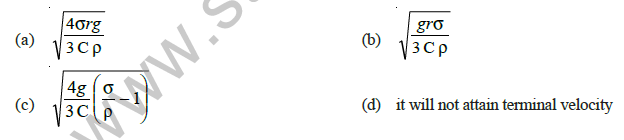
Answer: (c) \( \sqrt{\frac{4g}{3C}\left(\frac{\sigma}{\rho} - 1\right)} \)
1. At terminal speed: weight = upthrust + drag, so (4/3)πr³σg = (4/3)πr³ρg + CAρv² with A = πr².
2. So (4/3)πr³(σ - ρ)g = Cπr²ρv², which gives v² = \( \frac{4 r g (\sigma - \rho)}{3C\rho} \).
3. So v = \( \sqrt{\frac{4rg}{3C}\left(\frac{\sigma}{\rho} - 1\right)} \). Of the printed options, only (c) has the factor (σ/ρ - 1) from the upthrust; it prints g without the radius r, which is a printing slip for the r inside the root.
4. Hence, the correct option is (c).
Teacher's Note:
a) The printed key gives (a), which ignores the upthrust of the fluid; the buoyant force must be subtracted, so (c) is the correct choice.
b) The root in option (c) is missing the radius r (the correct expression has 4rg/3C); (c) is still the only option with the (σ/ρ - 1) form.
4. A small ball of radius r is floating in a tank, which is filled with liquid of density ρ and moving with constant speed v0. The tank collides with a wall and comes to rest. The velocity of the ball with which it collides with front end of tank is (neglect the jerk on the ball, when tank collides with wall)
(a) v0 e-3c l/4r
(b) \( \frac{4rg}{3c} \)
(c) \( \frac{3 v_0}{4} \) e-3e l/4r
(d) zero
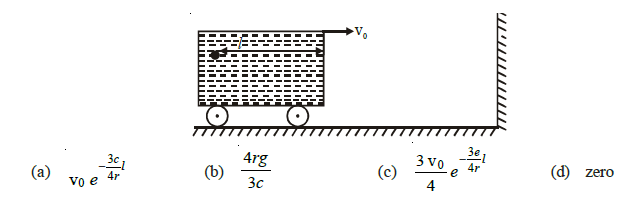
[Figure: A tank on wheels filled with liquid (shown by dashed horizontal lines) moving to the right with speed v0 towards a vertical hatched wall on the right. A small ball (dot) lies at the left end of the tank, and a double arrow marked l shows the length of the tank from the ball to the front end.]
Answer: (a) v0 e-3c l/4r
1. The ball floats inside the liquid, so its density equals ρ and its mass is m = (4/3)πr³ρ.
2. After the tank stops, the ball keeps moving through the liquid against the drag f = CAρv² = Cπr²ρv².
3. m v dv/dx = - Cπr²ρ v², so dv/v = - \( \frac{3C}{4r} \) dx.
4. Integrating over the length l of the tank: v = v0 e-3Cl/4r.
5. Hence, the correct option is (a).
Teacher's Note:
a) Use v dv/dx for acceleration when the drag is given in terms of v and distance is asked.
b) The constant written c in the options is the constant C of the passage.
5. Drag force on a body, which is moving in fluid is due to
(a) relative motion between the layers of fluid
(b) relative motion between the body and fluid
(c) random motion of fluid molecules
(d) Adhesive force between the body and fluid molecules
Answer: (b) relative motion between the body and fluid
1. Drag exists only when the body moves relative to the fluid, as the passage says fd depends on the speed of the body relative to the fluid.
2. The body gives momentum to the fluid particles, and the fluid then pushes back on the body.
3. Hence, the correct option is (b).
Teacher's Note:
a) If there is no relative motion, there is no drag.
b) Relative motion between layers of fluid is viscosity, which is a different effect.
6. If the radius of the body is doubled keeping its density constant, intial dragging retardation will (assuming initial velocity to be same).
(a) increase two times
(b) decrease half of its value
(c) decrease by \( \frac{1}{2^{1/3}} \) times
(d) increase by 21/3 times
Answer: (b) decrease half of its value
1. Drag force fd = CAρv² ∝ r² for the same v.
2. Mass m = (4/3)πr³ × density ∝ r³.
3. Retardation a = fd/m ∝ r²/r³ = 1/r, so doubling r halves the retardation.
4. Hence, the correct option is (b).
Teacher's Note:
a) Drag depends on area (r²) but inertia depends on volume (r³), so bigger bodies are retarded less.
b) This is why large drops fall faster than small drops.
Comprehension-3
When liquid is non viscous, non compressible and flow is steam line sum of pressure, kinetic and potential energy per unit volume is constant i.e. P + \( \frac{1}{2} \) pv² + ρgh = constant
According to equation of continuity AV = constant.
Water flows smoothly through the pipe shown in the figure descending in the process. Four sections of the pipe have been numbered.
7. The volume flow rate is maximum in
(a) 4
(b) 1
(c) 3
(d) same in all the four sections

[Figure: A pipe carrying water from left to right (arrow marked Flow). Section 1 is a narrow horizontal part at the top left; the pipe widens slightly at section 2, then bends and descends to a lower level where section 3 is as narrow as section 2; after this the pipe widens into a wide horizontal part where section 4 lies. Each section is marked by two dashed vertical lines.]
Answer: (d) same in all the four sections
1. For an incompressible liquid, the equation of continuity gives A v = constant along the pipe.
2. Av is the volume flow rate, so the same volume per second passes through every section.
3. Hence, the correct option is (d).
Teacher's Note:
a) The speed changes with the cross-section, but the volume flow rate does not.
b) Do not confuse flow speed with flow rate.
8. The flow speed is maximum in
(a) 1
(b) 2
(c) 3
(d) 4
Answer: (a) 1
1. By Av = constant, speed is largest where the cross-section is smallest.
2. Section 1 is the narrowest part of the pipe, so the flow speed is maximum there.
3. Hence, the correct option is (a).
Teacher's Note:
a) Sections 2 and 3 have a larger area than section 1, and section 4 has the largest area, so v is least there.
b) Compare the widths of the pipe in the figure carefully.
9. The water pressure is minimum in
(a) 1
(b) 2
(c) 3
(d) 4
Answer: (a) 1
1. By Bernoulli's equation, P + ½ρv² + ρgh is constant along the streamline.
2. Section 1 has the maximum speed and also the maximum height, so both ½ρv² and ρgh are largest there.
3. Therefore the pressure P is smallest at section 1.
4. Hence, the correct option is (a).
Teacher's Note:
a) A high speed or a high level means a low pressure for the same total.
b) Section 4 is wide (slow) and low, so its pressure is the largest.
Each of the questions given below consists of two statements, an assertion (A) and reason (R). Select the number corresponding to the appropriate alternative as follows
(a) If both A and R are true and R is the correct explanation of A
(b) If both A and R are true but R is not the correct explanation of A
(c) If A is true but R is false
(d) If A is false but R is true
10. A: Steel is more elastic than rubber.
R: Young's modulus of elasticity of steel is greater than the Young's modulus of elasticity of rubber.
(a) If both A and R are true and R is the correct explanation of A
(b) If both A and R are true but R is not the correct explanation of A
(c) If A is true but R is false
(d) If A is false but R is true
Answer: (a)
1. Elasticity is the ability to resist deformation and regain shape; the larger the Young's modulus, the more elastic the material.
2. Y(steel) is about 2 × 10¹¹ N/m² while Y(rubber) is only about 10⁶ to 10⁸ N/m², so both A and R are true.
3. R gives the reason for A.
4. Hence, the correct option is (a).
Teacher's Note:
a) Elastic here means resisting deformation, not stretching a lot.
b) Rubber stretches more but is less elastic in this sense.
11. A: When ice floating in water has density equal to the density of water, then upon melting of ice the level of water remains same.
R: Since V = V', so level of water remains unchanged. (Where v' is the volume of ice inside the water and v volume of water formed on melting of ice)
(a) If both A and R are true and R is the correct explanation of A
(b) If both A and R are true but R is not the correct explanation of A
(c) If A is true but R is false
(d) If A is false but R is true
Answer: (a)
1. A floating piece of ice displaces water equal to its weight, so V' = (weight of ice)/(ρwg).
2. The water formed by melting has the same weight, so its volume V = (weight of ice)/(ρwg) = V'.
3. The melt water exactly fills the space displaced by the ice, so the level does not change; A and R are true and R explains A.
4. Hence, the correct option is (a).
Teacher's Note:
a) The same reasoning holds whenever floating ice melts in its own water.
b) If the ice also held air bubbles or salt, the conclusion would change.
12. A: It is easier to swim in sea water than in the river water.
R: The density of sea water is greater than the density of river water.
(a) If both A and R are true and R is the correct explanation of A
(b) If both A and R are true but R is not the correct explanation of A
(c) If A is true but R is false
(d) If A is false but R is true
Answer: (a)
1. Sea water has greater density, so the upthrust ρVg on the swimmer is greater and he floats more easily.
2. Both A and R are true, and R is the reason for A.
3. Hence, the correct option is (a).
Teacher's Note:
a) Upthrust is directly proportional to the density of the liquid.
b) A higher density liquid supports more of the body weight.
13. A: For a floating body to be in stable equilibrium, its centre of buoyancy must be situated above the centre of gravity.
R: The torque formed by the weight of the body and upthrust will restore the body to its normal position.
(a) If both A and R are true and R is the correct explanation of A
(b) If both A and R are true but R is not the correct explanation of A
(c) If A is true but R is false
(d) If A is false but R is true
Answer: (a)
1. If the centre of buoyancy lies above the centre of gravity, a small tilt shifts the line of the upthrust so that the weight and upthrust form a couple.
2. This couple turns the body back to its normal position, so R is true and it gives the reason for A.
3. Hence, the correct option is (a).
Teacher's Note:
a) This is the simple textbook condition; for ships the exact condition uses the metacentre, which must lie above the centre of gravity.
b) Stable equilibrium needs a restoring torque.
14. A: A large soap bubble expands while small soap bubble shrinks, when they are connected to each other by a capillary tube.
R: The excess pressure inside a spherical bubble increases, as its volume decrease.
(a) If both A and R are true and R is the correct explanation of A
(b) If both A and R are true but R is not the correct explanation of A
(c) If A is true but R is false
(d) If A is false but R is true
Answer: (a)
1. Excess pressure inside a soap bubble is 4T/r, so it is larger for the smaller bubble (R is true).
2. When the bubbles are connected, air flows from the higher pressure (small bubble) to the lower pressure (large bubble).
3. The small bubble therefore shrinks and the large one expands, so A is true and R explains it.
4. Hence, the correct option is (a).
Teacher's Note:
a) Excess pressure is inversely proportional to the radius.
b) Bubbles of unequal size can never stay in equilibrium when joined, unlike two equal bubbles.
15. A: Oils of different viscosities are used in automobiles in different seasons.
R: Viscosity of lubricating oil increases with decreases of temperature.
(a) If both A and R are true and R is the correct explanation of A
(b) If both A and R are true but R is not the correct explanation of A
(c) If A is true but R is false
(d) If A is false but R is true
Answer: (a)
1. The viscosity of a liquid like oil increases when the temperature falls, so R is true.
2. In winter a thin (low viscosity) oil is needed so that it still flows, and in summer a thick oil is needed, so A is true.
3. R is the reason for A.
4. Hence, the correct option is (a).
Teacher's Note:
a) Liquids become more viscous on cooling, but gases become less viscous on cooling.
b) Engine oil grades such as 10W and 40 mark this seasonal choice.
16. A: If the radius of capillary tube is double all other conditions remaining same then volume of liquid flowing per second becomes 16 times.
R: V = \( \frac{\pi p r^4}{8\eta l} \)
(a) If both A and R are true and R is the correct explanation of A
(b) If both A and R are true but R is not the correct explanation of A
(c) If A is true but R is false
(d) If A is false but R is true
Answer: (a)
1. By Poiseuille's formula V = \( \frac{\pi p r^4}{8\eta l} \), so V ∝ r⁴ and R is true.
2. If r is doubled, V becomes 2⁴ = 16 times, so A is true.
3. R gives the formula from which A follows.
4. Hence, the correct option is (a).
Teacher's Note:
a) In R the letter p stands for the pressure difference across the tube.
b) The strong r⁴ dependence is why a small blockage in a narrow vessel cuts the flow by a large factor.
17. A: It is dangerous to stand on the edge of platform near the railway line, when the train is passing by.
R: \( \frac{P_1}{\rho} + \frac{1}{2} v_1^2 = \frac{P_2}{\rho} + \frac{1}{2} v_2^2 \)
(a) If both A and R are true and R is the correct explanation of A
(b) If both A and R are true but R is not the correct explanation of A
(c) If A is true but R is false
(d) If A is false but R is true
Answer: (a)
1. A passing train drags the air near it, so the air speed is high near the train and the pressure there falls (R, Bernoulli's equation at the same height).
2. The higher pressure on the side away from the train pushes the person towards the train, so A is true.
3. R is the principle that explains A.
4. Hence, the correct option is (a).
Teacher's Note:
a) In R the height terms are dropped because both points are at the same level.
b) This is the same effect that pulls two parallel ships together.
18. A: Strain causes stress, but not vice-versa
R: The force of reaction per unit area is called stress.
(a) If both A and R are true and R is the correct explanation of A
(b) If both A and R are true but R is not the correct explanation of A
(c) If A is true but R is false
(d) If A is false but R is true
Answer: (a)
1. When a body is deformed (strain), internal restoring forces appear; their value per unit area is the stress, so R is true.
2. The assertion treats the deformation as the cause and the restoring stress as the effect, which follows from R.
3. Hence, the correct option is (a).
Teacher's Note:
a) In the lab one often applies a force first (stress) and measures strain, so the cause and effect can be viewed either way; this key follows the restoring force view.
b) Stress = restoring force per unit area, and strain = change in dimension per original dimension.
19. A: A boat floats in a swimming pool. Water from a well is pumped into the pool to raise the level of water by a half metre. The work done in pumping water into the pool will be same, whether the boat is large or as small as a toy-boat.
R: Volume of water pumped into the pool will be same.
(a) If both A and R are true and R is the correct explanation of A
(b) If both A and R are true but R is not the correct explanation of A
(c) If A is true but R is false
(d) If A is false but R is true
Answer: (a)
1. The boat floats, so the volume of water it displaces depends only on its weight and remains the same before and after pumping.
2. Raising the level by 0.5 m therefore needs the same volume of water, A × 0.5, whatever the size of the boat, so R is true.
3. The same volume lifted through the same height needs the same work, so A is true and R explains it.
4. Hence, the correct option is (a).
Teacher's Note:
a) The displaced volume of a floating boat does not change when the level rises.
b) If the boat were resting on the bottom, the answer would differ.
20. A: When two liquids of density ratio 1 : 2 are mixed by taking equal masses, the density of the mixture is more than when these are mixed by taking equal volumes.
R: Total volume in the first case will be smaller as compared to the mass.
(a) If both A and R are true and R is the correct explanation of A
(b) If both A and R are true but R is not the correct explanation of A
(c) If A is true but R is false
(d) If A is false but R is true
Answer: (d)
1. Let the densities be ρ and 2ρ. For equal masses m, the density of the mixture is 2m/(m/ρ + m/2ρ) = 4ρ/3.
2. For equal volumes V, the density is (ρV + 2ρV)/2V = 3ρ/2. Since 4ρ/3 is less than 3ρ/2, A is false.
3. For the same total mass, the equal-mass mixture occupies the larger volume, which is the reason for its lower density. With R read as larger volume for the same mass (the printed word smaller is a misprint), R is true.
4. Hence, the correct option is (d).
Teacher's Note:
a) Mixing equal masses gives the harmonic mean of the densities, and mixing equal volumes gives the arithmetic mean; the harmonic mean is always smaller.
b) As printed, the word smaller in R would make it false, but then none of the four options would fit, so the intended reading is larger.
21. A: Snow flakes and rain drops fall to earth with a uniform velocity.
R: All freely falling objects have zero weight.
(a) If both A and R are true and R is the correct explanation of A
(b) If both A and R are true but R is not the correct explanation of A
(c) If A is true but R is false
(d) If A is false but R is true
Answer: (c)
1. Snow flakes and rain drops reach terminal velocity when the drag and upthrust balance their weight, so they fall with uniform velocity and A is true.
2. The weight mg of a freely falling object is not zero; only its apparent weight is zero, so R is false.
3. Hence, the correct option is (c).
Teacher's Note:
a) The printed key (b) is wrong, because R is a false statement; the correct choice is (c).
b) A freely falling body is weightless only in the sense that it exerts no force on its support.
22. A: Small droplets of rain are spherical in nature.
R: Due to strong molecular forces, these come as close as possible, thereby forming spherical shape.
(a) If both A and R are true and R is the correct explanation of A
(b) If both A and R are true but R is not the correct explanation of A
(c) If A is true but R is false
(d) If A is false but R is true
Answer: (c)
1. Small droplets are spherical because surface tension makes the liquid take the shape of least surface area for a given volume, so A is true.
2. Molecular forces do not pull molecules "as close as possible" into a sphere; the shape comes from the tendency to minimise surface energy, so R as stated is not the correct reason.
3. Hence, the correct option is (c).
Teacher's Note:
a) For small drops gravity is negligible against surface tension, which is why they are round, while large drops are flattened.
b) A sphere has the least surface area for a given volume.
23. A: For Reynold number Re > 2000, the flow of fluid is turbulent.
R: Inertial forces are dominant compared to the viscous forces at such high Reynold numbers.
(a) If both A and R are true and R is the correct explanation of A
(b) If both A and R are true but R is not the correct explanation of A
(c) If A is true but R is false
(d) If A is false but R is true
Answer: (a)
1. The Reynolds number is the ratio of inertial force to viscous force, so a large value means inertial forces dominate (R is true).
2. For Re above about 2000 the flow becomes turbulent, so A is true, and R explains why.
3. Hence, the correct option is (a).
Teacher's Note:
a) Streamline flow is expected for Re below about 1000, with a transition region in between.
b) Reynolds number = ρvD/η.
Free study material for Physics
CBSE Class 12 Physics Study Material: Solids and Fluids
Comprehensive Study Resources for Solids and Fluids
Access comprehensive study material for Solids and Fluids, including revision notes, concept maps, and high-probability questions. These resources are designed in alignment with the latest 2026 CBSE syllabus for Class 12 Physics to support effective exam preparation.
Understanding Marking Schemes
Built using official NCERT guidelines for Class 12 Physics, these materials provide reliable academic support. Integrating past examination questions and step-by-step solutions helps students understand official CBSE grading criteria.
Complete Revision for Physics
Maximize your grade potential by utilizing Class 12 Physics practice papers in tandem with these structured notes. All printable assignments and interactive mock tests on our platform are updated for the 2026 session and available free of charge.
FAQs
Our advanced study package for Solids and Fluids includes detailed concepts, diagrams, Mind Maps, and explanation of complex topics to ensure Class 12 students learn as per syllabus for 2026 exams.
The Mind Maps provided for Solids and Fluids act as visual anchors which will help faster recall during high-pressure exams.
Yes, teachers use our Class 12 Physics resources for lesson planning as they are in simple language and have lot of solved examples.
Yes, You can download the complete, mobile-friendly PDF of the Physics Solids and Fluids advanced resources for free.
Yes, our subject matter experts have updated the Solids and Fluids material to align with the rationalized NCERT textbooks and have removed deleted topics and added new competency-based questions.