

Official CBSE Study Materials for Class 12 Physics
Access comprehensive study materials and useful resources for Chapter 15 Communication Systems using the CBSE Class 12 Physics Communication Systems Concept Map. Designed to align with the 2026-27 CBSE academic guidelines, these advanced resources help Class 12 Physics students reinforce core concepts beyond standard textbooks.
Advanced Resources for Physics
View or download the dedicated CBSE Class 12 Physics Communication Systems Concept Map resource below. Engaging with these advanced study guides under focused conditions ensures continuous academic progress and mastery of the 2026-27 curriculum for Chapter 15 Communication Systems.
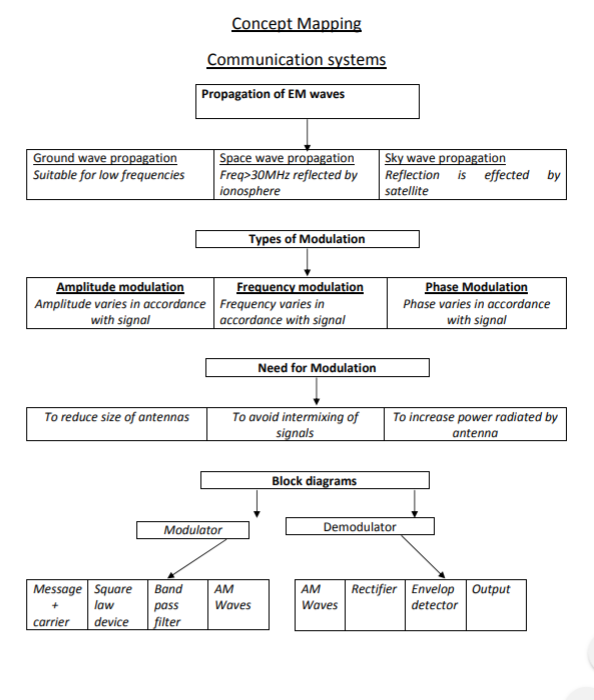
This CBSE Class 12 Physics concept map covers the chapter Communication Systems, with its key points on propagation of electromagnetic waves, types of modulation, the need for modulation and the modulator and demodulator block diagrams. It also includes the wave optics and optical instruments formulas from the same workshop map set, so it works as a one-page revision sheet for the board exam.
COMMUNICATION SYSTEMS
Propagation of EM Waves
1. Ground wave propagation: suitable for low frequencies.
2. Space wave propagation: used for frequencies above about 30 MHz. These waves travel in a straight line and are not reflected by the ionosphere, so they are used for line-of-sight links.
3. Sky wave propagation: waves in the frequency range of about 3 MHz to 30 MHz are reflected back to earth by the ionosphere.
Types of Modulation
1. Amplitude modulation (AM): the amplitude of the carrier varies in accordance with the signal.
2. Frequency modulation (FM): the frequency of the carrier varies in accordance with the signal.
3. Phase modulation (PM): the phase of the carrier varies in accordance with the signal.
Need for Modulation
1. To reduce the size of antennas.
2. To avoid intermixing of signals.
3. To increase the power radiated by the antenna.
Block Diagrams
Modulator:
Message signal + carrier wave → Square law device → Band pass filter → AM waves
Demodulator:
AM waves → Rectifier → Envelope detector → Output
WAVE OPTICS
Polarisation
1. Brewster's Law: μ = tan ip, where ip is the polarising angle.
2. Malus Law: I = I0 cos²θ
Interference
1. Constructive interference
i) Phase difference: Δφ = 2nπ
ii) Path difference: Δx = nλ
2. Destructive interference
i) Phase difference: Δφ = (2n - 1)π
ii) Path difference: Δx = (2n - 1)λ/2
Young's Double Slit Experiment
1. Resultant intensity of two waves
a) IR = I1 + I2 + 2√(I1I2) cos Δφ
b) I1 = a1², I2 = a2² (intensity is proportional to the square of the amplitude), so that I1/I2 = a1²/a2² = w1/w2
2. Resultant amplitude of two waves: A = √(a1² + a2² + 2a1a2 cos Δφ)
3. Maxima to minima intensity ratio: Imax/Imin = ((a1 + a2)/(a1 - a2))²
4. Fringe
i) Fringe width: β = λD/d
ii) Angular width: Δθ = λ/d
5. Position of fringes
i) nth maxima: Y = nλD/d
ii) nth minima: Y = (2n - 1)λD/(2d)
Diffraction
1. Condition for maxima (single slit): Δ = (2n + 1)λ/2
2. Condition for minima (single slit): Δ = nλ
3. Central maximum
i) Width: W = 2λD/a
ii) Angular width: θ = 2λ/a
4. Secondary maxima
i) Width: W = λD/a
ii) Angular width: θ = λ/a
5. Fresnel distance: ZF = a²/λ
6. Resolving power
i) Microscope: R.P. = 2μ sin β/(1.22λ)
ii) Telescope: R.P. = D/(1.22λ)
OPTICAL INSTRUMENTS
Human Eye
1. Normal eye: near point = 25 cm, far point = infinity.
2. Eye with defect
i) Myopia (short-sightedness): near point is 25 cm, but the far point is reduced. It is corrected by using a concave lens.
ii) Hypermetropia (long-sightedness): near point is greater than 25 cm, and the far point is infinity. It is corrected by using a convex lens.
Simple Microscope
1. Magnifying power
i) Image at near point: M = (1 + D/fe)
ii) Image at infinity: M = D/fe
Compound Microscope
1. Condition: fe is greater than fo.
2. Image at near point: M = -(v0/u0)(1 + D/fe)
3. Image at infinity: M = (L/f0) × (D/fe), where L is the tube length.
4. Resolving power: R.P. = 2n sin θ/(1.22λ)
Telescope
Refracting Type Telescope
1. Condition: fo is greater than fe.
2. Magnifying power
i) Image at near point: M = -(fo/fe)(1 + fe/D)
ii) Image at infinity: M = -fo/fe
3. Resolving power: R.P. = D/(1.22λ)
Reflecting Type Telescope
1. Cassegrain type
Magnifying power: m = fo/fe
Free study material for Physics
CBSE Class 12 Physics Study Material: Chapter 15 Communication Systems
Core Study Kit: Class 12 Physics Chapter 15 Communication Systems
Access comprehensive study material for Chapter 15 Communication Systems, including revision notes, concept maps, and high-probability questions. These resources are designed in alignment with the latest 2026 CBSE syllabus for Class 12 Physics to support effective exam preparation.
NCERT-Aligned Solutions for Chapter 15 Communication Systems
Built using official NCERT guidelines for Class 12 Physics, these materials provide reliable academic support. Integrating past examination questions and step-by-step solutions helps students understand official CBSE grading criteria.
Next Steps in Your Exam Preparation
For peak performance in upcoming evaluations, integrate official Physics sample papers directly into your study schedule. Follow up your revision by attempting online MCQ tests for Chapter 15 Communication Systems to refine calculation speed and precision.
FAQs
Our advanced study package for Chapter 15 Communication Systems includes detailed concepts, diagrams, Mind Maps, and explanation of complex topics to ensure Class 12 students learn as per syllabus for 2026 exams.
The Mind Maps provided for Chapter 15 Communication Systems act as visual anchors which will help faster recall during high-pressure exams.
Yes, teachers use our Class 12 Physics resources for lesson planning as they are in simple language and have lot of solved examples.
Yes, You can download the complete, mobile-friendly PDF of the Physics Chapter 15 Communication Systems advanced resources for free.
Yes, our subject matter experts have updated the Chapter 15 Communication Systems material to align with the rationalized NCERT textbooks and have removed deleted topics and added new competency-based questions.