

Advanced Study Material for Class 12 Physics: All Chapters
Access comprehensive study materials and useful resources for All Chapters using the CBSE Class 12 Physics Important Questions from Past Exams. Designed to align with the 2026-27 CBSE academic guidelines, these advanced resources help Class 12 Physics students reinforce core concepts beyond standard textbooks.
Practice Class 12 Physics Resources: All Chapters
View or download the dedicated CBSE Class 12 Physics Important Questions from Past Exams resource below. Engaging with these advanced study guides under focused conditions ensures continuous academic progress and mastery of the 2026-27 curriculum for All Chapters.
CBSE Class 12 Physics Important Questions from Past Exams. There are many more useful educational material which the students can download in pdf format and use them for studies. Study material like concept maps, important and sure shot question banks, quick to learn flash cards, flow charts, mind maps, teacher notes, important formulas, past examinations question bank, important concepts taught by teachers. Students can download these useful educational material free and use them to get better marks in examinations. Also refer to other worksheets for the same chapter and other subjects too. Use them for better understanding of the subjects.
CLASS XII PHYSICS – QUESTIONS FROM BOARD PAPERS WITH ANSWERS
Class 12 Physics – questions from board papers with answers, chapter by chapter (1 mark, 2 marks and 3 marks).
ELECTROSTATICS
1 mark questions
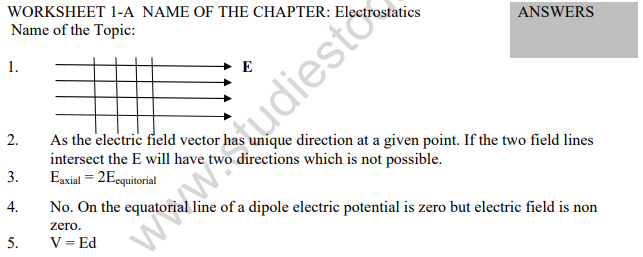
Draw the equipotential surfaces corresponding to a uniform electric field.
Answer: Equipotential surfaces are plane surfaces drawn perpendicular to the electric field lines, as shown in the figure.
Why do two electric field lines not intersect each other?
Answer: The electric field at a point has only one direction (the tangent to the field line at that point). If two lines intersected, the field at the point of intersection would have two directions, which is not possible.
What is the relation between the electric field at a point on the axial line and at a point on the equatorial line of a short electric dipole (a ≪ r)?
Answer: \(E_{axial}=2E_{equatorial}\).
Is it necessary that if the electric field is non-zero, the potential will also be non-zero at a point? Give an example.
Answer: No. On the equatorial line of a dipole the electric potential is zero, but the electric field is not zero.
What is the relation between the electric field and the potential difference between two points lying along the field in a uniform electric field?
Answer: \(V=Ed\), where \(d\) is the distance between the two points along the field.
2 marks questions
Draw the electric field lines due to an electric dipole and due to a pair of equal positive charges.
Answer: The field lines are drawn below. For the dipole they start on the positive charge and end on the negative charge. For two equal positive charges the lines start on the charges and bend away from each other; they never cross, and the field is zero at the mid-point.
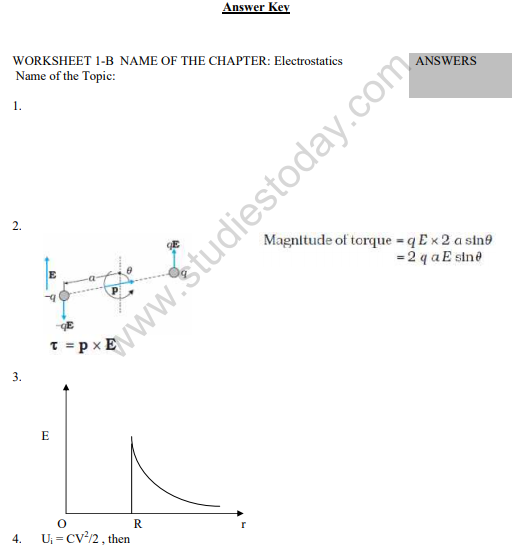
Deduce the expression for the torque acting on a dipole of dipole moment \(\mathbf{p}\) in the presence of a uniform electric field \(\mathbf{E}\).
Answer: Consider a dipole of charges \(+q\) and \(-q\) separated by \(2a\), making an angle \(\theta\) with a uniform field \(E\). The force on \(+q\) is \(qE\) along \(E\) and the force on \(-q\) is \(qE\) opposite to \(E\). These forces are equal and opposite, so the net force is zero, but they form a couple.
Magnitude of torque = force × perpendicular distance between the forces:
\[\tau=qE\times 2a\sin\theta=(2qa)E\sin\theta=pE\sin\theta\]
In vector form, \(\vec\tau=\vec p\times\vec E\).
Plot the graph showing the variation of electric field as a function of \(r\), for \(r>R\) and \(r<R\) (for a uniformly charged spherical shell of radius \(R\)).
Answer: Inside the shell (\(r\lt R\)) the field is zero. Outside (\(r\gt R\)) the field falls as \(1/r^2\), with its largest value just outside the surface.
A parallel plate capacitor of capacitance \(C\) is charged to a potential \(V\). It is then connected to another uncharged capacitor of the same capacitance. Find the ratio of the energy stored in the combined system to that stored initially in the single capacitor.
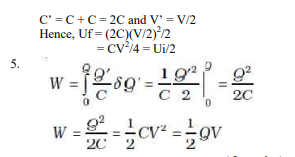
Answer: After connection the capacitance becomes \(C'=C+C=2C\) and the potential becomes \(V'=V/2\) (the charge is shared equally).
\[U_f=\tfrac12(2C)\left(\dfrac V2\right)^2=\dfrac{CV^2}{4}=\dfrac{U_i}{2}\]
So \(U_f:U_i=1:2\).
Derive the expression for the electrostatic energy stored in a capacitor of capacitance \(C\) and having charge \(Q\).
Answer: The work done in giving a small extra charge \(\delta Q'\) to a capacitor already holding charge \(Q'\) is \(\dfrac{Q'}{C}\delta Q'\). Total work in charging from 0 to \(Q\):
\[W=\int_0^Q\dfrac{Q'}{C}\,\delta Q'=\dfrac1C\left[\dfrac{Q'^2}{2}\right]_0^Q=\dfrac{Q^2}{2C}\]
\[U=W=\dfrac{Q^2}{2C}=\dfrac12CV^2=\dfrac12QV\]
3 marks questions
Define electric dipole moment. Is it a scalar or a vector? Derive the expression for the electric field of a dipole at a point on the equatorial plane of the dipole.
Answer: The electric dipole moment is the product of either charge and the distance between the charges, \(p=q\times 2a\). It is a vector quantity, directed from the negative to the positive charge.
Field on the equatorial plane: let \(P\) be at distance \(r\) from the centre on the perpendicular bisector. Each charge is at distance \(\sqrt{r^2+a^2}\) from \(P\), so \(E_+=E_-=\dfrac{q}{4\pi\varepsilon_0(r^2+a^2)}\). The components perpendicular to the axis cancel, and the components parallel to the axis add (each is \(E\cos\theta\) with \(\cos\theta=\dfrac{a}{\sqrt{r^2+a^2}}\)):
\[E=2E_+\cos\theta=\dfrac{2qa}{4\pi\varepsilon_0(r^2+a^2)^{3/2}}=\dfrac{p}{4\pi\varepsilon_0(r^2+a^2)^{3/2}}\]
The direction is opposite to \(\vec p\). For \(r\gg a\):
\[\vec E=-\dfrac{\vec p}{4\pi\varepsilon_0r^3}\]
Using Gauss’s theorem deduce the expression for the electric field due to a uniformly charged spherical conducting shell of radius \(R\) at a point (i) outside (ii) inside the shell.
Answer: (i) Outside the shell: take a concentric spherical Gaussian surface of radius \(r\gt R\). By Gauss’s law,
\[E\times4\pi r^2=\dfrac{\sigma}{\varepsilon_0}4\pi R^2\]
\[E=\dfrac{\sigma R^2}{\varepsilon_0r^2}=\dfrac{q}{4\pi\varepsilon_0r^2}\]
where \(q=4\pi R^2\sigma\) is the total charge on the shell. Vectorially, \(\vec E=\dfrac{q}{4\pi\varepsilon_0r^2}\hat r\). The shell behaves as if all its charge were at the centre.
(ii) Inside the shell: \(E=0\), because the charge enclosed by a Gaussian surface drawn inside the shell is zero.
Derive the expression for the electric field due to an infinite non-conducting plane sheet of charge having surface charge density \(\sigma\).
Answer: Take a cylindrical Gaussian surface (pill box) of cross-section \(A\) passing through the sheet. The field is perpendicular to the sheet, so flux passes only through the two flat faces (none through the curved surface). By Gauss’s law,
\[2EA=\dfrac{\sigma A}{\varepsilon_0}\]
so \(E=\dfrac{\sigma}{2\varepsilon_0}\). Vectorially, \(\vec E=\dfrac{\sigma}{2\varepsilon_0}\hat n\), where \(\hat n\) is the unit vector perpendicular to the sheet, pointing away from it.
Derive the expression for the electric field due to an infinitely long linear charge distribution having linear charge density \(\lambda\).
Answer: Take a cylindrical Gaussian surface of radius \(r\) and length \(l\) coaxial with the line charge. The flux through the flat ends is zero, so the flux equals the flux through the curved surface, \(E\times2\pi rl\). The charge enclosed is \(\lambda l\). Gauss’s law gives
\[E\times2\pi rl=\dfrac{\lambda l}{\varepsilon_0}\quad\Rightarrow\quad E=\dfrac{\lambda}{2\pi\varepsilon_0r}\]
Vectorially, \(\vec E=\dfrac{\lambda}{2\pi\varepsilon_0r}\hat n\), where \(\hat n\) is the radial unit vector perpendicular to the line.
Find the work done to rotate a dipole in a uniform electric field \(E\) from orientation \(\theta_0\) to \(\theta_1\).
Answer: The external torque needed to rotate the dipole against the electric torque is \(\tau_{ext}=pE\sin\theta\). The work done is
\[W=\int_{\theta_0}^{\theta_1}\tau_{ext}\,d\theta=\int_{\theta_0}^{\theta_1}pE\sin\theta\,d\theta=pE(\cos\theta_0-\cos\theta_1)\]
Mr. Bose was driving on a highway along fields. When a drizzle starts with lightning and thunderstorm, he spots a few farmers walking with iron spoke top umbrellas to avoid getting wet. He stops his car and instructs his co-passengers to keep sitting inside the car. He advises the farmers not to use the umbrella till the lightning subsides. (a) What are the two human qualities which Mr. Bose exhibited? (b) Why did he advise the farmers not to use the type of umbrella they were using? (c) Why did he advise his co-passengers to sit inside the car and not to venture out?
Answer: (a) Caring attitude, scientific temper (and presence of mind).
(b) The handle of the umbrella is conducting and it also has a pointed end, so there is a chance of charge passing through it (lightning can strike it).
(c) It is safe inside the car because inside the car \(E=0\) (electrostatic shielding by the metal body).
CURRENT ELECTRICITY
1 mark questions
The resistivity of the alloy manganin is nearly independent of temperature. Explain why.
Answer: Because manganin has a very small temperature coefficient of resistivity.
How does the internal resistance of a cell change when the distance between its electrodes decreases?
Answer: It decreases.
State the conditions for a balanced Wheatstone bridge.
Answer: The galvanometer shows no deflection when \(\dfrac PQ=\dfrac RS\).
State Kirchhoff’s current law.
Answer: At any junction in a circuit, the algebraic sum of the currents is zero, \(\sum i=0\) (current entering the junction equals current leaving it).
Write the principle of the potentiometer.
Answer: The potential drop across a length of a uniform wire carrying a constant current is directly proportional to its length.
2 marks questions
State Kirchhoff’s rules related to electricity.
Answer: (i) Junction rule: at any junction the algebraic sum of the currents is zero, \(\sum i=0\). (ii) Loop rule: in any closed loop the algebraic sum of the emfs equals the algebraic sum of the potential drops, \(\sum \varepsilon=\sum iR\) (the algebraic sum of potential changes around a closed loop is zero).
A battery of emf 10 V and internal resistance 3 Ω is connected to a resistor. If the current in the circuit is 0.5 A, what is the resistance of the resistor? What is the terminal voltage of the battery when the circuit is closed?
Answer: From \(I=\dfrac{\varepsilon}{R+r}\): \(0.5=\dfrac{10}{R+3}\), so \(R=17\ \Omega\).
Terminal voltage \(V=IR=0.5\times17=8.5\) V.
Two wires of equal length, one of copper and the other of manganin, have the same resistance. Which of the two wires will be thicker? Justify your answer with the help of a suitable formula.
Answer: The manganin wire will be thicker.
From \(R=\dfrac{\rho l}{A}\), for the same \(R\) and \(l\), the area is \(A\propto\rho\). Manganin has a larger resistivity than copper, so it needs a larger area of cross-section, i.e. it must be thicker.
How does the resistivity of (i) a metallic conductor and (ii) a semiconductor vary with increasing temperature?
Answer: (i) The resistivity of a metallic conductor increases with temperature. (ii) The resistivity of a semiconductor decreases with temperature.
A carbon resistor has the sequence of colours Blue, Yellow, Brown and Gold. Write its resistance and tolerance.
Answer: Blue = 6, Yellow = 4, Brown = multiplier \(10^1\), Gold = tolerance \(\pm5\%\).
So \(R=64\times10=640\ \Omega\), with tolerance \(\pm5\%\).
3 marks questions
State the principle of a potentiometer. Write the formula used to find the internal resistance. How can the sensitivity of the potentiometer be increased?
Answer: Principle: the potential drop across a length of a uniform wire carrying a constant current is directly proportional to its length.
Internal resistance of a cell: \(r=\left(\dfrac{l_1}{l_2}-1\right)R\), where \(l_1\) is the balancing length with the cell on open circuit, \(l_2\) is the balancing length when the cell sends current through the resistance \(R\).
Sensitivity is increased by using a longer potentiometer wire (and by reducing the potential gradient).
State the principle of the meter bridge. Write the mathematical relation used to determine the value of an unknown resistance by the meter bridge. Why can such an arrangement not be used for measuring very low resistance?
Answer: Principle: the Wheatstone bridge principle. The bridge is balanced when \(\dfrac{R}{S}=\dfrac{l}{100-l}\), where \(l\) is the balancing length from one end, so \(R=S\dfrac{l}{100-l}\).
For a very low resistance, the resistance of the metallic strips and the contacts (which is not considered in the formula) becomes comparable to it and causes a large error.
Establish the relation between electric current and drift velocity of electrons in a conductor.
Answer: Let a conductor have length \(l\), area of cross-section \(A\) and \(n\) free electrons per unit volume. Volume \(=Al\), number of charge carriers \(=nAl\), total charge \(q=nAle\).
Time taken by an electron to cross the length \(l\): \(t=\dfrac{l}{v_d}\). Hence
\[I=\dfrac qt=\dfrac{nAle}{l/v_d}=neAv_d\]
Define resistivity. Write its SI unit. Write a mathematical formula to find resistivity.
Answer: Resistivity is the resistance offered by a cube of the material of unit dimension across its two opposite faces. Its SI unit is ohm-metre (Ω m).
\[\rho=\dfrac{m}{ne^2\tau}\]
Define conductivity of a conductor and state its SI unit and explain the variation of conductivity of an ionic conductor with temperature.
Answer: Conductivity is the reciprocal of resistivity, \(\sigma=1/\rho\). Its SI unit is mho per metre (siemens per metre, S/m).
For an ionic conductor, the conductivity increases with temperature.
MAGNETIC EFFECT OF CURRENT AND MAGNETISM
1 mark questions
Where on the surface of the earth is the angle of dip (i) 90° (ii) 0°?
Answer: (i) At the poles. (ii) At the equator.
Under what condition is the force acting on a charge moving through a uniform magnetic field (i) minimum (ii) maximum?
Answer: (i) Minimum (zero) when the charged particle moves parallel or antiparallel to the magnetic field lines. (ii) Maximum when the charged particle moves normal to the magnetic field lines.
In which orientation will the bar magnet be in stable equilibrium in the magnetic field?
Answer: When the bar magnet is placed parallel to the magnetic field lines.
A long straight wire AB carries a current \(I\). A proton \(p\) travels with a speed \(v\), parallel to the wire, at a distance \(d\) from it. What is the force experienced by the proton?
Answer: The magnetic field at the proton due to the wire is \(B=\dfrac{\mu_0I}{2\pi d}\), perpendicular to the velocity. The force is \(F=qvB=\dfrac{\mu_0 e I v}{2\pi d}\) (with \(q=e\)). For the proton moving opposite to the current, as in the figure, the force is directed away from the wire.
What do you mean by the current sensitivity of a moving coil galvanometer (MCG)?
Answer: It is defined as the deflection per unit current.
2 marks questions
(a) Write two characteristics of a material used for making permanent magnets. (b) Why are cores of electromagnets made of ferromagnetic materials?
Answer: (a) High coercivity, high retentivity and high permeability. (b) High permeability and low retentivity.
A magnetic needle free to rotate in a vertical plane parallel to the magnetic meridian has its north tip pointing down at 60° with the horizontal. The horizontal component of the earth’s magnetic field at the place is known to be 0.4 G. Determine the magnitude of the earth’s magnetic field at that place.
Answer: \(B_H=B\cos\delta\), so
\[B=\dfrac{B_H}{\cos60^\circ}=\dfrac{0.4}{0.5}=0.8\ \text{G}\]
The susceptibility of a magnetic material is \(-2.6\times10^{-5}\). Identify the type of magnetic material and state its two properties.
Answer: The material is diamagnetic (negative susceptibility). Properties: (i) it is feebly repelled by a magnet; (ii) a net magnetic dipole moment is developed in the direction opposite to the magnetic field lines.
State the principle of working of a moving coil galvanometer, giving its labelled diagram.
Answer: Principle: whenever a current-carrying coil is placed in a radial magnetic field, it experiences a torque (maximum for every position of the coil), \(\tau=NBIA\), which deflects the coil. The coil is suspended between the curved pole pieces of a strong permanent magnet, with a soft iron core, a restoring spring and a pointer. (The labelled diagram of the galvanometer is given in the NCERT textbook; it is not reproduced here.)
A circular coil of ‘N’ turns and radius ‘R’ carries a current ‘I’. It is unwound and used to make another coil of radius \(R/2\); the current remains the same. Calculate the ratio of the magnetic moments of the new coil and the original coil.
Answer: The length of wire is the same: \(N\times2\pi R=N'\times2\pi\dfrac R2\), so \(N'=2N\).
Original coil: \(M_1=NI\pi R^2\). New coil: \(M_2=N'I\pi\left(\dfrac R2\right)^2=2N\cdot I\pi\dfrac{R^2}{4}=\dfrac12NI\pi R^2\).
So \(M_{new}:M_{original}=1:2\).
3 marks questions
Derive the relation for the force between two long parallel current-carrying conductors. Use the expression to define the SI unit of current.
Answer: Let two long parallel wires, at distance \(d\), carry currents \(I_1\) and \(I_2\) in the same direction. The magnetic field of wire 1 at wire 2 is \(B_1=\dfrac{\mu_0I_1}{2\pi d}\), directed perpendicular to wire 2. The force on a length \(l\) of wire 2 is \(F=I_2lB_1\), so the force per unit length is
\[\dfrac Fl=\dfrac{\mu_0I_1I_2}{2\pi d}\]
The force is attractive for currents in the same direction and repulsive for currents in opposite directions.
Definition of the ampere: one ampere is that steady current which, when flowing in each of two infinitely long parallel straight conductors placed 1 m apart in vacuum, produces a force of \(2\times10^{-7}\) N per metre of length between them.
Derive the expression for the torque on a rectangular current-carrying loop suspended in a uniform magnetic field.
Answer: Let the loop have sides \(l\) and \(b\) and carry current \(I\) in a uniform field \(B\), the plane of the loop making an angle with the field so that the normal makes angle \(\theta\) with \(B\). The forces on the two sides of length \(b\) are equal and opposite and act along the same line, so they cancel. The forces on the two sides of length \(l\) are \(F_1=F_2=BIl\); they are equal and opposite but act along different lines, so they form a couple. The torque is the force multiplied by the perpendicular distance between the forces:
\[\tau=BIl\times b\sin\theta=BIA\sin\theta\]
where \(A=lb\) is the area of the loop. For a coil of \(N\) turns, \(\tau=NBIA\sin\theta\).
Using the Biot–Savart law, derive the expression for the magnetic field due to a circular coil carrying current at a point along its axis.
Answer: Let the coil have radius \(R\) and carry current \(I\). Take a point \(P\) on the axis at distance \(x\) from the centre. Consider a small element \(dl\) of the coil. Its distance from \(P\) is \(r=\sqrt{R^2+x^2}\), and \(dl\) is perpendicular to the line joining it to \(P\). By the Biot–Savart law,
\[dB=\dfrac{\mu_0}{4\pi}\dfrac{I\,dl}{r^2}\]
\(dB\) is perpendicular to the line joining the element to \(P\). Resolve it into a component along the axis, \(dB\sin\phi\), and a component perpendicular to the axis, \(dB\cos\phi\), where \(\sin\phi=\dfrac Rr\). The perpendicular components of opposite elements cancel each other, and the axial components add:
\[B=\int dB\sin\phi=\dfrac{\mu_0I}{4\pi r^2}\cdot\dfrac Rr\int dl=\dfrac{\mu_0I}{4\pi r^3}R\,(2\pi R)\]
\[B=\dfrac{\mu_0IR^2}{2(R^2+x^2)^{3/2}}\]
For a coil of \(N\) turns, multiply by \(N\).
Using Ampere’s circuital law, obtain the expression for the magnetic field due to a long solenoid at a point inside the solenoid on its axis. How is the magnetic field inside a given solenoid made strong?
Answer: Consider a rectangular Amperian loop \(abcd\) with side \(ab=l\) inside the solenoid (along the axis) and side \(cd\) outside, where the field is negligible. Ampere’s law: \(\oint\vec B\cdot d\vec l=\mu_0I_{enclosed}\). On \(bc\) and \(da\) the field is perpendicular to the path (or zero), and on \(cd\) it is zero, so only \(ab\) contributes:
\[Bl=\mu_0(nl)I\]
where \(n\) is the number of turns per unit length. Hence
\[B=\mu_0nI\]
The field can be made stronger by increasing the number of turns per unit length, increasing the current, or by placing a soft iron core inside the solenoid.
Draw a schematic sketch of a cyclotron. Explain giving the essential details of its construction, how it is used to accelerate the charged particles.
Answer: Principle: a positive ion can acquire sufficiently large energy with a small potential difference by making the ion cross the same electric field again and again, using a strong magnetic field.
Construction: a cyclotron consists of a pair of hollow metal cylindrical chambers shaped like the letter D, called dees. Both dees are placed under the pole pieces of a very strong electromagnet, and both are connected to the terminals of a voltage oscillator of high frequency, of the order of a few million hertz.
Working: the charged ion ejected at the centre is allowed to pass through the electric field (the gap between the dees) again and again until it attains the required kinetic energy. The strong magnetic field turns the particle on a semicircular path in each dee, with the radius increasing each time. Finally the charged ion of the required kinetic energy, on a semicircular path of certain radius, is taken out from the window with the help of a deflector.
The oscillator frequency equals the cyclotron frequency, \(\nu=\dfrac{qB}{2\pi m}\), which does not depend on the speed or the radius.
ELECTROMAGNETIC INDUCTION AND ALTERNATING CURRENT
1 mark questions
Two loops of different shapes are moved in a region of uniform magnetic field in the directions marked by arrows as shown in the figure. What is the direction of the induced current in each loop?
Answer: Loop \(abc\) is entering the field, so the flux into the page through it is increasing. The induced current opposes this by producing a field out of the page, so it is anticlockwise: \(a\to b\to c\).
The second loop is leaving the field, so the flux through it is decreasing. The induced current is clockwise: \(d\to g\to f\to e\).
The motion of a copper plate is damped when it is allowed to oscillate between the two poles of a magnet. What is the cause of this damping?
Answer: Eddy currents are induced in the copper plate; by Lenz’s law they oppose the motion of the plate.
A bar magnet is moved in the direction indicated by the arrow between two coils PQ and CD. Predict the directions of induced current in each coil.
Answer: By Lenz’s law, the current in each coil is clockwise as seen from the side of the magnet: coil PQ (from which the magnet is moving away) and coil CD (towards which it is moving) both carry a clockwise induced current.
How does the mutual inductance of a pair of coils change when (i) the distance between the coils is increased and (ii) the number of turns in the coils is increased?
Answer: (i) It decreases. (ii) It increases.
What is the SI unit of self inductance?
Answer: Henry (H).
2 marks questions
A light bulb is rated 100 W for a 220 V ac supply of 50 Hz. Calculate (i) the resistance of the bulb, (ii) the rms current through the bulb.
Answer: (i) \(R=\dfrac{V^2}{P}=\dfrac{220^2}{100}=484\ \Omega\).
(ii) \(I_{rms}=\dfrac{P}{V}=\dfrac{100}{220}=\dfrac5{11}\ \text{A}\approx0.45\) A.
An alternating voltage given by \(V=140\sin314t\) is connected across a pure resistor of 50 Ω. Find (i) the frequency of the source, (ii) the rms current through the resistor.
Answer: (i) \(\omega=314\) rad/s, so \(f=\dfrac{\omega}{2\pi}=\dfrac{314}{2\pi}=50\) Hz.
(ii) \(I_{rms}=\dfrac{V_0}{\sqrt2R}=\dfrac{140}{\sqrt2\times50}=1.4\sqrt2\approx1.98\) A.
For a given a.c., \(i=i_m\sin\omega t\), show that the average power dissipated in a resistor \(R\) over a complete cycle is \(\tfrac12i_m^2R\).
Answer: The instantaneous power is \(i^2R=i_m^2R\sin^2\omega t\). The average over a complete cycle is
\[\langle P\rangle=\langle i^2\rangle R=i_m^2R\langle\sin^2\omega t\rangle=\dfrac{i_m^2R}{2}\]
because the average value of \(\sin^2\omega t\) over a cycle is \(\tfrac12\).
A series LCR circuit is connected to an ac source. Plot a graph to show the variation of current with frequency of the source, explaining the nature of its variation.
Answer: The instantaneous current is \(i=\dfrac{V_0\sin(\omega t+\phi)}{\sqrt{R^2+\left(\frac1{\omega C}-\omega L\right)^2}}\), with phase difference \(\tan\phi=\dfrac{X_C-X_L}{R}\). As the frequency increases, the current first increases, reaches its maximum at the resonant frequency \(f_r\) (where \(X_L=X_C\) and the impedance is least, equal to \(R\)), and then decreases.
A rectangular conductor LMNO is placed in a uniform magnetic field of 0.5 T. The field is directed perpendicular to the plane of the conductor. When the arm MN of length 20 cm is moved towards left with a velocity of 10 m/s, calculate the emf induced in the arm. Given the resistance of the arm to be 5 Ω (assuming that the other arm has negligible resistance), find the value of the current in the arm.
Answer: Induced emf: \(\varepsilon=Blv=0.5\times0.2\times10=1\) V.
Current: \(I=\dfrac{\varepsilon}{R}=\dfrac15=0.2\) A.
3 marks questions
State the underlying principle of a transformer. How is the large scale transmission of electric energy over long distances done with the use of transformers?
Answer: Principle: mutual induction. At the power station, a step-up transformer raises the ac voltage generated at the source to a very high voltage, so the current is small and the loss in the transmission lines (\(I^2R\)) is small. The energy is transmitted over the long distance at this high voltage with little loss, and near the consumer a step-down transformer reduces it to a safe, usable voltage.
A series LCR circuit is connected to an ac source. Using the phasor diagram, derive the expression for the impedance of the circuit.
Answer: Let a resistance \(R\), inductance \(L\) and capacitance \(C\) be connected in series across a source \(V=V_0\sin\omega t\). The same current \(i\) flows through all of them. The voltage across \(R\) is \(V_R\), in phase with the current; the voltage across \(L\) is \(V_L\), leading the current by 90°; the voltage across \(C\) is \(V_C\), lagging the current by 90°. \(V_C\) and \(V_L\) are in opposite directions, so their resultant is \(V_C-V_L\) (if \(V_C\gt V_L\)), which is at 90° to \(V_R\).
From the phasor diagram, the applied voltage is the resultant of \(V_R\) and \((V_C-V_L)\):
\[V^2=V_R^2+(V_C-V_L)^2\]
But \(V_R=iR\), \(V_C=iX_C\) and \(V_L=iX_L\), where \(X_C=\dfrac1{\omega C}\) and \(X_L=\omega L\). Therefore
\[V=i\sqrt{R^2+(X_C-X_L)^2}\]
The impedance is
\[Z=\dfrac Vi=\sqrt{R^2+(X_C-X_L)^2}=\sqrt{R^2+\left(\dfrac1{\omega C}-\omega L\right)^2}\]
A wheel with 8 metallic spokes each 50 cm long is rotated with a speed of 120 rev/min in a plane normal to the horizontal component of the earth’s magnetic field. The earth’s magnetic field at the place is 0.4 G and the angle of dip is 60°. Calculate the emf induced between the axle and the rim of the wheel. How will the value of emf be affected if the number of spokes were increased?
Answer: Horizontal component: \(B_H=0.4\cos60^\circ=0.2\ \text{G}=2\times10^{-5}\) T. Angular speed \(\omega=2\pi\times\dfrac{120}{60}=4\pi\) rad/s.
\[\varepsilon=\dfrac12B_Hl^2\omega=\dfrac12\times2\times10^{-5}\times(0.5)^2\times4\pi=3.14\times10^{-5}\ \text{V}\]
The emf will not change if the number of spokes is increased, because all spokes are connected in parallel between the axle and the rim and each has the same emf.
A voltage \(V=V_0\sin\omega t\) is applied to a series LCR circuit. Under what condition is (i) no power dissipated even though the current flows through the circuit, (ii) maximum power dissipated in the circuit?
Answer: (i) No power is dissipated when the resistance \(R=0\) (a purely inductive/capacitive circuit): the current and voltage are then 90° out of phase, so the power factor is zero.
(ii) Maximum power is dissipated at resonance, when \(\omega L=\dfrac1{\omega C}\); the impedance equals \(R\) and the power factor is 1.
Define the term self-inductance of a solenoid. Obtain the expression for the magnetic energy stored in an inductor of self-inductance \(L\) to build up a current \(I\) through it.
Answer: Self-inductance \(L\) is defined by \(\varepsilon=-L\dfrac{dI}{dt}\): it is numerically equal to the magnitude of the emf induced in the coil when the current in it changes at the rate of 1 A per second.
While the current grows, work must be done against the back emf. In a small time \(dt\), the work done is \(dW=|\varepsilon|I\,dt=LI\,dI\). Total work to raise the current from 0 to \(I\):
\[W=\int_0^ILI\,dI=\dfrac12LI^2\]
This work is stored as magnetic energy: \(U=\tfrac12LI^2\).
ELECTROMAGNETIC WAVES
1 mark questions
A plane electromagnetic wave travels in vacuum along the z-direction. What can you say about the direction of the electric and magnetic field vectors?
Answer: The electric and magnetic field vectors are along the x and y directions (perpendicular to each other and to the z-direction of propagation).
Arrange the following in descending order of wavelength: X-rays, radio waves, visible spectrum, infrared light.
Answer: Radio waves \(\gt\) infrared \(\gt\) visible light \(\gt\) X-rays.
Which part of the electromagnetic spectrum has the largest penetrating power?
Answer: Gamma rays.
Which part of the electromagnetic spectrum is used in satellite communication?
Answer: Microwaves.
Which part of the electromagnetic spectrum is absorbed by the ozone layer?
Answer: Ultraviolet (UV) rays.
2 marks questions
How are X-rays produced? Write their two important uses.
Answer: X-rays are produced by bombarding a metal target with fast moving electrons. Uses: (i) medical diagnosis; (ii) study of crystal structure.
How are microwaves produced? Write their two important uses.
Answer: Microwaves are produced by oscillating currents in special vacuum tubes such as the klystron and the magnetron. Uses: (i) in radar communication; (ii) in the analysis of molecular and atomic structure.
Name the electromagnetic radiations having the wavelength range from 1 nm to 700 nm. Give two important properties.
Answer: This range covers ultraviolet rays (about 1 nm to 400 nm) and visible light (400 nm to 700 nm). Properties of ultraviolet rays: (i) they can cause photoelectric emission and fluorescence; (ii) they are absorbed by glass and ozone, and can kill germs (used for sterilisation).
Write any two characteristics of EM waves.
Answer: (i) Electromagnetic waves are produced by accelerated charged particles. (ii) They do not require any medium for their propagation; they can propagate in vacuum as well as in a medium. Their velocity in free space is \(c=\dfrac1{\sqrt{\mu_0\varepsilon_0}}=3\times10^8\) m/s.
Identify the following electromagnetic radiation as per the wavelength given below and write one application of each: (a) \(10^{-12}\) m (b) \(10^{-4}\) m.
Answer: (a) Gamma rays – used in radiotherapy. (b) Infrared rays – used in haze photography (and in remote controls).
3 marks questions
What is meant by the transverse nature of an electromagnetic wave? Draw a diagram showing the propagation of an electromagnetic wave along the x-direction, indicating clearly the directions of the oscillating electric and magnetic fields associated with it.
Answer: Electromagnetic waves are transverse in nature, i.e. the electric field \(E\) and the magnetic field \(B\) are perpendicular to each other as well as to the direction of propagation of the wave. They are related by \(\dfrac{E_0}{B_0}=c\), or \(\dfrac EB=c\).
Name the constituent radiation of the electromagnetic spectrum which (a) is used in satellite communication, (b) is used for studying crystal structure, (c) is similar to the radiations emitted during decay of radioactive nuclei, (d) has its wavelength range between 390 nm and 770 nm, (e) is absorbed by the ozone layer, (f) produces intense heating effect.
Answer:
- Microwaves
- X-rays
- Gamma rays
- Visible light
- Ultraviolet rays
- Infrared rays
Identify and name the part of the electromagnetic spectrum to which these radiations belong: (1) the treatment of muscular strain, (2) used by FM radio stations for broadcasting, (3) to detect fractures in bones.
Answer:
- Infrared radiation
- Radio waves
- X-rays
Identify the part of the electromagnetic spectrum which is used in (1) radar systems, (2) adjacent to the low frequency end of the EM spectrum, (3) produced in nuclear reactions.
Answer:
- Microwaves
- Radio waves
- Gamma rays
Name the constituent radiation of the electromagnetic spectrum which is (1) used for studying crystal structures, (2) similar to the radiations emitted during radioactive decay, (3) has a wavelength between 390 nm and 770 nm.
Answer:
- X-rays
- Gamma rays
- Visible light
OPTICS
1 mark questions
A bi-concave lens of \(\mu=1.5\) is placed inside a liquid of \(\mu=1.8\). Will the lens behave as a converging or diverging lens?
Answer: The lens behaves as a converging lens, because the refractive index of the liquid is greater than that of the lens material.
State Brewster’s law.
Answer: The tangent of the polarising angle (Brewster angle) \(i_p\) equals the refractive index of the medium: \(\mu=\tan i_p\).
In Young’s double slit experiment, write the expression for the fringe width.
Answer: \(\beta=\dfrac{\lambda D}{d}\), where \(D\) is the distance of the screen and \(d\) the separation of the slits.
In a single slit diffraction pattern write the expression for the width of the central bright fringe.
Answer: Width of the central maximum \(=\dfrac{2\lambda D}{a}\), where \(a\) is the slit width and \(D\) is the distance of the screen.
How will the position of the image be affected if the lower half of the mirror’s reflecting surface is painted black?
Answer: The position of the image is not affected; only its intensity (brightness) decreases.
2 marks questions
Two polaroids are kept in crossed position. When a third polaroid is placed between the two making 30° with the first, find the intensity of light after the third polaroid if the intensity of light falling on the first is \(I_0\).
Answer: After the first polaroid: \(I_1=\dfrac{I_0}{2}\). After the third (at 30° to the first), by Malus’s law: \(I_2=\dfrac{I_0}2\cos^230^\circ=\dfrac{3I_0}{8}\).
The third polaroid makes 60° with the last (crossed) polaroid, so the intensity after it is
\[I_3=\dfrac{3I_0}{8}\cos^260^\circ=\dfrac{3I_0}{32}\]
A convex lens of focal length 25 cm is kept in contact with a concave lens of focal length 20 cm. Find the power of the combination. Will the system be converging or diverging in nature?
Answer: \(P=P_1+P_2=\dfrac{100}{25}-\dfrac{100}{20}=4-5=-1\ \text{D}\).
The power is negative, so the system is diverging in nature (\(f=-100\) cm).
Find the expression for the magnification of a compound microscope when the image is formed at infinity.
Answer: The magnifying power when the final image is at infinity is the product of the magnification of the objective and that of the eyepiece:
\[M=m_o\times m_e=\dfrac{L}{f_o}\times\dfrac{D}{f_e}=\dfrac{LD}{f_of_e}\]
where \(L\) is the distance between the objective and the eyepiece (tube length, approximately), \(D=25\) cm, \(f_o\) and \(f_e\) are the focal lengths of the objective and the eyepiece.
When light travels from a rarer to a denser medium, what happens to the frequency of light? Does a decrease in speed imply a reduction in energy?
Answer: The frequency of light remains the same. No, because the energy of the light (photon energy \(h\nu\)) depends on the frequency, and the frequency remains constant.
The far point of a myopic person is 80 cm. What is the power of the lens to be used to enable him to see infinity?
Answer: The lens must form an image of an object at infinity at his far point, so \(f=-80\) cm \(=-0.8\) m.
\[P=\dfrac1f=\dfrac{1}{-0.8}=-1.25\ \text{D}\]
A concave (diverging) lens of power \(-1.25\) D is needed.
3 marks questions
State Huygens’ principle. Verify Snell’s law from it.
Answer: Huygens’ principle: every point on a wavefront acts as a source of secondary wavelets, which spread out with the speed of the wave; the new wavefront at a later time is the forward envelope (common tangent) of these secondary wavelets.
Verification of Snell’s law: let a plane wavefront AB be incident at angle \(i\) on a plane surface separating medium 1 (speed \(v_1\)) and medium 2 (speed \(v_2\)). When the point \(B\) of the wavefront reaches the surface at \(C\) in time \(t\), \(BC=v_1t\), and the secondary wavelet from \(A\) has travelled \(AE=v_2t\) in medium 2. The refracted wavefront is \(CE\). In the triangles \(ABC\) and \(AEC\) (with common side \(AC\)):
\[\sin i=\dfrac{BC}{AC}=\dfrac{v_1t}{AC},\qquad \sin r=\dfrac{AE}{AC}=\dfrac{v_2t}{AC}\]
\[\dfrac{\sin i}{\sin r}=\dfrac{v_1}{v_2}=\text{constant}=n_{21}\]
This is Snell’s law.
In Young’s double slit experiment, find the expression for the fringe width.
Answer: Let the slits \(S_1\) and \(S_2\) be separated by \(d\), and the screen be at distance \(D\). The path difference at a point at distance \(y\) from the centre of the screen is \(\Delta=\dfrac{yd}{D}\). Bright fringes occur when \(\Delta=n\lambda\), so the position of the \(n\)th bright fringe is
\[y_n=\dfrac{n\lambda D}{d}\]
The fringe width is the distance between two successive bright (or dark) fringes:
\[\beta=y_{n+1}-y_n=\dfrac{\lambda D}{d}\]
Find the expression for the width of the central maximum in a single slit diffraction pattern.
Answer: Let a slit of width \(a\) be illuminated by light of wavelength \(\lambda\) and the screen be at distance \(D\). The first minimum occurs where the path difference between the extreme rays is \(\lambda\): \(a\sin\theta=\lambda\), i.e. \(\theta\approx\dfrac{\lambda}{a}\). The first minimum is at \(y=D\theta=\dfrac{\lambda D}{a}\) on each side of the centre, so
\[\text{width of the central maximum}=\dfrac{2\lambda D}{a}\]
Draw a ray diagram of a reflecting telescope. Mention its two advantages over the refracting telescope.
Answer: Ray diagram of a reflecting (Cassegrain) telescope:
Advantages: (i) the mechanical support needed is less (a mirror can be supported from the back, so large mirrors can be built); (ii) chromatic aberration is minimised, because a mirror does not disperse light.
Write the lens maker’s formula. A convex lens of focal length 20 cm in air is placed in water of refractive index 1.3. What will be the focal length of the lens?
Answer: Lens maker’s formula: \(\dfrac1f=\left(\dfrac{n_g}{n_m}-1\right)\left(\dfrac1{R_1}-\dfrac1{R_2}\right)\), where \(n_g\) is the refractive index of the lens and \(n_m\) that of the surrounding medium.
The refractive index of the glass is not given; taking \(n_g=1.5\): in air, \(\dfrac1{20}=(1.5-1)\left(\dfrac1{R_1}-\dfrac1{R_2}\right)\). In water, \(\dfrac1{f_w}=\left(\dfrac{1.5}{1.3}-1\right)\left(\dfrac1{R_1}-\dfrac1{R_2}\right)\).
\[\dfrac{f_w}{20}=\dfrac{0.5}{0.1538}=3.25\quad\Rightarrow\quad f_w=65\ \text{cm}\]
ATOMS AND NUCLEI
1 mark questions
State the law of radioactive decay.
Answer: The number of nuclei undergoing decay per unit time, at any instant, is proportional to the total number of nuclei in the sample at that instant: \(-\dfrac{dN}{dt}\propto N\).
What is the source of energy in a nuclear reaction?
Answer: The mass of the parent nuclei is greater than the mass of the daughter nuclei. This difference of mass (mass defect) appears as the energy, \(E=mc^2\).
The electron in a hydrogen atom is initially in the third excited state. What is the maximum number of spectral lines which can be emitted when it finally moves to the ground state?
Answer: Six (for the third excited state, \(n=4\): \(\dfrac{n(n-1)}2=6\)).
Define ionisation energy. What is its value for the hydrogen atom?
Answer: The energy required to remove the electron from its ground state and send it to infinity is called the ionisation energy. Its value for the hydrogen atom is 13.6 eV.
Write the relationship between half life and decay constant.
Answer: \(T_{1/2}=\dfrac{0.693}{\lambda}\).
2 marks questions
Using the Rutherford model of the atom, derive the expression for the total energy of the electron in the hydrogen atom. What is the significance of the negative energy possessed by the electron?
Answer: The electron revolves around the nucleus, and the required centripetal force is provided by the attractive electrostatic force between the electron and the nucleus. With \(k=\dfrac1{4\pi\varepsilon_0}\):
\[\dfrac{kZe^2}{r^2}=\dfrac{mv^2}{r}\quad\Rightarrow\quad mv^2=\dfrac{kZe^2}{r}\]
Kinetic energy \(K=\tfrac12mv^2=\dfrac{kZe^2}{2r}\); potential energy \(U=-\dfrac{kZe^2}{r}\). Total energy:
\[E=K+U=-\dfrac{kZe^2}{2r}\]
The negative sign shows that the electron is bound to the nucleus and revolves around it; energy must be supplied to free it.
Using Bohr’s postulates of the atomic model, derive the expression for the radius of the \(n\)th electron orbit.
Answer: The electron revolves around the nucleus, and the required centripetal force is provided by the attractive force between the electron and the nucleus:
\[\dfrac{kZe^2}{r^2}=\dfrac{mv^2}{r}\quad\Rightarrow\quad mv^2=\dfrac{kZe^2}{r}\]
By Bohr’s postulate, \(mvr=\dfrac{nh}{2\pi}\), so \(v=\dfrac{nh}{2\pi mr}\). Substituting,
\[r=\dfrac{n^2h^2}{4\pi^2mkZe^2}=\dfrac{n^2}{Z}\left(\dfrac{h^2}{4\pi^2mke^2}\right)\]
State Bohr’s postulates for the hydrogen atom.
Answer:
- The electron revolves around the nucleus in circular orbits.
- The electron can revolve only in those orbits in which its angular momentum is an integral multiple of \(h/2\pi\).
- When the electron jumps from one energy level (\(E_i\)) to another energy level (\(E_f\)), it absorbs or releases energy equal to \(E_f-E_i\) (the difference of the two energy levels).
Write any four properties of the nuclear force.
Answer: Nuclear force is (i) the strongest force, (ii) non-central, (iii) charge independent, (iv) short range.
Briefly explain the beta decay process.
Answer: In beta decay a nucleus spontaneously emits an electron (\(\beta^-\) decay) or a positron (\(\beta^+\) decay):
\[n\to p+e^-+\bar\nu\quad(\beta^-\ \text{decay})\]
\[p\to n+e^++\nu\quad(\beta^+\ \text{decay})\]
3 marks questions
(1) What characteristic property of nuclear force explains the constancy of binding energy per nucleon in the range of mass number \(A\) lying \(30\lt A\lt170\)? (2) Show that the density of a nucleus over a wide range of nuclei is constant and independent of mass number \(A\).
Answer: (1) The saturation (short range) nature of nuclear forces.
(2) The nuclear radius is \(R=R_0A^{1/3}\). The mass of the nucleus is \(mA\) (\(m\) = mass of a nucleon). So
\[\rho=\dfrac{mA}{\frac43\pi(R_0A^{1/3})^3}=\dfrac{mA}{\frac43\pi R_0^3A}=\dfrac{3m}{4\pi R_0^3}\]
which is independent of \(A\).
Using Bohr’s postulates of the atomic model, derive the expression for the total energy of the electron in the stationary state of the H atom. Hence draw the energy level diagram showing how the line spectrum corresponding to the Balmer series occurs due to transitions between energy levels.
Answer: From the centripetal force balance \(\dfrac{kZe^2}{r^2}=\dfrac{mv^2}{r}\), the kinetic energy is \(K=\dfrac{kZe^2}{2r}\) and the potential energy is \(U=-\dfrac{kZe^2}{r}\). Total energy:
\[E=K+U=-\dfrac{kZe^2}{2r}\]
Using Bohr’s radius \(r=\dfrac{n^2h^2}{4\pi^2mkZe^2}\), for hydrogen (\(Z=1\)):
\[E_n=-\dfrac{13.6}{n^2}\ \text{eV}\]
Energy level diagram: the Balmer series lines arise when the electron jumps from \(n=3,4,5,6,\dots\) to \(n=2\).
Draw the binding energy per nucleon versus mass number curve. Explain nuclear fission and fusion on the basis of this curve.
Answer: The curve rises steeply for light nuclei, reaches a maximum of about 8.8 MeV per nucleon near \(A\approx56\) (iron), and then falls slowly for heavy nuclei.
Light nuclei combine together (fusion) to form a bigger nucleus having a higher binding energy per nucleon, so they become more stable. Heavy nuclei also gain stability by splitting into lighter nuclei (fission), because the binding energy per nucleon of the lighter nuclei is larger than that of the heavier parent nucleus. In both cases energy is released.
For the past some time Arti had been observing some erratic body movement, unsteadiness and lack of coordination in the activities of her sister Radha, who also used to complain of severe headache occasionally. Arti suggested to her parents to get a medical checkup of Radha. The doctor thoroughly examined Radha and diagnosed that she has a brain tumour. (a) What, according to you, are the values displayed by Arti? (b) How can radioisotopes help a doctor to diagnose brain tumour?
Answer: (a) Arti shows good awareness towards health and care for her sister.
(b) Certain radioisotopes are injected into the body and they are absorbed by the brain tumour. By detecting the intensity of the radiations we can measure the location and severity of the tumour.
Define half life of a radioactive substance. Explain the law of radioactive decay. Derive a relation between half-life and decay constant of the radioactive substance.
Answer: Half life is the time in which the number of undecayed atoms of a radioactive substance in a sample is reduced to one half of its initial value.
Law of radioactive decay: the number of nuclei undergoing decay per unit time (\(dN/dt\)) is proportional to the total number of nuclei in the sample (\(N\)):
\[\dfrac{dN}{dt}=-\lambda N\]
Integrating, \(\int_{N_0}^N\dfrac{dN}{N}=-\lambda\int_0^tdt\), which gives \(N=N_0e^{-\lambda t}\).
When \(t=T_{1/2}\), \(N=\dfrac{N_0}{2}\):
\[\dfrac{N_0}2=N_0e^{-\lambda T_{1/2}}\quad\Rightarrow\quad \lambda T_{1/2}=\ln2\quad\Rightarrow\quad T_{1/2}=\dfrac{0.693}{\lambda}\]
DUAL NATURE OF MATTER AND RADIATION
1 mark questions
Define the following terms: (i) work function, (ii) threshold frequency.
Answer: (i) Work function: the minimum energy required to eject an electron from a metal surface. (ii) Threshold frequency: the minimum frequency of the incident photon below which emission of photoelectrons is not possible.
How does the stopping potential vary if the intensity of incident radiation is increased?
Answer: No change.
Two metals A and B have work functions 2 eV and 4 eV respectively. Which of them has the smaller threshold wavelength?
Answer: Metal B. Since \(\lambda_0=\dfrac{hc}{\phi_0}\), the metal with the larger work function has the smaller threshold wavelength.
The stopping potential in an experiment on the photoelectric effect is 1.5 V. What is the maximum kinetic energy of the photoelectrons emitted?
Answer: \(K_{max}=eV_0=1.5\) eV.
Define stopping potential.
Answer: The stopping potential is the minimum reverse (retarding) potential applied to the collector that makes the photoelectric current zero.
2 marks questions
The graph shows the variation of stopping potential with frequency of incident radiation for two photosensitive metals A and B. Which one of the two has the higher value of work function? Justify your answer.
Answer: Metal B has the higher work function. Its threshold frequency \(\nu_0'\) is greater than \(\nu_0\) of A, and the work function is \(\phi_0=h\nu_0\); equivalently its intercept \(-W_0'/e\) is more negative.
U.V. radiations of frequencies \(\nu_1\) and \(\nu_2\) are incident on two photosensitive materials having work functions \(W_1\) and \(W_2\) (\(W_1\gt W_2\)) respectively. The KE of emitted electrons is the same in both the cases. Which one of the two radiations will be of higher frequency?
Answer: From Einstein’s equation, \(h\nu_1-W_1=h\nu_2-W_2=K\) (same). Since \(W_1\gt W_2\), \(h\nu_1-h\nu_2=W_1-W_2\gt0\), so \(\nu_1\gt\nu_2\): the radiation incident on the material of larger work function (\(\nu_1\)) has the higher frequency.
The following graph shows the variation of stopping potential \(V_0\) with the frequency \(\nu\) of the incident radiation for two photosensitive metals X and Y. Which of the metals has the larger threshold wavelength? Give reason.
Answer: Metal X has the larger threshold wavelength, since it has the smaller threshold frequency (\(\lambda_0=c/\nu_0\)).
The work function for a photosensitive material is 3.2 eV. Find the threshold frequency.
Answer: \(\phi_0=h\nu_0\), so
\[\nu_0=\dfrac{3.2\times1.6\times10^{-19}}{6.6\times10^{-34}}\approx7.8\times10^{14}\ \text{Hz}\]
A photosensitive material is exposed to radiations of two different frequencies (greater than the threshold frequency) but of constant intensities. Draw the graph showing the variation of photoelectric current and applied collector potential.
Answer: Both curves reach the same saturation current (same intensity), but the radiation of higher frequency \(\nu_2\) has the larger stopping potential.
3 marks questions
Draw the graph showing the variation of stopping potential with the frequency of incident radiation in relation to the photoelectric effect. (i) Deduce the expression for the slope of this graph using Einstein’s photoelectric equation. (ii) What does the slope of this graph represent? (iii) What information can be obtained from the value of the intercept on the potential axis?
Answer: (i) Einstein’s equation: \(eV_0=h\nu-h\nu_0\), so
\[V_0=\dfrac he\,\nu-\dfrac{h\nu_0}{e}\]
which is a straight line with slope \(\dfrac{V_0}{\nu}\) (that is \(\dfrac{\Delta V_0}{\Delta\nu}\)) \(=\dfrac he\).
(ii) The slope represents \(h/e\) (the ratio of Planck’s constant to the electronic charge).
(iii) The intercept on the potential axis is \(-\dfrac{\phi_0}{e}\), which gives the work function \(\phi_0\) of the metal.
The frequency of incident radiation on a photocell is doubled for the same intensity. What changes will you observe in (i) the K.E. of the electrons emitted, (ii) the photoelectric current and (iii) the stopping potential? Justify your answer in each case.
Answer: (i) The kinetic energy will be more than double: \(K'=2h\nu-\phi_0=2K+\phi_0\gt2K\).
(ii) The photoelectric current will become half. The intensity (energy per second) is the same, but each photon now has twice the energy, so the number of photons per second (and hence the number of photoelectrons per second) is halved.
(iii) The stopping potential increases (\(eV_0'=K'\gt2eV_0\)).
(a) Why is the wave nature of matter not more apparent to our daily observation? (b) Draw a graph to show the variation of K.E. of a photoelectron with the increase of frequency (\(\nu\gt\nu_0\)). (c) Green light ejects photoelectrons from a given photosensitive surface whereas yellow light does not. What will happen in the case of violet and red light? Give reason.
Answer: (a) Due to the large mass of the object, the de Broglie wavelength \(\lambda=h/mv\) is extremely small compared with its dimensions, so it cannot be observed.
(b) The kinetic energy varies linearly with frequency, starting from the threshold frequency \(\nu_0\).
(c) Violet light will eject photoelectrons, but red light will not. The frequency of violet light is more than that of green light, and the frequency of red light is less than that of yellow light (which is already below the threshold frequency).
Write Einstein’s photoelectric equation and point out any two characteristic properties of photons on which this equation is based. Briefly explain the three observed features which can be explained by this equation.
Answer: Einstein’s equation: \(h\nu=h\nu_0+\tfrac12mv_{max}^2\).
Properties of photons: (i) the particle nature of light (energy is in packets called photons); (ii) the energy and momentum of all photons of a given frequency are equal, irrespective of the intensity of the incident light.
Observed features explained: (I) the K.E. of photoelectrons does not depend on the intensity; (II) there exists a minimum (threshold) frequency below which the photoelectric effect is not possible; (III) the stopping potential is directly proportional to the frequency of the incident radiation.
An electromagnetic wave of wavelength \(\lambda\) is incident on a photosensitive surface of negligible work function. If the photoelectrons emitted from this surface have the de Broglie wavelength \(\lambda_1\), prove that \(\lambda=\left(\dfrac{2mc}{h}\right)\lambda_1^2\).
Answer: The work function is negligible, so the kinetic energy of the electron is \(E_k=\dfrac{hc}{\lambda}\). The de Broglie wavelength of the electron is \(\lambda_1=\dfrac{h}{\sqrt{2mE_k}}\), so
\[\lambda_1^2=\dfrac{h^2}{2mE_k}=\dfrac{h^2}{2m\left(\frac{hc}{\lambda}\right)}=\dfrac{h\lambda}{2mc}\]
\[\Rightarrow\quad\lambda=\left(\dfrac{2mc}{h}\right)\lambda_1^2\]
SEMICONDUCTOR DEVICES
1 mark questions
How many diodes are used in a full wave rectifier?
Answer: Two (for the centre-tap full wave rectifier).
What is the limit in the use of intrinsic semiconductors?
Answer: In an intrinsic semiconductor \(n_e=n_h\), so the charge carriers are equal and few in number; the conductivity is low and cannot be controlled.
Name one dopant used as an acceptor in semiconductors.
Answer: Indium.
Write one advantage of an LED over incandescent lamps.
Answer: Low operational voltage and less power consumption.
What is a solar cell?
Answer: A solar cell is a junction diode which converts solar energy into electricity.
2 marks questions
Write two important criteria for the selection of a material for solar cell fabrication.
Answer: (i) The band gap should be about 1.0 eV to 1.8 eV. (ii) It should have a high optical absorption.
How does the conductivity of a semiconductor change with rise in temperature?
Answer: The conductivity increases (exponentially) with temperature.
Name one impurity each which, when added to pure silicon, produces (a) n-type and (b) p-type semiconductor.
Answer: (a) Arsenic. (b) Indium.
For a transistor, the value of \(\beta=100\). What is the value of \(\alpha\)?
Answer: \(\alpha=\dfrac{\beta}{1+\beta}=\dfrac{100}{101}\approx0.99\).
In a transistor, why is the forward bias smaller than the reverse bias?
Answer: The emitter–base junction is forward biased and conducts at a small voltage. A small forward bias also reduces the heating effect in the base region, while the collector–base junction is reverse biased with a larger voltage so that it can collect the charge carriers coming from the emitter.
3 marks questions
In what way must an LED and a photodiode be biased? Name the factors which determine (a) the frequency and (b) the intensity of light emitted by the LED.
Answer: The LED is forward biased and the photodiode is reverse biased. (a) The frequency of the emitted light is determined by the band gap of the semiconductor. (b) The intensity is determined by the doping level (and the forward current).
What is the difference between n-type and p-type semiconductors on the basis of the energy band?
Answer: In an n-type semiconductor, the number of free electrons in the conduction band is much more than the number of holes in the valence band. In a p-type semiconductor, the number of holes in the valence band is much more than the number of free electrons in the conduction band.
A photodiode is fabricated from a semiconductor with a band gap of 2.8 eV. Can it detect a wavelength of 600 nm?
Answer: The energy of the incident photon is \(E=\dfrac{hc}{\lambda}=\dfrac{1240\ \text{eV nm}}{600\ \text{nm}}\approx2.07\) eV.
Since \(E\lt E_g\) (2.07 eV \(\lt\) 2.8 eV), the photodiode cannot detect it.
Why do we prefer an NPN transistor to a PNP transistor for faster action?
Answer: In an NPN transistor, current conduction is mainly by free electrons, whereas in a PNP transistor it is mainly by holes. The mobility of electrons is greater than that of holes, so the NPN transistor acts faster.
In an NPN transistor circuit, the collector current is 5 mA. If 95% of the electrons emitted reach the collector, what is the base current?
Answer: \(\alpha=\dfrac{I_C}{I_E}=0.95\), so \(I_E=\dfrac{5}{0.95}\approx5.26\) mA.
\[I_B=I_E-I_C=5.26-5\approx0.26\ \text{mA}\]
COMMUNICATION SYSTEMS
1 mark questions
What is the limitation of ground wave propagation?
Answer: It is not suitable for long distance transmission, as the energy is absorbed by the ground.
Why is sky wave propagation limited to frequencies below 30 MHz?
Answer: Frequencies above 30 MHz are not reflected by the ionosphere.
State one advantage of FM over AM.
Answer: FM is less noisy.
What is meant by LOS mode of communication?
Answer: Line of sight communication (the transmitting and receiving antennas are in the direct line of sight of each other, as in space wave propagation above 30 MHz).
Define the term ‘attenuation’.
Answer: Attenuation is the loss of strength of a signal as it propagates through a medium.
2 marks questions
Define modulation. State any two types of modulation.
Answer: Modulation is the process of loading a low frequency message signal on a high frequency carrier. Types: amplitude modulation and frequency modulation (also phase modulation).
Write the function of (i) a transducer, (ii) a repeater with reference to a communication system.
Answer: (i) A transducer changes one form of energy into another (for example sound into an electrical signal). (ii) A repeater is a combination of a receiver and a transmitter: it picks up the signal, amplifies it and retransmits it.
Define modulation index. Why is its value kept less than 1?
Answer: Modulation index is the ratio of the amplitude of the message signal to that of the carrier, \(\mu=\dfrac{A_m}{A_c}\). Its value is kept less than 1 to avoid distortion (over-modulation).
A message signal of frequency 10 kHz and peak voltage of 10 volts is used to modulate a carrier of frequency 1 MHz and peak voltage of 20 volts. Determine (i) the modulation index, (ii) the side bands.
Answer: (i) \(\mu=\dfrac{A_m}{A_c}=\dfrac{10}{20}=0.5\).
(ii) Side bands: \(f_c+f_m=1000+10=1010\) kHz and \(f_c-f_m=1000-10=990\) kHz.
How is an AM wave produced?
Answer: The message signal and the carrier wave are applied to a non-linear device (such as a square-law device), followed by a band-pass filter.
3 marks questions
What is the need for modulation?
Answer: (i) To avoid intermixing of signals transmitted from different stations; (ii) to reduce the size of the antenna; (iii) to increase the power radiated by antennas.
What are the different types of electromagnetic wave propagation? Give their frequency range.
Answer:
- Ground wave propagation (up to a few MHz)
- Sky wave propagation (up to about 30 MHz)
- Space wave propagation (above 30 MHz)
Give the block diagram of a simple modulator for obtaining an AM signal.
Answer: The message signal and the carrier are added and passed through a square-law (non-linear) device; its output contains the carrier, the message and the side band frequencies, and a band-pass rectifier/filter tuned to \(\omega_c\) selects the AM wave.
Give the block diagram of a detector for an AM signal.
Answer: The received AM signal is passed through a rectifier; then an envelope detector (a low-pass filter) removes the carrier and recovers the message signal.
What is demodulation in a communication system? Explain how it is achieved.
Answer: Demodulation is the process of recovering the original message signal from the received (modulated) signal. The modulated signal is passed through a rectifier; the envelope of the rectified signal is the message signal. This signal is passed through an envelope detector to get the original message.
Free study material for Physics
Physics Class 12 Exam Resources: All Chapters
Quick Revision Material for All Chapters
Explore essential learning tools for Class 12 Physics All Chapters. This curated collection features in-depth notes and targeted practice questions built around the active 2026 curriculum to streamline your daily revision.
Expert Notes and Solved Exam Questions
Designed around the official curriculum, these study guides guarantee standard compliance. Reviewing step-by-step solutions clarifies complex sub-topics within All Chapters and demystifies standard marking schemes for Physics evaluations.
Additional Study Resources for Class 12
Maximize your grade potential by utilizing Class 12 Physics practice papers in tandem with these structured notes. All printable assignments and interactive mock tests on our platform are updated for the 2026 session and available free of charge.
FAQs
Our advanced study package for All Chapters includes detailed concepts, diagrams, Mind Maps, and explanation of complex topics to ensure Class 12 students learn as per syllabus for 2026 exams.
The Mind Maps provided for All Chapters act as visual anchors which will help faster recall during high-pressure exams.
Yes, teachers use our Class 12 Physics resources for lesson planning as they are in simple language and have lot of solved examples.
Yes, You can download the complete, mobile-friendly PDF of the Physics All Chapters advanced resources for free.
Yes, our subject matter experts have updated the All Chapters material to align with the rationalized NCERT textbooks and have removed deleted topics and added new competency-based questions.