

Official CBSE Study Materials for Class 12 Physics
Access comprehensive study materials and useful resources for Practical using the CBSE Class 12 Physics Practical Questions. Designed to align with the 2026-27 CBSE academic guidelines, these advanced resources help Class 12 Physics students reinforce core concepts beyond standard textbooks.
Advanced Resources for Physics
View or download the dedicated CBSE Class 12 Physics Practical Questions resource below. Engaging with these advanced study guides under focused conditions ensures continuous academic progress and mastery of the 2026-27 curriculum for Practical.
1. OHM’S LAW
1. A constant potential difference is maintained across two resistors of resistances R1 and R2 (R2
Ans; Resistor R1 ; since current is inversely proportional to resistance.
2. Give examples of ohmic and non ohmic conductors.
Ans. Ohmicconductor :- magnet at constant temperature,Non ohmicconductor :- electric bulb, diodes
3.In the Ohm’s law experiment, if the position of ammeter and volt meter are interchanged, what happens to the measurement readings?
Ans. If both are ideal instruments, they will show any reading.
4. Two resistors of resistance R and 2R connected in parallel and the combination are connected in series with another resistor of resistance 4R, (a) find the ratio of current in parallel combination.
(b) If a supply of V volt is connected across the free terminals, what is the ratio of potential difference between the junctions?
Ans:- (a) 2 : 1 (b) 1 : 6
5. In the Ohm’s law experiment copper wire and nichrome wire are used for the same length and area of cross section. Of the two wires which has higher resistivity? If nichrome wire and the
copper wire are interchanged? Is Ohm’s law still valid?
Ans :-Nichrome wire has higher resistivity.
6. What is resistivity ?
Ans : It is defined as the resistance offered by a wire of unit length and unit area of cross section.
7. Write the dimension of resistance and resistivity.
Ans :- [ M L2 T-3A-2 ] and [ M L3 T-3A-2 ]
8. What is the S I unit of conductivity?
Ans :- Ohm-1 m-1.
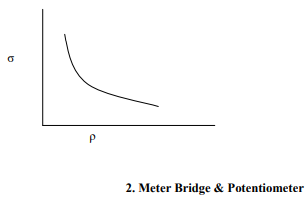
9. Draw the graph between conductivity and resistivity of a metallic conductor
Ans :-
1. Meter Bridge & Potentiometer Worksheet 1 Name of The Chapters-Meter Bridge & Potentiometer 1 In a meter Bridge, the balance point is found to be at 39.5 cm from its zero end, when the resistor R is 12.5Ω. Determine the value of resistance X.
2. Why are the connection between resistors in a meter Bridge made of thick copper strips?
3. What happens if the galvanometer & cell are interchanged at the balance point of the bridge? Would the galvanometer will show any current?
4. In a meter bridge exp., balance point was observed at distance ‘l’ from its zero end.
(i) The values of known resistors R and X were doubled and then interchanged. What would be the new position of new balance point?
(ii) If the galvanometer and battery are interchanged at the balance point, how will the balance point get affected?
5. In a meter bridge exp., the balance point is found to at 40 cm from its zero end. When the resistor Y is of value 20 Ω is in the right gap of the meter bridge & unknown resistor X is in the left gap. Calculate the balancing length if X and Y are interchanged.
6. In a meter bridge, two unknown resistors R and S are connected in the left and right gap respectively and the null point is found at a distance of 40 cm from the zero end. If a resistance of 12 Ω is connected in parallel with S, the null point occurs at 50 cm from zero end. Determine the values of R and S.
7. What do you mean by potential gradient?
8. A student uses a cell of emf 2 V and found the balance point at distance 350 cm. When a cell of unknown emf is attached and balance point shift 150 cm ahead than previous. Find the unknown emf.
9. The balance points in a potentiometer experiment is found to be at 600 cm and 400 cm respectively by using a known resistance 50 Ω and a cell of emf 6 V. Find the internal resistance of the cell.
10. In a potentiometer arrangement , a cell of emf 1.25 V gives a balance point at 35 cm length of the wire. If the cell is replaced by another cell and the balance point shifts to 63 cm. What is the emf of the second cell? Worksheet 1 Name of The Chapters- Meter Bridge & Potentiometer ANSWER
1. R/X= 39.5/100-39.5 =39.5/60.5 =0.65 , so X= R/0.65= 12.5/0.65= 1.9 Ω
2. To minimize resistance of the connection which are not accounted for in the bridge formula.
3. The galvanometer will show no current.
4. (i) new balance point= 100-l
(ii) No change in the position of balance point.
5. l= 60 cm.
6. R/S= 40/60 =2/3
Now, R/S
eq = 50/50 = 1
R(12 +S)/12 S= 1 , on solving we get S= 6 Ω & R= 4 Ω
7. Potential drop per unit length is called potential gradient.
8. ε1 / ε2=l1/l2=350/500= 7/10 so, ε2 = 10 x 2/7 =20/7 V
9. r= (l1/l2-1) R=(600/400-1) x 50 = 25 Ω
10. ε2 = 1.25 x 63/35 =2.25 V
3. CONVERTION OF GALVANOMETER INTO AMMETER AND VOLTMETER.
1. What is the resistance of an ideal ammeter?
2. What is the resistance of an ideal voltmeter?
Please click the link below to download CBSE Class 12 Physics Practical Questions.
Free study material for Physics
Useful Resources and Notes for Class 12 Physics Practical
Core Study Kit: Class 12 Physics Practical
Explore essential learning tools for Class 12 Physics Practical. This curated collection features in-depth notes and targeted practice questions built around the active 2026 curriculum to streamline your daily revision.
NCERT-Aligned Solutions for Practical
Designed around the official curriculum, these study guides guarantee standard compliance. Reviewing step-by-step solutions clarifies complex sub-topics within Practical and demystifies standard marking schemes for Physics evaluations.
Next Steps in Your Exam Preparation
Maximize your grade potential by utilizing Class 12 Physics practice papers in tandem with these structured notes. All printable assignments and interactive mock tests on our platform are updated for the 2026 session and available free of charge.
FAQs
Our advanced study package for Practical includes detailed concepts, diagrams, Mind Maps, and explanation of complex topics to ensure Class 12 students learn as per syllabus for 2026 exams.
The Mind Maps provided for Practical act as visual anchors which will help faster recall during high-pressure exams.
Yes, teachers use our Class 12 Physics resources for lesson planning as they are in simple language and have lot of solved examples.
Yes, You can download the complete, mobile-friendly PDF of the Physics Practical advanced resources for free.
Yes, our subject matter experts have updated the Practical material to align with the rationalized NCERT textbooks and have removed deleted topics and added new competency-based questions.