

Advanced Study Material for Class 12 Physics: Chapter 06 Electromagnetic Induction
Explore structured advanced study materials through the CBSE Class 12 Physics Magnetic Effect of Current Solved Examples.. Tailored for Class 12 learners, utilizing these Physics resources ensures thorough preparation and strengthens foundational knowledge before final CBSE evaluations.
Practice Class 12 Physics Resources: Chapter 06 Electromagnetic Induction
Navigate directly to the advanced Physics study materials using the digital viewer below. Each resource pack includes detailed conceptual summaries and solved practice questions, allowing students to instantly reinforce their learning.
CBSE Class 12 Physics Magnetic Effect of Current Solved Examples.. Please refer to the examination notes which you can use for preparing and revising for exams. These notes will help you to revise the concepts quickly and get good marks.
This Class 12 Physics worksheet gives solved examples on the magnetic effects of electric current, covering the Biot-Savart law and the magnetic field due to straight wires, circular loops and arcs, the force on a current-carrying conductor and between two parallel wires, the torque on a current loop and a moving coil, the magnetic moment, the motion of charged particles in magnetic fields including cyclotron and helical paths, velocity selectors, and the Lorentz force, with numerical problems and their answers.
MAGNETIC EFFECT OF CURRENT - SOLVED EXAMPLES
1. For the magnetic field due to a small element of a current carrying conductor at a point to be maximum, the angle between the element and the line joining the element to point P must be
(A) 0°, (B) 90°, (C) 180°, (D) 45°
Answer: (B) 90°
1. dB = μ0 i dℓ sinθ / (4πr²).
2. When θ = 90°, sinθ = 1, which is its maximum value, so dB is maximum.
Teacher's Note:
a) The field is zero along the line of the element (θ = 0° or 180°).
b) The field is maximum when the element is at right angles to the line joining it to the point.
2. A current of 30 A is flowing in a vertical straight wire. If the horizontal component of earth's magnetic field is 2 × 10⁻⁵ tesla, then the position of the null point will be
(A) 0.9 m, (B) 0.3 mm, (C) 0.3 cm, (D) 0.3 m
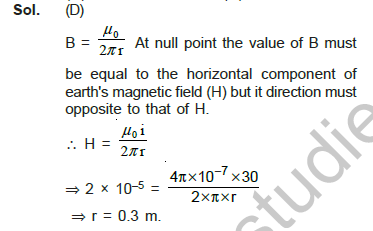
Answer: (D) 0.3 m
1. At the null point, the field of the wire B = μ0 i / (2πr) must equal the horizontal field H and be opposite to it.
2. μ0 i / (2πr) = H, so r = μ0 i / (2πH).
3. r = (4π × 10⁻⁷ × 30) / (2π × 2 × 10⁻⁵) = 0.3 m.
Teacher's Note:
a) At the null point the two fields cancel, so their magnitudes are equal.
b) Substitute μ0 = 4π × 10⁻⁷ T m/A to get the distance in metres.
3. A length L of wire carrying current I is bent into a circle of one turn. The field at the centre of the coil is B1. A similar wire of length L carrying current I is bent into a square of one turn. The field at its centre is B2. Then
(A) B1 > B2, (B) B1 < B2, (C) B1 = B2, (D) Nothing can be predicted.
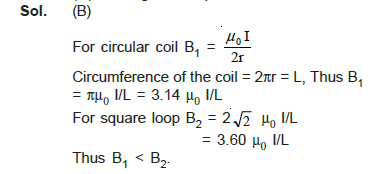
Answer: (B) B1 < B2
1. For the circular coil, r = L / (2π), so B1 = μ0 I / (2r) = π μ0 I / L = 3.14 μ0 I / L.
2. For the square loop of side a = L / 4, the field at the centre is B2 = 2√2 μ0 I / (πa) = 8√2 μ0 I / (πL) = 3.60 μ0 I / L.
3. Hence B1 < B2.
Teacher's Note:
a) For a fixed wire length, the square gives a stronger centre field than the circle.
b) The result depends only on the shape of the loop, not on the current alone.
4. If a uniform wire loop is connected to the terminals of a battery then the magnetic induction at the centre will be
(A) zero, (B) infinite, (C) directly proportional to applied e.m.f., (D) inversely proportional to the radius of the loop.
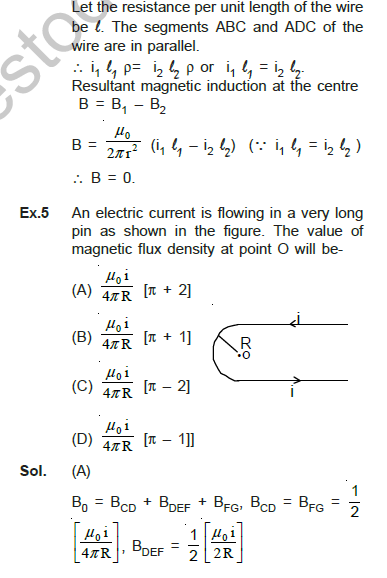

Answer: (A) zero
1. The segments ABC and ADC of the wire are in parallel. Let ρ be the resistance per unit length; then i1 ℓ1 ρ = i2 ℓ2 ρ, or i1 ℓ1 = i2 ℓ2.
2. The resultant magnetic induction at the centre is B = B1 - B2 = μ0 / (2πr²) (i1 ℓ1 - i2 ℓ2), and since i1 ℓ1 = i2 ℓ2, B = 0.
3. Hence the net magnetic induction at the centre is zero.
Teacher's Note:
a) This is because the two parts of the wire are arranged so that their currents produce opposite fields.
b) The condition is that the loop is uniform, so the two parts have resistances in the ratio of their lengths.
5. An electric current is flowing in a very long pin as shown in the figure. The value of magnetic flux density at point O will be
(A) μ0 i / (4πR) [π + 2], (B) μ0 i / (4πR) [π + 1], (C) μ0 i / (4πR) [π - 2], (D) μ0 i / (4πR) [π - 1]
Answer: (A) μ0 i / (4πR) [π + 2]
1. B0 = B_CD + B_DEF + B_FG.
2. B_CD = μ0 i / (4πR) and B_FG = μ0 i / (4πR), from the two straight portions.
3. B_DEF = (1/2) × μ0 i / (2R) = μ0 i / (4R) = μ0 i / (4πR) × π, from the semicircular part.
4. Adding the three parts gives B0 = μ0 i / (4πR) [π + 2].
Teacher's Note:
a) Find the field of each straight segment and of the semicircular arc separately, then add them with their directions.
b) A semicircular arc of radius R gives half of the field of a complete loop, which is μ0 i / (4R).
6. A current i is flowing in a conductor shaped as shown in the figure. The radius of the curved part is r and the length of the straight portions is very large. The value of the magnetic field at the centre will be
(A) μ0 i / (4πr) [3π/2 + 1], (B) μ0 i / (4πr) [3π/2 - 1], (C) μ0 i / (4πr) [π/2 + 1], (D) μ0 i / (4πr) [π/2 - 1]
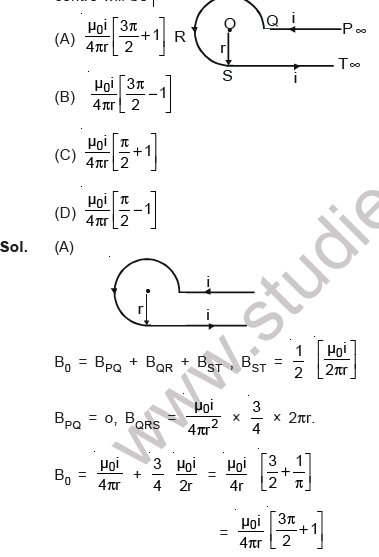
Answer: (A) μ0 i / (4πr) [3π/2 + 1]
1. B0 = B_PQ + B_QRS + B_ST.
2. The three-quarter circle arc contributes (3/4) × μ0 i / (2r) = 3μ0 i / (8r) = μ0 i / (4πr) × 3π/2.
3. The straight portion PQ lies along a line through the centre, so B_PQ = 0.
4. For the semi-infinite straight portion ST, B_ST = (1/2) × μ0 i / (2πr) = μ0 i / (4πr).
5. Total B0 = μ0 i / (4πr) [3π/2 + 1].
Teacher's Note:
a) Straight wires that point along the radius through the centre contribute no field at the centre.
b) The arc gives the term with π, and the straight portion gives the term with 1.
7. Electric currents i1 and i2 are flowing in two mutually perpendicular conductors as shown in the figure. The equation of zero magnetic field points will be
(A) y = x, (B) y = (i1 / i2) x, (C) y = x i2 / i1, (D) y = x i1 i2
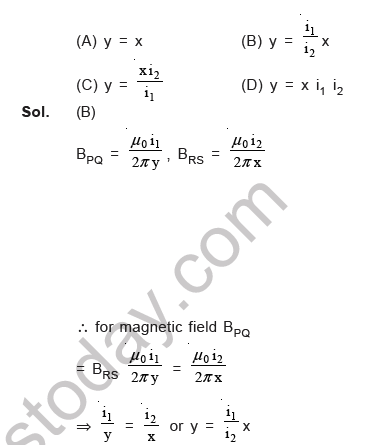
Answer: (B) y = (i1 / i2) x
1. B_PQ = μ0 i1 / (2πy) and B_RS = μ0 i2 / (2πx).
2. At a zero field point, B_PQ = B_RS, so i1 / y = i2 / x.
3. Hence y = (i1 / i2) x.
Teacher's Note:
a) The two fields point in opposite directions at the zero field points, so their magnitudes are equal.
b) The result is a straight line through the origin.
8. In the above problem the locus of zero magnetic field points will be
(A) a circle, (B) an ellipse, (C) a straight line, (D) a parabola
Answer: (C) a straight line
1. The equation y = (i1 / i2) x has the form y = mx, where m = i1 / i2.
2. This is the equation of a straight line passing through the origin.
Teacher's Note:
a) Only a linear relation between x and y gives a straight line.
b) The slope of the line depends on the ratio of the two currents.
9. In the above problem the points of zero magnetic field are
(A) C, (B) C and D, (C) D and E, (D) E
Answer: (C) D and E
1. The points D and E lie on the line y = (i1 / i2) x.
2. Hence the zero field points are D and E.
Teacher's Note:
a) Check each labelled point against the equation y = (i1 / i2) x.
b) Points off this line do not give zero field.
10. An electric current of i ampere is flowing in a long conductor as shown in the figure. The magnitude and direction of magnetic induction at the centre of circular part will be
(A) μ0 i / (2r) (1 + 1/π), directed out of the plane of paper, (B) 0, (C) μ0 i / (2r) (1 - 1/π), directed into the plane of paper, (D) μ0 i / (2r), directed out of the plane of paper
Answer: (A) μ0 i / (2r) (1 + 1/π), out of the plane of paper
1. B0 = B_CG + B_DEF.
2. The circular part gives μ0 i / (2r) and the straight part gives μ0 i / (2πr), with both contributing in the same direction.
3. B0 = μ0 i / (2r) + μ0 i / (2πr) = μ0 i / (2r) (1 + 1/π), directed normal to the plane of the paper, upwards.
Teacher's Note:
a) Use the right-hand rule to find the direction of the field from the current in the loop.
b) Both parts add because they produce fields in the same direction at the centre.
11. A circular arc of wire of radius of curvature r subtends an angle of π/4 radian at its centre. If i current is flowing in it then the magnetic induction at its centre will be
(A) μ0 i / (8r), (B) μ0 i / (4r), (C) μ0 i / (16r), (D) 0
Answer: (C) μ0 i / (16r)
1. The field at the centre due to an arc of angle α is B = μ0 i α / (4πr).
2. With α = π/4, B = μ0 i π / (4 × 4π r) = μ0 i / (16r).
Teacher's Note:
a) The arc angle must be in radians in the formula.
b) A full circle, with α = 2π, gives the familiar μ0 i / (2r).
12. The total magnetic induction at point O due to curve portion and straight portion in the following figure will be
(A) μ0 i / (2πr) [π - φ + tan φ], (B) μ0 i / (2πr), (C) 0, (D) μ0 i / (πr) [π - φ + tan φ]
Answer: (A) μ0 i / (2πr) [π - φ + tan φ]
1. B0 = B_PSR + B_PQR.
2. The arc PSR gives B_PSR = μ0 i / (2πr) [π - φ].
3. The straight portion PQR gives B_PQR = μ0 i / (4π) · 2 sinθ / OQ, with OQ = r cosθ (θ = φ), so B_PQR = μ0 i / (4π) · 2 sinφ / r cosφ = μ0 i / (2πr) tan φ.
4. Adding the two, B0 = μ0 i / (2πr) [π - φ + tan φ].
Teacher's Note:
a) The angle φ is the angle marked in the figure, measured at the centre O.
b) The arc's contribution is proportional to its angle in radians.
13. A 6.28 m long wire is turned into a coil of diameter 0.2 m and a current of 1 A is passed in it. The magnetic induction at its centre will be
(A) 6.28 × 10⁻⁵ tesla, (B) 0, (C) 6.28 tesla, (D) 6.28 × 10⁻³ tesla
Answer: (A) 6.28 × 10⁻⁵ tesla
1. Radius r = 0.1 m, so the number of turns n = ℓ / (2πr) = 6.28 / (2π × 0.1) = 10.
2. B = μ0 n i / (2r) = (4π × 10⁻⁷ × 10 × 1) / (2 × 0.1) = 6.28 × 10⁻⁵ T.
Teacher's Note:
a) Find the number of turns first, from the wire length and the circumference of one turn.
b) The field at the centre of a coil is proportional to the number of turns.
14. A long straight wire is turned into a loop of radius 10 cm (as shown in figure). If a current of 8 A is passed through the loop, then the value of the magnetic field B at the centre C of the loop will be (Wb/m²)
(A) 3.424 × 10⁻⁵, vertically upward, (B) 3.424 × 10⁻⁵, vertically downward, (C) 4.24 × 10⁻⁵, vertically upward, (D) 4.24 × 10⁻⁵, vertically downward
Answer: (A) 3.424 × 10⁻⁵ Wb/m², vertically upward
1. Field due to the straight part at C: B1 = (μ0 / 4π) × 2i / r = 10⁻⁷ × 2 × 8 / 0.1 = 16 × 10⁻⁶ Wb/m², vertically downwards.
2. Field due to the circular part at C: B2 = μ0 n i / (2r) = 4π × 10⁻⁷ × 1 × 8 / (2 × 0.1) = 16π × 10⁻⁶ = 50.3 × 10⁻⁶ Wb/m², vertically upwards.
3. Net field B = (50.3 - 16) × 10⁻⁶ = 3.424 × 10⁻⁵ Wb/m², vertically upwards.
Teacher's Note:
a) The two contributions are in opposite directions, so subtract them.
b) The circular part gives 16π × 10⁻⁶ ≈ 50.3 × 10⁻⁶ Wb/m², which is larger than the straight part's 16 × 10⁻⁶ Wb/m².
15. The magnetic dipole moment of a coil is 5.4 × 10⁻⁶ joule per tesla and it is lined up with an external magnetic field whose strength is 0.80 T. Then the work done in rotating the coil end for end (θ = 180°) is
(A) 4.32 μJ, (B) 2.16 μJ, (C) 8.6 μJ, (D) None of the above.
Answer: (C) 8.6 μJ
1. Potential energy U = -m · B. Starting from alignment (U = -mB) to anti-alignment (U = +mB), the change is ΔU = 2mB.
2. W = ΔU = 2 × 5.4 × 10⁻⁶ × 0.80 = 8.6 × 10⁻⁶ J = 8.6 μJ.
Teacher's Note:
a) Rotating through 180° reverses the dipole, so the energy changes by twice mB.
b) The magnetic moment is given in J/T, so the product with B gives energy in joules.
16. 4 ampere current is passing through a coil of radius 5 cm and 100 turns. The magnetic moment of the coil is
(A) 3.14 Am², (B) 3.14 cm², (C) 314 Am², (D) 0.0314 A cm²
Answer: (A) 3.14 Am²
1. m = NiA = N × i × πr².
2. m = 100 × 4 × 3.14 × (0.05)² = 3.14 Am².
Teacher's Note:
a) Convert the radius to metres before squaring.
b) The magnetic moment has the unit A m².
17. You are given a closed circuit with radii a and b as shown in fig carrying current i. The magnetic dipole moment of the circuit is
(A) π(a² + b²) i, (B) (1/2) π(a² + b²) i, (C) π(a² - b²) i, (D) (1/2) π(a² - b²) i
Answer: (B) (1/2) π(a² + b²) i
1. The circuit consists of two half circles, of radii a and b, so the enclosed area is A = (1/2)πa² + (1/2)πb² = (1/2)π(a² + b²).
2. m = i × A = (1/2) π(a² + b²) i.
Teacher's Note:
a) The dipole moment is the product of current and the enclosed area.
b) Each half circle contributes half of the area of a full circle.
18. A proton, a deuteron and an α-particle are accelerated through the same potential difference and then they enter a normal uniform magnetic field. The ratio of their kinetic energies will be
(A) 2 : 1 : 3, (B) 1 : 1 : 2, (C) 1 : 1 : 1, (D) 1 : 2 : 4
Answer: (B) 1 : 1 : 2
1. The kinetic energy gained through potential V is E_k = qV.
2. Proton has charge e, deuteron has charge e, and α-particle has charge 2e.
3. So E_k(proton) : E_k(deuteron) : E_k(α) = 1 : 1 : 2.
Teacher's Note:
a) The kinetic energy depends on charge only, not on mass, when the potential is the same.
b) The magnetic field does not change the kinetic energy.
19. A proton of energy 8 eV is moving in a circular path in a uniform magnetic field. The energy of an α-particle moving in the same magnetic field and along the same path will be
(A) 4 eV, (B) 2 eV, (C) 8 eV, (D) 6 eV
Answer: (C) 8 eV
1. For the same path, the radius r = mv / (qB) is the same, so E_k = q²r²B² / (2m) ∝ q² / m.
2. For the proton, q² / m = e² / m. For the α-particle, q² / m = (2e)² / (4m) = e² / m.
3. The two q² / m values are equal, so the α-particle also has 8 eV.
Teacher's Note:
a) The same path in the same field gives the same radius, so the energy depends only on q² / m.
b) The result is found from the ratio q² / m, not from q or m alone.
20. An electron is revolving in a circular path of radius 2 × 10⁻¹⁰ m with a speed of 3 × 10⁶ m/s. The magnetic field at the centre of circular path will be
(A) 1.2 Tesla, (B) 2.4 Tesla, (C) 0, (D) 3.6 Tesla
Answer: (A) 1.2 Tesla
1. The field at the centre due to a moving charge is B = μ0 q v / (4πr²).
2. B = (10⁻⁷ × 1.6 × 10⁻¹⁹ × 3 × 10⁶) / (2 × 10⁻¹⁰)² = (4.8 × 10⁻²⁰) / (4 × 10⁻²⁰) = 1.2 T.
Teacher's Note:
a) Use the magnitude of the electron's charge, 1.6 × 10⁻¹⁹ C.
b) Square the radius before dividing, as the formula has r².
21. An α particle is moving in a magnetic field of (3i + 2j) tesla with a velocity of 5 × 10⁵ i m/s. The magnetic force acting on the particle will be
(A) 3.2 × 10⁻¹³ dyne, (B) 3.2 × 10¹³ N, (C) 0, (D) 3.2 × 10⁻¹³ N
Answer: (D) 3.2 × 10⁻¹³ N
1. F = q (v × B), with q = 2e = 3.2 × 10⁻¹⁹ C.
2. v × B = (5 × 10⁵ i) × (3i + 2j) = 5 × 10⁵ × 2 k = 10⁶ k.
3. F = 3.2 × 10⁻¹⁹ × 10⁶ k = 3.2 × 10⁻¹³ k N, so |F| = 3.2 × 10⁻¹³ N.
Teacher's Note:
a) Only the component of B perpendicular to v (here the j part) contributes to the force.
b) The force is along the positive z direction (k) for this order of the cross product.
22. If an α-particle moving with velocity v enters a perpendicular to a magnetic field then the magnetic force acting on it will be
(A) 1 eVB, (B) 2 eVB, (C) 0, (D) 4 eVB
Answer: (B) 2 eVB
1. F = qvB sin 90° with q = 2e.
2. F = 2e × v × B = 2 eVB.
Teacher's Note:
a) The α-particle carries charge 2e.
b) The force is maximum when v is perpendicular to B.
23. A potential difference of 600 volt is applied across the plates of a parallel plate condenser placed in a magnetic field. The separation between the plates is 3 mm. An electron projected vertically upward parallel to the plates with a velocity of 2 × 10⁶ m/s moves undeflected between the condenser plates. The magnitude and direction of the magnetic field in the region between the condenser plates will be (in Wb/m²) (Given charge of electron = -1.6 × 10⁻¹⁹ coulomb.)
(A) 0.1, vertically downward, (B) 0.2 vertically downward, (C) 0.3 vertically upward, (D) 0.4 vertically downward.
Answer: (A) 0.1 Wb/m², vertically downward
1. The electron is undeflected, so the electric and magnetic forces balance: eE = evB, giving B = E / v.
2. E = V / d = 600 / (3 × 10⁻³) = 2 × 10⁵ V/m.
3. B = (2 × 10⁵) / (2 × 10⁶) = 0.1 Wb/m², directed vertically downward.
Teacher's Note:
a) The electric force and the magnetic force must be equal and opposite for zero deflection.
b) Convert the plate separation to metres before dividing.
24. A beam of protons enters a uniform magnetic field of 0.3 tesla with a velocity of 4 × 10⁵ m/s at an angle of 60° to the field. The radius of the helical path taken by the beam and the pitch of the helix (which is the distance travelled by a proton parallel to the magnetic field during one period of rotation) will be respectively (Mass of the proton = 1.7 × 10⁻²⁷ kg)
(A) 1.226 × 10⁻² m, 4.45 × 10⁻³ m, (B) 1.226 × 10⁻² m, 4.45 × 10⁻² m, (C) 1.226 × 10⁻³ m, 4.45 × 10⁻³ m, (D) 1.226 × 10⁻⁴ m, 4.45 × 10⁻⁴ m
Answer: (B) 1.226 × 10⁻² m and 4.45 × 10⁻² m
1. Velocity component parallel to B: v cos60° = 2 × 10⁵ m/s. Component perpendicular to B: v sin60° = 2√3 × 10⁵ m/s.
2. Radius r = m v sin60° / (qB) = (1.7 × 10⁻²⁷ × 2√3 × 10⁵) / (1.6 × 10⁻¹⁹ × 0.3) = 1.226 × 10⁻² m.
3. Period T = 2πm / (qB), so pitch = v cos60° × T = 2 × 10⁵ × 2π × 1.7 × 10⁻²⁷ / (1.6 × 10⁻¹⁹ × 0.3) = 4.45 × 10⁻² m.
Teacher's Note:
a) Only the perpendicular component of velocity gives the circular motion, and only the parallel component gives the pitch.
b) Check the powers of ten carefully, since the pitch is about 4.45 cm.
25. A 5 MeV proton moves vertically downward through a magnetic field of induction 1.5 weber/m² pointing horizontally from south to north. The force acting on the proton, mass of proton = 1.6 × 10⁻²⁷ kg, will be
(A) 7.44 × 10⁻¹² N, (B) 3.1 × 10⁻¹² N, (C) 5 × 10⁻¹² N, (D) 6 × 10⁻¹² N
Answer: (A) 7.44 × 10⁻¹² N
1. Kinetic energy = 5 MeV = 5 × 10⁶ × 1.6 × 10⁻¹⁹ = 8 × 10⁻¹³ J.
2. v² = 2 × KE / m = (2 × 8 × 10⁻¹³) / (1.6 × 10⁻²⁷) = 10¹⁵, so v = 3.1 × 10⁷ m/s.
3. The velocity is vertical and B is horizontal, so the angle is 90°. F = qvB = 1.6 × 10⁻¹⁹ × 3.1 × 10⁷ × 1.5 = 7.44 × 10⁻¹² N.
4. According to Fleming's left hand rule, the direction of the force is horizontal from west to east.
Teacher's Note:
a) Convert the energy from MeV to joules before finding the speed.
b) The force is maximum because the velocity and the field are at right angles.
26. A proton is to circulate the earth along the equator with a speed of 1.0 × 10⁷ m/s. The minimum magnetic field which should be created at the equator for this purpose (The mass of proton = 1.7 × 10⁻²⁷ kg and radius of earth = 6.37 × 10⁶ m.) will be (in Wb/m²)
(A) 1.6 × 10⁻¹⁹, (B) 1.67 × 10⁻⁸, (C) 1.0 × 10⁻⁷, (D) 2 × 10⁻⁷
Answer: (B) 1.67 × 10⁻⁸ Wb/m²
1. The magnetic field must be horizontal and perpendicular to the equator, so that the magnetic force provides the centripetal force.
2. qvB = mv² / r, so B = mv / (qr).
3. B = (1.7 × 10⁻²⁷ × 1.0 × 10⁷) / (1.6 × 10⁻¹⁹ × 6.37 × 10⁶) = 1.67 × 10⁻⁸ Wb/m².
Teacher's Note:
a) The radius of the path is taken as the radius of the earth.
b) The field value is very small, which is why it is not felt in daily life.
27. An α-particle is describing a circle of radius 0.45 m in a field of magnetic induction 1.2 weber/m². The potential difference required to accelerate the particle, so as to give this much energy to it (the mass of α-particle is 6.8 × 10⁻²⁷ kg and its charge is 3.2 × 10⁻¹⁹ coulomb) will be
(A) 6 × 10⁶ V, (B) 2.3 × 10⁻¹² V, (C) 7 × 10⁶ V, (D) 3.2 × 10⁻¹² V
Answer: (C) 7 × 10⁶ V
1. v = qBr / m = (3.2 × 10⁻¹⁹ × 1.2 × 0.45) / (6.8 × 10⁻²⁷) ≈ 2.6 × 10⁷ m/s. The frequency of rotation is n = v / (2πr) = (2.6 × 10⁷) / (2 × 3.14 × 0.45) = 9.2 × 10⁶ s⁻¹.
2. Kinetic energy = (1/2) m v² = (1/2) × 6.8 × 10⁻²⁷ × (2.6 × 10⁷)² ≈ 2.3 × 10⁻¹² J, which is about 14 MeV.
3. For an α-particle, E_k = qV with q = 2e = 3.2 × 10⁻¹⁹ C, so V = 2.3 × 10⁻¹² / (3.2 × 10⁻¹⁹) ≈ 7 × 10⁶ V.
Teacher's Note:
a) The charge of the α-particle is twice that of the electron, so use 2e in E_k = qV.
b) Convert joules to electron volts by dividing by 1.6 × 10⁻¹⁹ J/eV.
Also, the kinetic energy is 14 × 10⁶ eV = 2eV (since the charge on the α-particle is 2e), so V = (14 × 10⁶) / 2 = 7 × 10⁶ volt.
28. (a) A stream of positive charges, each of charge q is projected into a region where there are electric and magnetic fields at right angles to each other. The initial direction of stream is perpendicular to both the fields. The fields have magnitudes E and B respectively. Show that only those particles which have speed v = E/B will be transmitted undeflected.
(b) An electron beam passes through a magnetic field of 2 × 10⁻³ weber/m² and an electric field of 1.0 × 10⁴ volt/m both acting simultaneously. The path of electrons remaining undeviated, calculate the speed of the electrons. If the electric field is removed, what will be the radius of the electron path?
Answer:
(a)
1. The total force on the charge is F = qE + q(v × B).
2. For no deflection, the two forces are equal and opposite, so qE = qvB.
3. Hence v = E / B. Only particles with this speed pass undeflected.
(b)
1. v = E / B = (1.0 × 10⁴) / (2 × 10⁻³) = 5 × 10⁶ m/s.
2. When E is removed, the electron moves in a circle, so r = mv / (eB) = (9.1 × 10⁻³¹ × 5 × 10⁶) / (1.6 × 10⁻¹⁹ × 2 × 10⁻³) ≈ 1.42 × 10⁻² m, which is about 1.4 cm.
Teacher's Note:
a) The velocity selector works for any charge, since the speed is independent of charge and mass.
b) The radius is about 1.42 cm (1.422 cm before rounding).
29. A straight horizontal stretch of copper wire carries a current i = 30 A. The linear mass density of the wire is 45 g/m. What is the magnitude of the magnetic field needed to "float" the wire, that is to be balance its weight?
(A) 147 G, (B) 441 G, (C) 14.7 G, (D) 0 G
Answer: (A) 147 G
1. For the magnetic force to balance the weight, ILB = mg, so B = mg / (IL) = (m/L) g / I.
2. B = (45 × 10⁻³ × 9.8) / 30 = 1.47 × 10⁻² T = 147 G (since 1 G = 10⁻⁴ T).
Teacher's Note:
a) The magnetic force must be upward and perpendicular to the wire.
b) Use the linear mass density, so the mass per unit length multiplied by g gives the weight per unit length.
30. The magnetic force on segment PQ, due to a current of 5 amp. flowing in it, if it is placed in a magnetic field of 0.25 Tesla, will be
(A) 0.3125 sin 65° N, (B) 0, (C) 31.25 sin 65° N, (D) 3.125 sin 65° N
Answer: (A) 0.3125 sin 65° N
1. F = BiL sinθ, where the length of PQ is taken as 0.25 m and θ = 65°.
2. F = 0.25 × 5 × 0.25 × sin 65° = 0.3125 sin 65° N.
Teacher's Note:
a) The angle θ is between the wire and the field.
b) The working in the source takes the length of PQ as 0.25 m.
31. A 1 m long conducting wire is lying at right angles to the magnetic field. A force of 1 kg wt. is acting on it in a magnetic field of 0.98 Tesla. The current flowing in it will be
(A) 100 A, (B) 10 A, (C) 1 A, (D) 0
Answer: (B) 10 A
1. F = mg = 1 × 9.8 = 9.8 N.
2. F = Bi L, so 9.8 = 0.98 × i × 1, which gives i = 10 A.
Teacher's Note:
a) 1 kg wt equals 9.8 N, so convert the force before using F = BiL.
b) The wire is at right angles to the field, so sin 90° = 1.
32. A loop of flexible conducting wire of length 0.5 m lies in a magnetic field of 1.0 tesla perpendicular to the plane of the loop. The tension developed in the wire if the current is of 1.57 amp. will be
(A) 0.15 N, (B) 0.25 N, (C) 0.125 N, (D) 0.138 N
Answer: (C) 0.125 N
1. The magnetic force on each element acts outward, normal to the wire, and the loop stretches into a circle of radius r.
2. Circumference = 2πr = 0.5 m, so r = 0.5 / (2π) = 0.0796 m.
3. For a small element, 2T sinθ = B i Δℓ. With θ small, T = B i r = 1 × 1.57 × 0.0796 = 0.125 N.
Teacher's Note:
a) The tension in the loop is T = BiR, where R is the radius of the circle.
b) Use r = L / (2π), the radius of the circle, and not the diameter.
33. A coil in the shape of equilateral triangle of side 0.2 m is suspended from the vertex such that it is hanging in a vertical plane between the pole-pieces of a permanent magnet producing a horizontal magnetic field of 5 × 10⁻² Tesla. The couple acting on the coil when a current of 0.1 amp. is passed through it and the magnetic field is parallel to its plane will be
(A) 3.28 × 10⁻⁷ N.m., (B) 5.28 × 10⁻⁷ N.m., (C) 8.66 × 10⁻⁷ N.m., (D) 1.23 × 10⁻⁷ N.m.
Answer: (C) 8.66 × 10⁻⁷ N m (see Teacher's Note)
1. Area of the equilateral triangle = (√3 / 4) × (0.2)² = 1.732 × 10⁻² m².
2. Torque τ = B i A sinθ. The field is parallel to the plane of the coil, so the angle is 90° and sinθ = 1.
3. τ = 0.05 × 0.1 × 1.732 × 10⁻² = 8.66 × 10⁻⁵ N m.
Teacher's Note:
a) The area of the triangle is 1.732 × 10⁻² m², and the torque is 8.66 × 10⁻⁵ N m by direct calculation.
b) The option whose digits match this value is (C), 8.66, so (C) is the intended choice, although the exponent in the printed option differs.
34. A metal wire of mass m slides without friction on two rails spaced at a distance d apart. The track lies in a vertical uniform field of induction B, a constant current i flows along one rail, across the wire and back down the other rail. The velocity (speed and direction) of the wire as a function of time, assuming it to be at rest initially will be
(A) (Bid / m) t, (B) 0, (C) Bidmt, (D) none
Answer: (A) v = (Bid / m) t
1. The force on the wire is F = Bid sin 90° = Bid, directed away from the battery by Fleming's left hand rule.
2. Acceleration a = F / m = Bid / m, which is constant.
3. From v = u + at with u = 0, v = (Bid / m) t.
Teacher's Note:
a) The force is constant, so the acceleration is constant.
b) The velocity is directed along the force, which is away from the battery.
35. An electric current of 30 ampere is flowing in each of two parallel conducting wires placed 5 cm apart. The force acting per unit length on either of the wires will be
(A) 3.6 × 10⁻³ N/m, (B) 3.6 × 10⁻³ dyne/cm, (C) 3.6 × 10⁻⁵ N/m, (D) 3.6 × 10⁻² N/m
Answer: (A) 3.6 × 10⁻³ N/m
1. F / ℓ = μ0 i1 i2 / (2πd) = (4π × 10⁻⁷ × 30 × 30) / (2π × 5 × 10⁻²).
2. F / ℓ = 3.6 × 10⁻³ N/m.
Teacher's Note:
a) The wires attract each other because the currents are in the same direction.
b) Convert 5 cm to 0.05 m before using the formula.
36. The distance between the wires of electric mains is 12 cm. These wires experience 4 mg wt. per unit length. The value of current flowing in each wire will be
(A) 4.85 A, (B) 0, (C) 4.85 × 10⁻² A, (D) 4.85 × 10⁻⁴ A
Answer: (A) 4.85 A
1. Force per unit length F / ℓ = 4 mg wt = 4 × 10⁻⁶ × 9.8 = 3.92 × 10⁻⁵ N/m.
2. F / ℓ = μ0 i² / (2πd), so i² = (F / ℓ) × 2πd / μ0.
3. i² = (3.92 × 10⁻⁵ × 2π × 0.12) / (4π × 10⁻⁷) = 23.5, so i = 4.85 A.
Teacher's Note:
a) Both wires carry the same current, so the formula uses i².
b) Convert 12 cm to 0.12 m.
37. In the adjoining figure, two very long, parallel wires A and B carry currents of 10 ampere and 20 ampere respectively, and are at a distance 20 cm apart. If a third wire C (length 15 cm) having a current of 10 ampere is placed between them, then how much force will act on C? The direction of current in all the three wires is same.
(A) 3 × 10⁻⁵ N (left), (B) 3 × 10⁻⁵ N (right), (C) 6 × 10⁻⁵ N (left), (D) 6 × 10⁻⁵ N (right)
Answer: (B) 3 × 10⁻⁵ N (right)
1. Wire C is at 10 cm from A and from B.
2. Force on C due to A (10 A, same direction, so attractive, towards the left): F_CA = (μ0 / 4π) × 2 × 10 × 10 × 0.15 / 0.10 = 3 × 10⁻⁵ N (left).
3. Force on C due to B (20 A, same direction, attractive, towards the right): F_BC = (μ0 / 4π) × 2 × 20 × 10 × 0.15 / 0.10 = 6 × 10⁻⁵ N (right).
4. Net force on C = 6 × 10⁻⁵ - 3 × 10⁻⁵ = 3 × 10⁻⁵ N towards the right.
Teacher's Note:
a) Parallel currents in the same direction attract each other.
b) The net force is found by subtracting the two opposite forces, which act in opposite directions.
38. A 5 cm × 12 cm coil with number of turns 600 is placed in a magnetic field of strength 0.10 Tesla. The maximum magnetic torque acting on it when a current of 10⁻⁵ A is through it will be
(A) 3.6 × 10⁻⁶ N-m, (B) 3.6 × 10⁻⁶ dyne-cm, (C) 3.6 × 10⁶ N-m, (D) 3.6 × 10⁶ dyne-m
Answer: (A) 3.6 × 10⁻⁶ N m
1. τ_max = MB = niAB = n i (ℓ × b) B.
2. τ_max = 600 × 10⁻⁵ × (5 × 10⁻² × 12 × 10⁻²) × 0.10 = 3.6 × 10⁻⁶ N m.
Teacher's Note:
a) Convert both sides of the coil from cm to m before multiplying.
b) Maximum torque occurs when the coil's plane is parallel to the field.
39. The length of a solenoid is 0.4 m and the number of turns in it is 500. A current of 3 amp. is flowing in it. In a small coil of radius 0.01 m and number of turns 10, a current of 0.4 amp. is flowing. The torque necessary to keep the axis of this coil perpendicular to the axis of solenoid will be
(A) 5.92 × 10⁻⁶ N-m, (B) 5.92 × 10⁻⁴ N-m, (C) 5.92 × 10⁻⁶ dyne-cm, (D) 5.92 × 10⁻⁴ dyne-cm
Answer: (A) 5.92 × 10⁻⁶ N m
1. Field inside the solenoid: B_S = μ0 N_S i_S / L_S = (4π × 10⁻⁷ × 500 × 3) / 0.4 = 4.71 × 10⁻³ T.
2. Torque τ = B_S × i × N × A = 4.71 × 10⁻³ × 0.4 × 10 × π (0.01)² = 5.92 × 10⁻⁶ N m.
Teacher's Note:
a) The coil's axis is perpendicular to the solenoid's field, so the torque is maximum.
b) Use N for the number of turns in the small coil, and N_S for the solenoid.
40. A conducting wire of length ℓ is turned in the form of a circular coil and a current i is passed through it. For torque due to magnetic field produced at its centre, to be maximum, the number of turns in the coil will be
(A) 1, (B) 2, (C) any value, (D) more than 1
Answer: (A) 1
1. Torque τ = niπa²B, where the wire length ℓ = n × 2πa, so a = ℓ / (2πn).
2. Substituting, τ = i B ℓ² / (4π n).
3. Torque is largest when n is smallest, that is n = 1.
Teacher's Note:
a) The torque is inversely proportional to the number of turns for a fixed wire length.
b) A single turn therefore gives the maximum torque.
41. A mono-energetic (18 keV) electron beam initially in the horizontal direction is subjected to a horizontal magnetic field of 0.40 G normal to the initial direction. Estimate the up or down deflection of the beam over a distance of 30 cm (m_e = 9.11 × 10⁻³¹ kg and e = 1.60 × 10⁻¹⁹ C).
Answer:
1. Speed from V = 18 kV: v = √(2eV / m).
2. Radius R = mv / (eB) = √(2 m e V) / (eB), with B = 0.40 G = 0.4 × 10⁻⁴ T.
3. R = √(2 × 9.11 × 10⁻³¹ × 1.60 × 10⁻¹⁹ × 18 × 10³) / (1.60 × 10⁻¹⁹ × 0.40 × 10⁻⁴) = 11.3 m.
4. For a horizontal distance x = 0.3 m along the arc, sinθ = x / R = 0.3 / 11.3, so θ ≈ 1.5° and cosθ ≈ 0.9997.
5. Downward deflection y = R(1 - cosθ) = 11.3 × 0.0003 ≈ 0.004 m = 4 mm.
Teacher's Note:
a) Convert the field from gauss to tesla, using 1 G = 10⁻⁴ T.
b) For a small angle, the deflection is about x² / (2R), which gives the same value.
Free study material for Physics
Useful Resources and Notes for Class 12 Physics Chapter 06 Electromagnetic Induction
Essential Notes for Class 12 Physics
Explore essential learning tools for Class 12 Physics Chapter 06 Electromagnetic Induction. This curated collection features in-depth notes and targeted practice questions built around the active 2026 curriculum to streamline your daily revision.
Verified Solutions for Class 12 Physics
Designed around the official curriculum, these study guides guarantee standard compliance. Reviewing step-by-step solutions clarifies complex sub-topics within Chapter 06 Electromagnetic Induction and demystifies standard marking schemes for Physics evaluations.
Enhance Accuracy with Online Tests
Maximize your grade potential by utilizing Class 12 Physics practice papers in tandem with these structured notes. All printable assignments and interactive mock tests on our platform are updated for the 2026 session and available free of charge.
FAQs
Our advanced study package for Chapter 06 Electromagnetic Induction includes detailed concepts, diagrams, Mind Maps, and explanation of complex topics to ensure Class 12 students learn as per syllabus for 2026 exams.
The Mind Maps provided for Chapter 06 Electromagnetic Induction act as visual anchors which will help faster recall during high-pressure exams.
Yes, teachers use our Class 12 Physics resources for lesson planning as they are in simple language and have lot of solved examples.
Yes, You can download the complete, mobile-friendly PDF of the Physics Chapter 06 Electromagnetic Induction advanced resources for free.
Yes, our subject matter experts have updated the Chapter 06 Electromagnetic Induction material to align with the rationalized NCERT textbooks and have removed deleted topics and added new competency-based questions.