

Official CBSE Study Materials for Class 12 Physics
Review targeted academic resources with the CBSE Class 12 Physics Heat and Thermodynamics Basic Problems. Built according to official CBSE standards for the 2026-27 term, these downloadable Class 12 Physics study materials support effective daily practice and deeper conceptual understanding for Heat and Thermodynamics.
Advanced Resources for Physics
Navigate directly to the advanced Physics study materials using the digital viewer below. Each resource pack includes detailed conceptual summaries and solved practice questions, allowing students to instantly reinforce their learning.
CBSE Class 12 Physics Heat and Thermodynamics Basic Problems. Please refer to the examination notes which you can use for preparing and revising for exams. These notes will help you to revise the concepts quickly and get good marks.
1. A cylinder closed at both ends is separated into two equal (42 cm each) parts by a piston impermeable to heat. Both the parts contain the same masses of a gas at a temperature of 27° C and a pressure of 1 atm. How much should the gas in one part of the cylinder be heated to shift the piston by 2 cm? Find the pressure of the gas after the shifting of the piston.
2. A tall cylindrical vessel with gaseous nitrogen is located in the gravitational field. The temperature of the gas varies with height h in such a way that its density is the same throughout the volume. Find the temperature gradient.
3. A horizontal cylinder closed at one end is rotated with a constant angular velocity ω about a vertical axis passing through the open end of the cylinder. The outside pressure is p0, the absolute temperature is T and the molar mass of air is M. Find the air pressure as a function of the distance r from the axis of rotation. The molar mass is assumed to be independent of r.
4. An ideal gas at 300 K occupies a volume of 0.5 m³ at a pressure of 2 atm. The gas expands adiabatically until its volume is 1.2 m³. Next, the gas is compressed isobarically to its original volume. Finally, the pressure is increased isochorically until the gas returns to its initial state. Represent the change on the p-V diagram. Determine the temperature at the end of each transformation, and the work done during the cycle. Assume γ = 1.4.
5. Five moles of neon gas (molecular weight = 20) at 2 atm and 27° C is adiabatically compressed to one third its initial volume. Find the final pressure, the temperature and the work done on the gas.
6. One mole of certain ideal gas is contained under the weightless piston of a vertical cylinder at a temperature T. The space over the piston opens into the atmosphere of pressure p0. What work has to be done in lifting the piston so that the volume of the gas under the piston increases isothermally n times?
7. As a result of the isobaric heating by ΔT = 72 K one mole of a certain ideal gas receives heat Q = 1.6 kJ. Find the work performed by the gas, the increment of its internal energy and the value of its adiabatic exponent γ.
8. A reversible heat engine carries 1 mole of an ideal monoatomic gas around the cycle 1-2-3-1. Process 1-2 takes place at constant volume, process 2-3 is adiabatic and process 3-1 takes place at constant pressure. Compute the values for the heat Δ Q, the change in internal energy ΔU, and the work done ΔW, for each of the three processes and for the cycle as whole. O Vp1(300 K)2(600 K)3(455 K).
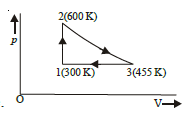
9. One mole of argon expands polytropically, the polytropic constant being 1.5, that is, according to the law pV1.5 = constant. In the process, its temperature changes by ΔT = –26 K. Find
(a) the amount of heat obtained by the gas, and
(b) the work performed by the gas.
10. An ideal gas expands adiabatiacally from an initial temperature T1 to a final temperature T2. Prove that the work done by the gas is Cv(T1 – T2).
11. Ten grams of oxygen is heated at constant atmospheric pressure from 27°C to 127°C. How much heat is transferred to the oxygen? What fraction of the heat is used to increase the internal energy of the oxygen.
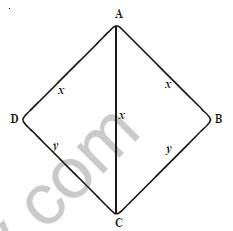
12. Three rods of material x and two rods of material y are connected as shown in the figure here. All the rods are identical (each 1 m long and of cross-sectional area 100 cm²). At the junctions A and C, there are two sources of heat of 25 W and 100 W, and at B and at D there are two sinks maintained at 30°C and 10°C, respectively. Calculate the temperatures of the points A and C is the steady stae. The thermal conductivity of x is 200 J s–1 m–1K–1 and that of y is 400 J s–1 m–1 K–1.
13. A cylindrical block of length l = 0.4 m and area of cross-section A = 0.04 m² is placed coaxially on a thin metal disc of mass m = 0.4 kg of the same cross section. The upper face of the cylinder is maintained at a constant temperature T = 400 K and the initial temperature of the disc is T0 = 300 K. If the thermal conductivity of the material of the cylinder is λ = 10 W m–1K–1 and the specific heat of the material of the disc is s = 600 J kg–1 – K–1, how long will it take for the temperature of the disc to increase to T1 = 350 K? Assume for purposes of calculation that the thermal conductivity is very high and that the system is thermally insulated except for the upper face of the cylinder.
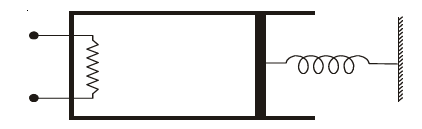
14. An ideal monoatomic gas is confined in a cylinder by a spring loaded piston of cross-section 8.0 × 10⁻³ m². Initially the gas is at 300 K and occupies a volume of 2.4 × 10⁻³ m³ and the spring is in its relaxed state. The gas is heated by a small heater until the piston moves out slowly by 0.1 m. Calculate the final temperature of the gas. The force constant of the spring is 8000 N/m, and the atmospheric pressure is 1.0 × 10⁵ N/m2. The cylinder and the piston are thermally insulated. The piston and the spring are massless and there is no friction between the piston and the cylinder. Neglect and heat loss through the lead wires of the heater. The heat capacity of the heater coil is negligible.
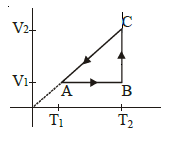
15. Figure shows a process ABCA performed on n moles of an ideal gas. Find the net heat given to the system during the process.
Please click on below link to download pdf file for CBSE Class 12 Physics Heat and Thermodynamics Basic Problems.
Free study material for Physics
Physics Class 12 Exam Resources: Heat and Thermodynamics
Core Study Kit: Class 12 Physics Heat and Thermodynamics
Explore essential learning tools for Class 12 Physics Heat and Thermodynamics. This curated collection features in-depth notes and targeted practice questions built around the active 2026 curriculum to streamline your daily revision.
NCERT-Aligned Solutions for Heat and Thermodynamics
Each resource draws directly from authorized textbooks to maintain academic accuracy. Evaluating solved examples allows Class 12 students to master the formal presentation and answer-writing standards expected in upcoming school exams.
Next Steps in Your Exam Preparation
Wrap up your chapter revision by testing your knowledge against standard objective question formats. Explore our full library of free, up-to-date sample papers and online assessments to secure top grades in your CBSE examinations.
FAQs
Our advanced study package for Heat and Thermodynamics includes detailed concepts, diagrams, Mind Maps, and explanation of complex topics to ensure Class 12 students learn as per syllabus for 2026 exams.
The Mind Maps provided for Heat and Thermodynamics act as visual anchors which will help faster recall during high-pressure exams.
Yes, teachers use our Class 12 Physics resources for lesson planning as they are in simple language and have lot of solved examples.
Yes, You can download the complete, mobile-friendly PDF of the Physics Heat and Thermodynamics advanced resources for free.
Yes, our subject matter experts have updated the Heat and Thermodynamics material to align with the rationalized NCERT textbooks and have removed deleted topics and added new competency-based questions.