

Download CBSE Class 12 Physics Useful Resources
Explore structured advanced study materials through the CBSE Class 12 Physics Optics Basic Problems. Tailored for Class 12 learners, utilizing these Physics resources ensures thorough preparation and strengthens foundational knowledge before final CBSE evaluations.
Access CBSE Study Guides and Summaries
View or download the dedicated CBSE Class 12 Physics Optics Basic Problems resource below. Engaging with these advanced study guides under focused conditions ensures continuous academic progress and mastery of the 2026-27 curriculum for Chapter 09 Ray Optics and Optical Instruments.
CBSE Class 12 Physics Optics Basic Problems. Please refer to the examination notes which you can use for preparing and revising for exams. These notes will help you to revise the concepts quickly and get good marks.
1. A rod of length 10 cm lies along the principal axis of a concave mirror of focal length 10 cm in such a way that the end closer to the pole is 20 cm away from it. Find the length of the image.
2. At what distance from a convex mirror of focal length 2.5 m should a boy stand so that his image has a height equal to half the original height? The principal axis is perpendicular to the height.
3. A 2.0 cm high object is placed on the principal axis of a concave mirror at a distance of 12 cm from the pole. If the image is inverted, real and 5.0 cm high, find the location of the image and the focal length of the mirror
4. A point object O is placed in front of a transparent slab at a distance x from its closer surface. It is seen from the other side of the slab by light incident nearly normally to the slab. The thickness of the slab is t and its refractive index is μ. Show that the apparent shift in the position of the object is independent of x and find its value.
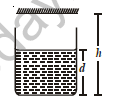
5. Consider the situation shown in figure. A plane mirror is fixed at a height h above the bottom of a beaker containing water (refractive index μ) upto a height d. Find the position of the image of the bottom formed by the mirror.
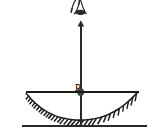
6. A concave mirror of radius 40 cm lies on a horizontal table and water is filled in it up to a height of 5.00 cm. A small dust particle floats on the water surface at a point P vertically above the point of contact of the mirror with the table. Locate the image of the dust particle as seen from a point directly above it. The refractive index of water is 1.33.
7. An object is placed 21 cm in front of a concave mirror of radius of curvature 20 cm. A glass slab of thickness 3 cm and refractive index 1.5 is placed close to the mirror in the space between the object and the mirror. Find the position of the final image formed. The distance of the nearer surface of the slab from the mirror is 10 cm.
8. There is a small air bubble inside a glass sphere (μ = 1.5) of radius 10 cm. The bubble is 4.0 cm below the surface and is viewed normally from the outside. Find the apparent depth of the bubble.
9. A point source S is placed at a distance of 15 cm from a converging lens of focal length 10 cm on its principal axis. Where should a diverging mirror of focal length 12 cm be placed so that a real image is formed on the source itself.
10. A converging lens of focal length 15 cm and a converging mirror of focal length 20 cm are placed with their principal axes coinciding. A point source S is placed on the principal axis at a distance of 12 cm from the lens on the other side. It is found that the final beam of light comes out parallel to the principal axis. Find the separation between the mirror and the lens.
11. A biconvex thin lens is prepared from glass (μ = 1.5), the two bounding surfaces having equal radii of 25 cm each. One of the surfaces is silvered from outside to make it reflecting. Where should an object be placed before this lens so that the image is formed on the object itself ?
12. Consider the situation shown in figure. The bottom of the vessel is a reflecting plane mirror, S is a small fish and T is the observer’s eye. Refractive index of water is μ.

(a) At what distance(s) from itself will the fish see image(s)of the eye H S
(b) At what distances from itself will the eye see the image(s)of the fish.
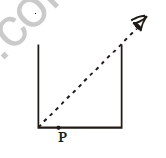
13. A cylindrical vessel, whose diameter and height both are equal to 30 cm, is placed on a horizontal surface and a small particle P is placed in it at a distance of 5.0 cm from the centre of the circular base. A person is looking at the vessel at such an angle that the edge of the bottom is just visible. The particle P is in the plane of this drawing. Up to what minimum height should water be poured in the vessel to make the particle P visible to the person?
14. A ball is kept at a height h above the surface of a heavy transparent sphere made of a material of refractive index μ. The radius of the sphere is R. At t = 0, the ball is dropped to fall normally on the sphere. Find the speed of the image formed as a function of time for t < g2 h. Consider only the image formed by a single refraction.
15. Two concave mirrors of equal radii of curvature R are fixed on a stand such that the mirrors face opposite directions. The whole system has a mass m and is kept on a frictionless horizontal table
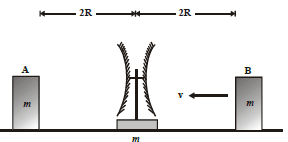
Two blocks A and B, each of mass m, are placed on the two sides of the stand. At t = 0, the separation between A and the mirrors is 2 R and also the separation between B and the mirrors is 2 R. The block B
Please click on below link to download pdf file for CBSE Class 12 Physics Optics Basic Problems.
Free study material for Physics
CBSE Class 12 Physics Study Material: Chapter 09 Ray Optics and Optical Instruments
Core Study Kit: Class 12 Physics Chapter 09 Ray Optics and Optical Instruments
Explore essential learning tools for Class 12 Physics Chapter 09 Ray Optics and Optical Instruments. This curated collection features in-depth notes and targeted practice questions built around the active 2026 curriculum to streamline your daily revision.
NCERT-Aligned Solutions for Chapter 09 Ray Optics and Optical Instruments
Built using official NCERT guidelines for Class 12 Physics, these materials provide reliable academic support. Integrating past examination questions and step-by-step solutions helps students understand official CBSE grading criteria.
Next Steps in Your Exam Preparation
For peak performance in upcoming evaluations, integrate official Physics sample papers directly into your study schedule. Follow up your revision by attempting online MCQ tests for Chapter 09 Ray Optics and Optical Instruments to refine calculation speed and precision.
FAQs
Our advanced study package for Chapter 09 Ray Optics and Optical Instruments includes detailed concepts, diagrams, Mind Maps, and explanation of complex topics to ensure Class 12 students learn as per syllabus for 2026 exams.
The Mind Maps provided for Chapter 09 Ray Optics and Optical Instruments act as visual anchors which will help faster recall during high-pressure exams.
Yes, teachers use our Class 12 Physics resources for lesson planning as they are in simple language and have lot of solved examples.
Yes, You can download the complete, mobile-friendly PDF of the Physics Chapter 09 Ray Optics and Optical Instruments advanced resources for free.
Yes, our subject matter experts have updated the Chapter 09 Ray Optics and Optical Instruments material to align with the rationalized NCERT textbooks and have removed deleted topics and added new competency-based questions.