

Advanced Study Material for Class 12 Physics: Chapter 08 Electromagnetic Waves
Explore structured advanced study materials through the CBSE Class 12 Physics Electro Magnetic Waves chapter notes and important questions. Tailored for Class 12 learners, utilizing these Physics resources ensures thorough preparation and strengthens foundational knowledge before final CBSE evaluations.
Practice Class 12 Physics Resources: Chapter 08 Electromagnetic Waves
Access the complete useful resource PDF for Class 12 Physics below. Regular practice with these targeted academic notes builds familiarity with complex topics and helps secure higher marks in final school evaluations.
CBSE Class 12 Physics Electro Magnetic Waves chapter notes and important questions. There are many more useful educational material which the students can download in pdf format and use them for studies. Study material like concept maps, important and sure shot question banks, quick to learn flash cards, flow charts, mind maps, teacher notes, important formulas, past examinations question bank, important concepts taught by teachers. Students can download these useful educational material free and use them to get better marks in examinations. Also refer to other worksheets for the same chapter and other subjects too. Use them for better understanding of the subjects.
ELECTRO MAGNETIC WAVES
Class 12 Physics: Electromagnetic Waves (Chapter Notes and Important Questions)
Chapter 5: Electromagnetic Waves – Gist
- Conduction current and displacement current together have the property of continuity.
- Conduction current and displacement current are precisely the same.
- Conduction current arises due to the flow of electrons in a conductor. Displacement current arises due to an electric flux changing with time.
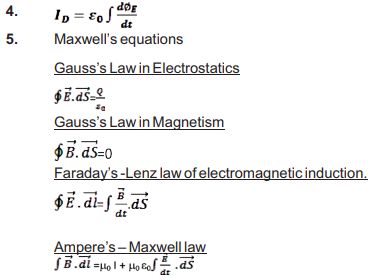
- The displacement current is \[ I_D=\varepsilon_0\frac{d\phi_E}{dt} \]
- Maxwell's equations:
Gauss's law in electrostatics: \( \displaystyle\oint\vec E\cdot d\vec S=\frac{q}{\varepsilon_0} \)
Gauss's law in magnetism: \( \displaystyle\oint\vec B\cdot d\vec S=0 \)
Faraday–Lenz law of electromagnetic induction: \( \displaystyle\oint\vec E\cdot d\vec l=-\frac{d\phi_B}{dt} \)
Ampere–Maxwell law: \( \displaystyle\oint\vec B\cdot d\vec l=\mu_0 I+\mu_0\varepsilon_0\frac{d\phi_E}{dt} \) - Electromagnetic wave: the wave in which there are sinusoidal variations of the electric and magnetic fields at right angles to each other as well as at right angles to the direction of wave propagation.
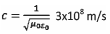
- Velocity of EM waves in free space: \[ c=\frac{1}{\sqrt{\mu_0\varepsilon_0}}=3\times10^8\ \text{m/s} \]
- The scientists associated with the study of EM waves are Hertz, Jagdish Chandra Bose and Marconi.
- An EM wave is a transverse wave, because of which it undergoes the polarization effect.
- Electric vectors are only responsible for the optical effects of EM waves.
- The amplitudes of the electric and magnetic fields are related by \( \dfrac{E}{B}=c \).
- An oscillating or accelerating charged particle produces EM waves.
- The orderly arrangement of electromagnetic radiation according to its frequency or wavelength is the electromagnetic spectrum.
- A hint to memorise the electromagnetic spectrum in decreasing order of frequency: G X U V I M R (gamma rays, X-rays, ultraviolet, visible, infrared, microwaves, radio waves).
- EM waves also carry energy, momentum and information.
Electromagnetic spectrum: its production, detection and uses in general
| Type | Wavelength range / frequency range | Production | Detection | Uses |
|---|---|---|---|---|
| Radio | > 0.1 m \(10^9\) to \(10^5\) Hz | Rapid acceleration/deceleration of electrons in aerials | Receiver's aerials | Radio, TV communication |
| Microwave | 0.1 mm \(10^{11}\) to \(10^{9}\) Hz | Klystron valve or magnetron valve | Point contact diodes | Radar, TV communication |
| Infrared | 1 mm to 700 nm \(10^{11}\) to \(10^{14}\) Hz | Vibration of atoms or molecules | Thermopiles, bolometer, infrared photographic film | Greenhouse effect, looking through haze, fog and mist, aerial mapping |
| Light | 700 nm to 400 nm \(4\times10^{14}\) to \(8\times10^{14}\) Hz | Electrons in an atom during transition | Eye, photocell, photographic film | Photography, illumination; emitted and reflected by the objects |
| Ultraviolet | 400 nm to 1 nm \(5\times10^{14}\) to \(8\times10^{14}\) | Inner shell electrons in an atom moving from one energy level to a lower energy level | Photocell and photographic film | Preservation of food items, detection of invisible writing, finger prints in a forensic laboratory, determination of the structure of molecules and atoms |
| X-rays | 1 nm to \(10^{-3}\) nm \(10^{16}\) to \(10^{21}\) Hz | X-ray tube or inner shell electrons | Photographic film, Geiger tube, ionization chamber | Study of crystal structure and atoms, fracture of bones |
| Gamma rays | < \(10^{-3}\) nm \(10^{18}\) to \(10^{22}\) Hz | Radioactive decay of the nucleus | Photographic film, Geiger tube, ionization chamber | Nuclear reactions and the structure of atoms and nuclei; to destroy cancer cells |
Questions
Write the SI unit of displacement current. (1 mark)
Answer: Ampere (A).
If \(\vec E\) and \(\vec B\) represent the electric and magnetic field vectors of the electromagnetic wave, then what is the direction of propagation of the electromagnetic wave? (1 mark)
Answer: \( \vec E\times\vec B \)
Can the velocity of light in vacuum be changed? (1 mark)
Answer: No, it is not possible; it is a universal constant, \(c=3\times10^8\) m/s.
Calculate the wavelength of the e.m. waves emitted by an oscillator antenna system, if \(L=0.253\ \mu\text{H}\) and \(C=25\ \text{pF}\).
The frequency is \( \nu=\dfrac{1}{2\pi\sqrt{LC}}=\dfrac{1}{2\pi\sqrt{0.253\times10^{-6}\times25\times10^{-12}}}\approx6.3\times10^{7}\ \text{Hz} \), so the wavelength is
\[ \lambda=\frac{c}{\nu}=2\pi c\sqrt{LC}\approx\frac{3\times10^8}{6.33\times10^7}\approx4.7\ \text{m} \]
(The source gives only the formula for the frequency; the numerical value is worked out here.)
The magnetic component of a polarized wave of light is \( B_x=(4\times10^{-6}\ \text{T})\sin\left[(1.57\times10^{7}\ \text{m}^{-1})\,y+(4.5\times10^{11}\ \text{s}^{-1})\,t\right] \). (a) Find the direction of propagation of light. (b) Find the frequency. (c) Find the wavelength and write the expression for the electric field. (3 marks)

(a) The phase is \(ky+\omega t\), so the wave travels along the y-axis, in the \(-y\) direction.
(b) \( f=\dfrac{\omega}{2\pi}=\dfrac{4.5\times10^{11}}{2\pi}\approx7.2\times10^{10}\ \text{Hz} \)
(c) \( \lambda=\dfrac{2\pi}{k}=\dfrac{2\pi}{1.57\times10^{7}}=4\times10^{-7}\ \text{m} \). The amplitude of the electric field is \( E_0=cB_0=3\times10^8\times4\times10^{-6}=1.2\times10^3\ \text{V/m} \), perpendicular to both \(B\) (x) and the direction of propagation (y), i.e. along z:
\[ E_z=-(1.2\times10^{3}\ \text{V/m})\sin\left[(1.57\times10^{7})y+(4.5\times10^{11})t\right] \]
Note: the given \(\omega\) and \(k\) correspond to a phase speed \(\omega/k\approx2.9\times10^4\) m/s, not \(c\); the data are used as printed.
Which physical quantity is the same for X-rays of wavelength \(10^{-10}\) m, red light of wavelength 6800 Å and radio waves of wavelength 500 m? (1 mark)
Answer: The velocity (speed) in vacuum, \(3\times10^8\) m/s.
The amplitude \(B_0\) of a harmonic electromagnetic wave in vacuum is 510 nT. What is the amplitude of the electric field part of the wave? (1 mark)
Answer: \( E_0=cB_0=3\times10^8\times510\times10^{-9}=153\ \text{N/C} \)
Suppose \(E_0=120\) N/C and its frequency \( \nu=50\) Hz. Find \(B_0\), \(\omega\), \(k\) and \(\lambda\), and write the expressions for \(\vec E\) and \(\vec B\). (2 marks)

\( B_0=E_0/c=400\ \text{nT} \); \( \omega=3.14\times10^8 \) rad/s; \( k=1.05 \) rad/m; \( \lambda=6 \) m.
\[ E_y=120\sin\left[1.05x-3.14\times10^8t\right]\hat j\ \text{N C}^{-1} \]
\[ B_z=400\sin\left[1.05x-3.14\times10^8t\right]\hat k\ \text{nT} \]
Note: the source question says 50 Hz, but its answer (and the standard NCERT problem) uses 50 MHz.
The charging current for a capacitor is 0.25 A. What is the displacement current across its plates? (1 mark)
Answer: 0.25 A (the displacement current equals the conduction (charging) current).
A variable frequency a.c. source is connected to a capacitor. Will the displacement current increase or decrease with increasing frequency? (1 mark)
Answer: It increases (the current \( I=\omega CV \) is proportional to the frequency).
An e.m. wave travels in a medium at a speed of \(2\times10^8\) m/s. The relative permeability of the medium is 1.0. Calculate the relative permittivity.
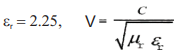
\[ v=\frac{c}{\sqrt{\mu_r\varepsilon_r}}\ \Rightarrow\ \varepsilon_r=\left(\frac cv\right)^2\frac1{\mu_r}=\left(\frac{3\times10^8}{2\times10^8}\right)^2=2.25 \]
How does a charge q oscillating at a certain frequency produce an electromagnetic wave? (1 mark)
Answer: An oscillating charge produces an oscillating electric field, which produces an oscillating magnetic field, which in turn produces an oscillating electric field, and so on; the fields propagate as an electromagnetic wave.
How would you establish an instantaneous displacement current of 1 A in the space between the parallel plates of a 1 \(\mu\)F capacitor? (1 mark)
Answer: By changing the voltage across the capacitor at the rate \( \dfrac{dV}{dt}=\dfrac{I}{C}=\dfrac{1}{10^{-6}}=10^6\ \text{V/s} \).
Name the Maxwell equation, among the four, which shows that a magnetic monopole does not exist. (1 mark)
Answer: Gauss's law for magnetism, \( \oint\vec B\cdot d\vec S=0 \).
Write the unit of \( \mu_0\varepsilon_0 \). (1 mark)
Answer: Since \( \mu_0\varepsilon_0=1/c^2 \), its unit is \( (\text{m/s})^{-2} \).
Give a reason for the decrease or increase in the velocity of light when it moves from air to glass or from glass to air respectively. (1 mark)
Answer: The velocity of light in a medium is \( v=\dfrac{1}{\sqrt{\mu\varepsilon}} \); it depends on the permittivity \(\varepsilon\) and permeability \(\mu\) of the medium. Glass has larger \(\varepsilon\) and \(\mu\) than air, so the velocity decreases in glass and increases again when the light comes back to air.
A parallel plate capacitor made of circular plates each of radius 10 cm has a capacitance of 200 pF. The capacitor is connected to a 200 V a.c. supply with an angular frequency of 200 rad/s. (a) What is the rms value of the conduction current? (b) Is the conduction current equal to the displacement current? (c) Find the peak value of the displacement current. (d) Determine the amplitude of the magnetic field at a point 2 cm from the axis between the plates.
(a) \( I_{rms}=\omega C V_{rms}=200\times200\times10^{-12}\times200=8\ \mu\text{A} \)
(b) Yes, \( I_c=I_d \).
(c) \( I_0=\sqrt2\,I_{rms}=11.3\ \mu\text{A} \)
(d) \[ B=\frac{\mu_0}{2\pi}\frac{r\,I_0}{R^2}=\frac{2\times10^{-7}\times0.02\times11.3\times10^{-6}}{(0.1)^2}\approx4.525\times10^{-12}\ \text{T} \]
Electromagnetic waves with wavelengths (i) \(\lambda_1\) are used to treat muscular strain, (ii) \(\lambda_2\) are used by an FM radio station for broadcasting, (iii) \(\lambda_3\) are produced by bombarding a metal target by high speed electrons, (iv) \(\lambda_4\) are absorbed by the ozone layer of the atmosphere. Identify and name the part of the electromagnetic spectrum to which these radiations belong. Arrange these wavelengths in decreasing order of magnitude. (3 marks)
\( \lambda_1 \): infrared radiation; \( \lambda_2 \): VHF/radio waves; \( \lambda_3 \): X-rays; \( \lambda_4 \): ultraviolet (UV).
\[ \lambda_2>\lambda_1>\lambda_4>\lambda_3 \]
(a) Which of the following, if any, can act as a source of electromagnetic waves? (i) A charge moving with constant velocity. (ii) A charge moving in a circular orbit. (iii) A charge at rest. Give reasons. (b) Identify the part of the electromagnetic spectrum to which waves of frequency (i) \(10^{20}\) Hz and (ii) \(10^{9}\) Hz belong. (3 marks)
(a) (i) It cannot produce e.m. waves, because there is no acceleration.
(ii) It is an accelerated motion, so it can produce e.m. waves.
(iii) It cannot produce e.m. waves, because there is no acceleration.
(b) (i) Gamma rays. (ii) Microwaves.
Ans : 
Ans : 
BX=(4×10⁻⁶T) Sin [(1.57×10⁷m-1)y+(4.5×10¹¹t)]
(c) and wavelength write the expressions for electric field.
Ans :
Ans : Gauss’s theorem of Magnetism
15. Write the unit of µ0ε0 ?
Ans : The velocity of light depends on ε & μ of the medium.
Free study material for Physics
Free CBSE Study Guides: Class 12 Physics Chapter 08 Electromagnetic Waves
Quick Revision Material for Chapter 08 Electromagnetic Waves
Review targeted study resources for Chapter 08 Electromagnetic Waves tailored for Class 12 learners. Utilizing these structured notes and quick-revision tools ensures complete alignment with current CBSE evaluation standards.
Expert Notes and Solved Exam Questions
Designed around the official curriculum, these study guides guarantee standard compliance. Reviewing step-by-step solutions clarifies complex sub-topics within Chapter 08 Electromagnetic Waves and demystifies standard marking schemes for Physics evaluations.
Additional Study Resources for Class 12
For peak performance in upcoming evaluations, integrate official Physics sample papers directly into your study schedule. Follow up your revision by attempting online MCQ tests for Chapter 08 Electromagnetic Waves to refine calculation speed and precision.
FAQs
Our advanced study package for Chapter 08 Electromagnetic Waves includes detailed concepts, diagrams, Mind Maps, and explanation of complex topics to ensure Class 12 students learn as per syllabus for 2026 exams.
The Mind Maps provided for Chapter 08 Electromagnetic Waves act as visual anchors which will help faster recall during high-pressure exams.
Yes, teachers use our Class 12 Physics resources for lesson planning as they are in simple language and have lot of solved examples.
Yes, You can download the complete, mobile-friendly PDF of the Physics Chapter 08 Electromagnetic Waves advanced resources for free.
Yes, our subject matter experts have updated the Chapter 08 Electromagnetic Waves material to align with the rationalized NCERT textbooks and have removed deleted topics and added new competency-based questions.