

Download CBSE Class 12 Physics Useful Resources
Explore structured advanced study materials through the CBSE Class 12 Physics Simple Harmonic Motion Advanced Problems. Tailored for Class 12 learners, utilizing these Physics resources ensures thorough preparation and strengthens foundational knowledge before final CBSE evaluations.
Access CBSE Study Guides and Summaries
View or download the dedicated CBSE Class 12 Physics Simple Harmonic Motion Advanced Problems resource below. Engaging with these advanced study guides under focused conditions ensures continuous academic progress and mastery of the 2026-27 curriculum for Simple Harmonic Motion.
Question. In a simple pendulum, the period of oscillation T is related to length of the pendulum l as:
a. l/T = constant
b. l2/T = constant
c. l/T2 = constant
d. l2/T2 = constant
Answer : C
Question. A plate oscillated with time period ‘T’. Suddenly, another plate put on the first plate, then time period :
a. Will decrease
b. Will increase
c. Will be same
d. None of these
Answer : C
Question. The height of a swing changes during its motion from 0.1 m to 2.5 m. The minimum velocity of a boy who swings in this swing is:
a. 5.4 m / s
b. 4.95 m / s
c. 3.14 m / s
d. Zero
Answer : D
Question. The metallic bob of simple pendulum has the relative density ρ. The time period of this pendulum is T. If the metallic bob is immersed in water, then the new time period is given by:

Answer : D
Question. A simple pendulum is executing S.H.M. with a time period T. if the length of the pendulum is increased by 21% the percentage increase in the time period of the pendulum is:
a. 10%
b. 21%
c. 30%
d. 50%
Answer : A
Question. The mass and diameter of a planet are twice those of earth. The period of oscillation of pendulum on this planet will be: (if it is a second’s pendulum on earth)
a. (1/√2)sec
b. 2√2 sec
c. 2 sec
d. (1/2)sec
Answer : B
Question. A spring of force constant k is cut into two pieces such that one pieces is double the length of the other. Then the long piece will have a force constant of:
a. 2/3k
b. 3/2k
c. 3k
d. 6k
Answer : B
Question. Two bodies M and N of equal masses are suspended from two separate mass less springs of force constants 1 k and 2 k respectively. If the two bodies oscillate vertically such that their maximum velocities are equal, the ratio of the amplitude of M to that of N is:

Answer : D
Question. Two identical springs of constant k are connected in series and parallel as shown in figure. A mass m is suspended from them. The ratio of their frequencies of vertical oscillation will be:

a. 2 : 1
b. 1 : 1
c. 1 : 2
d. 4 : 1
Answer : C
Question. A particle of mass 200 gm executes S.H.M. The restoring force is provided by a spring of force constant 80 N/m.
The time period of oscillations is:
a. 0.31 sec
b. 0.15 sec
c. 0.05 sec
d. 0.02 sec
Answer : A
Question. The length of a spring is l and its force constant is k when a weight w is suspended from it. Its length increases by x. if the spring is cut into two equal parts and put in parallel and the same weight W is suspended from them, then the extension will be:
a. 2x
b. x
c. x/2
d. x/4
Answer : D
Question. A simple pendulum has a bob of mass m and swings with an angular amplitude φ . The tension in the thread is T. At a certain time, the string makes an angle θ with the vertical (θ ≤ φ):
a. T = mg cos, for all values of θ
b. T = mg cos, only for θ = φ
c. T = mg , for θ = cos-1 [ 1/2 (2cos φ + 1)]
d. T will be larger for smaller value θ
Answer : B, C, D
Question. A particle moves in the x–y plane according to the equation: r = (iˆ + ˆj) (Asinωt + Bcosωt)Motion of the particle is:
a. Periodic
b. SHM
c. Along a straight line
d. Along an ellipse
Answer : A, C, D
Question. A linear harmonic oscillator of force constant 2 x 10⁶ N / m times and amplitude 0.01 m has a total mechanical energy of 160 joules. Its:
a. Maximum potential energy is 100 J
b. Maximum K.E. is 100 J
c. Maximum P.E. is 160 J
d. Minimum P.E. is zero
Answer : B, C
Question. Three simple harmonic motions in the same direction having the same amplitude a and same period are superposed. If each differs in phase from the next by 45°, then:
a. The resultant amplitude is (1 + 2)a
b. The phase of the resultant motion relative to the first is 90°
c. The energy associated with the resulting motion is (3 + 2√2) times the energy associated with any single motion
d. The resulting motion is not simple harmonic
Answer : A, C
Question. The phase of a particle executing simple harmonic motion is π / 2 when it has:
a. Maximum velocity
b. Maximum acceleration
c. Maximum energy
d. Maximum displacement
Answer : B, D
Question. Which of the following expressions represent simple harmonic motion?
a. x = A sin(ω t +δ )
b. x = B cos(ω t +φ)
c. x = A tan(ω t +φ )
d. x = A sinω t cosω t
Answer : A, B, D
Question. A particle free to move along the x-axis has potential energy given by U(x) = K[1− exp (−x2 )] for – ∞ ≤ x ≤ +∞. Where K is a positive constant of appropriate dimensions, then:
a. at points away from origin the particle is in unstable equilibrium
b. for any finite non-zero value of x, there is a force directed away from the origin
c. if its total mechanical energy is K/2, it has minimum kinetic energy at the origin.
d. for small displacements for x = 0, the motion is simple harmonic
Answer : D
Assertion and Reason
Note: Read the Assertion (A) and Reason (R) carefully to mark the correct option out of the options given below:
a. If both assertion and reason are true and the reason is the correct explanation of the assertion.
b. If both assertion and reason are true but reason is not the correct explanation of the assertion.
c. If assertion is true but reason is false.
d. If the assertion and reason both are false.
e. If assertion is false but reason is true.
Question. Assertion: In SHM, the motion is to and fro and periodic.
Reason: Velocity of the particle, 2 2 v =ω R − x (where x is the displacement and k is amplitude)
Answer : B
Question. Assertion: The amplitude of an oscillation pendulum decreases gradually with time.
Reason: The frequency of the pendulum decreases with time.
Answer : C
Question. Assertion: In simple harmonic motion, the velocity is maximum when acceleration is minimum.
Reason: Displacement and velocity of SHM differ in phase by π/2
Answer : B
Question. Assertion: The spring constant of a spring is k. When it is divided into n equal parts, then spring constant of one piece is k/n.
Reason: The spring constant is independent of material used for the spring.
Answer : D
Question. Assertion: The frequency of a second pendulum in an elevator moving up with an acceleration half the acceleration due to gravity is 0.612 s–1.
Reason: The frequency of second pendulum does not depend upon acceleration due to gravity.
Answer : C
Question. Assertion: Simple harmonic motion is a uniform motion.
Reason: Simple harmonic motion is the projection of uniform circular motion.
Answer : E
Question. Assertion: Damped oscillation indicates loss of energy.
Reason: The energy loss in damped oscillation may be due to friction, air resistance etc.
Answer : B
Question. Assertion: In a S.H.M., kinetic and potential energies become equal when the displacement is 1 / √2 times the amplitude.
Reason: In SHM, kinetic energy is zero when potential energy is maximum.
Answer : B
Question. Assertion: In extreme position of a particle executing S.H.M., both velocity and acceleration are zero.
Reason: In S.H.M., acceleration always acts towards mean position.
Answer : E
Question. Assertion: Soldiers are asked to break steps while crossing the bridge.
Reason: The frequency of marching may be equal to the natural frequency of bridge and may lead to resonance which can break the bridge.
Answer : A
Comprehension Based
Paragraph –I
Two simple pendulum A and B of lengths 1.69 m and 1.44 m start swinging at the same time form a location where acceleration due to gravity is 10 ms–2 answer the following questions?
Question. How many vibrations pendulum A will complete when it will be out of phase with B?
a. 4
b. 5
c. 6
d. 8
Answer : C
Question. After how much time, the two pendulums will be out of phase?
a. 5.5 s
b. 10.0 s
c. 12.6 s
d. 15.5 s
Answer : D
Question. After how much time, the two pendulums will be in phase again?
a. 11.0 s
b. 20.0 s
c. 25.2 s
d. 31.0 s
Answer : D
Question. What will be the approximate gain or loss of time by pendulum A in a day with respect to second’s pendulum?
a. 11.0 s
b. 20.0 s
c. 25.2 s
d. 31.0 s
Answer : B
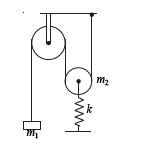
1. Calculate the period of free oscillations of the system shown in the figures if the mass m1 is pulled down a little. Force constant of the spring is k and the masses of the fixed pulleys are negligible.
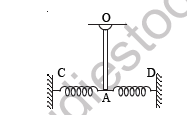
2. Calculate the frequency of oscillations of thin uniform rod of mass m and length l hinged at the upper endas shown in figure. The force constants of the springs are k1 and k2. The mass of the springs are negligible.
3. A ball is suspended by a thread of length l from a point O of a leaning wall, forming an angle α with the vertical. Thread is drawn through β(β > α) away from the wall and released. Assuming elastic collision of the ball with the wall, find the period of oscillations. Also considerthe case α = β.

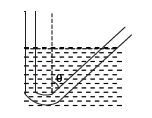
4. Determine the period of oscillations of a liquid of mass m = 200 g and density ρ = 13.6 × 10³ kg m–3 poured into a bent tube whose right arm forms an angle θ =60° with the vertical. The cross-sectional area of the tube is s = 0.5 cm².
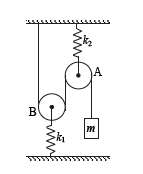
5. A block of mass m is tied to one end of a string which passes over a smooth fixed pulley A and under a light smooth movable pulley B. The end of the string is attached to the lower end of a spring of spring constant k2. The motion of the pulley B is controlled by a spring of spring constant k1. Find the period of small oscillations.
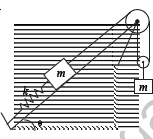
6. Calculate the natural frequency ω of the system shown in figure. There is no friction anywhere and the threads, spring and the pulleys are massless.
7. A pendulum clock is mounted in an elevator car which starts going up with a constant acceleration a(a < g). At a height h the acceleration of the car reverses, its magnitude remaining constant. How soon after the start of the motion will the clock show the right time again?
8. A uniform plate of mass M stays horizontally and symmetrically on two wheels rotating in opposite directions. The separation between the wheels is L. The friction coefficient between each wheel and the plate is μ. Find the time period of oscillation of the plate if it is slightly displaced along its length and released.
9. Three simple harmonic motions of equal amplitudes A and equal time periods in the same direction combine. The phase of the second motion is 60° ahead of the first and the phase of the third motion is 60° ahead of the second. find the amplitude of the resultant motion.
10. A particle is subjected to two simple harmonic motions given by x1 = 2.0 sin(100 πt) and x2 = 2.0 sin (120 πt + π/3) where x is in centimeter and t in second. Find the displacement of the particle at
(a) t = 0.012 s (b) t = 0.02 s
11. A simple pendulum of length l oscillates with an amplitude of 30° on either side of the vertical. Show that the time period lies between 2π g√l/g and 2π √l/g √ π/3.
Please click on below link to download pdf file for CBSE Class 12 Physics Simple Harmonic Motion Advanced Problems.
Free study material for Physics
CBSE Class 12 Physics Study Material: Simple Harmonic Motion
Essential Notes for Class 12 Physics
Access comprehensive study material for Simple Harmonic Motion, including revision notes, concept maps, and high-probability questions. These resources are designed in alignment with the latest 2026 CBSE syllabus for Class 12 Physics to support effective exam preparation.
Verified Solutions for Class 12 Physics
Each resource draws directly from authorized textbooks to maintain academic accuracy. Evaluating solved examples allows Class 12 students to master the formal presentation and answer-writing standards expected in upcoming school exams.
Enhance Accuracy with Online Tests
For peak performance in upcoming evaluations, integrate official Physics sample papers directly into your study schedule. Follow up your revision by attempting online MCQ tests for Simple Harmonic Motion to refine calculation speed and precision.
FAQs
Our advanced study package for Simple Harmonic Motion includes detailed concepts, diagrams, Mind Maps, and explanation of complex topics to ensure Class 12 students learn as per syllabus for 2026 exams.
The Mind Maps provided for Simple Harmonic Motion act as visual anchors which will help faster recall during high-pressure exams.
Yes, teachers use our Class 12 Physics resources for lesson planning as they are in simple language and have lot of solved examples.
Yes, You can download the complete, mobile-friendly PDF of the Physics Simple Harmonic Motion advanced resources for free.
Yes, our subject matter experts have updated the Simple Harmonic Motion material to align with the rationalized NCERT textbooks and have removed deleted topics and added new competency-based questions.