

Official CBSE Study Materials for Class 12 Physics
Access comprehensive study materials and useful resources for Refraction at Curved Surface using the CBSE Class 12 Physics Refraction at Curved Surface Solved Examples. Designed to align with the 2026-27 CBSE academic guidelines, these advanced resources help Class 12 Physics students reinforce core concepts beyond standard textbooks.
Advanced Resources for Physics
Navigate directly to the advanced Physics study materials using the digital viewer below. Each resource pack includes detailed conceptual summaries and solved practice questions, allowing students to instantly reinforce their learning.
CBSE Class 12 Physics Refraction at Curved Surface Solved Examples. Please refer to the examination notes which you can use for preparing and revising for exams. These notes will help you to revise the concepts quickly and get good marks.
Ex.1 An image is formed on the screen by a convex lens. When upper half part of lens is covered with black paper, then :
(A) half image is formed (B) full image is formed (C) intensity of image will be enhanced
(D) intensity of image will be reduced
Sol On covering the lens half by a black paper will reduce the intensity of image and not the part of image. So full image is formed.
Hence correct answer is (B, D).
Ex.2 A convex lens is made out of a substance of 1.2 refractive index. The two surfaces of lens are convex. If this lens is placed in water whose refractive index is 1.33, it will behave as :
(A) convergent lens (B) divergent lens
(C) plane glass plate (D) like a prism
Sol. The focal length of lens in water is given by Hence fl is negative and as such it behaves as a divergent lens.
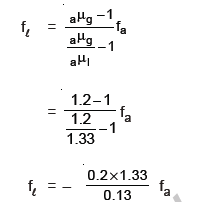
Hence correct answer is (B).
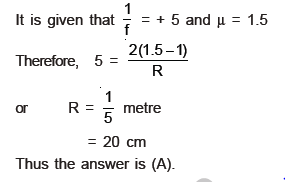
Ex.3 An equiconvex lens has a power of 5 diopter. If it is made of glass of refractive index 1.5 then the radius of the curvature of each
surface will be
(A) 20 cm (B) 10 cm (C) 5 cm (D) zero
Sol. The focal length of an equiconvex lens is given by 1/f= 2(μ −1)/ R
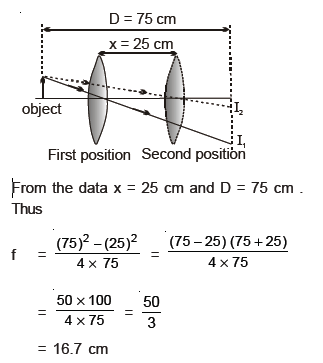
Ex.4 A convex lens when placed in the first position forms a real image of an object on a fixed screen. The distance between the object and the screen is 75 cm. On displacing the lens from first position by 25 cm to the second position, again a real image is formed on the screen. Then the focal length of the lens is(A) 25.0 cm (B) 16.7 cm (C) 50.3 cm (D) 33.3 cm
Sol. The question is based on the conventional method of measurement of focal length by displacement method. According to this method where D is the distance between object and the image, and x is the displacement given to the object.
Ex.5 A bi-convex lens is made from glass of refractive index 1.5 and radius of curvature of both surfaces of the lens is 20 cm. The incident ray parallel to principal axis will be focussed at a distance L cm from lens on principal axis where :
(A) L = 10 (B) L = 20 (C) L = 40 (D) L = 20/3
Sol. From lens formula
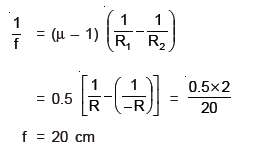
Therefore rays coming parallel to axis will form image at 20 cm.
Hence correct answer is (B).
Ex.6 A convex lens of power 4D is kept in contact with a concave lens of power 3D, the effective power of combination will be :
(A) 7D (B) 4D/3 (C) 1D (D) 3D/4
Sol. Effective power P is= P1 + P2 = 4 – 3 = 1D
Hence correct answer is (C).
Ex.7 The power of a plano-convex lens is P. If this lens is cut longitudinally along its principal axis into tow equal parts and then they are joined as given in the figure. The power of combination will be
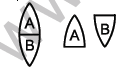
(A) P (B) 2P (C) P/2 (D) zero
Sol. One part of combination will behave as converging lens and the other as diverging lens of same focal length. As such total power will be zero.
Hence correct answer is (D).
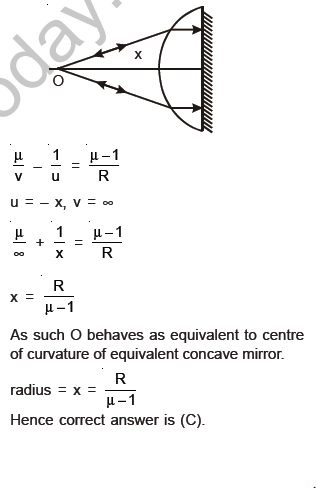
Ex.8 The plane surface of a planoconvex lens is silvered. If radius of curved surface is R and refractive index is μ, then the system behaves like a concave mirror whose radius will be :
(A) R/ μ (B) Rμ (C) μ −1/R (D) R (μ – 1)
Sol. Let the image of an object at O is formed at the same point as shown in figure. The distance of O from the plane surface is x. The rays suffer refraction at first surface (curved) as they reach lens. After wards become parallel and gets reflected form plane surface and so retrace the path and image is
formed at O itself.
Free study material for Physics
Useful Resources and Notes for Class 12 Physics Refraction at Curved Surface
Comprehensive Study Resources for Refraction at Curved Surface
Review targeted study resources for Refraction at Curved Surface tailored for Class 12 learners. Utilizing these structured notes and quick-revision tools ensures complete alignment with current CBSE evaluation standards.
Understanding Marking Schemes
Designed around the official curriculum, these study guides guarantee standard compliance. Reviewing step-by-step solutions clarifies complex sub-topics within Refraction at Curved Surface and demystifies standard marking schemes for Physics evaluations.
Complete Revision for Physics
Wrap up your chapter revision by testing your knowledge against standard objective question formats. Explore our full library of free, up-to-date sample papers and online assessments to secure top grades in your CBSE examinations.
FAQs
Our advanced study package for Refraction at Curved Surface includes detailed concepts, diagrams, Mind Maps, and explanation of complex topics to ensure Class 12 students learn as per syllabus for 2026 exams.
The Mind Maps provided for Refraction at Curved Surface act as visual anchors which will help faster recall during high-pressure exams.
Yes, teachers use our Class 12 Physics resources for lesson planning as they are in simple language and have lot of solved examples.
Yes, You can download the complete, mobile-friendly PDF of the Physics Refraction at Curved Surface advanced resources for free.
Yes, our subject matter experts have updated the Refraction at Curved Surface material to align with the rationalized NCERT textbooks and have removed deleted topics and added new competency-based questions.