

Advanced Study Material for Class 12 Physics: Chapter 01 Electric Charges and Fields
Access comprehensive study materials and useful resources for Chapter 01 Electric Charges and Fields using the CBSE Class 12 Physics Electric Circuits Important Questions. Designed to align with the 2026-27 CBSE academic guidelines, these advanced resources help Class 12 Physics students reinforce core concepts beyond standard textbooks.
Practice Class 12 Physics Resources: Chapter 01 Electric Charges and Fields
View or download the dedicated CBSE Class 12 Physics Electric Circuits Important Questions resource below. Engaging with these advanced study guides under focused conditions ensures continuous academic progress and mastery of the 2026-27 curriculum for Chapter 01 Electric Charges and Fields.
CBSE Class 12 Physics Electric Circuits Important Questions. Please refer to the examination notes which you can use for preparing and revising for exams. These notes will help you to revise the concepts quickly and get good marks.
Comprehension-1
Two persons are pulling a square of side a along one of the diameters horizontally to make it rhombus. Plane of rhombus is always vertical and uniform magnetic field B exist perpendicular to plane. They start pulling at t = 0 and with constant velocity v.
1. The induced emf in the frame when angle at corner being pulled is 60°
(a) Bav (b) 2Bav (c) 2B/av (d) 4B/av
2. If the resistance of the frame is R the current induced is
(a) Bav/2R (b)2Ba v/R (c) Bav/ R (d) Bav/4R
3. Finally square frame reduces to straight wire. The total charge flown is
(a)a2B/ R (b) a2B/2 R (c) 2a2B/R (d) 4a2B/R
Comprehension-2
In case of analysis of circuits, containing cells, resistences and inductances two things are very important one is conservation of charge which leads to the fact that at any junction of circuit incoming current is equal to out going current. The other thing is that sum of voltage drop in a closed loop is equal to zero. Inductors have a unique property by which they oppose the change in magnetic flux linked to them. The voltage drop across resistor is
VR = IR and across inductor is L dt /dI
. In the steady state current through inductor becomes constant which leads to zero voltage drop across inductor. ie. it behaves like short circuit. Refer to circuit given in the figure. E = 10 V, R1 = 2Ω, R2 = 3Ω, R3 = 6Ω and L = 5H.
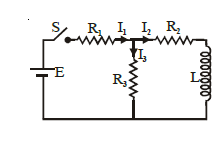
Now answer the following questions
4. The current I1 just after pressing the switch S is
(a) 10/8 A (b) 10/5 A (c) 10/12 A (d) 10/6A
5. The current I1 long after pressing the switch S is
(a) 10/4 A (b) 10/5 A (c) 10/12 A (d) 10/6 A
6. The current I2 long after pressing the switch S is
(a) 10/4 A (b) 10/5 A (c) 10/12 A (d) 10/6A
7. The current through R2 just after releasing the switch S is
(a) 10/4A (b) 10/5 A (c) 10/6 A (d) 10/12 A
Each of the questions given below consists of two statements, an assertion (A) and reason (R).Select the number corresponding to the appropriate alternative as follows
(a) If both A and R are true and R is the correct explanation of A
(b) If both A and R are true but R is not the correct explanation of A
(c) If A is true but R is false
(d) If A is false but R is true
8. A: We prefer a potentiometer with a longer bridge wire.
R: By doing this, the sensitivity of the bridge is increased because for longer wire potential drop per unit length will be small.
9. A: In steady state the branch of the circuit containing a capacitor acts as a open circuit.
R: In steady state, inductor acts as a conductor of zero resistance.
10. A: Ohm’s law and Kirchhoff’s laws are contradictory.
R: Electrons in a conductor have no motion in the absence of a potential difference across it.
11. A: Current is a vector quantity.
R: It obeys vector addition.
12. A: The wire of a potentiometer should be of uniform area of cross section.
R: The resistance per unit length and hence fall of potential per unit of length in case of a uniform wire is constant.
13. A: Fuse wire should have high resistance but low melting point.
R: It is used to control the current.
14. A: Terminal voltage of a cell is greater than e.m.f. of the cell, during charging of the cell.
R: For charging, current must flow from positively to the negative plate inside the cell.
15. A: The element of a heater is very hot, while the conducting wire carrying the current are cold.
R: It happens because the resistance of connecting wires is high as compared to that of element of heater.
16. A: Higher the range greater is the resistance of ammeter.
R: To increase the range of ammeter shunt has to be increased.
17. A: The range of an ammeter can be decreased.
R: The value of shunt, S =− Ig-G/I-Ig . S can not be negative. Therefore range of ammeter can not be decreased.
Please click on below link to download pdf file for CBSE Class 12 Physics Electric Circuits Important Questions.
Free study material for Physics
Physics Class 12 Exam Resources: Chapter 01 Electric Charges and Fields
Essential Notes for Class 12 Physics
Review targeted study resources for Chapter 01 Electric Charges and Fields tailored for Class 12 learners. Utilizing these structured notes and quick-revision tools ensures complete alignment with current CBSE evaluation standards.
Verified Solutions for Class 12 Physics
Each resource draws directly from authorized textbooks to maintain academic accuracy. Evaluating solved examples allows Class 12 students to master the formal presentation and answer-writing standards expected in upcoming school exams.
Enhance Accuracy with Online Tests
For peak performance in upcoming evaluations, integrate official Physics sample papers directly into your study schedule. Follow up your revision by attempting online MCQ tests for Chapter 01 Electric Charges and Fields to refine calculation speed and precision.
FAQs
Our advanced study package for Chapter 01 Electric Charges and Fields includes detailed concepts, diagrams, Mind Maps, and explanation of complex topics to ensure Class 12 students learn as per syllabus for 2026 exams.
The Mind Maps provided for Chapter 01 Electric Charges and Fields act as visual anchors which will help faster recall during high-pressure exams.
Yes, teachers use our Class 12 Physics resources for lesson planning as they are in simple language and have lot of solved examples.
Yes, You can download the complete, mobile-friendly PDF of the Physics Chapter 01 Electric Charges and Fields advanced resources for free.
Yes, our subject matter experts have updated the Chapter 01 Electric Charges and Fields material to align with the rationalized NCERT textbooks and have removed deleted topics and added new competency-based questions.