

Read and download the CBSE Class 10 Social Science Forest and Wild Life Resources Assignment for the 2026-27 academic session. We have provided comprehensive Class 10 Social Science school assignments that have important solved questions and answers for Contemporary India Chapter 2 Forest And Wildlife Resources. These resources have been carefuly prepared by expert teachers as per the latest NCERT, CBSE, and KVS syllabus guidelines.
Solved Assignment for Class 10 Social Science Contemporary India Chapter 2 Forest And Wildlife Resources
Practicing these Class 10 Social Science problems daily is must to improve your conceptual understanding and score better marks in school examinations. These printable assignments are a perfect assessment tool for Contemporary India Chapter 2 Forest And Wildlife Resources, covering both basic and advanced level questions to help you get more marks in exams.
Contemporary India Chapter 2 Forest And Wildlife Resources Class 10 Solved Questions and Answers
INTRODUCTION
Earth is habitat for humans along with other living beings. The earth has immense biodiversity with microorganisms and bacteria, lichens to banyan trees, elephants, whales etc. Human along with all living organisms inclusively form a complex web of ecological systems, where forests play a key role as primary
producers on which other living beings depend. Biodiversity or biological diversity exists in plants and wildlife through multiple network of interdependencies.
7.1 IMPORTANCE OF FOREST FOR HUMAN BEING
(a) Economic importance:
(i) Supports a variety of Industries
(ii) Provide livelihood for many communities
(b) Ecological importance:
(i) Improve the quality of environment
(ii) Modify local climate, controls soil erosion
(iii) Regulate stream flow, provide fertility to the soil
(iv) Provide environmental stability and maintain ecological balance Today, environmental stability and maintenance of ecological balance are more important than the direct economic benefit.
7.2 FLORA AND FAUNA IN INDIA
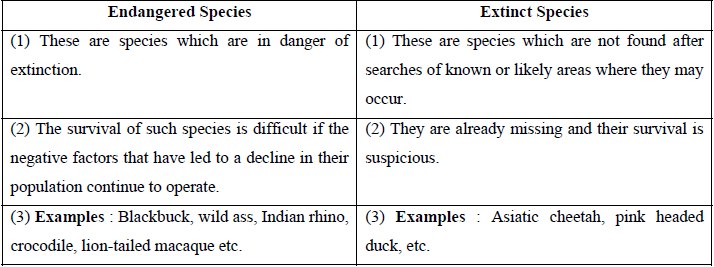
India is one of the world's richest countries in terms of its vast array of biological diversity, and has nearly 8 per cent of the total number of species in the world (estimated to be 1. 6 million). This is possibly twice or thrice the number yet to be discovered. These diverse flora and fauna are under great stress mainly due to insensitivity to our environment. At least 10 per cent of India’s recorded wild flora and 20 per cent of its mammals are on the threatened list. Many of these would now be categorised as critical that is on the verge of extinction like the cheetah, pink-headed duck, mountain quail, forest spotted owlet, and plants like madhuca insignis (a wild variety of mahua) and hubbardia heptaneuron, (a specie of grass). Over 81, 000 species of fauna and 47, 000 species of flora are found in this country so far.
(a) Different Categories of Existing Plants and Animal Species :
Based on the International Union for conservation of Nature and Natural Resources (IUCN), existing plants and animal species can be classified as :-
(b) Negative Factors That Cause Fearful Depletion of the Flora and Fauna :
(i) We have transformed nature into a resource, obtaining directly and indirectly from the forests and wildlife – wood, barks, leaves, rubber, medicines( a chemical compound called ‘taxol’ is extracted from the bark, needles, twigs and roots of the Himalayan Yew, and it has been successfully used to treat some cancers - the drug is now the biggest selling anti-cancer drug in the world. The species is under great threat due to over exploitation), dyes, food, fuel, fodder, manure, etc. thus depleting our forests and wildlife.
(ii) The greatest damage inflicted on Indian forests was during the colonial period.
(iii) Agricultural expansion continues to be one of the major causes of depletion of forest resources. Between 1951 and 1980 over 26,200 sq. km. of forest area was converted into agricultural land.
(iv) Large scale development projects have also contributed significantly to the loss of forests. Since 1951, over 5,000 sq km of forest was cleared for river valley projects.
(v) Mining is another important factor behind deforestation.
(vi) The greatest degrading factors behind the depletion of forest resources are grazing and fuelwood collection.
(vii) Habitat destruction, hunting, poaching, over-exploitation, environmental pollution, poisoning and forest fires are factors, which have led to the decline in India's biodiversity.
(viii) Other important causes are unequal access, inequitable consumption of resources and differential sharing of responsibility for environmental well-being.
(c) Effects :
(i) The biological loss is strongly correlated with the loss of cultural diversity. Such losses have increasingly., marginalised and impoverished many indigenous and other forest-dependent communities.
(ii) Within the poor, women are affected more than men. As these resources gets depleted, the drudgery of women increases and sometimes they have to walk for more than 10 km to collect these resources. This causes serious health problems for women and negligence of home and children which often has serious social implications .
(iii) Over half of India’s natural forests are gone, one-third of its wetlands drained out, 70 percent of its surface water bodies polluted, 40 percent of its mangroves wiped out, and with continued hunting and trade of wild animals and commercially valuable
(iv) The indirect impact of degradation such as severe drought or deforestation induced floods, etc. also hits the poor the hardest. Poverty in these cases is a direct outcome of environmental destruction.
7.3 CONSERVATION OF FOREST AND WILDLIFE IN INDIA
Conservation in the background of rapid decline in wildlife population and forestry has become essential. Conservation preserves the ecological diversity and our life support systems - water, air and soil. It also preserves the genetic diversity of plants and animals for better growth of species and breeding.
(i) In the 1960s and 1970s, conservationists demanded a national wildlife protection programme.
The Indian Wildlife (Protection) Act was implemented in 1972, with various provisions for protecting habitats. An all India list of protected species was also published.
(ii) Central and many state governments have established national parks and wildlife sanctuaries and several projects for protecting specific animals, The tiger, the one-horned rhinoceros, the Kashmir stag or hangul, three types of crocodiles – fresh water crocodile, saltwater crocodile and the Gharial, the Asiatic lion, and others. Most recently the Indian elephant, black buck (chinkara), the great Indian bustard (godawan) and the snow leopard, etc. have been given full or partial legal protection against hunting and trade throughout India.
(iii) In the notification under Wildlife Act of 1980 and 1986, several hundred butterflies, moths, beetles, and one dragonfly have been added to the list of protected species. In 1991, for the first time plants were also added to the list, starting with six species.
(iv) “Project Tiger”, one of the well-publicised wildlife campaigns in the world, was launched in 1973. There are 39 tiger reserves in India covering an area of 32137.14sq.km
7.4 TYPES AND DISTRIBUTION OF FOREST
(a) Types of Forests in India :
According to the density :
(A) Dense forests: Occupies 59% of the total forest cover
(B) Open forests : Occupies 40% of the total forest cover
(C) Mangrove forests (Tidal forests):
Occupies 1% of the total forest cover
(b) Distribution of Forests in India :
Madhya Pradesh has the largest area under permanent forests, constituting 75 per cent of its total forest area. Jammu and Kashmir, Andhra Pradesh, Uttaranchal, Kerala, Tamil Nadu, West Bengal, and Maharashtra have large percentages of reserved forests of its total forest area whereas Bihar, Haryana, Punjab, Himachal Pradesh, Orissa and Rajasthan have a bulk of it under protected forests. All North-eastern states and parts of Gujarat have a very high percentage of their forests as un-classed forests managed by local communities.
7.5 COMMUNITY AND CONSERVATION
(i) Forests are also home to some of the traditional communities. In some areas of India, local communities are struggling to conserve these habitats along with government officials. In Sariska Tiger Reserve, Rajasthan, villagers have fought against mining by citing the Wildlife Protection Act. The inhabitants of five villages in the Alwar district of Rajasthan have declared 1,200 hectares of forest as the Bhairodev Dakav ‘Sonchuri’, declaring their own set of rules and regulations to protect wild life.
(ii) Sacred Groves (the forests of God and Goddesses), are patches of forest or part of large forests which have been left untouched by the local people and any interference with them is banned.
In and around Bishnoi villages in Rajasthan, herds of blackbuck, (chinkara), nilgai and peacocks can be seen as an integral part of the community and nobody harms them.
(iii) The famous Chipko movement in the Himalayas has not only successfully resisted deforestation in several areas but has also shown that community afforestation with indigenous species can be enormously successful.
(iv) The Beej Bachao Andolan in Tehri and Navdanya have shown that adequate levels of diversified crop production without the use of synthetic chemicals are possible and economically viable.
(v) In India Joint Forest Management (JFM) programme furnishes a good example for involving local communities in the management and restoration of degraded forests. The programme has been in formal existence since 1988.
MCQ Questions for Class 10 Social Science Forest and Wildlife Resources
(a) Unclassed forest
Fill In The Blank
True/False
Assertion And Reason
Very Short Questions for Class 10 Social Science Forest and Wildlife Resources
Short Questions for Class 10 Social Science Forest and Wildlife Resources

Long Questions for Class 10 Social Science Forest and Wildlife Resources
Free study material for Social Science
CBSE Class 10 Social Science Contemporary India Chapter 2 Forest And Wildlife Resources Assignment
Access the latest Contemporary India Chapter 2 Forest And Wildlife Resources assignments designed as per the current CBSE syllabus for Class 10. We have included all question types, including MCQs, short answer questions, and long-form problems relating to Contemporary India Chapter 2 Forest And Wildlife Resources. You can easily download these assignments in PDF format for free. Our expert teachers have carefully looked at previous year exam patterns and have made sure that these questions help you prepare properly for your upcoming school tests.
Benefits of solving Assignments for Contemporary India Chapter 2 Forest And Wildlife Resources
Practicing these Class 10 Social Science assignments has many advantages for you:
- Better Exam Scores: Regular practice will help you to understand Contemporary India Chapter 2 Forest And Wildlife Resources properly and you will be able to answer exam questions correctly.
- Latest Exam Pattern: All questions are aligned as per the latest CBSE sample papers and marking schemes.
- Huge Variety of Questions: These Contemporary India Chapter 2 Forest And Wildlife Resources sets include Case Studies, objective questions, and various descriptive problems with answers.
- Time Management: Solving these Contemporary India Chapter 2 Forest And Wildlife Resources test papers daily will improve your speed and accuracy.
How to solve Social Science Contemporary India Chapter 2 Forest And Wildlife Resources Assignments effectively?
- Read the Chapter First: Start with the NCERT book for Class 10 Social Science before attempting the assignment.
- Self-Assessment: Try solving the Contemporary India Chapter 2 Forest And Wildlife Resources questions by yourself and then check the solutions provided by us.
- Use Supporting Material: Refer to our Revision Notes and Class 10 worksheets if you get stuck on any topic.
- Track Mistakes: Maintain a notebook for tricky concepts and revise them using our online MCQ tests.
Best Practices for Class 10 Social Science Preparation
For the best results, solve one assignment for Contemporary India Chapter 2 Forest And Wildlife Resources on daily basis. Using a timer while practicing will further improve your problem-solving skills and prepare you for the actual CBSE exam.
FAQs
You can download free PDF assignments for Class 10 Social Science Contemporary India Chapter 2 Forest And Wildlife Resources from StudiesToday.com. These practice sheets have been updated for the 2026-27 session covering all concepts from latest NCERT textbook.
Yes, our teachers have given solutions for all questions in the Class 10 Social Science Contemporary India Chapter 2 Forest And Wildlife Resources assignments. This will help you to understand step-by-step methodology to get full marks in school tests and exams.
Yes. These assignments are designed as per the latest CBSE syllabus for 2026. We have included huge variety of question formats such as MCQs, Case-study based questions and important diagram-based problems found in Contemporary India Chapter 2 Forest And Wildlife Resources.
Practicing topicw wise assignments will help Class 10 students understand every sub-topic of Contemporary India Chapter 2 Forest And Wildlife Resources. Daily practice will improve speed, accuracy and answering competency-based questions.
Yes, all printable assignments for Class 10 Social Science Contemporary India Chapter 2 Forest And Wildlife Resources are available for free download in mobile-friendly PDF format.