

School Assignments for Class 10 Social Science: Democratic Politics II Chapter 03 Gender Religion And Caste
Explore structured practice materials through the CBSE Class 10 Social Science Gender Religion and Caste Assignment Set 02. Tailored for Class 10 learners, utilizing these Social Science assignments ensures thorough preparation and strengthens foundational knowledge before final CBSE evaluations.
Practice Class 10 Social Science Assignments: Democratic Politics II Chapter 03 Gender Religion And Caste
View or download the dedicated CBSE Class 10 Social Science Gender Religion and Caste Assignment Set 02 resource below. Engaging with these assignments under focused study conditions ensures continuous academic progress and mastery of the 2026-27 curriculum.
Objective Questions
INTRODUCTION
In this chapter, we will study about the major three kinds of social differences that can take the forms of social divisions and inequalities. These are social difference based on gender, religion and caste.
16.1 GENDER AND POLITICS
(a) Sexual division of labour :
(i) The sexual division of labour has been under practice for time immemorial.
(ii) The result of this division of labour is that women have been confined to a private domain of family, while the public domain has been monopolised by the men.
(iii) Although women constitute half of the population of the world, their role in public life especially in politics is minimum in most of the societies.
(iv) Though the role of women in world politics is increasing but still it is male-dominating.
(b) Feminist Movements :
Movements which are organised by various women organisations to create equality for women in personal and family life have been termed as Feminist Movement.
(i) They demanded equal rights for women in all spheres of life.
(ii) There were agitations in different countries for the extension of voting rights to women.
(iii) They demanded enhancing the political and legal status of women.
(iv) They demanded improvement in the educational and career opportunities for the women.
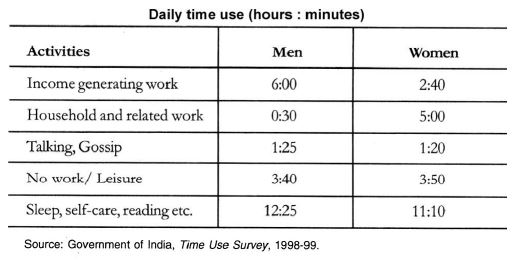
(c) Different aspects of life in which women are discriminated :
(i) Literacy rate : The literacy rate among women is only 54 percent as compared to 76 percent among men. Similarly, a smaller proportion of girl students go for higher studies because parents prefer to spend their resources for their boys’ education than spending equally on their daughters.
(ii) Unpaid work : The proportion of women among the highly paid and valued jobs is still very small. Though on an average Indian woman works one hour more than an average man everyday but most of them are not paid equally and therefore, their work is often not valued. The Equal Wages Act provides that equal wages should be paid to equal work. However in almost all areas of work, from sports and cinema, to factories and fields, women are paid less than men, even when both do exactly the same work.
(iii) Sex ratio : In many parts of India, parents prefer to have sons and find ways to have the girl child aborted before she is born. This has led to a decline in child sex-ratio, mere 940 girl child per thousand boys.
(iv) Domestic violence : There are reports of various kinds of harassment, exploitation and violence against women. Both urban as well as rural areas have become unsafe for women.
They are not safe even within their own home from beating and other forms of domestic violence.
(d) Women’s Political Representation :
“In India, the proportion of women in
legislature has been very low.”
The percentage of elected women members in Lok Sabha has never reached even 10 percent of its total strength. Their share in the state assemblies is less than 5 percent. In this respect, India is among the bottom group of nations in the world. In the government, cabinets are largely all male even when a woman becomes the Chief Minister or the Prime Minister.
One way to solve this problem is to make it legally binding to have a fair proportion of women in the elected bodies. This is what the Panchayati Raj has done in India. One-third of seats in local government bodies–in Panchayats and Municipalities– are now reserved for women. Now there are more than 10 lakh elected women representatives in rural and urban local bodies. At least one–third of seats in the Lok Sabha and State Assemblies should be reserved for Women. A bill with this proposal has been pending before the Parliament for more than a decade.
16.2 RELIGION, COMMUNALISM AND POLITICS
(a) Different considerations about religion and politics :
(i) Gandhiji’s view regarding Religion and Politics : Gandhiji used to say that religion can never be separated from politics. What he meant by religion was not any particular religion like Hinduism or Islam, but moral values that form all religions. He believed that politics must be guided by ethics drawn from religion.
(ii) Humanist, Religion and Politics : Human rights groups in our country have argued that most of the victims of communal riots in our country are people from religious minorities. They have demanded that the government should take special steps to protect religious minorities.
(iii) Women, Religion and Politics : Women’s movement has argued that family laws of all religions discriminate against women. So they have demanded that government should change these laws to make them more equitable.
Conclusion :
(A) All these instances involve a relationship between religion and politics. But they do not seem very wrong or dangerous. Ideas, ideals and values drawn from different religions can and perhaps should play a role in politics. People should be able to express in politics their needs, interests and demands as a member of a religious community.
(B) Those who hold political power should sometimes be able to regulate the practice of religion so as to prevent discrimination and oppression. These political acts are not wrong as long as they treat every religion equally.
(b) Communalism :
Communalism is a situation when a particular community tries to promote its own interest at the cost of other communities.
The communalism problem becomes acute when :
(i) Religion is seen as the basis of the nation.
(ii) When one religion and its followers are discriminated against by another.
(iii) When people start believing that beliefs of one religion are superior to those of other religion.
(iv) When the demands of one religious group are formed in opposition to another.
(v) When state power is used to establish domination of one religious group over the rest.
(c) Communal Politics :
Religion is used in politics in exclusive and partisan terms. This manner of using religion in politics is communal politics.
Communal politics is based on the idea that religion is the principal basis of social community.
Communalism involves thinking along the following lines :
(i) The followers of a particular religion must belong to one community.
(ii) Their fundamental interests should be the same. Any difference that they may have is irrelevant or trivial for community life.
(iii) Communalism also follows that people who follow different religions cannot belong to the same social community. If the followers of different religions have some commonalities, these are superficial and immaterial. Their interests are bound to be different and involve a conflict.
(iv) Sometime communalism leads to the belief that people belonging to different religions cannot live as equal citizens within one nation. Either one of them has to dominate the rest or they have to form different nations.
(d) Various forms of communalism in politics :
The most common expression of communalism is in everyday beliefs. These routinely involve religious prejudices, stereotypes of religious communities and belief in the superiority of one’s religion over other religions.
A communal mind often leads to a quest for political dominance of one’s own religious community.
For those belonging to majority community, this takes the form of majoritarian dominance. For those belonging to the minority community, it can take the form of a desire to form a separate political unit.
Political mobilisation on religious lines is another frequent form of communalism. This involves the use of sacred symbols, religious leaders, emotional appeal and plain fear in order to bring the followers of one religion together in the political arena. In electoral politics this often involves special appeal to the interests or emotions of voters of one religion in preference to others.
Sometimes communalism takes its most ugly form of communal violence, riots and massacre. India and Pakistan suffered some of the worst communal riots at the time of the Partition. The post- Independence period also saw large scale communal violence.
(e) Secular state :
There is no official religion for the Indian state. Unlike the status of Buddhism in Sri Lanka, that of Islam in Pakistan and that of Christianity in England, our Constitution does not give a special status to any religion.
(i) The Constitution provides to all individuals and communities freedom to profess, practice and propagate any religion, or not to follow any.
(ii) The Constitution prohibits discrimination on grounds of religion.
(iii) The Constitution allows the state to intervene in the matters of religion in order to ensure equality within religious communities. For example, it bans untouchability. Understood in this sense, secularism is not just an ideology of some parties or persons. This idea constitutes one of the foundations of our country.
16.3 CASTE AND POLITICS
(a) Reasons for the decline of the caste system :
Under the caste system, work is divided among people on the basis of their caste. Occupations are passed from generation to generation. Every caste group has exclusive hereditary occupations.
Members of the same caste are believed to be from the same community. They are allowed to marry only within their community and cannot even eat with the members of other castes.
However, the caste system is declining in India. Many political leaders and social reformers like Mahatama Gandhi, Jyotiba Phule worked to end the caste system in India. They worked to establish a society where caste inequalities are absent.
Due to such measures and due to increase in education and awareness, the caste system is on a decline in India. With economic development, urbanization and growth in literacy, the old ideas of the caste system are breaking down. The capability of a person is more important now, than his caste. The opportunities available to people do not differentiate on the basis of caste anymore.
(b) Caste has not disappeared from contemporary India :
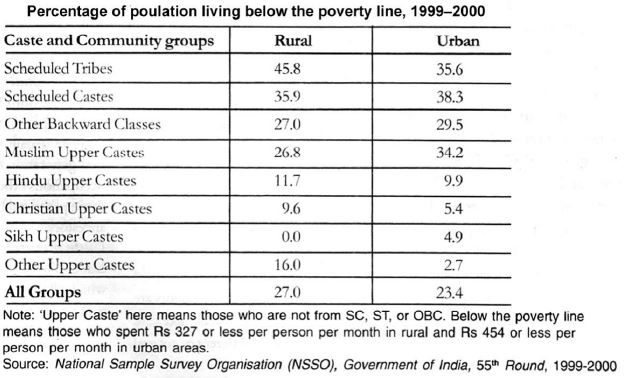
Some of the older aspects of caste have persisted. Even now most people marry within their own caste or tribe. Untouchability has not ended completely, despite constitutional prohibition. Effects of centuries of advantages and disadvantages continue to be felt today. There is a disproportionately large presence of ‘upper caste’ among the urban middle classes in our country. Caste continues to be closely linked to economic status.
(c) Various forms of Caste in Politics :
When parties choose candidates in elections, they keep in mind the caste composition of the electorate and nominate candidates from different castes so as to muster necessary support to win elections. When governments are formed, political parties usually take care that representatives of different castes and tribes find a place in it.
(i) Political parties and candidates in elections make appeals to caste sentiment to muster support. Some political parties are known to favour some castes and are seen as their representatives.
(ii) Universal adult franchise and the principle of one–person – one – vote compelled political leaders to gear up to the task of mobilising and securing political support. It also brought new consciousness among the people of castes that were hitherto treated as inferior and low.
(d) Caste alone cannot determine election results in India :
(i) No parliamentary constituency in the country has a clear majority of one single caste. So, every candidate and party needs to win the confidence of more than one caste and community to win elections.
(ii) No party wins the votes of all the voters of a caste or community. When people say that a caste is a ‘vote bank’ of one party, it usually means that a large proportion of the voters from that caste vote for that party.
(iii) Many political parties may put up candidates from the same caste (if that caste is believed to dominate the electorate in a particular constituency). Some voters have more than one candidate from their caste while many voters have no candidate from their caste.
(iv) The ruling party and the sitting MP or MLA frequently lose elections in our country. That could not have happened if all castes and communities were frozen in their political preferences.
(v) The voters have strong attachment to political parties which is often stronger than their attachment to their caste or community.
(vi) People within the same caste or community have different interests depending on their economic condition.
(vii) Rich and poor or men and women from the same caste often vote very differently.
(viii) People’s assessment of the performance of the government and the popularity rating of the leaders matter and are often decisive in elections.
(e) Caste system a great threat to Indian democracy :
Most of the politicians and scholars accept that the caste system has become very complicated resently. It has become a great threat to Indian democracy. Caste system implies denial of equality and freedom, and hence in contrary to the principles of equality. As such it is passing a big threat to our democratic policy.
(i) The politics of caste as its worst is being practiced now-a-days.
(ii) This type of politics is responsible for creating social tension, violence and fear psychosis.
(iii) It has given rise to instability in the political system of our country.
(f) Steps taken by the government to do away with casteism :
(i) Untouchability has been abolished by Indian Constitution and it has been made a criminal offence.
(ii) The fundamental rights guaranteed in our Constitution provide equality and freedom to all citizens.
(iii) Reservation has been provided to scheduled castes, scheduled tribes and people of the other backward castes in educational institutions, jobs and legislatures.
(iv) As per Directive Principles, State is duty-bound to promote and protect the interest of scheduled castes and scheduled tribes.
(v) Education is provided to more and more people. Inter-caste marriages are being welcomed by most of the state governments, progressive parties and leaders.
Choose the Correct Option
Question : Which one of the following social reformers fought against caste inequalities.
(a) Periyar Ramaswami Naiker
(b) Swami Dayanand Saraswati
(c) Raja Ram Mohan Roy
(d) Ishwar Chandra Vidyasagar
Answer : A
Question : Which one of the following was the view of Mahatma Gandhi about religion ?
(a) He was in favour of Hinduism.
(b) He was an ardent supporter of Muslim Religion.
(c) By religion, Gandhi meant for moral values that inform all religions.
(d) He said that India should adopt Christianity.
Answer : C
Question : Name any two political leaders who fought against caste inequalities.
(a) Dr. Manmohan Singh and Smt. Pratibha Devi Singh Patil.
(b) Mr. Nitesh Kumar and Mr. Narendra Modi.
(c) Dr.S. Radhakrishnan and Shri Morarji Desai
(d) Mahatma Gandhi and B.R. Ambedkar
Answer : D
Question : What is the average child sex ratio in India ?
(a) 923
(b) 926
(c) 935
(d) 933
Answer : D
Question : Which one of the following refers to gender division ?
(a) The hierarchical unequal roles assigned to man and woman by the society.
(b) Biological difference between man and woman.
(c) The ratio of male child and female child.
(d) The division between male labourers and female labourers.
Answer : A
Question : Which one of the following is the basis of communal politics?
(a) People of different religions may have the same interests.
(b) People of different religions have different interests that involve conflicts.
(c) People of different religions live in mutual co-operation.
d) People who follow different religions belong to the same social community.
Answer : B
Question : Name any two countries where women’s participation in public life is very high.
(a) Sri Lanka and Nepal
(b) Pakistan and Bhutan
(c) Sweden and Finland
(d) South Africa and Maldives
Answer : C
Question : What is the literacy rate among women and men respectively in India?
(a) 54% and 76%
(b) 46% and 51%
(c) 76% and 85%
(d) 37% and 54%
Answer : A
Question : Which one of the following is a form of communalism?
(a) Communal Unity and integrity.
(b) Communal fraternity.
(c) Communal violence, riots and massacre.
(d) Communal harmony.
Answer : C
Question : Which one of the following refers to a feminist?
(a) The female labourers
(b) The employer who employs female workers
(c) A woman who does not believe in equal rights for women.
(d) A woman or a man who believes in equal rights and opportunities for woman and man.
Answer : D
Very Short Answer Type Questions
Question : How much representation do local governments provide for women in India?
or
How many seats are reserved for the women in the Indian local self-government?
Answer : One-Third
Question : At which level of government in India 1/3rd of seats are reserved for women?
Answer : Local self government bodies.
Short Answer Type Questions
Question : Explain the factors responsible for low female literacy rate.
Answer : (1)Indian society is basically a patriarchal society where boys are given preference over the girls.
(2) The parents do not expense equally for both boys and girls. Boys are given more attention.
(3) It is a prevailing stereotype for women that even after getting well education, they have to do household jobs.
Question. Communalism poses a great threat to the Indian Democracy?
Answer : It leads to violence and riots
Human rights are threateened by communalism
Destroys the secular values of the country
Communalism will disintegrate nation.
Question. What are the major demands of feminist movements?
Answer : Equal right to women as men in all spheres of life.
Voting rights
Enhancement in political and legal status of women.
Improvement in educational and career opportunity.
Question. What are the positive impacts of caste politics?
Answer : Expression in caste difference in politics gives many disadvantaged communities
the space to demand their share of power.
It helped Dalits and OBCs to gain better access to decision making.
Political agencies has been demanding for an end to discrimination against particular
castes,for more diginity and more access to land,resources and oppertunities.
Question. Write about the constitutional provisions that makes India a secular country.
Answer : There is no official religion for India.
Constitution does not give special status to any religion.
The constitution grants the right to practice and propagate and practice any religion.
Constitution prohibits discrimination on grounds of religion.
State is having the right to intervene in the matters of religion inorder to ensure equality within religious communities.
Question. Caste alone cannot determine Indian elections?
Answer : No parliamentry constituency in the country has a clear majority of one single caste.
No party wins the votes of all the voters of a caste or a community.
The voters attatchment to his party and the party ideology can be stronger than his attatchment to his caste group.
Question : What do you mean by secular state ? Give any two provisions that make India a secular state ?
Answer : A nation or state which keeps itself equidistant from different religious issues, and does not give protection to a particular religion.
(1) India is a country of diverse religions. It was the religions on the basis of which India was divided. Unlike Pakistan Buddhism in Sri Lanka. Christianity in England.
(2) The constitution provides to all individuals and communities freedom to profess practice and propagate any religion.
Long Answer Type Questions
Question. What are the factors which promote communalism?
Answer : Believing that one religion is superior to those of other religions.
When demands of one religious groups are formed in opposition to other.
When state power is used to establish domination of one religious group over other.
Question. Explain the factors which are responsible for breaking down the old notions of caste hierarchy?
Answer : Economic development ,urbanisation,growth rate of education and literacy,occupational mobility and weakening of the position of land lords in the villages results in the breaking
Down of old notions of csate hierarchy.
The Constitution of India prohibited any caste based discrimination and laid the foundations of policies to reverse the injustices of the caste system.
Spread of education has brought awareness among people,and broadened their out look.
Caste system weakened due to the efforts of political leaders and social reformers like Jyotiba Phule,B.R. Ambedkar P.R.Naiker .
Question : Suggest any three measures to enhance the participation of woman in politics.
Answer : (i) Women should be given proper education, so that they are aware of their rights and duties and participate actively in politics.
(ii) Every woman should be self reliant, so that she enjoys a respectable position in the society and is confident about her meaningful contribution in politics as well.
(iii) It should be legally binding to have a fair proportion of woman in the elected bodies. That is why 1/3rd of seats in local government bodies in panchayats and in municipalities are now reserved for women.
Question : What was the Feminist Movement? Explain the political demands of the Feminist Movement in India.
Answer : Feminist Movement was a radical movement which demanded equality for women in personal and family life and also in politics, society and education field.
The political demands of the Feminist Movements in India were :
(i) More women representatives in local government.
(ii) More political representatives for women by having elected women representatives.
(iii) Reserving at least one-third of the seats in Lok Sabha and Legislative Assemblies for women.
(iv) They demanded equal pay as men for same work done.
(v) They demanded same inheritance rights for daughters as given to sons.
Question : How can communalism pose a great threat to Indian democracy?
Answer : Communalism can pose a great threat to Indian democracy as :
(i) It leads to the dangerous belief that people belonging to different religion cannot live as equal citizens within one nation. Either group has to dominate the rest or they have to form a different nation.
(ii) Any attempt to bring followers of one religion together in the context of politics bound to suppress many voices within that society.
Question : Describe the three factors which determine the outcome of the politics of social divisions.
Answer : Factors that decide the outcome of the politics of social divisions are
(i) When the people's perception of their identities is strict, the accommodation of other identities becomes difficult in the group.
(ii) Representation of a community by political leaders : While representing a community, if politicians raise demands that are constitutional, then, it is easier to accommodate those demands.
(iii) The government's reaction : If the reasonable demands of a community are suppressed by the government, then it leads to social divisions, which in turns threatens the integrity of the country.
Question : The focus on caste in politics can sometimes give an impression that elections are all about caste and nothing else. Do you agree? Explain.
Answer : No, I do not agree. The focus on caste in politics can sometimes give an impression that elections are all about caste and nothing else is not correct because–
(i) No parliamentary constituency in the country has a clear majority of one single caste. So, every candidate and party needs to win the confidence of more than one caste and community to win elections.
(ii) No party wins the votes of all voters of a caste or community. When people say that a cast is a 'vote bank' of one party, it usually means that a large proportion of the voters from the caste vote for the party, not all.
(iii) Many political parties may put up candidates from the same caste (if that caste is believed to dominate the electorate in a particular constituency). Some voters may have more than one candidate from their caste while many voters may have no candidate from their caste.
(iv) The ruling party or the sitting M.P. or M.L.A. frequently lose elections in our country. That could not have happened if all castes or communities were frozen in their political preferences.
Question : Describe the positive and negative aspects of relationship between caste and politics.
Answer : Positive aspects :
(i) It gives the disadvantaged group the opportunity to demand a share in power and decision-making.
(ii) Many political parties take up the issue of ending caste discrimination.
(iii) Measures for uplifting the status of the backward castes can be undertaken seriously.
Negative aspects :
(i) Caste-based politics diverts attention from main issues such as poverty, corruption, etc.
(ii) Caste based politics leads to tensions, conflicts and violence amongst caste segments.
Free study material for Social Science
Download Practice Assignments: Class 10 Social Science Democratic Politics II Chapter 03 Gender Religion And Caste
Download Assignment: Democratic Politics II Chapter 03 Gender Religion And Caste (Class 10 Social Science)
Review targeted chapter assignments for Class 10 Social Science Democratic Politics II Chapter 03 Gender Religion And Caste. Built according to official CBSE guidelines, these downloadable problem sets help students build accuracy and prepare effectively for school tests.
Maximize Exam Scores with Chapter Practice Sets
- Curriculum Standards: Assignments match modern CBSE sample formats to ensure relevant preparation.
- Thorough Revision: Detailed problem sets reinforce core concepts and eliminate conceptual weak spots.
- Execution Speed: Timed practice with assignment sets sharpens overall response timing.
Effective Strategy for Class 10 Social Science Assignments
- Initial Reading: Begin by reading the NCERT book for Class 10 Social Science to build a baseline understanding.
- Independent Testing: Attempt assignment questions unassisted, then verify work using provided answer keys.
- Supplementary Aids: Leverage revision notes and worksheets whenever you encounter difficult topics.
FAQs
You can download free PDF assignments for Class 10 Social Science Democratic Politics II Chapter 03 Gender Religion And Caste from StudiesToday.com. These practice sheets have been updated for the 2026-27 session covering all concepts from latest NCERT textbook.
Yes, our teachers have given solutions for all questions in the Class 10 Social Science Democratic Politics II Chapter 03 Gender Religion And Caste assignments. This will help you to understand step-by-step methodology to get full marks in school tests and exams.
Yes. These assignments are designed as per the latest CBSE syllabus for 2026. We have included huge variety of question formats such as MCQs, Case-study based questions and important diagram-based problems found in Democratic Politics II Chapter 03 Gender Religion And Caste.
Practicing topicw wise assignments will help Class 10 students understand every sub-topic of Democratic Politics II Chapter 03 Gender Religion And Caste. Daily practice will improve speed, accuracy and answering competency-based questions.
Yes, all printable assignments for Class 10 Social Science Democratic Politics II Chapter 03 Gender Religion And Caste are available for free download in mobile-friendly PDF format.