

Read and download the CBSE Class 10 Social Science Geography Water Resources Hindi Assignment for the 2026-27 academic session. We have provided comprehensive Class 10 Geography school assignments that have important solved questions and answers for Contemporary India Chapter 3 Water Resources. These resources have been carefuly prepared by expert teachers as per the latest NCERT, CBSE, and KVS syllabus guidelines.
Solved Assignment for Class 10 Geography Contemporary India Chapter 3 Water Resources
Practicing these Class 10 Geography problems daily is must to improve your conceptual understanding and score better marks in school examinations. These printable assignments are a perfect assessment tool for Contemporary India Chapter 3 Water Resources, covering both basic and advanced level questions to help you get more marks in exams.
Contemporary India Chapter 3 Water Resources Class 10 Solved Questions and Answers
Water Resources Summary Class 10 Social Science
Fresh water:
96.5 per cent of the total volume of world’s water is estimated to exist as oceans and only 2.5 per cent exists as fresh water. 70 per cent of the fresh water occurs as ice sheets and glaciers in Antarctica, Greenland and the mountainous regions of the world. Less than 30 per cent is stored as groundwater in the world’s acquirers. Fresh water is mainly obtained from surface run off and ground water. This is continually being renewed and recharged through the hydrological cycle. All the water moves within the hydrological cycle making water a renewable resource.
Three fresh water sources are:
Precipitation—from rainfall; Surface water—in rivers, lakes, etc.; Ground water—water stored in underground acquirers which gets recharged by rainfall.
Water scarcity:
Water scarcity means shortage of water. It is usually associated with regions having low rainfall or drought prone areas.
There are many other reasons which lead to scarcity of water:
Large growing population; In the agricultural sector, water resources are being over-exploited to expand irrigated areas and dry- season agriculture; More water required for irrigation purposes to facilitate higher food production, i. e., for doing multiple cropping and for HYV seeds; There is greater demand for water with growing urbanization and industrialization; An unequal access to water among different social groups; The quality of water is deteriorating, i.e., getting polluted by domestic and industrial wastes, chemical fertilizers and pesticides used in agriculture; Excessive use of water by industries which also require water to generate hydro-electric power to run them; and Over exploitation of water in the urban areas.
Adverse effects of over-exploitation of ground water resources:
● Pumping out more water from under the ground may lead to falling ground water levels.
● It will adversely affect water availability.
● This, in turn, will affect our agriculture and food security of the people.
● Impoverishment of water resources may adversely affect the ecological cycle.
Main causes of water pollution:
Domestic wastes, especially urban sewers; industrial wastes are disposed off in the water without proper treatment; chemical effluents from industries and from agricultural sector; and many human activities, e.g., religious rituals and immersing of idols, etc. in the water also pollute water.
Measures for water conservation:
● Do not overdraw the ground water, recharge it by techniques like rainwater harvesting; tapping rainwater in reservoirs, watershed development programmes, etc.
● Avoid wastage of water at all levels and do not pollute the water.
● Adopting water conserving techniques of irrigation, e.g., drip irrigation and sprinklers etc., especially in dry areas.
A dam is a barrier across flowing water that obstructs, directs or retards the flow, creating a reservoir, lake or impoundment. A dam is the reservoir and not the whole structure.
Multipurpose river valley projects —’The Temples of Modem India’:
Jawaharlal Lai Nehru pro-claimed that multipurpose projects are ‘The Temples of Modem India’, because they were thought of as the vehicle that would lead the nation to development and progress. He believed that these projects with their integrated water resource management approach would integrate development of agriculture and the village economy with rapid industrialization and growth of the urban economy.
Advantages:
● They bring water to those areas which suffer from water scarcity and also provide water for irrigation;
● These projects generate electricity for industries and our homes;
● They help in controlling floods;
● These projects can be used for recreation, inland navigation and fish breeding.
Disadvantages:
● Damming of rivers affects their natural flow causing poor sediment flow;
● Excessive sedimentation at the bottom of the reservoir;
● Lack of sediments results in (a) rockier stream bed and (b) poorer habitat for the rivers aquatic life;
● The reservoirs submerge the existing vegetation and soil, leading to its decomposition over time;
● They affect the fertility levels of the soil;
● Cause large scale displacement of local communities.
Traditional rainwater harvesting methods practiced in different parts of the country:
● In mountainous areas ‘Guls’ and ‘Kuls’ the diversion channels were built for agriculture.
● ‘Rooftop rainwater harvesting’ was commonly practiced to store drinking water, especially in Rajasthan.
● Inundation channels for irrigation were developed in the flood plains of West Bengal.
● In arid and semi-arid regions, agricultural fields were converted into rain fed storage structures, e.g., ‘Khadins’ in Jaisalmer and ‘Johads’ in other parts of Rajasthan.
● In semi-arid and arid regions of Rajasthan, particularly in Bikaner, Phalodi and Banner, all the houses had underground tanks or ‘tankas’ built inside the house for storing drinking water. They were a part of the well-developed rooftop rainwater harvesting system. ‘
Narmada Bachao Andolan’:
Narmada Bachao Andolan or Save Narmada Movement is an NGO that mobilized tribal people, farmers, environmentalists and human rights activists against the Sardar Sarovar Dam being built across the Narmada river in Gujarat. The movement originally focused on environmental issues related to submerging of trees under the dam water. Recently its aim has been to enable the displaced poor people to get full rehabilitation facilities from the government.
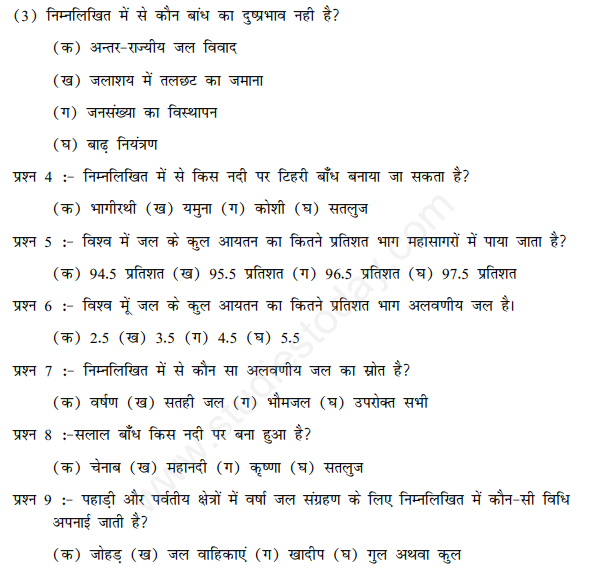
CBSE Class 10 Geography Contemporary India Chapter 3 Water Resources Assignment
Access the latest Contemporary India Chapter 3 Water Resources assignments designed as per the current CBSE syllabus for Class 10. We have included all question types, including MCQs, short answer questions, and long-form problems relating to Contemporary India Chapter 3 Water Resources. You can easily download these assignments in PDF format for free. Our expert teachers have carefully looked at previous year exam patterns and have made sure that these questions help you prepare properly for your upcoming school tests.
Benefits of solving Assignments for Contemporary India Chapter 3 Water Resources
Practicing these Class 10 Geography assignments has many advantages for you:
- Better Exam Scores: Regular practice will help you to understand Contemporary India Chapter 3 Water Resources properly and you will be able to answer exam questions correctly.
- Latest Exam Pattern: All questions are aligned as per the latest CBSE sample papers and marking schemes.
- Huge Variety of Questions: These Contemporary India Chapter 3 Water Resources sets include Case Studies, objective questions, and various descriptive problems with answers.
- Time Management: Solving these Contemporary India Chapter 3 Water Resources test papers daily will improve your speed and accuracy.
How to solve Geography Contemporary India Chapter 3 Water Resources Assignments effectively?
- Read the Chapter First: Start with the NCERT book for Class 10 Geography before attempting the assignment.
- Self-Assessment: Try solving the Contemporary India Chapter 3 Water Resources questions by yourself and then check the solutions provided by us.
- Use Supporting Material: Refer to our Revision Notes and Class 10 worksheets if you get stuck on any topic.
- Track Mistakes: Maintain a notebook for tricky concepts and revise them using our online MCQ tests.
Best Practices for Class 10 Geography Preparation
For the best results, solve one assignment for Contemporary India Chapter 3 Water Resources on daily basis. Using a timer while practicing will further improve your problem-solving skills and prepare you for the actual CBSE exam.
FAQs
You can download free PDF assignments for Class 10 Geography Chapter Contemporary India Chapter 3 Water Resources from StudiesToday.com. These practice sheets have been updated for the 2026-27 session covering all concepts from latest NCERT textbook.
Yes, our teachers have given solutions for all questions in the Class 10 Geography Chapter Contemporary India Chapter 3 Water Resources assignments. This will help you to understand step-by-step methodology to get full marks in school tests and exams.
Yes. These assignments are designed as per the latest CBSE syllabus for 2026. We have included huge variety of question formats such as MCQs, Case-study based questions and important diagram-based problems found in Chapter Contemporary India Chapter 3 Water Resources.
Practicing topicw wise assignments will help Class 10 students understand every sub-topic of Chapter Contemporary India Chapter 3 Water Resources. Daily practice will improve speed, accuracy and answering competency-based questions.
Yes, all printable assignments for Class 10 Geography Chapter Contemporary India Chapter 3 Water Resources are available for free download in mobile-friendly PDF format.