

School Assignments for Class 10 Social Science: Contemporary India Chapter 05 Minerals And Energy Resources
Review targeted academic assignments with the CBSE Class 10 Social Science Minerals and Energy Resources Assignment. Built according to official CBSE standards for the 2026-27 term, these downloadable Class 10 Social Science worksheets support effective daily practice for Contemporary India Chapter 05 Minerals And Energy Resources.
Practice Class 10 Social Science Assignments: Contemporary India Chapter 05 Minerals And Energy Resources
Navigate directly to the solved Social Science assignments using the digital viewer below. Each practice set includes detailed step-by-step solutions, allowing students to instantly cross-check their work and identify areas requiring further revision.
Minerals and Energy Resources
Points to Remember
• Mineral- Naturally occurring homogeneous substance with a definable internal structure.
• Ores- Naturally occuring substances from which minerals can be extracted profitably.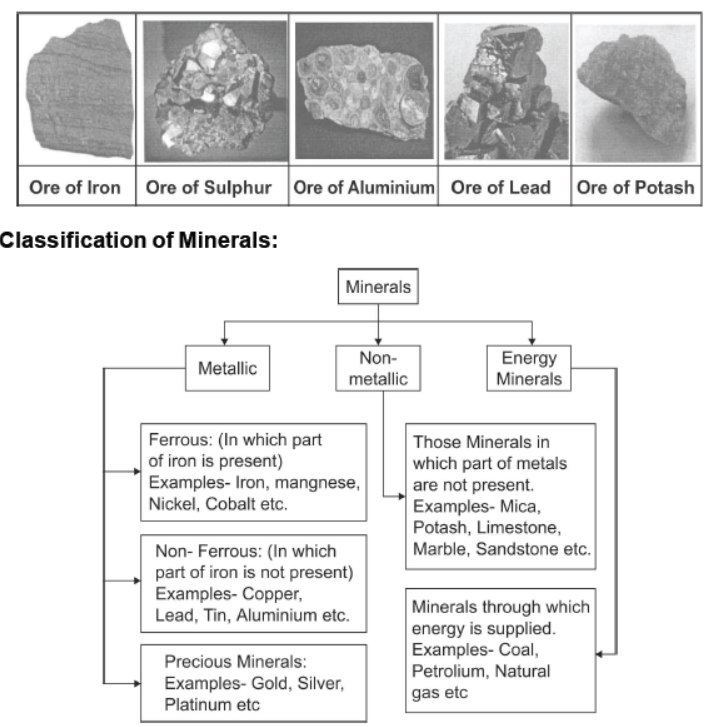
Sources of Minerals:-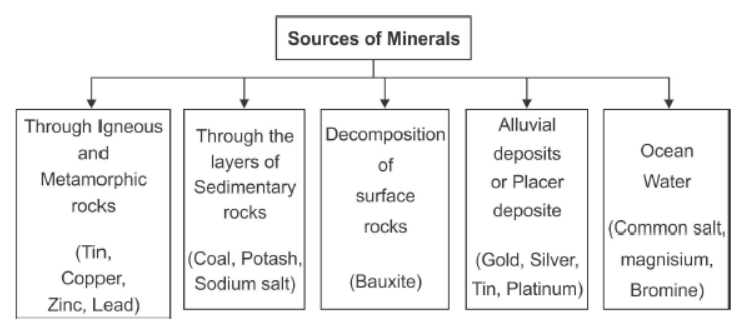
• Mining- The extraction of useful and commerically viable minerals by digging down the earth is called mining.
• Mining is a hazards industry as the resources are dug out from the interior of the earth by making tunnels or pit. During this process risk to the life of the workers are very high due to leakage of poisonous gas or fires or flooding of water into the mine or even collapsing of mine roofs. Along with that workers have also to face health issues.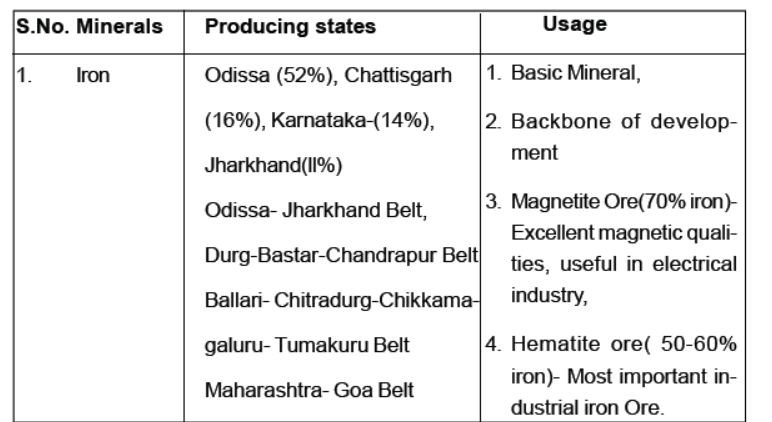
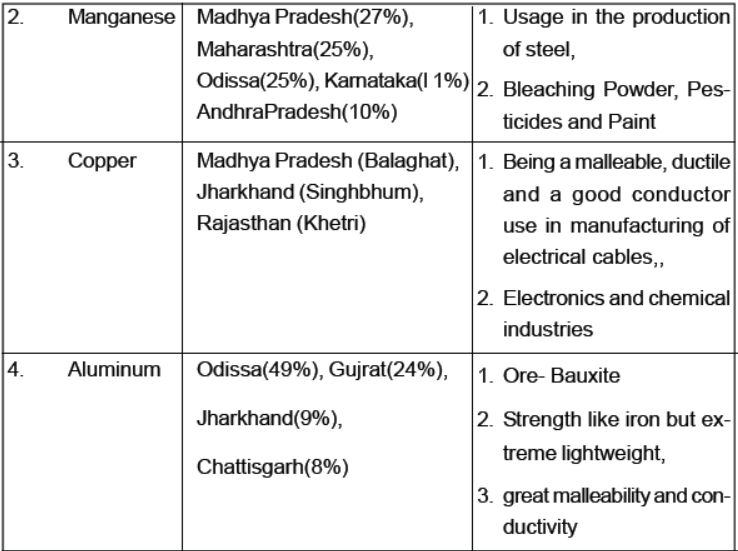
Need for the conservation of resources/Minerals
• High rate of consumption
• Limited reserves
• Low rate of replenishment
• Ill effects on Environment
Methods to conserve Resources/ Minerals
• Reduce
• Reuse
• Recycle
• Replace
Question. Which one of the following metals can be obtained from Bauxite?
(a) Aluminium
(b) Copper
(c) Iron
(d) Silver
Answer : A
Question. Which one of the following places is known for lignite deposits?
(a) Khetri
(b) Neyeli
(c) Baliadila
(d) Bokaro
Answer : B
Question. Which is the finest iron ore with a very high content of iron?
(a) Magnetite
(b) Haematite
(c) Limonite
(d) None of these
Answer : A
Question. Where is the largest wind farm cluster located in India?
(a) Andhra Pradesh
(b) Kerala
(c) Karnataka
(d) Tamil Nadu
Answer : D
Question. Iron ore is exported Japan and South Korea via which port?
(a) Chennai
(b) Vishakhapatnam
(c) Haldia
(d) Mangaluru
Answer : B
Question. Which type of sand in Kerala is rich in thorium?
(a) Monazite sands
(b) Gypsum snads
(c) Silica sands
(d) Black sands
Answer : A
Question. The toothbrush and tube containing paste are made up of plastic obtained from
(a) Mica
(b) Petroleum
(c) Fibre
(d) Paper
Answer : B
Question. Which out of the following metallic minerals is obtained from veins and lodes?
(a) Zinc
(b) Limestone
(c) Rutile
(d) Mica
Answer : A
Question. In which kind of rocks are the minerals deposited and accumulated in the stratas?
(a) Igneous rocks
(b) Metamorphic rocks
(c) Sedimentary rocks
(d) None of these
Answer : C
Question. Minerals are generally found in:
(a) ores
(b) rocks
(c) soil
(d) none of these
Answer : A
Question. In India, the Gulf of Khambhat, The Gulf of Kuchch and Gangetic delta provide ideal condition for utilising which energy?
(a) Tidal energy
(b) Wind energy
(c) Solar energy
(d) Non-conventional energy
Answer : A
Question. Oceans beds are a treasure house of:
(a) fishes
(b) minerals
(c) tones
(d) none of these
Answer : B
Question. The Badamphar mine in Mayurbhanj and Kendujhar district is situated in which of the following Indian state?
(a) Karnataka
(b) Odisha
(c) Chattisgarh
(d) Jharkhand
Answer : B
Question. Ferrous minerals account for about .......... of the total value of production of metallic minerals.
(a) One-fourth
(b) Two-fourth
(c) Three-fourth
(d) Two-third
Answer : C
Question. Large reserves of natural gas have been discovered in which place in India?
(a) Arabian Sea
(b) Andaman Nicobar Islands
(c) Krishna Godavari Basin
(d) Gulf of Mannar
Answer : C
Question. The white colour in tooth paste comes from which of the following?
(a) Titanium oxide
(b) Fluoride
(c) Silica
(d) Limestone
Answer : A
Question. In which of the following minerals is India sufficient?
(a) Gold
(b) Glass
(c) Limestone
(d) All of these
Answer : C
Question. Which of the following is a mineral?
(a) Diamond
(b) Talc
(c) Mica
(d) All of these
Answer : D
Question. What quantity of India’s petroleum production is obtained from Mumbai High?
(a) 63%
(b) 36%
(c) 69%
(d) 65%
Answer : A
Question. Which of the following mineral is used to reduce cavities in teeth?
(a) Limestone
(b) Aluminium oxide
(c) Fluoride
(d) Silica
Answer : C
Question. Which of the following is the basic mineral and the backbone of industrial development?
(a) Zinc ore
(b) Iron ore
(c) Manganese ore
(d) Silver ore
Answer : B
Question. The mineral having wide application in the electrical industry is:
(a) nickel
(b) manganese
(c) iron ore
(d) zinc
Answer : C
Question. Which of the following is the highest quality hard coal
(a) Bituminus
(b) Anthrasite
(c) Lignite
(d) None of the above
Answer. B
Question. Which of the following is used as raw material in the cement industry?
(a) Lime stone
(b) Coal
(c) Mica
(d) Aluminium
Answer. A
Question. Manikaran in Himachal Pradesh is famous for coal mine.
Answer. Geothermal energy
Question. Geothermal energy plant is situated in kaiga in Karnataka.
Answer. Atomic energy
FILL IN THE BLANK :
Question. Minerals are usually found in .......... .
Answer : ores
Question. Although, over .......... minerals have been identified, only a few are abundantly found in most of the rocks.
Answer : 2000
Question. In .......... and .......... rocks minerals may occur in the cracks, crevices, faults or joints.
Answer : igneous, metamorphic
Question. Fluoride which is used to reduce cavities comes from a mineral .......... .
Answer : flourite
Question. Geographers study .......... as part of the earth’s crust for a better understanding of landforms.
Answer : minerals
Question. The sparkle in some toothpaste comes from .......... .
Answer : mica
Question. Rocks are combinations of homogenous substances called .......... .
Answer : minerals
Question. .................... is a source of atomic energy.
Answer. Urenium/Thorium
Question. .................... is the most important industrial ore of iron.
Answer. Hematite
Question. What is ore?
Answer. Naturally occurring substances from which minerals can be extracted profitably.
Question. What is meant by metallic ore?
Answer. Those minerals in which part of metals are found are called metallic minerals.
Question. Write one method of conservation of energy.
Answer. Reduce/reuse/recycle/replace/ any other
Question. Why is Tidal energy called as clean source of energy?
Answer. No harm to environment
Question. Why is coal called as the fossil fuel?
Answer. Because it is formed by the decomposition of fossils that buried deep into the earth millions of year ago.
TRUE/FALSE :
Question. Odisha is the largest bauxite producing state in India.
Answer : True
Question. There are over 380 thermal plants in India.
Answer : False
Question. Anthracite is the highest quality hard coal.
Answer : True
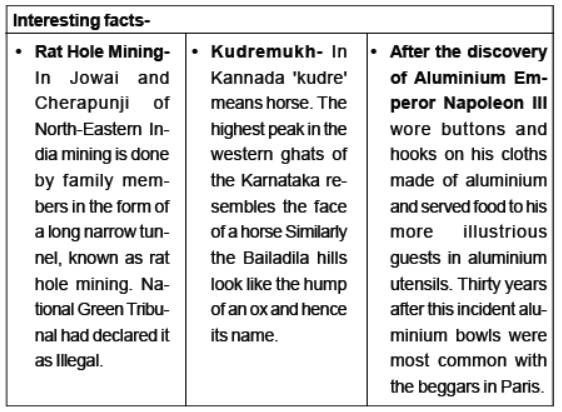
Question. Coal mining in Jowai and Cherapunjee is done by family member in the form of a long narrow tunnel, known as rat hole mining.
Answer : True
Question. The largest solar plant of India is located at Madhpur, near Bhuj.
Answer : True
Question. Thermal energy is obtained by altering the structure of atoms.
Answer : False
Question. Mineral oil is the next major energy resource in India after coal.
Answer : True
Question. Kudremukh mines Madhya Pradesh produces 52% of India’s copper.
Answer : False
ASSERTION AND REASON :
DIRECTION : In the following questions, a statement of assertion is followed by a statement of reason. Mark the correct choice as :
(a) If Both assertion and reason are true and reason is the correct explanation of assertion.
(b) If Both assertion and reason are true but reason is not the correct explanation of assertion.
(c) If Assertion is true but reason is false.
(d) If Both assertion and reason are false.
Question. Assertion : Conservation of Energy Resources is essential.
Reason : Energy is a basic requirement for economic development.
Answer : A
Question. Assertion : Geological processes of mineral formation is slow
Reason : Minerals resources are consumed way quickly than they are formed.
Answer : B
Question. Assertion : Minerals are an indispensable part of our lives.
Reason : Minerals have a universal use, they are used to manufacture everything we use in our day to day lives.
Answer : A
Question. Assertion : Iron ore is the basic mineral and the backbone of India.
Reason : India is rich in good quality Iron ore.
Answer : A
Question. Assertion : Mica is a metallic mineral.
Reason : Mica mineral is the basic raw material for cement industry
Answer : D
Question. Assertion : Natural gas is referred as an environment friendly fuel.
Reason : Natural gas contains low carbon dioxide emissions.
Answer : A
Question. Assertion : Increased use of fossil fuels creates a healthy environment.
Reason : Fossil fuels such as coal, oil and gas are easily obtained from natural resource.
Answer : D
Question. Assertion : Uses of iron brought a radical change in human life.
Reason : Different kinds of tools where invented by using minerals
Answer : A
Question. Assertion : Mining activity is often called a “Killer Industry”.
Reason : Mining helps in agriculture.
Answer : C
Question. Assertion : Thermal power stations are located on or near the coalfields.
Reason : Coal is a bulky material, which loses weight on use as it is reduced to ash. Hence, heavy industries and thermal power stations are located on or near the coalfields.
Answer : A
In an assertion (A) and its reason (B) is given below. Read the following statements and choose the right answer from the options given below.
Assertion (A): The activities of fishing come under Primary sector.
Reasoning (R): Fishing depends directly upon natural resources.
(a) Both A and R are correct and R is the correct explanation of A
(b) Both A and R are correct but R is the not the correct explanation of A
(c) A is correct but R is wrong
(d) A is wrong but R is correct
Question. Assertion (A): Mica is a non metallic mineral.
Reasoning (R): No metallic properties are present in Mica.
Answer. A
Question. Assertion (A): Copper is used to make electrical wire.
Reasoning (R): Copper is insulator of electricity.
Answer. C
Question. Assertion (A): Gold and silver is found as 'placer deposite'.
Reasoning (R): These are low reactive metal.
Answer. A
Question. Assertion (A): Solar energy is an example of conventional source of energy.
Reasoning (R): Solar energy is an example of clean energy.
Answer. D
Very Short Questions for Class 10 Social Science Minerals and Energy Resources
Question : How many thermal power plants are there in India?
Answer : There are over 310 thermal power plants in India.
Question : ‘Different regions of India contain different minerals’. What is the reason behind it?
Answer : It happens because of the difference in the geological structure, processes and time involved.
Question : Name the two countries which import iron ore from India.
Answer : Japan and South Korea.
Question : What are the Khetri mines in Rajasthan famous for?
Answer : The Khetri mines in Rajasthan are famous for copper production.
Short Questions for Class 10 Social Science Minerals and Energy Resources
Question : Explain any three values attached with the use of minerals in a sustainable manner.
Answer : (i) Our industries and agriculture immensely depend on mineral deposits and the substances manufactured from them. The total volume of workable mineral deposits is an insignificant fraction i.e. one per cent of the earth’s crust. Hence, minerals should be used cautiously.
(ii) The geological processes of mineral formation are so slow that the rates of replenishment are infinitely small in comparison to the present rates of consumption.
(iii) Mineral resources are finite and non-renewable. Rich mineral deposits are our country’s extremely valuable but short-lived possessions.
Question : How do minerals occur in sedimentary rocks?
Answer : (i) In sedimentary rocks a number of minerals occur in beds or layers.
(ii) They have been formed as a result of deposition, accumulation and concentration in horizontal strata.
(iii) Coal and some forms of iron ore have been concentrated as a result of long periods under great heat and pressure.
(iv) Another group of sedentary numerals such as gypsum, potash salt and sodium salt are formed as a result of evaporation.
Question : (i) How are deposits of bauxite formed and aluminium obtained?
(ii) What is the utility of aluminium?
(iii) Describe the distribution of aluminium.
Answer : (i) Bauxite deposits are formed due to decomposition of wide variety of rocks rich in aluminium silicates. Ores containing aluminium are obtained from bauxite which is a clay-like substance from which alumina and later aluminium is obtained.
(ii) It is an important metal because it combines the strength of metals such as iron with good conductivity and great malleability.
(iii) Odisha is the largest bauxite producing state. 45% of country’s total production in 2000-2001 was from Orissa. Panchpatmali deposits in Koraput district are the most important bauxite deposits in the state.
Question : How are minerals an indispensable part of our lives? Explain with three examples.
Answer : Minerals from an indispensable part of our lives in the following ways:
(i) From a tiny pin that we use to a towering building or tall ships are all made up of minerals.
(ii) The food that we consume also contains minerals which are essential for the growth of human body.
(iii) Cars, buses, trains and aeroplanes are manufactured with the help of minerals and they run on power resource derived from minerals.
Question : State any two factors affecting the economic viability of mineral reserves.
Answer : (i) The mineral content of the ore must be in sufficient concentration to make its extraction commercially viable.
(ii) The type of formation or structure in which minerals are found determines the relative ease with which mineral ores may be mined. This also determines the cost of extraction.
Question : “Discovery and use of iron brought a radical change in human life” prove it with three examples.
Answer :
a) Revolution in agriculture-different type of tools invented like axe, hook, plough etc.
b) Revolution in industry-different tools and machines like spinning.
c) Revolution in transportation- bullock-cart, ships, boats etc.
Question : Describe the various forms in which minerals occur.
Answer :
a) In igneous and metamorphic rocks ( cracks, crevice, faults or joints)
b) In beds or layers of sedimentary rocks due to deposition, accumulation and concentration.
c) Decomposition of surface rocks
d) Alluvial deposits in sands of valleys and the base of hills as “ Placer Deposits”
Question : Why is mining activity often called a “Killer Industry”. Give three reasons.
Answer : a) High risk involved
b) Due to poisonous fumes, mines are vulnerable to workers for pulmonary diseases.
c) Risk of collapsing mines roofs, and fires in coal mines.
d) Water sources get contaminated
Question : Give three reasons in the favour of use of ‘Atomic energy’.
Answer :
a) Coal and natural oil are exhaustible.
b) Nuclear power plants are easy to handle
c) Most developed countries are utilizing this energy successfully
d) It can be useful in fields of medicines and agriculture
e) Hydel energy is not satisfactory due to environmental issues
Question : Why does solar energy in Rajasthan have greater potential as non –conventional source of energy?
Answer : a) Hot and dry region
b) Clear sky almost whole year
c) Cheaper installation
d) Renewable and pollution free energy source.
e) Government motivation
Long Questions for Class 10 Social Science Minerals and Energy Resources
Question : What are the different varieties of iron one? How will you differentiate between them? Give any two points.
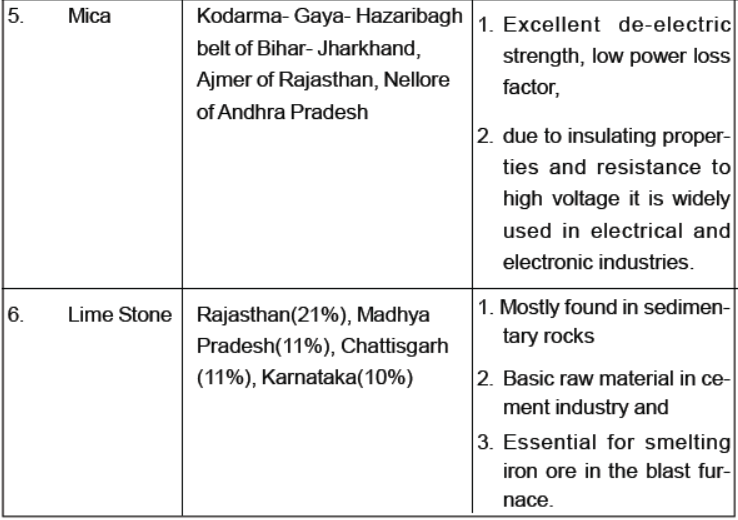
Answer : Iron-ore is the backbone of India’s industrial development. The different varieties of iron-ore are-Magnetite, hematite, Limonite and Siderite.
• Magnetite is the finest iron-ore with a very high content of iron up to 70%. It has excellent magnetic qualities. it is valuable for electrical industry.
• Hematite is the most important industrial iron-ore in term of quantity used.
It has a slightly lower iron content than 50-60%.
• Limonite has 40-60% iron content.
• Siderite has 40-50% iron content.
Question : What are the Petroleum producing areas in India. Explain.
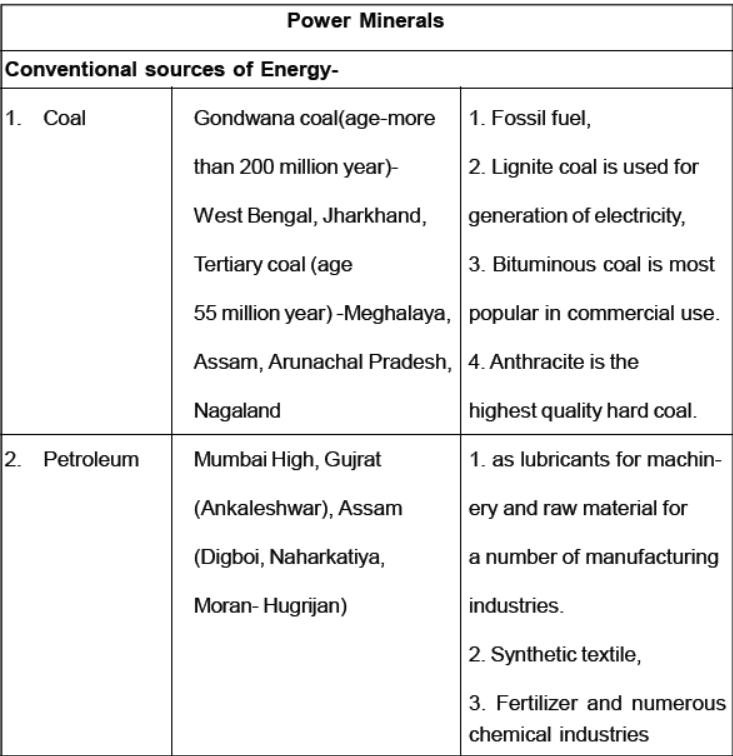
Answer : Most of the petroleum producing areas in India are associated with anticlines and faults traps in the rock formations of the tertiary age. In the region folding, anticlines or domes, it occurs where oil is trapped in the crest of the uphold. Petroleum is also found in fault traps between porous rocks.
Major petroleum producing areas of India are …
1) ASSAM- Digboi, Naharkatia, Moran-Hugrijan, Namdang region
2) GUJRAT- Ankeleshwar, Lunez, Navgan
3) MUMBAI HIGH
4) Godavari – Mahanadi basin
Question : Distinguish between Natural Gas and Bio Gas.
Answer :
• NATURAL GAS
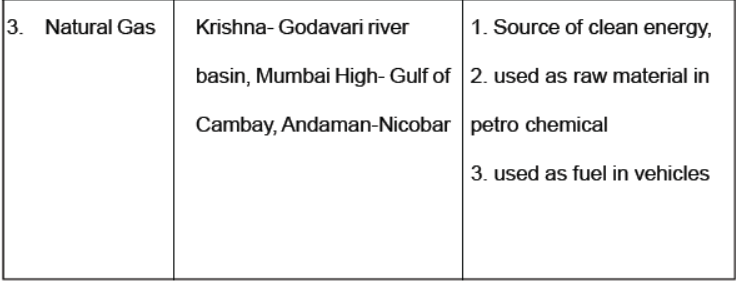
• It is a mixture of combustible gaseous hydrocarbons occurring in the rocks of earth crust.
• This is commercial energy.
• It is used as raw material in the petrochemicals.
• It is transported from one place to another through pipeline.
• Mostly used in urban areas.
• BIO GAS
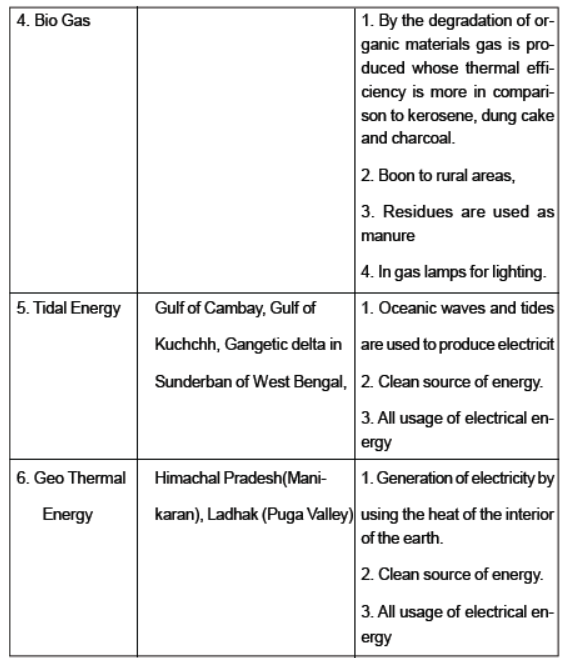
• It is derived by decomposition of waste of animals and plants with the help of microorganism in presence of water.
• Non commercial energy
• It is produced in tanks
• It is found in rural areas
Question : What is Non - Conventional sources of energy? Discuss two sources of such types of energy.
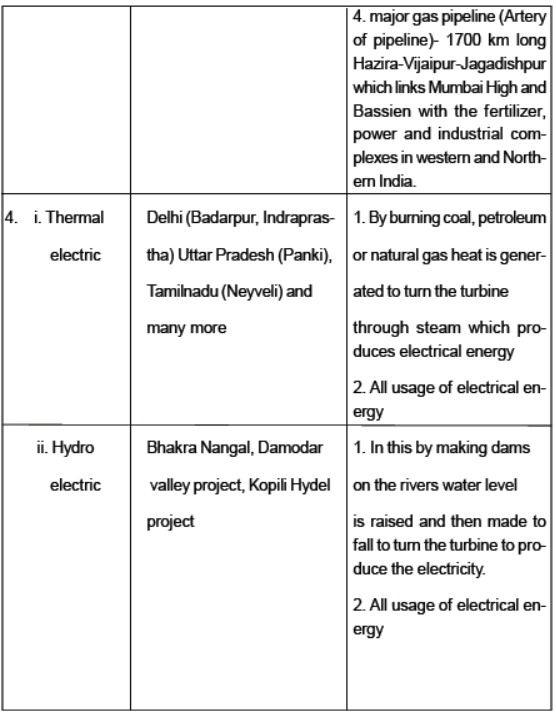
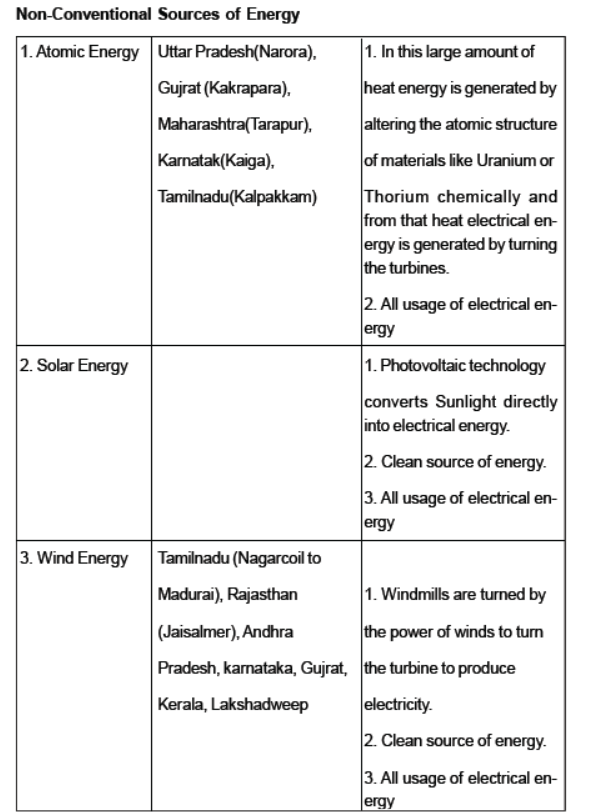
Answer : Sources of energy which are renewable, eco-friendly and newer one are called non conventional sources of energy i.e. wind energy, geothermal energy, tidal energy etc.
GEOTHERMAL ENERGY:
Geothermal energy refers to the heat and electricity produced by using the heat from the interior of the earth. Where the geothermal gradient is high , high temperature is found at shallow depth . There are several hot springs in India which could be used to generate electricity. Two projects, one is MANIKARAN in Himachal and second in PUGA VALLEY in Ladakh has been set up in India to harness Geothermal energy.
TIDAL ENERGY:
Oceanic tides can be used to generate electricity .During high tides water flows into the inlet and get trapped when it is closed. After the fall of tide the water flows back to the sea via pipe lines that carry it through power generating turbines. In India gulf of Kutch provides ideal conditions for tidal energy.
Question : India now ranks as a “WIND SUPER POWER “in the world. Why?
Answer :
• India gets advantage of trade winds, western lies and monsoon winds.
• Wind energy completely pollution free and non exhaustible that’s why it becomes popular.
• India has an ambitious program to install 250 wind driven turbines with total capacity of 45 mega watts spread over 12 suitable locations.
• India’s potential wind power generation is of 50000 megawatts of which ¼ can be easily harnessed.
• Rajasthan, Gujarat, Maharashtra, Karnataka and Tamil Nadu have favorable conditions for wind energy. Wind power plant at LAMBA in Gujarat, is the largest in Asia.
Question : How can we conserve energy resources in India? Explain.
Answer : Following efforts can be made to conserve energy resource in India:
i) Using public transport instead of individual vehicles.
ii) Switching of electricity when not in use.
iii) Using power saving devices.
iv) More and more use of non conventional source of energy as they are renewable and eco-friendly.
v) In automobiles electrical motors should be introduced.
vi) Intensified exploration and research of new sources of energy.
Source based Questions
1. Read the extract and answer the following questions-
We use different things in our daily life made from metal. Can you list a number of items used in your house made of metals. Where do these metals come from? You have studied that the earth's crust is made up of different minerals embedded in the rocks. Various metals are extracted from these minerals after proper refinement. Minerals are an indispensable part of our lives. Almost everything we use, from a tiny pin to a towering building or a big ship, all are made from minerals. The railway lines and the tarmac (paving) of the roads, our implements and machinery too are made from minerals. Cars, buses, trains, aeroplanes are manufactured from minerals and run on power resources derived from the earth. Even the food that we eat contains minerals. In all stages of development, human beings have used minerals for their livelihood, decoration, festivities, religious and ceremonial rites.
Question. Where do we get metals?
Answer. From daily life
Question. Write two uses of minerals from your day to day life.
Answer. Student will give usage from their day to day life
Question. How minerals affected the different stages of development of human being?
Answer. Decoration, festivities and religions ceremonies
Question. Write two energy resources that we get from the earth.
Answer. Coal, Petrolium etc.
Free study material for Social Science
Contemporary India Chapter 05 Minerals And Energy Resources Printable Assignments & Solutions for Class 10 Social Science
Class 10 Social Science Contemporary India Chapter 05 Minerals And Energy Resources Printable Assignments
Review targeted chapter assignments for Class 10 Social Science Contemporary India Chapter 05 Minerals And Energy Resources. Built according to official CBSE guidelines, these downloadable problem sets help students build accuracy and prepare effectively for school tests.
Why Practice Class 10 Social Science Assignments?
- Curriculum Standards: Assignments match modern CBSE sample formats to ensure relevant preparation.
- Thorough Revision: Detailed problem sets reinforce core concepts and eliminate conceptual weak spots.
- Execution Speed: Timed practice with assignment sets sharpens overall response timing.
How to Approach Social Science Contemporary India Chapter 05 Minerals And Energy Resources Assignments
- Initial Reading: Begin by reading the NCERT book for Class 10 Social Science to build a baseline understanding.
- Independent Testing: Attempt assignment questions unassisted, then verify work using provided answer keys.
- Supplementary Aids: Leverage revision notes and worksheets whenever you encounter difficult topics.
FAQs
You can download free PDF assignments for Class 10 Social Science Contemporary India Chapter 05 Minerals And Energy Resources from StudiesToday.com. These practice sheets have been updated for the 2026-27 session covering all concepts from latest NCERT textbook.
Yes, our teachers have given solutions for all questions in the Class 10 Social Science Contemporary India Chapter 05 Minerals And Energy Resources assignments. This will help you to understand step-by-step methodology to get full marks in school tests and exams.
Yes. These assignments are designed as per the latest CBSE syllabus for 2026. We have included huge variety of question formats such as MCQs, Case-study based questions and important diagram-based problems found in Contemporary India Chapter 05 Minerals And Energy Resources.
Practicing topicw wise assignments will help Class 10 students understand every sub-topic of Contemporary India Chapter 05 Minerals And Energy Resources. Daily practice will improve speed, accuracy and answering competency-based questions.
Yes, all printable assignments for Class 10 Social Science Contemporary India Chapter 05 Minerals And Energy Resources are available for free download in mobile-friendly PDF format.