

School Assignments for Class 10 Social Science: India And Contemporary World II Chapter 02 Nationalism In India
Access comprehensive school assignments for India And Contemporary World II Chapter 02 Nationalism In India using the CBSE Class 10 Social Science Nationalism In India Assignment Set 02. Designed to align with the 2026-27 CBSE academic guidelines, these practice sets help Class 10 Social Science students reinforce core concepts and improve their problem-solving accuracy.
Practice Class 10 Social Science Assignments: India And Contemporary World II Chapter 02 Nationalism In India
Navigate directly to the solved Social Science assignments using the digital viewer below. Each practice set includes detailed step-by-step solutions, allowing students to instantly cross-check their work and identify areas requiring further revision.
Objective Type Questions
Question. Who among the following wrote the ‘Vande Mataram’?
(a) Rabindranath Tagore
(b) Bankim Chandra Chattopadhyay
(c) Abanindranath Tagore
(d) Dwarkanath Tagore
Answer : B
Question. Which of the following agreement gave seats to the Depressed Classes in Provincial and Central Legislative Council?
(a) Poona Pact
(b) Lucknow Pact
(c) Gandhi – Irwin Pact
(d) None of these
Answer : A
Question. Identify the appropriate reason for the formation of the Swaraj party from the options given below:
(a) Wanted Members of Congress to return to Council Politics.
(b) Wanted Members of Congress to ask for Purna Swaraj for Indians.
(c) Wanted Members of Congress to ask Dominion Status for India.
(d) Wanted Members of Congress to oppose Simon Commission.
Answer : A
Question. Study the picture and answer the question that follows:
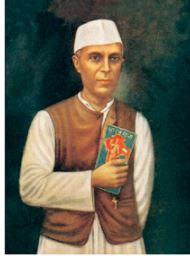
Which of the following things is being held by Jawaharlal Nehru in this image?
(a) Bhagwad Gita
(b) Image of Bharat Mata
(c) Discovery of India
(d) Hind Swaraj
Answer : B
Question. Study the picture and answer the question that follows:
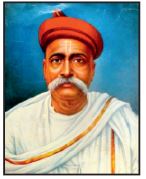
Which of the following personalities is shown in the given image?
(a) Vallabhbhai Patel
(b) C. R. Das
(c) Motilal Nehru
(d) Bal Gangadhar Tilak
Answer : D
Question.
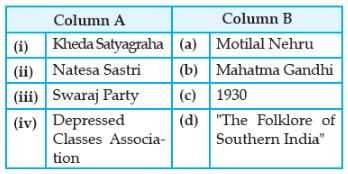
(a) (i)-(a), (ii)-(d), (iii)-(b), (iv)-(c)
(b) (i)-(d), (ii)-(c), (iii)-(a), (iv)-(b)
(c) (i)-(b), (ii)-(a), (iii)-(d), (iv)-(c)
(d) (i)-(b), (ii)-(d), (iii)-(a), (iv)-(c)
Answer : D
Question. Certain events are given below. Choose the appropriate chronological order:
(i) Coming of Simon Commission to India
(ii) Demand of Purna Swaraj in Lahore Session of INC
(iii) Government of India Act, 1919
(iv) Champaran Satyagraha
Options:
(a) (iii) – (ii) – (iv) – (i)
(b) (i) – (ii) – (iv) – (iii)
(c) (ii) – (iii) – (i) – (iv)
(d) (iv) – (iii) – (i) – (ii)
Answer : D
Question. Arrange the following in the correct sequence:
(i) Rowlatt Act passed.
(ii) The Partition of Bengal officially came into existence.
(iii) Satyagraha Movement in Ahmedabad.
(iv) Satyagraha Movement in Kheda District (Gujarat).
Options:
(a) (iv) – (ii) – (i) – (iii)
(b) (ii) – (iii) – (iv) – (i)
(c) (ii) – (iv) – (iii) – (i)
(d) (i) – (iii) – (ii) – (iv)
Answer : C
Question. Arrange the following in the correct sequence:
(i) Formation of the Muslim League.
(ii) The First Word War.
(iii) The first meeting of the Indian National Congress in Bombay.
(iv) Through the war prices increased in double.
Options:
(a) (ii) – (iv) – (iii) – (i)
(b) (i) – (iii) – (iv) – (ii)
(c) (iv) – (ii) – (i) – (iii)
(d) (iii) – (i) – (ii) – (iv)
Answer : D
Question. Analyze the information given below, consider the following given options and identify the most appropriate one in reference to the given information:
Mahatma Gandhi’s letter was, in a way, an ultimatum. If the demands were not fulfilled by 11 March, the letter stated, the Congress would launch a civil disobedience campaign. Irwin was unwilling to negotiate. So Mahatma Gandhi started his famous Salt March accompanied by 78 of his trusted volunteers. The march was over 240 miles, from Gandhiji’s ashram in Sabarmati to the Gujarati coastal town of Dandi. The volunteers walked for 24 days, about 10 miles a day. Thousands came to hear Mahatma Gandhi wherever he stopped, and he told them what he meant by Swaraj and urged them to peacefully defy the British. On 6 April, 1930 he reached Dandi and ceremonially violated the law, manufacturing salt by boiling sea water.
(a) Non-Cooperation Movement
(b) Salt March
(c) Khilafat Movement
(d) Rowlatt Act
Answer : B
Question. Find the incorrect option from the following:
(a) Against this background the new Tory Government in Britain constituted a Statutory Commission under Sir John Simon.
(b) Set up in response to Nationalist Movement, the Commission was to look into the functioning of the Constitutional System in India and suggest changes.
(c) The problem was that the Commission did not have a single Indian Member.
(d) They were all Americans.
Answer : D
Assertion and Reason Based Questions
Question. Assertion (A): Dyer entered the area, blocked the exit points and opened fire on the crowd, killing hundreds.
Reason (R): His object, as he declared later, was to ‘produce a moral effect’, to create in the minds of satyagrahis a feeling of terror and awe.
Option:
(a) Both A and R are true and R is the correct explanation of A.
(b) Both A and R are true but R is NOT the correct explanation of A.
(c) A is true but R is false.
(d) A is false and R is true.
Answer : A
Question. Assertion (A): Folklores gave a picture of traditional culture, it helps in discovering a national identity and restoring a sense of pride in one’s past.
Reason (R): Nationalism spreads when people discover some unity that binds them together.
Option:
(a) Both A and R are true and R is the correct explanation of A.
(b) Both A and R are true but R is NOT the correct explanation of A.
(c) A is true but R is false.
(d) A is false and R is true.
Answer : B
Question. Assertion (A): Mahatma Gandhi decided to take up the Khilafat issue.
Reason (R): After many leaders were arrested, violent clashes broke out at many places in India and women and children were beaten up.
Option:
(a) Both A and R are true and R is the correct explanation of A.
(b) Both A and R are true but R is NOT the correct explanation of A.
(c) A is true but R is false.
(d) A is false and R is true.
Answer : B
Case Based Questions
I. Read the source given below and answer the questions that follows:
The identity of the nation, as you know is most often symbolised in a figure or image. This helps create an image with which people can identify the nation. It was in the twentieth century, with the growth of nationalism, that the identity of India came to be visually associated with the image of Bharat Mata. The image was first created by Bankim Chandra Chattopadhyay. In the 1870s, he wrote ‘Vande Mataram’ as a hymn to the Motherland. Later it was included in his novel Anandamath and widely sung during the Swadeshi Movement in Bengal. Moved by the Swadeshi movement, Abanindranath Tagore painted his famous image of Bharat Mata. In this painting Bharat Mata is portrayed as an ascetic figure; she is calm, composed, divine and spiritual. In subsequent years, the image of Bharat Mata acquired many different forms, as it circulated in popular prints and was painted by different artists. Devotion to this mother figure came to be seen as evidence of one’s nationalism.
Answer the following MCQs by choosing the most appropriate option.
Question. Means of creating a feeling of nationalism was through:
(a) Reinterpretation of Astronomy
(b) Reinterpretation of Philosophy
(c) Reinterpretation of Mythology
(d) Reinterpretation of History
Answer : D
Question. Bharat Mata was first created by:
(a) Bankim Chandra Chattopadhyay
(b) Natesa Sastri
(c) Rabindranath Tagore
(d) Abanindranath Tagore
Answer : A
Question. As Bharat Mata is to India, ___________ is to Italy and ____________ is to Germany.
(a) Statue of Liberty, Mother Mary
(b) Marianne, Germania
(c) Germania, Marianne
(d) Statue of Liberty, Germania
Answer : B
Question. What quality is emphasized by Bharat mata?
(a) Anxious
(b) Sacred
(c) Mortal
(d) All of the above
Answer : B
Very Short Answer Type Questions
Question. Who organised Dalits into the ‘Depressed Classes Association’ in 1930?
Answer : Dr. B.R. Ambedkar.
Question. Why was the Inland Emigration Act of 1859 troublesome for Plantation Workers?
Answer : Under this Act, Plantation Workers were not permitted to leave tea-gardens without permission.
Question. Name the writer of the book ‘Hind Swaraj’.
Answer : The writer of the book ‘Hind Swaraj’ is Mahatma Gandhi.
Question. Under which agreement the Indian ‘Depressed Classes’ got reserved seats in the Provincial and Central Legislative Councils in 1932?
Answer : Poona Pact.
Question. Why did Indians oppose the ‘Simon Commission’?
Answer : Because there was no Indian Member in the Commission.
Question. What kind of Movement was launched by the tribal Peasants of Gudem Hills in Andhra Pradesh?
Answer : Militant Guerrilla Movement
Short Answer Type Questions
Question. Evaluate the role of Business Classes in the ‘Civil Disobedience Movement’.
Answer : Role of Business classes in ‘Civil Disobedience Movement’:
(i) The Business class reached against policies that restricted business activities.
(ii) They wanted protection against Imports of Foreign goods and a Rupee-Sterling Foreign exchange ratio that would discourage imports.
(iii) In order to organise business interest, they formed the Indian Industrial and Commercial Congress in 1920 and the Federation of the Indian Chamber of Commerce and Industries (FICCI) in 1927.
(iv) They gave financial assistance for the Movement.
Question. “The Civil Disobedience Movement was different from the Non-Cooperation Movement.” Support the statement with examples.
OR
How was the Civil Disobedience Movement different from the Non-Cooperation Movement? State any three points of difference.
Answer : The Civil Disobedience Movement was different from the Non-Cooperation Movement in the following ways:
Non-Cooperation Movement:
(i) The people were asked not to co-operate with the government.
(ii) Foreign goods were boycotted.
(iii) Liquor shops were picketed.
(iv) Foreign clothes were burnt in heap.
(v) In many places merchants and traders refused to trade in Foreign goods or Finance Foreign Traders.
(vi) Students left the Government – owned schools and colleges.
(vii) Lawyers gave up legal practices.
Civil Disobedience Movement:
(i) People were asked to break Colonial Laws.
(ii) The Countrymen broke the Salt Law.
(iii) Peasants refused to pay revenue and chaukidari tax.
(iv) Village officials resigned from their jobs.
Question. Analyse any three reasons for slow down of Non- Cooperation Movement in cities.
Answer : Reasons for slowing down of Non-Cooperation Movement:
(i) The Indians could not boycott for a long time because, Khadi cloth was more expensive than mass produced mill cloth and poor people could not afford to buy it.
(ii) The Boycott of British institutions posed a problem as alternative Indian institutions had to be set up so that they could be used in place of British ones.
(iii) Students and teachers began trickling back to government schools and lawyers joined back work in government courts in the absence of alternate Indian Institutions.
Question. How could Non-Cooperation become a Movement? Give your opinion.
Answer : Non-Cooperation became a Movement as:
(i) It was the view of Gandhiji that the British Rule was set in India with the cooperation of Indians.
(ii) If Indians refused cooperation, British rule in India would collapse within a year and Swaraj would come.
(iii) Gandhiji proposed that the Movement should unfold in stages.
(iv) In case the Government used repression, a full Civil Disobedience Campaign would be launched.
Question. Why did Gandhiji start Non-Cooperation Movement? Explain.
Answer : (i) Gandhiji launched the Non-Cooperation Movement with the aim of self-governance and obtaining full independence.
(ii) The Indian National Congress withdrew its support for British reforms against the Rowlatt Act and the Jallianwala Bagh incident.
(iii) Indian Muslims who had participated in the Khilafat Movement to restore the status of the Caliph/Khalifa (the spiritual leader of Muslims) gave their support to the Non-Cooperation Movement.
Question. Describe the role of Alluri Sitarama Raju in Andhra Pradesh during 1920s.
Answer : Role of Alluri Sitarama Raju in the Gudem hills of Andhra Pradesh.
(i) Alluri Sitarama Raju claimed that he had a variety of special powers like making astrological predictions, healing people and surviving bullet shots.
(ii) The Rebels proclaimed him as an Incarnation of God.
(iii) Raju was inspired by Gandhiji’s Non-Cooperation Movement.
(iv) He persuaded people to wear khadi and give up drinking.
(v) But at the same time he asserted that India could be liberated only by the use of force, not non-violence.
(vi) He used Guerrilla warfare for achieving Swaraj.
Question. “British rule in India would have collapsed if Indians had not cooperated.” How did this statement help in starting a Mass Movement in India against the British Rule?
Answer : (i) Mahatma Gandhi declared that British rule was established in India with the cooperation of Indians and if Indians had refused to cooperate, British rule in India would have collapsed within a year.
(ii) He proposed that the movement should unfold in stages.
(iii) It should begin with the surrendering of titles that the government had awarded to the Indians.
(iv) A boycott of Civil Services, Army, Police, Courts and Legislative Assemblies, Schools and Foreign Goods would show their non-cooperation to the British Empire.
Question. Evaluate the contribution of folklore, songs, popular symbols, etc., in shaping Nationalism during the freedom struggle.
Answer : Role of folklore:
(i) History and fiction, folklore and songs, popular prints and symbols, all played a part in the making of Nationalism.
(ii) The identity of India came to be visually associated with the image of Bharat Mata.
(iii) In the 1870s Bankim Chandra Chattopadhyay wrote ’Vande Mataram’ as a hymn to the motherland.
(iv) The idea of Nationalism also developed through a movement to revive Indian folklore.
Question. Explain any three effects of the ‘Non-Cooperation Movement’ on the economic front.
Answer : Effects of the ‘Non-Cooperation Movement’:
(i) Foreign goods were boycotted.
(ii) Liquor shops picketed and foreign cloth burnt in huge.
(iii) Import of Foreign cloth halved.
(iv) In many places Merchants and Traders refused to trade in Foreign goods or finance foreign trade.
Question. What were Mahatma Gandhi‘s views on women‘s participation in the National Movements?
Answer : (i) According to Gandhiji, the Woman is the companion of man and gifted with equal rights of freedom and liberty.
(ii) The Woman is more fit than a man to take exploration and bolder action in non-violence.
(iii) The Woman is the better half of humanity, not the weaker sex.
Question. Describe the main features of ‘Poona Pact‘.
Answer : The main features of ‘Poona Pact’ were:
(i) The Poona Pact (September 1932) gave Depressed Classes (later to be known as Scheduled Caste) reserved seats in Provincial and Central Legislative Councils.
(ii) They were to be voted in by the general electorate.
(iii) The Act came into force due to Gandhiji’s fast unto death.
(iv) Dr. B. R. Ambedkar ultimately accepted Gandhiji’s stand.
Question. “The Plantation Workers in Assam had their own understanding of Mahatma Gandhi and the notion of Swaraj”. Support the statement with arguments.
Answer : “The Plantation Workers in Assam had their own understanding of Mahatma Gandhi and the notion of Swaraj” as:
(i) For Plantation Workers in Assam, Freedom meant the right to move freely in and out of the confined space in which they were enclosed.
(ii) Swaraj meant retaining a link to the village from which they had come.
(iii) Under the Inland Emigration Act of 1859 plantation workers were not permitted to leave the Tea gardens without permission.
(iv) When they heard of the Non-Cooperation Movement, thousands of workers defied the authorities, left the plantations and headed home.
Long Answer Type Questions
Question. Who had organized the Dalits into the ‘Depressed Classes Association’ in 1930? Describe his achievements.
Answer : Depressed Classes Association was organized by Dr. B. R. Ambedkar in 1930.
Achievements:
(i) Dr. B. R. Ambedkar raised the demand of separate electorate for Dalits.
(ii) British Government conceded Ambedkar’s demand of separate electorates for Dalits.
(ii) The depressed classes got reservation of seats in Provincial and Central Legislative Councils.
(iv) Ambedkar accepted Gandhiji’s proposal and as a result Poona Pact was signed.
Question. Why was the ‘Salt March’ considered an effective symbol of resistance against Colonialism? Explain.
Answer : Salt March:
(i) Salt was consumed by all the sections of the society.
(ii) It was the most essential item of food.
(iii) The tax on salt and the Government Monopoly over production.
(iv) Gandhiji found salt as a powerful symbol that could unite the nation.
(v) On 31st January, 1930, he sent a letter to Viceroy Irwin stating eleven demands.
(vi) The idea was to make the demands wide ranging, so that all classes within Indian Society could identify with them and everyone could be brought together in a United Campaign.
Question. Why did Gandhiji decide to launch a nationwide ‘Satyagraha’ against the proposed Rowlatt Act (1919)? How was it opposed or organised? Explain.
Answer : Gandhiji decided to launch a nation-wide Satyagraha:
(i) This Act had been hurriedly passed through the Imperial Legislative Council.
(ii) Indian members opposed the Act.
(iii) It gave the Government enormous powers to repress political activities.
(iv) It allowed detention of Political Prisoners without trial for two years.
It opposed in the following ways:
(i) Rallies were organised in various cities.
(ii) Workers went on strike.
(iii) Shops were closed.
(iv) Communication, Railway, Telegraphs lines were disrupted.
Question. How did Colonial Government repress the Civil Disobedience Movement? Explain.
Answer : Colonial Government repressed the ‘Civil Disobedience Movement’:
(i) The Colonial Government took brutal steps to repress the Civil Disobedience Movement.
(ii) The government began arresting the congress leaders one by one. This led to violent clashes in many places.
(iii) Abdul Ghaffar Khan, a devout disciple of Mahatma Gandhi was arrested (April 1930).
(iv) Angry crowds demonstrated in the streets of Peshawar facing armoured cars and police firing, many were killed.
(v) Gandhiji was himself arrested.
(vi) A frightened government responded with a policy of brutal repression.
Question. How had a variety of cultural processes developed a sense of collective belongingness in India during the 19th century? Explain with examples.
Answer : Collective belongingness:
(i) History and fiction, folklore and songs, popular prints and symbols, all played a part in the making of Nationalism.
(ii) Identity of the nation was most often symbolized in a figure or image.
(iii) The identity of India came to be visually associated with the image of Bharat Mata.
(iv) Bankim Chandra Chattopadhyay and Abanindra Nath Tagore created a picture of Bharat Mata.
(v) Vande Matram as a hymn for the Motherland.
(vi) Folklores and tales gave true picture of Traditional culture.
Question. How was the sense of collective belonging developed during the Freedom Movement? Explain.
OR
How did a variety of cultural processes play an important role in the making of Nationalism in India? Explain with examples.
OR
How did people belonging to different communities, regions or language groups develop a sense of Collective belonging?
Answer : (i) This sense of collective belonging came partly through the experience of united struggles and growing anger among people against the Colonial Government.
(ii) But there were also a variety of cultural processes through which nationalism captured people‘s imagination:
(a) The identity of the nation symbolised in a figure or image of Bharat Mata created through literature, songs, paintings, etc.
(b) Movement to revive Indian folklore to enhance nationalist sentiments.
(c) Role of icons and symbols in unifying people and inspiring in them a feeling of nationalism.
(d) Creating a feeling of nationalism was through reinterpretation of history.
Question. Describe the Incident and impact of the Jallianwala Bagh.
OR
Explain the reason and effects of Jallianwala Bagh Massacre.
OR
Explain the impact of Jallianwala Bagh incident on the people.
OR
Describe the Jallianwala Bagh Massacre and the aftermath. Which basic human rights did the British violate?
Answer : Incident and Impact of the Jallianwala Bagh: On 13th April, large crowd gathered in Jallianwala Bagh.
Some of them had come to protest against the government’s new repressive measures and others had come to attend Baisakhi fair.
General Dyer entered the area, blocked the exit points and opened fire on the crowd, killing hundreds to create a feeling of terror.
Impact:
(i) As the news spread, crowd took to the streets in North Indian towns.
(ii) There were strikes, clashes with Police.
(iii) Attacks on government buildings.
(iv) The Government responded with brutal repression to terrorise people.
(v) Satyagrahis were forced to rub their noses on the ground.
Question. Explain the meaning and notion of ‘Swaraj’ as perceived by the Plantation Workers. How did they respond to the call of the Non-cooperation Movement?
Answer : (i) For plantation workers in Assam, Swaraj meant the right to move freely in and out of the confined space in which they were enclosed, and it meant retaining a link with the village from which they had come.
(ii) (a) Under the Inland Emigration Act of 1859, plantation workers were not permitted to leave the tea gardens without permission, and in fact, they were rarely given such permission.
(b) When they heard of the Non-Cooperation Movement, thousands of workers defied the authorities, left the plantations and headed home.
(c) They believed that Gandhi Raj was coming and everyone would be given land in their own villages.
(d) They, however, never reached their destination. Stranded on the way by a Railway and Steamer strike, they were caught by the Police and brutally beaten up.
Question. Why did Mahatma Gandhi launch the ‘Non- Cooperation Movement’? How did this Movement unite the country? Explain.
Answer : Mahatma Gandhi declared that British Rule was established in India with the co-operation of Indians and if Indians had refused to cooperate, the British rule in India would have collapsed within a year. He proposed that the Non-Cooperation Movement should unfold in stages.
(i) It should begin with the surrendering of titles that the government had awarded to the Indians.
(ii) A boycott of Civil Services, Army, Police, Courts and Legislative Assemblies, a full civil disobedience campaign would be launched.
(iii) Mahatma Gandhi felt that in case the government used repression, a full Civil Disobedience campaign would be launched.
Unification of the Country:
(i) In many places, Merchants and Traders refused to trade in Foreign goods or invest in foreign trade. Foreign cloth was boycotted.
(ii) Thousands of students left the Government- controlled Schools and Colleges, Headmasters and Teachers resigned, and Lawyers gave up their legal practices.
(iii) The Council Elections were boycotted in most provinces except Madras.
Question. Define the term ‘Civil Disobedience Movement’. Describe the participation of rich and poor peasant communities in the ‘Civil Disobedience Movement’.
Answer : Civil Disobedience Movement means to disobey the rule of the British Government.
Participation of rich and poor peasant communities:
(i) In the countryside, rich peasant communities like Patidars of Gujarat and Jats of UP were active in movement.
(ii) Rich peasants participated in the movement as a struggle against high revenue demand.
(iii) Rich peasants organized their community to support Civil Disobedience Movement.
(iv) The poor peasants participated as they wanted their unpaid rent to be remitted.
Question. The Civil Disobedience Movement saw the participation of different social classes and groups. Give reasons for the participation of the following:
(a) Rich Peasants
(b) Poor Peasants
(c) Business Classes
(d) Industrial Working Classes
(e) Women.
OR
Why did the different social groups join the Civil Disobedience Movement? Explain.
OR
How did different social groups participate in the Civil Disobedience Movement? Explain with examples.
Answer : The reasons for the participation of various social classes and groups in Civil Disobedience Movement are as follows:
(a) Rich peasants- Rich peasant communities like Patidars of Gujarat and the Jats of Uttar Pradesh joined the Movement because, being producers of commercial crops they were hard hit by the Trade Depression and falling prices. Due to the refusal of the Government to reduce the revenue demand made them fight against high revenues.
(b) Poor peasants- Joined the Movement because they found it difficult to pay rent. They wanted the unpaid rent to the Landlord to be remitted.
(c) Business class- They reacted against Colonial Policies that restricted activities because they were keen on expanding their Business and for this they wanted protection against imports of foreign goods. They thought that Swaraj would cancel Colonial restrictions and trade would flourish without restrictions.
(d) Industrial working class- They did not participate in large numbers except in the Nagpur region. Some workers did participate in, selectively adopting some of the Gandhian programme, like boycott of foreign goods, as a part of their own Movements against low wages and poor working conditions.
(e) Women- There were large scale participation of women in the Movement. They participated in Protest Marches, manufactured salt, and picketed foreign cloth and liquor shops. Many went to jail.
Question. Describe the development which led to the launching of Non-Cooperation Movement.
Answer : The following developments took place which led to the launching of Non-Cooperation Movement:
(i) Mahatma Gandhi successfully organised Satyagraha Movements in various places.
(ii) In 1916, he travelled to Champaran in Bihar to inspire the peasants to struggle against the oppressive plantation system.
(iii) Then in 1917, he organised a Satyagraha to support the peasants of the Kheda district of Gujarat.
(iv) In 1918, he went to Ahmedabad to organise a Satyagraha Movement amongst Cotton Mill Workers.
(v) In 1919, he decided to launch a nationwide Satyagraha against the proposed Rowlatt Act.
(vi) Rallies were organised in various places.
Question. Why was Congress reluctant to allow women to hold any position of authority within the organisation? How did women participate in Civil Disobedience Movement? Explain.
Answer : Congress was reluctant in the participation of Women because:
(i) Congress was keen only on the symbolic presence of Women within the Organization.
(ii) Gandhiji was convinced that it was the duty of women to look after home and hearth, be good mothers and good wives.
Participation of women in Civil Disobedience Movement:
(i) During Gandhiji’s Salt March, thousands of women came out of their homes to participate in Protest Marches.
(ii) Manufactured salt and picketed liquor shops.
(iii) Boycotted foreign goods.
(iv) Many went to jail.
(v) Women from High Caste families and from rich peasant households participated.
Free study material for Social Science
Chapter Assignment & Practice Material for Class 10 Social Science India And Contemporary World II Chapter 02 Nationalism In India
Download Assignment: India And Contemporary World II Chapter 02 Nationalism In India (Class 10 Social Science)
Review targeted chapter assignments for Class 10 Social Science India And Contemporary World II Chapter 02 Nationalism In India. Built according to official CBSE guidelines, these downloadable problem sets help students build accuracy and prepare effectively for school tests.
Why Practice Class 10 Social Science Assignments?
- Curriculum Standards: Assignments match modern CBSE sample formats to ensure relevant preparation.
- Thorough Revision: Detailed problem sets reinforce core concepts and eliminate conceptual weak spots.
- Execution Speed: Timed practice with assignment sets sharpens overall response timing.
Effective Strategy for Class 10 Social Science Assignments
- Initial Reading: Begin by reading the NCERT book for Class 10 Social Science to build a baseline understanding.
- Independent Testing: Attempt assignment questions unassisted, then verify work using provided answer keys.
- Supplementary Aids: Leverage revision notes and worksheets whenever you encounter difficult topics.
FAQs
You can download free PDF assignments for Class 10 Social Science India And Contemporary World II Chapter 02 Nationalism In India from StudiesToday.com. These practice sheets have been updated for the 2026-27 session covering all concepts from latest NCERT textbook.
Yes, our teachers have given solutions for all questions in the Class 10 Social Science India And Contemporary World II Chapter 02 Nationalism In India assignments. This will help you to understand step-by-step methodology to get full marks in school tests and exams.
Yes. These assignments are designed as per the latest CBSE syllabus for 2026. We have included huge variety of question formats such as MCQs, Case-study based questions and important diagram-based problems found in India And Contemporary World II Chapter 02 Nationalism In India.
Practicing topicw wise assignments will help Class 10 students understand every sub-topic of India And Contemporary World II Chapter 02 Nationalism In India. Daily practice will improve speed, accuracy and answering competency-based questions.
Yes, all printable assignments for Class 10 Social Science India And Contemporary World II Chapter 02 Nationalism In India are available for free download in mobile-friendly PDF format.