
CBSE Class 10 Social Science Economics Sectors of the Indian Economy Assignment

Read and download the CBSE Class 10 Social Science Economics Sectors of the Indian Economy Assignment for the 2025-26 academic session. We have provided comprehensive Class 10 Economics school assignments that have important solved questions and answers for Understanding Economic Development Chapter 2 Sectors Of The Indian Economy. These resources have been carefuly prepared by expert teachers as per the latest NCERT, CBSE, and KVS syllabus guidelines.

Solved Assignment for Class 10 Economics Understanding Economic Development Chapter 2 Sectors Of The Indian Economy

Practicing these Class 10 Economics problems daily is must to improve your conceptual understanding and score better marks in school examinations. These printable assignments are a perfect assessment tool for Understanding Economic Development Chapter 2 Sectors Of The Indian Economy, covering both basic and advanced level questions to help you get more marks in exams.

Understanding Economic Development Chapter 2 Sectors Of The Indian Economy Class 10 Solved Questions and Answers

Objective Questions

Question : ATM is an example of
(a) primary sector (b) secondary sector
(c) tertiary sector
Answer : C 
 
Question : The goods that are used as raw materials for further production are known by which name?
(a) Final goods (b) Consumer goods
(c) Material goods (d) Intermediate goods
Answer : D 
 
Question : Hidden unemployment is also called
(a) organised sector
(b) disguised unemployment
(c) tertiary sector
(d) contractual unemployment
Answer : B 
 
Question : Which among the following is a feature of unorganised sector?
(a) Fixed number of work hours
(b) Paid holidays
(c) Employment is insecure
(d) Registered with the government
Answer : C 
 
Question : Which among the following workers are not very productive in tertiary sector?
(a) Educated and trained professionals
(b) Repair persons and daily wage earners
(c) People in defence services
(d) People working in health centres and hospitals
Answer : B 
 
Question : All economic activities that directly involve conversion of natural resources are classified under
(a) secondary sector (b) primary sector
(c) tertiary sector (d) government sector
Answer : B 
 
Question : Public health is responsibility of
(a) primary sector (b) government
(c) private sector (d) none of these
Answer : B 
 
Question : Service is
(a) tangible (b) intangible
(c) both a and b (d) physical Product
Answer : C 
 
Question : The sum total of production of all goods and services in the three sectors are combinedly
(a) NDP (b) NI
(c) GNI (d) GDP
Answer : D 
 
Question : In the last 100 years, the sector gaining prominance is
(a) secondary sector (b) primary sector
(c) tertiary sector (d) all of these
Answer : C 
 
Question : The type of unemployment in which more number of people work than actually needed is known as
(a) disguised unemployment
(b) seasonal unemployment
(c) underemployed
(d) over employed
Answer : A 
 
Question : A labourer working under a contractor, is in which type of sector?
(a) Public sector (b) Unorganised sector
(c) Service sector (d) None of these
Answer : B 


Fill In The Blank

 
DIRECTION : Complete the following statements with appropriate word(s). 
 
Question : The goods produced by exploiting natural resources comes under the category of _____. .
Answer : Primary sector 
 
Question : Another name for secondary sector is _____. .
Answer : Industrial sector 
 

True/False 

DIRECTION : Read each of the following statements and write if it is true or false. 
 
Question : Maximum share of GDP comes from Public Sector.
Answer : True 
 
Question : Tertiary sector is gaining importance in India.
Answer : True


Assertion And Reason 


DIRECTION : Mark the option which is most suitable :‘
(a) If Both assertion and reason are true, and reason is the correct explanation of assertion.
(b) If Both assertion and reason are true, but reason is not the correct explanation of assertion.
(c) If Assertion is true, but reason is false.
(d) If Both assertion and reason are false.
 
 
Question : Assertion : Reliance industries is a privately-owned firm.
Reason : Government is a major stakeholder is reliance industries.
Answer : (c) Assertion is true, but reason is false.
Reliance industry is a privately-owned firm as the assets and delivery of goods and services in Reliance is controlled by private individuals.
 
Question : Assertion : An individual who manufactures flour from wheat is engaged in primary sector.
Reason : When some process of manufacturing is used the product is a part of secondary sector.
Answer : (d) Both assertion and reason are false.
An individual who manufactures flour from wheat is engaged in secondary sector as the products that are not manufactured directly from nature but require some manufacturing process are a part of secondary sector.
 
Question : Assertion : Rakesh is an educated and skilled worker who earns a high monthly salary as he is employed in a private bank in a city.
Reason : All service sectors in India are growing extremely well and each individual engaged in any kind of tertiary activity earns a high income.
Answer : (c) Assertion is true, but reason is false.
In India, not the entire service sector is growing equally well. Service sector in India employs many different kinds of people. At one end there are a limited number of services that employ highly skilled and educated workers. At the other end, there are a very large number of workers engaged in services such as small shopkeepers, repair persons, transport persons, etc.
These people barely manage to earn a living and yet they perform these services because no alternative opportunities for work are available to them.
 
Question : Assertion : Mohan is a shopkeeper who pays his taxes on time. He has employed two workers Rakesh and Raghu in his shop. He pays them well, however, none of the workers get any paid leaves in the year.
Reason : Rakesh and Raghu are employed in unorganized sector.
Answer : (a) Both assertion and reason are true, and reason is the correct explanation of assertion.
If Rakesh and Raghu were employed in organized sector, they would receive benefits such as paid leaves, medical insurance and pension schemes from the employer. Mohan is not following labour laws as he does not provide any paid leave to his employees in the year.
 
Question : Assertion : There are several goods and services that the society needs; however, the private sector does not produce all of them.
Reason : Private sector is profit driven.
Answer : (a) Both assertion and reason are true, and reason is the correct explanation of assertion.
Some of the services such as defense require a lot of spending and do not provide any profit. Therefore, private sector does not invest in such activities. Also, certain services such as public transportation and irrigation facilities require massive spending which is beyond the capacity of private sector. 


Very Short Answer Type Questions 

 
Question : Who has the ownership of the assets in the public sector?
Answer :  The ownership of the assets in the public sector is with the government.
 
Question : Mention any one feature of the unorganised sector.
Answer :  Unorganised sector is not registered with the government.
 
Question : In which sector are a large number of workers losing their jobs since 1990 ?
Answer :  In the organised sector, a large number of workers losing their jobs since 1990.
 
Question : Name the sector which forms the base for all other products. 
Answer : Primary sector forms the base for all other products.
 
Question : Name the sector which helps in the development of primary and secondary sectors.
Answer :  Tertiary sector helps in the development of primary and secondary sectors. 


Short Answer Type Questions


Question : Name the sector that is the largest employer in India. Why does this sector produce only a quarter of the national GDP? 
or
Explain the meaning of disguised employment with the help of an example.
Answer :  Primary sector is the largest employer sector in India.
This sector produce only a quarter of the national GDP because there is a problem of disguised unemployment in this sector. Though almost 60% people of India are engaged in this sector but all are not required there.
Many of them are extra people. They are forced to be in this sector as there is less job opportunities in the other sectors.
 
Question : How does service sector help in the development of the primary and secondary sectors? Explain with examples.
Answer : Tertiary sector does not produce any good but it helps in the production of goods in the primary and the secondary sectors. For example:
a. In the primary sector we need the service of transportation, cold storage, banking etc., which comes under the service sector.
b. In the secondary sector, we need the help of transportation for bringing the raw materials and taking the final products to the market. Banking, trade, technology etc., are the other requirements.
 
Question : Explain the working condition of the workers in unorganised sector. 
Answer :  The working condition of the workers in unorganised sector:
a. They do not follow the rules and regulations followed by the government.
b. There are no formal processes and procedures in this sector. Therefore, it is called unorganised.
c. There is no security of employment.
d. There are no fixed working hours and workers are not paid for overtime.
e. There are no benefits like paid holidays, medical facilities, safe working environment, provident fund etc.
 
Question : “Consequences of the environmental degradation do not respect national or state boundaries.” Explain.
Answer :  Yes, it is true to say that the consequences of the environmental degradation do not respect national or state boundaries.
For example: If any country or state causes air pollution then it will affect not only to that state or country but to all throughout the world.
If there is water pollution caused by any state/ country then it will affect all states/ countries through which the river is flowing.
 
Question : Explain the interdependence of all three sectors giving examples from transportation system.
Answer :  Tertiary sector does not produce any good but it helps in the production of goods in the primary and the secondary sectors. For example:
a. In the primary sector, we need the service of transportation for getting the supply of the agricultural inputs and also for selling the food grains in the market or supplying the agricultural raw materials to the agro- based industries.
b. In the secondary sector, we need the help of transportation for bringing the raw materials and taking the final products to the market.
c. Transportation is required in the service sector as well such as for providing medical facilities to the people and other services like fire services etc.
 
Question : Why has the entire tertiary sector not grown in importance? Explain. 
Answer :  The service sector includes two different kinds of people. One who is highly educated, skilled and earning very high such as doctors, engineers, software professionals etc., and on the other hand those who are not educated and unskilled such as street vendors, repair persons etc. Though the service sector has grown over the past few decades but not all of the service sector has grown equally. The educated and highly skilled workers have grown very high whereas the uneducated and the unskilled are still struggling.
 
Question : Explain the objectives of implementing the NREGA 2005.
Answer :  Mahatma Gandhi National Rural Employment
Guarantee Act:
a. This Act was passed in the year 2005.
b. According to this Act, 100 days of guaranteed employment is provided to all those who are able to work and are in need of work in the rural areas.
c. Unemployment allowance is provided to the workers if the government is riot able to provide them work within 15 days.
d. This Act helps in providing income and livelihood to the people in the rural areas. 


Question : Though maximum share of GDP is coming from tertiary sector, but still the share of employment in the primary sector is maximum. Discuss.
Answer : (a) This situation is because not enough jobs are created in the secondary and tertiary sectors.
         (b) Though the industrial production of goods went up by eight times, but employment in the industry went up by only 2.5 times.
         (c) Similarly in the tertiary sector, production rose by 11 times but employment rose less than three times. As a result, more than half of the population is dependent on the primary sector which contributes only a quarter of GDP.


Question : Why does only final goods and services are included while calculating National Income?
Answer : Only final goods and services are included while calculating National Income because:
       (a) Final goods are those goods which have crossed the boundary line of production and are ready for final consumption and investment.
       (b) The value of final goods already includes the value of all the intermediate goods that are used in making the final goods. This would lead to the problem of double counting if all the goods of the economy will be included while calculating national income.
       (c) This should be avoided because if the value of any commodity is counted more than once it will result in overestimation of national income.


Question : What is the meaning of under employment? In which economic sector is under employment conditions more prevalent? &Why?
Answer : A condition in which each individual appears working but no one is fully employed. This is the situation of under employment. People under such type of employment cannot utilize their potential and capacity in full.
It is in primary sector because-
    (i) This sector comprises the poorest section of society in majority
    (ii) People engaged in this sector are illiterate or semi-literate. 


Long Answer Type Questions
 
Question : Describe the provisions of National Rural Employment Guarantee Act, 2005.
Answer :  Mahatma Gandhi National Rural Employment Guarantee Act:
a. This act was passed in the year 2005.
b. According to this Act, 100 days of guaranteed employment is provided to all those who are able to work and are in need of work in the rural areas.
c. Unemployment allowance is provided to the workers if the government is not able to provide them work within 15 days.
d. This act helps in providing income and livelihood to the people in the rural areas.
 
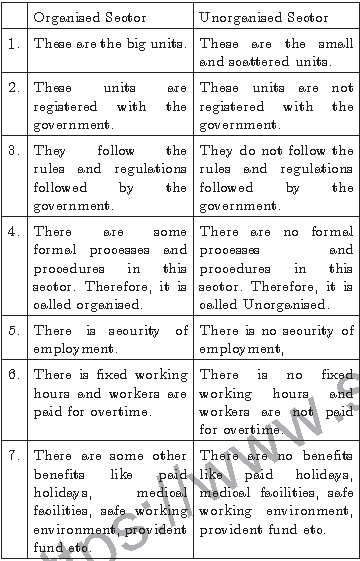
Question : Compare the employment conditions prevailing in the organised and unorganised sector?
Answer :  The comparison between the employment conditions prevailing in the organised and unorganised sector is as follows :
Table-3

CBSE Class 10 Economics Understanding Economic Development Chapter 2 Sectors Of The Indian Economy Assignment

Access the latest Understanding Economic Development Chapter 2 Sectors Of The Indian Economy assignments designed as per the current CBSE syllabus for Class 10. We have included all question types, including MCQs, short answer questions, and long-form problems relating to Understanding Economic Development Chapter 2 Sectors Of The Indian Economy. You can easily download these assignments in PDF format for free. Our expert teachers have carefully looked at previous year exam patterns and have made sure that these questions help you prepare properly for your upcoming school tests.

Benefits of solving Assignments for Understanding Economic Development Chapter 2 Sectors Of The Indian Economy

Practicing these Class 10 Economics assignments has many advantages for you:

  • Better Exam Scores: Regular practice will help you to understand Understanding Economic Development Chapter 2 Sectors Of The Indian Economy properly and  you will be able to answer exam questions correctly.
  • Latest Exam Pattern: All questions are aligned as per the latest CBSE sample papers and marking schemes.
  • Huge Variety of Questions: These Understanding Economic Development Chapter 2 Sectors Of The Indian Economy sets include Case Studies, objective questions, and various descriptive problems with answers.
  • Time Management: Solving these Understanding Economic Development Chapter 2 Sectors Of The Indian Economy test papers daily will improve your speed and accuracy.

How to solve Economics Understanding Economic Development Chapter 2 Sectors Of The Indian Economy Assignments effectively?

  1. Read the Chapter First: Start with the NCERT book for Class 10 Economics before attempting the assignment.
  2. Self-Assessment: Try solving the Understanding Economic Development Chapter 2 Sectors Of The Indian Economy questions by yourself and then check the solutions provided by us.
  3. Use Supporting Material: Refer to our Revision Notes and Class 10 worksheets if you get stuck on any topic.
  4. Track Mistakes: Maintain a notebook for tricky concepts and revise them using our online MCQ tests.

Best Practices for Class 10 Economics Preparation

For the best results, solve one assignment for Understanding Economic Development Chapter 2 Sectors Of The Indian Economy on daily basis. Using a timer while practicing will further improve your problem-solving skills and prepare you for the actual CBSE exam.

Where can I download the latest CBSE Class 10 Economics Chapter Understanding Economic Development Chapter 2 Sectors Of The Indian Economy assignments?

You can download free PDF assignments for Class 10 Economics Chapter Understanding Economic Development Chapter 2 Sectors Of The Indian Economy from StudiesToday.com. These practice sheets have been updated for the 2025-26 session covering all concepts from latest NCERT textbook.

Do these Economics Chapter Understanding Economic Development Chapter 2 Sectors Of The Indian Economy assignments include solved questions?

Yes, our teachers have given solutions for all questions in the Class 10 Economics Chapter Understanding Economic Development Chapter 2 Sectors Of The Indian Economy assignments. This will help you to understand step-by-step methodology to get full marks in school tests and exams.

Are the assignments for Class 10 Economics Chapter Understanding Economic Development Chapter 2 Sectors Of The Indian Economy based on the 2026 exam pattern?

Yes. These assignments are designed as per the latest CBSE syllabus for 2026. We have included huge variety of question formats such as MCQs, Case-study based questions and important diagram-based problems found in Chapter Understanding Economic Development Chapter 2 Sectors Of The Indian Economy.

How can practicing Chapter Understanding Economic Development Chapter 2 Sectors Of The Indian Economy assignments help in Economics preparation?

Practicing topicw wise assignments will help Class 10 students understand every sub-topic of Chapter Understanding Economic Development Chapter 2 Sectors Of The Indian Economy. Daily practice will improve speed, accuracy and answering competency-based questions.

Can I download Economics Chapter Understanding Economic Development Chapter 2 Sectors Of The Indian Economy assignments for free on mobile?

Yes, all printable assignments for Class 10 Economics Chapter Understanding Economic Development Chapter 2 Sectors Of The Indian Economy are available for free download in mobile-friendly PDF format.