

Read and download the CBSE Class 10 Social Science Geography Water Resources Assignment Set 01 for the 2026-27 academic session. We have provided comprehensive Class 10 Geography school assignments that have important solved questions and answers for Contemporary India Chapter 3 Water Resources. These resources have been carefuly prepared by expert teachers as per the latest NCERT, CBSE, and KVS syllabus guidelines.
Solved Assignment for Class 10 Geography Contemporary India Chapter 3 Water Resources
Practicing these Class 10 Geography problems daily is must to improve your conceptual understanding and score better marks in school examinations. These printable assignments are a perfect assessment tool for Contemporary India Chapter 3 Water Resources, covering both basic and advanced level questions to help you get more marks in exams.
Contemporary India Chapter 3 Water Resources Class 10 Solved Questions and Answers
MCQ Questions for Class 10 Social Science Water Resources
Explanation: Iltutmish constructed a water tank in hauz Khas ,Delhi in the 14th Century to supply water to siri fort.
Explanation: Jawaharlal Nehru proudly proclaimed the dams as the ‘temples of modern India’; the reason being that it would integrate development of agriculture and the village economy with rapid industrialisation and growth of the urban economy.
Explanation: 70 per cent of the freshwater occurs as ice sheets and glaciers in Antarctica, Greenland and the mountainous regions of the world
Explanation: In the flood plains of Bengal, people developed inundation channels to irrigate their fields. Rooftop rain water harvesting’ was commonly practised to store drinking water, particularly in Rajasthan.
Fill In The Blank
True/False
Assertion And Reason
Very Short Questions for Class 10 Social Science Water Resources
Answer : Sringaverapura near Allahabad the oldest water harvesting system channeling the flood water of river Ganga.
Short Questions for Class 10 Social Science Water Resources
Question : State any three objectives of Rainwater harvesting?
Answer : (a) To reduce run off water
(b) To raise the water table
(c) To reduce ground water pollution
Question : What is multipurpose river valley project? State any two purposes which are fulfilled by a river valley project?
Answer : Multipurpose river valley project consists a dam or series of dames on a river or rivers for fulfill many purposes like:
(a) irrigation
(b) electricity
(c) control flood
(d) check soil erosion
(e) inland navigation
(f) fisheries etc.
Question : Mention three major sources of irrigation in India, which source of irrigation is more popular in southern state? and Why?
Answer : (I) The three major sources pf irrigation in India are –
(a) Canals
(b) Wells & tube wells
(c) Tanks
(II) Tank irrigation
(III) Because Southern States are mostly come under Deccan plateau which are not suitable for irrigation by canals
Question : What is “Water scarcity” what are its main causes?
Answer : “Water scarcity” means shortage of water.
CAUSES: (may write any two)
(a) Unequal distribution of rainfall
(b) Large & growing population
(c) Over exploitation of water
(d)Wastage of water by people (Explain all in brief)
Question : Name any two multipurpose river valley projects or dams which are causes of new social movements. Why did people oppose them?
Answer : Two Multipurpose project which are caused social movements –
(a) Narmada –Bachao Andolan
(b) Tehri-Dam Andolan
(c) Sardar Sarover Dam
-Large scale displacement of local communities
-Environment issues
-Demand for Rehabilitation facilities from Govt.
Question : Describe the working of the Roof Top Rainwater Harvesting being practised in India.
Answer : (i) Rooftop rainwater is collected using a PVC pipe.
(ii) Collected water is filtered using sand and bricks.
(iii) Underground pipe is used to take the water to the tank for immediate usage.
(iv) Excess water from the tank is taken to the well.
(v) Water from the well recharges the underground water.
Question : Why did Jawaharlal Nehru proclaim the dams as the "temples of modern India"? Explain any three reasons.
Answer : Jawaharlal Nehru proclaimed the dams as the "temples of modern India" because :
(i) They eliminate or reduce flooding
(ii) Provide water for agriculture.
(iii) Provide water for human and industrial consumption.
(iv) Provide hydroelectricity for houses and industries.
Question : What is Bamboo Drip Irrigation? Mention any two features of it.
Answer : (i) Bamboo Drip irrigation system is a 200 years old system of tapping stream and spring water by using bamboo pipe and transporting water from higher to lower regions through gravity.
(ii) Features :
(a) 18-20 liters of water entres the bamboo pipe system, get transported over hundreds of meters and finally reduces to 20-80 drops per minute at the site of the plants.
(b) The flow of water into the pipes is controlled by manipulating the pipe positions.
Question : What is the traditional system of rain water harvesting used in Rajasthan?
Answer : Taanka is a traditional rainwater harvesting technique indigenous to the Thar desert region of Rajasthan. A Taanka is a cylindrical paved underground pit into which rainwater from rooftops, courtyards or artificially prepared catchments accumulate for later use.
Question : Highlight any three hydraulic structures as part of water management programmesintiated in ancient India along with the period when they were built.
Answer : Sophisticated hydraulic structures like dams build of stone rubble, reservoirs of lakes, embankments and canals for irrigation were built in various regions of the country.
(i) A sophisticated water harvesting system channelling the flood water of river Ganga was build at Sringaverapura near Allahabad in the first century B.C.
(ii) Nagarjunakonda in Andhra Pradesh, Bennur in Karnataka, Kolhpur in Maharashtra and Kalinga in Odisha have evidences of irrigation structures.
(iii) In the 11th century, Bhopal Lake, one of the largest artificial lakes of its time was built.
(iv) The tank in Hauz Khas, Delhi was constructed by Iltutmish in the 14th century to supply water to the Siri Fort Area.
Long Questions for Class 10 Social Science Water Resources
Question : Describe any four traditional methods of rain water harvesting adopted in different parts of India.
Answer : Methods of rain water harvesting used in India are :
(i) Guls and Kuls : People built guls and kuls in hilly and mountainous regions to divert water. These are simple channels. They are mainly used in the Western Himalayas.
(ii) Roof top rain water harvesting : Commonly practised to store drinking water in Rajasthan.
(iii) Inundation Channels : These channels developed in the flood plains of Bengal to irrigate fields.
(iv) Khadins and Johads : In arid and semi-arid regions, some agricultural fields were converted into rain fed storage structures. These structures are found in Rajasthan.
(v) Tankas : The tankas were build inside the house or the courtyard. They were connected to the sloping roofs of the houses through a pipe. Rain falling on the rooftops would travel down the pipe and was stored in these underground tanks'. The rainwater was stored in the tankas.
Key Concepts of the lesson -
WATER SCARCITY AND THE NEED FOR WATER CONSERVATION AND MANAGEMENT
Roof top rainwater harvesting, objectives of Rainwater harvesting, Meaning of multipurpose
river valley project, Causes of social movements for some dames, Bamboo drip Irrigation System, Khadins & Johads,
Guls & Kuls, major sources of irrigation in India, Conserve of water resources.
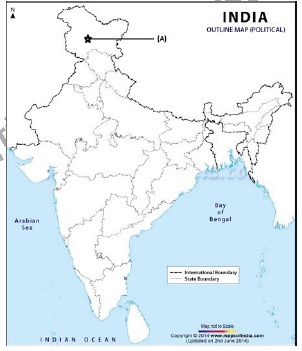
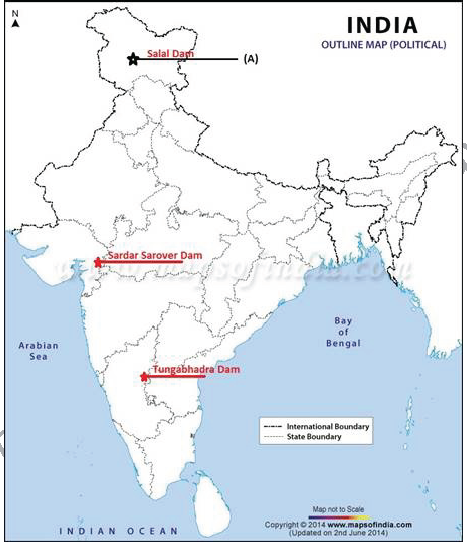
Locating and Labeling ; Dams: (1) Salal; (2) Bhakra Nangal; (3) Tehri; (4) Rana Pratap Sagar; (5) Sardar Sarovar; (6) Hirakud; (7) Nagarjuna Sagar and (8) Tungabhadra.
Question. The total volume of the world’s water is estimated to exist as ocean:
(a) 75.5%
(b) 85.5%
(c) 95.5%
(d) 65.5%
Answer: C
Question. Roof top rainwater harvesting is the most common practice in-
(a) Shillong
(b) Guwahati
(c) Imphal
(d) Patna
Answer: A
Question. On which river has Nagarjun Sager Dam been constructed?
(a) River Coyana
(b) River Krishna
(c) River Godavari
(d) river Tapti
Answer: B
Question. How much %of the Earth’s Surface is covered with water?
(a) About 70%
(b) About 90%
(c) About 60%
(d) None of these
Answer: A
Question. What is the rank of India in the world countries in the terms of Water availability per person p.a.?
(a) 129th
(b) 130th
(c) 131st
(d) 133rd
Answer: D
Question. It is predicated that nearly 2 billion people will live in absolute water scarcity in the year of –
(a) 2015
(b) 2020
(c) 2025
(d) 2030
Answer: C
Question. The first & the only state in India which has made Roof Top Rain water Harvesting Structured compulsory to all the across the state is –
(a) Karnataka
(b) Tamil Nadu
(c) Kerala
(d) none of these
Answer: B
Question. Explain in brief –
(a) Bamboo drip Irrigation System
(b) Khadins & Johads
(c) Guls & Kuls
Answer:
(1) In Meghalaya, 200 years old system of tapping stream and spring water by using Bamboo –pipes.
(2) People built division channels from rivers for irrigation to their field in western Himalaya is called Guls or kuls .
(3) People developed inundation channels to irrigate their fields were converted into rain storage structure in particularly western Rajasthan Jaisalmer called Khadins and Johads in other parts of its state.
Question. Why do we conserve water resources?
Answer:
i)To safeguard ours from health hazards
ii) To ensure food scarcity
iii) To protect natural ecosystem
LONG ANSWER TYPE QUESTIONS
Question. How can rainwater be harvested? Explain.
Answer: Rainwater can be harvested in the following ways :
i) By digging ponds and tanks.
ii) By building embankments and check dams.
iii) By making arrangements for storage of rainwater on rooftops.
iv) By constructing concrete underground reservoirs.
v) By constructing reservoirs in park and public places and covering them with concrete slabs.
vi) Building plans should invariably be made only when there is a provision for water harvesting.
Question. What is the different causes of water pollution? Explain by four reasons.
Answer: The different causes of water pollution are:
(a) Mix-up of domestic wastes
(b) Mix-up of Industrial wastes,
(c)Use of Chemicals, pesticides and fertilizers used in agriculture
(d) Oil slicking by ships in oceans
Question. Match the following
| Column A | Column B |
| 1. Social movement | a) highest rainfall in the world |
| 2. A dam | b) temples of modern India |
| 3. Jawaharalal Nehru declared the dams as the | c) a barrier across flowing water that obstructs the flow |
| 4. Mawsynram | d) Narmada Bachao Andolan. |
CBSE Class 10 Geography Contemporary India Chapter 3 Water Resources Assignment
Access the latest Contemporary India Chapter 3 Water Resources assignments designed as per the current CBSE syllabus for Class 10. We have included all question types, including MCQs, short answer questions, and long-form problems relating to Contemporary India Chapter 3 Water Resources. You can easily download these assignments in PDF format for free. Our expert teachers have carefully looked at previous year exam patterns and have made sure that these questions help you prepare properly for your upcoming school tests.
Benefits of solving Assignments for Contemporary India Chapter 3 Water Resources
Practicing these Class 10 Geography assignments has many advantages for you:
- Better Exam Scores: Regular practice will help you to understand Contemporary India Chapter 3 Water Resources properly and you will be able to answer exam questions correctly.
- Latest Exam Pattern: All questions are aligned as per the latest CBSE sample papers and marking schemes.
- Huge Variety of Questions: These Contemporary India Chapter 3 Water Resources sets include Case Studies, objective questions, and various descriptive problems with answers.
- Time Management: Solving these Contemporary India Chapter 3 Water Resources test papers daily will improve your speed and accuracy.
How to solve Geography Contemporary India Chapter 3 Water Resources Assignments effectively?
- Read the Chapter First: Start with the NCERT book for Class 10 Geography before attempting the assignment.
- Self-Assessment: Try solving the Contemporary India Chapter 3 Water Resources questions by yourself and then check the solutions provided by us.
- Use Supporting Material: Refer to our Revision Notes and Class 10 worksheets if you get stuck on any topic.
- Track Mistakes: Maintain a notebook for tricky concepts and revise them using our online MCQ tests.
Best Practices for Class 10 Geography Preparation
For the best results, solve one assignment for Contemporary India Chapter 3 Water Resources on daily basis. Using a timer while practicing will further improve your problem-solving skills and prepare you for the actual CBSE exam.
FAQs
You can download free PDF assignments for Class 10 Geography Chapter Contemporary India Chapter 3 Water Resources from StudiesToday.com. These practice sheets have been updated for the 2026-27 session covering all concepts from latest NCERT textbook.
Yes, our teachers have given solutions for all questions in the Class 10 Geography Chapter Contemporary India Chapter 3 Water Resources assignments. This will help you to understand step-by-step methodology to get full marks in school tests and exams.
Yes. These assignments are designed as per the latest CBSE syllabus for 2026. We have included huge variety of question formats such as MCQs, Case-study based questions and important diagram-based problems found in Chapter Contemporary India Chapter 3 Water Resources.
Practicing topicw wise assignments will help Class 10 students understand every sub-topic of Chapter Contemporary India Chapter 3 Water Resources. Daily practice will improve speed, accuracy and answering competency-based questions.
Yes, all printable assignments for Class 10 Geography Chapter Contemporary India Chapter 3 Water Resources are available for free download in mobile-friendly PDF format.