

Read and download the CBSE Class 10 Social Science Geography Minerals And Energy Resources Hindi Assignment for the 2026-27 academic session. We have provided comprehensive Class 10 Geography school assignments that have important solved questions and answers for Contemporary India Chapter 5 Minerals And Energy Resources. These resources have been carefuly prepared by expert teachers as per the latest NCERT, CBSE, and KVS syllabus guidelines.
Solved Assignment for Class 10 Geography Contemporary India Chapter 5 Minerals And Energy Resources
Practicing these Class 10 Geography problems daily is must to improve your conceptual understanding and score better marks in school examinations. These printable assignments are a perfect assessment tool for Contemporary India Chapter 5 Minerals And Energy Resources, covering both basic and advanced level questions to help you get more marks in exams.
Contemporary India Chapter 5 Minerals And Energy Resources Class 10 Solved Questions and Answers
Minerals And Energy Resources Summary Class 10 Social Science
Mineral:
Geologists define mineral as a “homogeneous, naturally occurring substance with a definable internal structure.” They have physical and chemical properties by which they can be identified.
Rocks are combinations or aggregates of minerals in varying proportions. Some rocks consist of a single mineral, e.g., limestone while most rocks consist of several minerals.
The term ‘ore’ is used to describe an accumulation of any mineral mixed with other elements.
Minerals generally occur in the following forms:
1. Veins and lodes. In igneous and metamorphic rocks minerals may occur in the cracks, faults or joints by getting solidified in them. The smaller occurrences are called veins and the larger lodes, e.g., metallic minerals like tin, copper, zinc and lead, etc. are found in lodes and veins.
2. In sedimentary rocks minerals occur in beds or layers. They are formed as a result of deposition, accumulation and concentration in horizontal strata. Some sedimentary minerals are formed as a result of evaporation, especially in arid regions, e.g., gypsum, potash and salt.
3. Another mode of formation involves decomposition of surface rocks and the removal of soluble contents, leaving a residual mass of weathered material containing ores. Bauxite is formed this way.
4. Placer deposits. Certain minerals occur as alluvial deposits in sands of valley floors and the base of hills, e.g., gold, silver, tin and platinum. These are called placer deposits and contain minerals which are not corroded by water.
5. Ocean waters contain vast quantities of minerals, e.g., common salt, magnesium and bromide are largely derived from the ocean waters. The ocean beds are rich in manganese nodules.
Four types of iron ores are: Magnetite, Hematite, Siderite and Limonite.
Two best ores are:
● Magnetite—It is the finest iron ore available with upto 70% iron content. It has excellent magnetic qualities and is especially valuable in the electrical industry.
● Hematite—It is the most important industrial iron ore in terms of quantity used. It has 50-60% iron content.
Four major iron ore belts:
1. Odisha-Jharkhand Belt: Badampahar Mines—High grade hematite ore is found here.
2. Durg-Bastar-Chandrapur Belt: Bailadila Mines—Super high grade hematite ore deposits are found in Bailadila range. Iron ore from these mines is exported to Japan and South Korea.
3. Bellary-Chitradurga-Chikmaglur Tumkur Belt in Karnataka: Kudremukh Mines — A 100 per cent export unit. The ore is transported as slurry to a port near Mangalore.
4. Maharashtra-Goa Belt: Ratnagiri district of Maharashtra—Ores are not of very high quality. Iron ore is exported through Marmagao port.
Aluminum is obtained from bauxite ore. It is an important metal because—it has the strength of metals such as iron, and is extremely light at the same time; it has good conductivity; and it has great malleability.
Bauxite deposits are formed by the decomposition of a wide variety of rocks rich in aluminium silicates. Leading State of bauxite production is Odisha, producing 45% of the total bauxite of India. The most important bauxite deposits are found in Panchpatmali in Koraput district. Other States are Gujarat (17%), Jharkhand (14%) and Maharashtra (11%).
Mica is made up of a series of plates or leaves. It splits easily into such thin sheets that a thousand put together are only a few centimeters thick. Mica is indispensable for electric and electronic industry because it has —
● excellent di-electric strength;
● Low power loss factor;
● Insulating properties; and
● Resistance to high voltage.
Mica deposits are found in the northern edge of Chhota Nagpur Plateau. Jharkhand is the leading producer. The important mica producing belt here is Koderma-Gaya-Hazaribagh.
Dangers involved in mining are—
1. The risk of collapsing mine roofs;
2. Inundation, i.e., flooding in mines;
3. Fires in coal-mines is a constant threat to miners; and
4. Poisonous gases, dust and noxious fumes inhaled by miners make them vulnerable to pulmonary diseases
Adverse effects of mining on the environment:
1. The water sources in the region get contaminated;
2. Dumping of the slurry and waste leads to degradation of land and soil; and
3. It also leads to an increase in stream and river pollution.
Conservation of minerals is necessary because:
1. The formation of minerals takes a long geological period of millions of years.
2. They are finite in nature, non-renewable and exhaustible.
3. The rate of replenishment of minerals is infinitely small in comparison to rate of consumption.
4. They have to be preserved for our future generations.
Methods of mineral conservation:
1. We should use minerals in a planned and sustainable manner.
2. Improved technologies need to be evolved to allow use of low grade ores at low cost.
3. Recycling of metals, using scrap metals and other substitutes.
4. Wastage’s in mining, processing and distribution should be minimized.
5. Controlled export of minerals.
Energy resources can be classified as conventional and non-conventional sources.
Conventional sources include coal, petroleum, natural gas and electricity (both hydel and thermal). All these sources have been in use for quite some time.
Non-conventional sources of energy are relatively new sources as their large scale generation has started recently. These include solar, wind, tidal, geothermal, biogas and atomic energy.
Coal as an important source of energy:
1. It provides a substantial part of the nation’s energy needs as it is abundantly available.
2. It is used for power generation, to supply energy for industrial and domestic needs.
3. India is highly dependent on coal for meeting its commercial needs. Its share in total—67%.
4. It can easily be converted into other forms of energy—electricity, gas, oil, etc.
Coal as an industrial raw material:
1. It is an indispensable raw material for iron and steel industry.
2. It provides raw material for chemical industries and synthetic textile industries.
3. Many coal-based products are processed in industries, e.g., coal tar, graphite, soft coke, etc.
4. Power generation industry is mainly based on this fossil fuel.
Four types of coal and their characteristics:
(a) Anthracite—
1. It is the highest quality hard coal;
2. It contains more than 80% carbon content. It gives less smoke. ,
(b) Bituminous—
1. It is the most popular coal in commercial use and has 60-80% carbon content;
2. Metallurgical coal is high grade bituminous coal and is of special value for smelting iron in blast furnaces.
(c) Lignite—
1. It is a low grade brown coal;
2. It is soft with high moisture content. The main lignite reserve is Neyveli in Tamil Nadu.
(d) Peat—
1. It has a low carbon and high moisture content;
2. It has low heating capacity and gives lot of smoke on burning.
Occurrence of coal:
● Gondwana Coal Belt—A little over 200 million years in age. Mainly metallurgical coal is found in:
(a) Damodar Valley Belt (West Bengal, Jharkhand) which contains important coal mines of Jharia, Raniganj and Bokaro;
(b) The Godavari Valley Belt;
(c) The Mahanadi Valley Belt; and (d) Wardha Valley Belt.
● Tertiary coal deposits are only about 55 million years old, i.e., they are comparatively younger. They occur in North-Eastern States, namely:
(a) Assam (b) Meghalaya,
(c) Arunachal Pradesh and
(d) Nagaland.
Petroleum:
It is the second most important energy source of India after coal. It can be easily trans-ported by pipelines and does not leave any residue. It provides fuel for heat and light. It provides lubricants for machinery. It provides raw material for a number of manufacturing industries. It is an important fuel used in transportation sector. Petroleum refineries act as a ‘nodal industry’ for synthetic textiles, fertilizers and many chemical industries.
Occurrence and formation of petroleum:
Most of the petroleum occurrences in India are associated with anticlines and fault traps in the rock formations of the tertiary age. In regions of folding anticlines it occurs where oil is trapped in the crest of the unfold. The oil bearing layer is porous limestone or sandstone through which oil may flow. Petroleum is also found in fault traps between porous and non-porous rocks.
Distribution of petroleum:
1. Mumbai High—It is an offshore oilfield and is the richest oilfield of India. Its share is about 63% of India’s petroleum production;
2. Gujarat—It produces 18% petroleum of India. Ankaleshwar is the most important field; and
3. Assam—It is the oldest oil producing State of India. Its contribution in the total production is 16%. Important oilfields are Digboi, Naharkatiya and Moran-Hugrijan.
Non-Conventional Sources of Energy:
● Nuclear Energy: Nuclear energy is obtained by altering the structure of atom. When the structure of an atom is altered, too much energy is released in the form of heat. This heat is utilised to generate electric power. Uranium and Thorium are used for generating atomic power. These minerals are available in Jharkhand, Aravalli ranges of Rajasthan.
● Solar Energy: Photovoltaic technology is used to convert solar energy into electricity. The largest solar plant of India is located at Madhapur near Bhuj. Solar energy holds great promises for the future. It can help in minimizing the dependence on firewood and animal dung cakes in rural areas. This will also help in conservation of fossil fuels.
● Wind Power: The wind farm cluster in Tamil Nadu (from Nagarcoil to Madurai) is the largest cluster in India. Andhra Pradesh, Karnataka, Gujarat, Kerala, Maharashtra and Lakshadweep are also important centres of wind power production. India is now a “Wind Super Power” in the world.
● Biogas: Biogas can be produced from shrubs, farm waste, and animal and human waste. It is more efficient than kerosene, dung cake and charcoal. Biogas plants can be set up at municipal, cooperative and individual levels. The gobar gas plants provide energy and also manure.
● Tidal Energy: Dams are built across inlets. The water flows into the inlet during high tide and gets trapped when the gate is closed. Once the tide recedes, the floodgates are opened so that water can flow back to the sea. The flow of water is used to run the turbine to generate electricity. A 900 mw tidal energy power plant is set up by the National Hydropower Corporation in the Gulf of Kuchchh.
● Geo Thermal Energy: We know that the inside of the earth is very hot. At some places, this heat is released on the surface through fissures. Groundwater in such areas becomes hot and rises up in the form of steam. This steam is used to drive turbines. Two geo thermal energy projects—the Parvati valley near Manikam in Himachal Pradesh and the Puga valley in Ladakh.
Importance of energy:
Energy is required for all activities. It is needed to cook, to provide light and heat, to propel vehicles and to drive machinery in industries. It is the basic requirement for economic development. Every sector of national economy—agriculture, industry, transport and commerce needs greater inputs of energy. Energy demands, in the form of electricity, are growing because of increasing use of electrical gadgets and appliances.
Ways to conserve energy:
1. Using more of public transport system instead of individual vehicles.
2. Switching off electrical devices when not in use, using power saving devices.
3. Using non-conventional sources of energy such as solar energy, wind energy, etc.
4. Getting the power equipment regularly checked to detect damages and leakages.
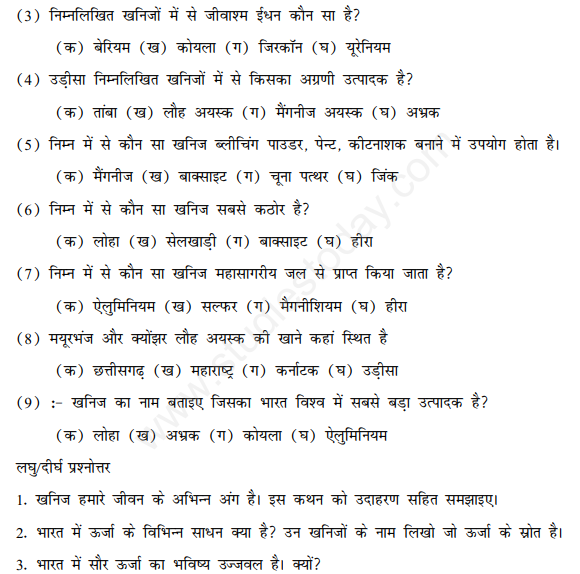
Please refer to attached file for CBSE Class 10 Social Science Geography Minerals And Energy Resources Hindi Assignment
CBSE Class 10 Geography Contemporary India Chapter 5 Minerals And Energy Resources Assignment
Access the latest Contemporary India Chapter 5 Minerals And Energy Resources assignments designed as per the current CBSE syllabus for Class 10. We have included all question types, including MCQs, short answer questions, and long-form problems relating to Contemporary India Chapter 5 Minerals And Energy Resources. You can easily download these assignments in PDF format for free. Our expert teachers have carefully looked at previous year exam patterns and have made sure that these questions help you prepare properly for your upcoming school tests.
Benefits of solving Assignments for Contemporary India Chapter 5 Minerals And Energy Resources
Practicing these Class 10 Geography assignments has many advantages for you:
- Better Exam Scores: Regular practice will help you to understand Contemporary India Chapter 5 Minerals And Energy Resources properly and you will be able to answer exam questions correctly.
- Latest Exam Pattern: All questions are aligned as per the latest CBSE sample papers and marking schemes.
- Huge Variety of Questions: These Contemporary India Chapter 5 Minerals And Energy Resources sets include Case Studies, objective questions, and various descriptive problems with answers.
- Time Management: Solving these Contemporary India Chapter 5 Minerals And Energy Resources test papers daily will improve your speed and accuracy.
How to solve Geography Contemporary India Chapter 5 Minerals And Energy Resources Assignments effectively?
- Read the Chapter First: Start with the NCERT book for Class 10 Geography before attempting the assignment.
- Self-Assessment: Try solving the Contemporary India Chapter 5 Minerals And Energy Resources questions by yourself and then check the solutions provided by us.
- Use Supporting Material: Refer to our Revision Notes and Class 10 worksheets if you get stuck on any topic.
- Track Mistakes: Maintain a notebook for tricky concepts and revise them using our online MCQ tests.
Best Practices for Class 10 Geography Preparation
For the best results, solve one assignment for Contemporary India Chapter 5 Minerals And Energy Resources on daily basis. Using a timer while practicing will further improve your problem-solving skills and prepare you for the actual CBSE exam.
FAQs
You can download free PDF assignments for Class 10 Geography Chapter Contemporary India Chapter 5 Minerals And Energy Resources from StudiesToday.com. These practice sheets have been updated for the 2026-27 session covering all concepts from latest NCERT textbook.
Yes, our teachers have given solutions for all questions in the Class 10 Geography Chapter Contemporary India Chapter 5 Minerals And Energy Resources assignments. This will help you to understand step-by-step methodology to get full marks in school tests and exams.
Yes. These assignments are designed as per the latest CBSE syllabus for 2026. We have included huge variety of question formats such as MCQs, Case-study based questions and important diagram-based problems found in Chapter Contemporary India Chapter 5 Minerals And Energy Resources.
Practicing topicw wise assignments will help Class 10 students understand every sub-topic of Chapter Contemporary India Chapter 5 Minerals And Energy Resources. Daily practice will improve speed, accuracy and answering competency-based questions.
Yes, all printable assignments for Class 10 Geography Chapter Contemporary India Chapter 5 Minerals And Energy Resources are available for free download in mobile-friendly PDF format.