1.What do you mean by Communal Politics?
Ans- Communal politics is the use of religion in politics. In communal politics, one religion is presented as superior to other religions.
2.What is casteism?
Ans- Casteism is the exploitation of caste consciousness for narrow political and electoral gains.
3.State any two situations in which problem of communalism becomes acute.
Ans- Problems of communalism become acute when
(a) Religion is used in politics.
(b) There is a feeling of distrust among the people of different religions.
4.Can we have a party-less democracy? Why/Why not?
Ans- No, it is not possible to have a party-less democracy because parties are necessary to conduct elections and to make parliamentary system more systematic.
5.List the elements of political parties.
Ans- The elements of a political party are:
(a) The leaders
(b) The active members
(c) The followers
6.In what way do political parties play the role of opposition?
Ans- Political parties play the role of opposition by voicing different views and criticising the government in power for its failures or wrong policies.
7.Which institution allots symbols to political parties?
Ans- The Election Commission of India allots symbols to political parties.
8.How many parties are registered with the Election Commission of India?
Ans- More than 750 parties are registered with the Election Commission of India.
9.Which party is given a unique symbol by the Election Commission of India?
Ans- A recognised party is given a unique symbol by the Election Commission of India.
10.On what basis does a country choose its party system?
Ans- A country chooses its party system on the basis of the:
(a) nature of society. (b) history of elections. (c) social differences.
11.What do you mean by two-party or bi-party system?
Ans- The two-party or bi-party system is a political system where there are two major parties.
Power usually changes between two main parties, for instances, the United Kingdom and the United States.
12.Define multiparty system.
Ans- The multiparty is a political system where more than two parties exist and contest elections to come to power, for example, India.
13.What does the term coalition government imply?
Ans- The term coalition government implies a government which is formed by various parties coming together in the situation when no single party wins the majority of seats.
14.What is a national party?
Ans- A party that is present in several or all units of a federation is known as a national party.
15.Give the meaning of state or regional party.
Ans- State or regional party is the party which is present in only one of the federal units and is identified with that region only.
16.How many recognised national parties are there in India?
Ans- There are six recognised national parties in India.
17.Name the oldest political party of India.
Ans- The Indian National Congress (INC) is the oldest political party of India, formed in 1885.
18.Under whose leadership was the Bahujan Samaj Party formed?
Ans- The Bahujan Samaj Party was formed under the leadership of Kanshi Ram.
19.Which political party seeks to represent and secure power for dalits, OBCs and adivasis?
Ans- The Bahujan Samaj Party (BSP) seeks to represent and secure power for dalits, OBCs and adivasis.
20.Which political party believes in Marxism-Leninism?
Ans- The Communist Party of India (CPI) and Communist Party of India-Marxist (CPI-M) believe in Marxism-Leninism. (any one)
21.In which state does Biju Janata Dal exist as a regional political party?
Ans- The Biju Janata Dal exists as a regional political party in Odisha.
22.Which two parties were formed after their split with parent party?
Ans- The two parties formed after their split with parent party are as follows.
(a) Communist Party of India-Marxist (CPI-M) from Communist Party of India (CPI) in 1964.
(b) Nationalist Congress Party (NCP) from Indian National Congress (INC) in 1999.
23.Which state has maximum number of recognised regional or state parties?
Ans- Tamil Nadu has maximum number of recognised regional or state parties.
24.What is an alliance?
Ans- Several parties in a multiparty system join for the purpose of contesting elections and winning power. This is known as an alliance. In India, UPA, NDA and Left Front are the examples of alliances.
25.If all the decisions of a political party are made by a single family and all other members are neglected, then what challenge is being faced by that party?
Ans- In this situation the party faces the challenge of dynastic succession.
26.Define defection.
Ans- Defection is a new concept which advocates the changing of allegiance from the party in which a person got elected to a different party. It means leaving a political party to join another for some personal gains.
27.How does the new system of affidavit reduce the money and muscle power in politics?
Ans- An affidavit is a signed document submitted to an officer, where a person makes a sworn statement regarding his assets and criminal records. This system makes a lot of information available to the public, thereby reducing money and muscle power in politics.
28.Which constitutional bodies suggest reforms in political parties?
Ans- The Constitution of India and the Election Commission of India suggest reforms in political parties.
29.What are partisan and partisanship?
Ans- (a) The term partisan relates to a person who is strongly committed to a party group or faction.
(b) Partisanship is marked by a tendency to take side of a political party and inability to take a balanced view on an issue.
30.Do political parties educate people?
Ans- Yes, political parties educate people through various means like debates, discussions,etc.
31.How do political parties shape public opinion?
Ans- Political parties shape public opinion by raising and highlighting public issues with the help of their activists and members spread all over the country.
32.Which party can be referred to as a recognised party?
Ans- A party which gets registered with the Election Commission with a unique election symbol and other facilities can be referred to as a recognised party.
33.Define mono-party system.
Ans- The one-party or mono-party system is such a political system in which only one party is allowed to control and run the government, for example, Communist Party in China.
34.Why is democracy preferred as the better form of government than dictatorship?
Or
Why is a democratic government better than other alternatives?
Ans- Democracy is preferred as the better form of government because it ensures people’s rule based on popular consensus and enhances the dignity of the individual.
35.What are the basic elements of democracy in practical sense?
Ans- The basic elements of democracy are formal constitutions, regular, fair and free elections, political parties and fundamental rights to citizens.
36.What thoughts should be put in to assess the outcome of democracy?
Ans- The first step towards thinking carefully about the outcome of democracy is to recognise that democracy is a just form of government.
37.What should be the basic outcome of democracy?
Ans- The most basic outcome of democracy should be that it produces an accountable,responsive and legitimate government.
38.Why are decisions delayed in democracy?
Ans- Decisions are delayed in democracy because democratic governments are based on the idea of deliberation and negotiation.
39.What do democracies ensure regarding decision-making?
Ans-Democracies ensure that decision-making is based on norms and procedures.
40.What is meant by transparency?
Ans-In democracy, the term transparency signifies that decisions are taken through the correct procedure by involving the people and that people have the right to examine the process of decision-making.
41.Is a democratic government efficient and effective? How?
Ans-Yes, a democratic government, to some extent, is efficient and effective as it produces an accountable government and develops a mechanism for citizens to take part in decision-making.
42.Democracy is not free from corruption. Is it true?
Ans-There is no denying the fact the democracy is not free from corruption but, it is only in a democracy that people can openly expose this evil and ask for its elimination.
43.List any two factors on which economic development depends.
Ans-Economic development depends on several factors like
(a) country's population size
(b) global situation
(c) cooperation from other countries
(d) economic priorities (any two)
44.Do democracies appear to be successful in reducing economic inequalities?
Ans-In actual life, democracies do not appear to be very successful in reducing economic inequalities.
45.In what ways are democracies different from each other?
Ans-In spite of common basic elements, democracies are different from each other in terms of social situation, economic achievements and cultures.
46.How can you say that democracies are based on political equality?
Ans-Democracies are based on political equality as they ensure and promote universal adult franchise. All citizens have weight in electing representatives.
47.‘Democracy cannot solve all economic and social problems but still it is percieved.’ Why?
Ans-Not only democracy but no other form of government can fully solve all economic and social problems, however, it is democracy which creates situations that help citizens to solve their social and economic problems.
48.Which country is suffering from adverse form of economic inequality?
Ans-Bangladesh is suffering from the adverse effect of economic inequality, i.e. poverty, as more than half of its population lives in poverty.
49.Trace any two provisions of Indian government to eradicate caste inequalities.
Ans- The following are the two provisions of Indian government to eradicate caste inequalities.
(a) Legal and moral rights have been granted to fight for equal status.
(b) The practice of untouchability has been banned.
50.Which two sections of society get special emphasis in Indian Constitution regarding equal status and equal opportunities?
Ans-Two sections of society getting special emphasis in Indian Constitution regarding equal status and equal opportunities are women, and disadvantaged and discriminated castes and tribes.
51.List two valid points which promote dignity of women in a democratic government.
Ans-Two valid points which promote dignity of women in a democratic government are as follows.
(a) Women empowerment through reservation and freedom
(b) Freedom to launch movements against ill practices
52.List the countries which have the most stable democracies in the world.
Ans-The United States, Canada and Switzerland have the most stable democracies because there is 100 per cent literacy and they have very successful welfare schemes for all citizens.
53.Name any two basic constituents of democracy.
Ans-The basic constituents or aspects of democracy are:
(a) Political: government by consent.
(b) Social: social and economic equality.
(c) Economic: equal opportunity, equal status and equal distribution of income. (any two)
54.What is the dilemma regarding the practical aspect of democracy?
Ans- The main dilemma regarding the practical aspect of democracy is that democracy is seen to be good in principle but felt to be not so good in practice.
55.List the countries which strongly believe in democracy and people’s rule. Which country has least belief in the strength of people’s vote?
Ans- India and USA strongly believe in democracy and Pakistan has least belief in democracy.
56.What do people need to get more income?
Ans- People need regular work, better wages and decent price for crops to get more income.
57.What does national development refer to?
Ans- National development refers to the ability of a county to improve the social welfare of the people. For example, by providing social amenities such as quality education, potable water, transportation, infrastructure and medical care.
58.Define average income.
Ans- Per capita income or average income is calculated by dividing the total income of a country with its population.
59.What does HDI stand for?
Ans- HDI stands for Human Development Index. It is a tool developed by the United Nations to measure a country’s overall achievement in its social and economic dimensions.
60.Define sustainable development.
Ans- Sustainable development refers to the development that meets the needs of the present without compromising the needs of the future generation.
61.What does national income refer to?
Ans- National income refers to the value of the total goods and services produced within a country in a year.
62.Why does Kerala have low infant mortality rate?
Ans- Kerala has low infant mortality rate because it has adequate provisions of basic health and educational facilities.
63.Besides more income, what other things do the people seek?
Ans- Besides more income, people seek to have equal treatment, freedom, security and health.
64.Which state in India has the least per capita income?
Ans- Bihar has recorded the least per capita income in the year 2013-14.
65.Define sex ratio.
Ans- The total number of females per thousand males in a country is termed as sex ratio.
66.Define economic growth.
Ans- Economic growth refers to the increase in per capita GDP of an economy over a long period of time.
67.Define infant mortality rate.
Ans- The number of children that die before the age of one year as a proportion of 1000 live children born in that particular year is known as infant mortality rate.
68.What is Life Expectancy at Birth?
Ans- Life Expectancy at Birth is the average expected length of life of a person at the time of birth.
69.Why do different people have different developmental goals?
Ans- Different people have different developmental goals because people have diverse wishes, likes and dislikes, and aspirations.
70.What is net attendance ratio?
Ans- Net attendance ratio is the total number of children of age group 14 and 15 years attending school as a percentage of total number of children in the same age group.
71.Why is the total income of countries not used to make comparisons between them?
Ans- The total income of the countries is not used to make comparisons between them because the population of different countries is different.
72.Besides the size of per capita income, which other property of income is important in comparing two or more countries?
Ans- Per capita income is an important but not the only criterion for development. Along with average income, equitable distribution of income in a country should also be considered.
73.Among Maharashtra, Kerala and Bihar, which one has the lowest infant mortality rate?
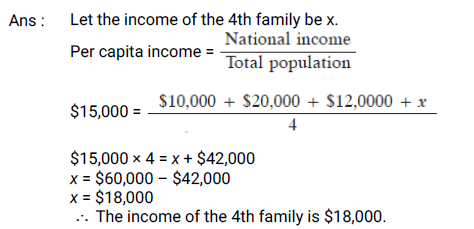
Ans- Kerala has the lowest infant mortality rate. Suppose there are 4 families in a country with per capita income of $15,000. The income of 3
74.families is $10,000, $20,000 and $12,000 respectively. What is the income of the 4th family?
Ans-
75.Give any two common developmental goals of the people.
Ans- The two common developmental goals of the people are as follows.
(a) Peace and security
(b) Better living conditions
76.Mention any one limitation of per capita income as an indicator of development.
Ans- One limitation of per capita income as an indicator of development is that:
(a) Per capita income does not tell us anything about the distribution of income. A poor country with a more equal distribution of income would be better than a richer country with unequal distribution of income.
(b) Per capita income does not measure various facilities and services that influence quality of life, for example, health facilities, education facilities, equal treatment, etc.
(c) It is affected by size of population. Even with a large national income, per capita income will be low if a country has a large population. (any one)
77.What are non-material things?
Ans- Things like love, care, equal treatment, freedom, security and respect for others are nonmaterial things.
78.What condition may allow women to take up a variety of jobs or run business?
Ans- A safe and secure environment may allow women to take up a variety of jobs or run business.
79.According to the World Bank, what are low-income countries?
Ans- Countries that have per capita income of USD 1035 or less are termed low-income countries by the World Bank.
80.What does BMI stand for?
Ans- BMI stands for Body Mass Index. It is calculated by dividing the weight with the heights in meters.
81.State one cause of high infant mortality rate.
Ans- Inadequate health facilities are the main cause for the high infant mortality rate.
82.Which neighbouring country of India has better performance in terms of human development than India?
Ans- Sri Lanka has better performance in terms of human development than India.
83.What is economic development?
Ans- Economic development means that the rate of production must be faster than the rate of increase in population. In other words, we can say that it makes people better off by increasing their command over goods and services and the choices open to them.
84.What does the tertiary sector include?
Ans- Tertiary sector includes distribution of services, training and support.
85.Biscuits for the consumer in the market are an example of which type of goods?
Ans- Biscuits for the consumer in the market are an example of final goods.
86.Which sector has grown considerably in the recent years?
Ans- In the recent years, the tertiary sector has shown a considerable growth.
87.Which sector has contributed the most to the employment?
Ans- Primary sector has contributed the most to the employment.
88.Where are most of the underemployed people found?
Ans-Most of the underemployed people are found in agriculture.
89.What is per capita income?
Ans-Per capita income of a nation is national income divided by the total population.
90.What is an economic activity?
Ans-An activity which gives an income in return is called an economic activity. For example, a teacher teaching in a school is performing an economic.
91.What is a non-economic activity?
Ans-An activity which does not give any income in return is called a non-economic activity.
For example, a father teaching his son is performing a non-economic activity.
92.State any two factors of production.
Ans-Capital and labour are the two factors of production.
93.Define the term enterprise.
Ans-When a person or a group of persons are engaged in the production or distribution of goods or services meant mainly for the purpose of sale, it is called an enterprise.
94.Mention any one feature of unorganized sector.
Ans-One feature of unorganized sector is that:
(a) the working conditions are very harsh.
(b) there are no benefits for the workers.
(c) there is no job security. (any one)
95.Where is the disguised unemployment found mostly?
Ans-Disguised unemployment is mostly found in the agriculture sector.
96.In which sector are a large number of workers losing their jobs since 1990?
Ans- Workers in the organized sector are losing their jobs since 1990.
97.What was the most important sector of economic activities at the earliest stages of development?
Ans-Primary sector was the most important sector of economic activities at the earliest stages of development.
98.Through which act is Right to Work implemented?
Ans-Right to Work is implemented through National Rural Employment Guarantee Act (NREGA) 2005.
99.Suggest any one way to solve underemployment situation in rural areas.
Ans-Underemployment in the rural areas can be solved by providing an easy access to th financial institutions like banks and cooperatives to the rural population so that easy loans can be availed by them.
100What is double counting?
Ans-When the value of a product is counted more than once, it is called double counting. This leads to the overestimation of the value of goods and services produced.
More questions-
1. Define the terms given below:
a. Resources b. Stock
c. Sustainable development d. Resource planning
e. Renewable resource f. Non renewable resource
2. Answer the following questions
a. Explain the importance of resource planning in India with suitable examples.
b. What is the importance of land as a resource?
c. What is the classification of purposes for which land is used?
d. Explain the factors responsible for the land degradation.
e. Name the factors effecting the formation of the soil
f. Distinguish between: Laterite soil & Arid Soil
g. What is soil erosion? What are the factors causing soil erosion?
Please click the below link to access CBSE Class 10 Social Science Revision Assignment Set I

