

Class 10 Civics Practice Assignments: CBSE Class 10 Social Science Civics Political Parties Hindi Assignment
Explore structured practice materials through the CBSE Class 10 Social Science Civics Political Parties Hindi Assignment. Tailored for Class 10 learners, utilizing these Civics assignments ensures thorough preparation and strengthens foundational knowledge before final CBSE evaluations.
Download Democratic Politics II Chapter 04 Political Parties Assignment PDF with Solutions
View or download the dedicated CBSE Class 10 Social Science Civics Political Parties Hindi Assignment resource below. Engaging with these assignments under focused study conditions ensures continuous academic progress and mastery of the 2026-27 curriculum.
Political Parties Summary Class 10 Social Science
A Political party is a group of people who come together to contest elections and hold power in the government.
A Political party has three components
1) The Leaders
2) The Active citizens
3) The Followers
FUNCTIONS OF POLITICAL PARTIES
1) Parties contest elections
2) Voters choose from different policies and programs put forward by parties.
3) Parties play a decisive role in making laws.
4) Parties form and run government.
5) Parties that loose elections play the role of opposition to the parties in power.
6) Parties shape public opinion.
7) Parties provide people access to government machinery and welfare schemes implemented by government.
➢ SITUATION WITHOUT POLITICAL PARTIES
• No one will be responsible for how the country will be run.
• The government will be formed but its utility will remain uncertain.
HOW MANY PARTIES SHOULD WE HAVE?
It will depend upon the social and geographical diversity of a country.
For e.g.:- India has a multiparty system in which more than 750 parties are registered with the election commission.
ONE PARTY SYSTEM is a system in which only one party is allowed to control and run the government
e.g.:- China
TWO PARTY SYSTEM is a system in which two parties compete to run the government.
e.g.:- USA, UK
MULTI-PARTY SYSTEM is a system in which various parties come together for running the government in a coalition.
e.g.:- India
NATIONAL POLITICAL PARTIES
There are country-wide parties called national parties.
Every party in the country has to register with the election commission- called registered political parties.
A party which secure at least 6% of the total votes in an election to the legislative assembly of a state and win at least 2 seats is recognized as a State party and a party which secure at least 6% of the total votes in Lok sabha elections or Assembly election in four states and wins at least 4 seats in the lok sabha is recognized as a National party.
There are 8 national recognized parties in the country in 2020. They are
1. Indian National Congress(INC)
2. Bharatiya Janata Party(BJP)
3. Bahujan Samaj Party(BSP)
4. Communist Party of India(CPI)
5. Communist Party of India- Marxist(CPI-M)
6. National Congress Party(NCP)
7. All India Trinamool Congress(AITC)
8. National people’s party(NPP)
STATE PARTIES
These are commonly referred to as regional parties. Since 1996, nearly every one of the state parties has got an opportunity to be a part of one or the other national level coalition government.
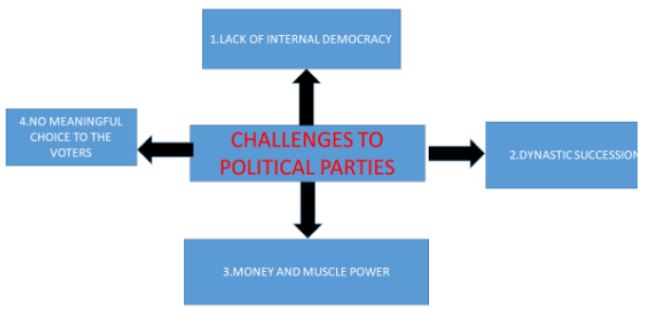
CHALLENGES TO POLITICAL PARTIES
➢ Lack of internal democracy
➢ Dynastic succession
➢ Money and muscle power
➢ No meaningful choice to the voters.
HOW CAN PARTIES BE REFORMED?
Efforts made in India to reform political parties and its leaders:
Constitution was amended to prevent defection, affidavits were implemented,political parties to hold their organisational elections and file their income tax returns.
SUGGESTIONS ARE MADE TO REFORM POLITICAL PARTIES:
Regulation of party’s internal affairs
State funding of election
Pressure of public opinion
Ensure women participation


राजनीति दल
(ब) बहुवैकल्पिक प्रश्न :-
Question 1. निम्न में कौन राजनीतिक पार्टी नही है।
(1) बी. जे. पी
(2) आई. एन. सी
(3) बी. एस. पी
(4) वामसेफ
Answer: (4) वामसेफ
वामसेफ (WAMCEP) एक कर्मचारी संगठन है, न कि राजनीतिक दल। जबकि अन्य तीनों (बीजेपी, कांग्रेस, बीएसपी) पंजीकृत राजनीतिक दल हैं।
In simple words: वामसेफ राजनीतिक दल नहीं बल्कि एक कर्मचारी संगठन है।
Exam Tip: राजनीतिक दलों और कर्मचारी संगठनों या संघों के बीच अंतर स्पष्ट रखें।
Question 2. निम्न में से कौन राष्ट्रीय राजनीतिक पार्टी नही है?
(1) भारतीय जनता पार्टी
(2) कांग्रेस पार्टी
(3) बहुजन समाज पार्टी
(4) समाजवादी पार्टी
Answer: (4) समाजवादी पार्टी
समाजवादी पार्टी मुख्य रूप से उत्तर प्रदेश राज्य की एक क्षेत्रीय पार्टी है, जबकि भारतीय जनता पार्टी, कांग्रेस और बहुजन समाज पार्टी राष्ट्रीय राजनीतिक दल हैं।
In simple words: समाजवादी पार्टी एक राज्य-स्तरीय (क्षेत्रीय) दल है।
Exam Tip: राष्ट्रीय दलों और राज्यीय दलों की चुनाव आयोग द्वारा तय की गई शर्तों को याद रखें।
Question 3. निम्न में कौन भारत में राजनीतिक दल को मान्यता देता है?
(1) राष्ट्रपति
(2) उपराष्ट्रपति
(3) प्रधानमन्त्री
(4) चुनाव आयोग
Answer: (4) चुनाव आयोग
भारत में राजनीतिक दलों का पंजीकरण करने और उन्हें राष्ट्रीय या राज्यीय दल के रूप में मान्यता देने का अधिकार केवल निर्वाचन आयोग (चुनाव आयोग) के पास है।
In simple words: चुनाव आयोग ही राजनीतिक दलों को मान्यता प्रदान करता है।
Exam Tip: चुनाव आयोग के कार्यों से संबंधित प्रश्न बोर्ड परीक्षाओं में अक्सर पूछे जाते हैं।
Question 4. निम्न में किस देश में बहुदलीय व्यवस्था है?
(1) भारत
(2) ब्रिटेन
(3) संयुक्त राज्य अमेरिका
(4) चीन
Answer: (1) भारत
भारत में बहुदलीय प्रणाली है जहाँ सत्ता के लिए कई दल आपस में मुकाबला करते हैं। ब्रिटेन और अमेरिका में द्वि-दलीय व्यवस्था है तथा चीन में एक-दलीय शासन है।
In simple words: भारत बहुदलीय व्यवस्था वाला देश है।
Exam Tip: विभिन्न देशों की दलीय प्रणालियों (एक-दलीय, द्वि-दलीय, बहुदलीय) के उदाहरण याद रखें।
Question 5. निम्न में किस देश में एक दलीय शासन प्रणाली है?
(1) पाकिस्तान
(2) चीन
(3) नेपाल
(4) बांग्लादेश
Answer: (2) चीन
चीन में केवल कम्युनिस्ट पार्टी को ही शासन करने की अनुमति है, इसलिए वहाँ एक-दलीय शासन प्रणाली है।
In simple words: चीन में केवल एक ही पार्टी (कम्युनिस्ट पार्टी) का शासन है।
Exam Tip: एक-दलीय प्रणाली का यह सबसे प्रमुख और प्रसिद्ध उदाहरण है।
Question 6. निम्न में किस देश में दो दलीय शासन व्यवस्था है?
(1) भारत
(2) पाकिस्तान
(3) चीन
(4) ब्रिटेन
Answer: (4) ब्रिटेन
ब्रिटेन और संयुक्त राज्य अमेरिका द्वि-दलीय व्यवस्था के प्रमुख उदाहरण हैं जहाँ सत्ता मुख्य रूप से दो प्रमुख दलों के बीच बदलती रहती है।
In simple words: ब्रिटेन में दो प्रमुख दल शासन करते हैं।
Exam Tip: अमेरिका और ब्रिटेन दोनों द्वि-दलीय व्यवस्था के अंतर्गत आते हैं।
Question 7. किसी देश के लिये कानून बनाने में निर्णायक भूमिका कौन निभाता है?
(1) नेता
(2) पार्टियाँ
(3) मतदाता
(4) चुनाव क्षेत्र
Answer: (2) पार्टियाँ
देश के कानून निर्माण में राजनीतिक पार्टियाँ निर्णायक भूमिका निभाती हैं क्योंकि विधायिका के अधिकांश सदस्य किसी न किसी दल से संबंधित होते हैं और दल के निर्देश पर फैसला करते हैं।
In simple words: राजनीतिक पार्टियाँ कानून बनाने में मुख्य भूमिका निभाती हैं।
Exam Tip: राजनीतिक दलों के कार्यों (कानून बनाना, सरकार चलाना आदि) को भली-भांति समझें।
Question 8. निम्न में से कौन बहुजन समाज पार्टी का संस्थापक है?
(1) इन्दिरा गांधी
(2) मायावती
(3) डॉ. बी. आर. अम्बेडकर
(4) कांशीराम
Answer: (4) कांशीराम
बहुजन समाज पार्टी (BSP) की स्थापना वर्ष 1984 में कांशीराम जी द्वारा की गई थी।
In simple words: कांशीराम बहुजन समाज पार्टी के संस्थापक थे।
Exam Tip: प्रमुख राजनीतिक दलों के स्थापना वर्ष और उनके संस्थापक का नाम याद रखना आवश्यक है।
Question 9. समर्थक का अर्थ ऐसे व्यक्ति से है जो
(1) किसी दल के प्रति प्रतिबद्ध है
(2) क्रान्ति कारी है
(3) पक्षपाती है
(4) आधुनिक है
Answer: (1) किसी दल के प्रति प्रतिबद्ध है
राजनीतिक दल के तीन प्रमुख हिस्सों में अनुयायी या समर्थक आते हैं जो उस दल की नीतियों और विचारधारा के प्रति प्रतिबद्ध होते हैं।
In simple words: समर्थक वह होता है जो किसी राजनीतिक दल के प्रति समर्पित और प्रतिबद्ध हो।
Exam Tip: राजनीतिक दल के तीन मुख्य हिस्से (नेता, सक्रिय सदस्य, अनुयायी/समर्थक) परीक्षा की दृष्टि से महत्वपूर्ण हैं।
Question 10. निम्न में से किस पार्टी की स्थापना भारतीय जनसंघ को पुनर्जीवित करके की गई थी?
(1) समाजवादी पार्टी
(2) राष्ट्रीय जनता दल
(3) भारतीय जनता पार्टी
(4) बहुजन समाज पार्टी
Answer: (3) भारतीय जनता पार्टी
भारतीय जनता पार्टी (BJP) की स्थापना वर्ष 1980 में भारतीय जनसंघ को पुनर्जीवित करके की गई थी।
In simple words: भारतीय जनता पार्टी का पुराना रूप भारतीय जनसंघ था।
Exam Tip: बीजेपी के गठन का इतिहास और इसका मूल नाम (भारतीय जनसंघ) याद रखें।
(3) लघु/दीर्घ प्रश्न
Question 1. राजनीतिक दल के कार्य बताओ?
Answer: राजनीतिक दल के प्रमुख कार्य निम्नलिखित हैं:
(1) चुनाव लड़ना
(2) कानून बनाना
(3) सरकार बनाना व चलाना
(4) विपक्ष की भूमिका निभाना
(5) जनमत का निर्माण करना
In simple words: राजनीतिक दल चुनाव लड़ने, सरकार चलाने और कानून बनाने जैसे महत्वपूर्ण कार्य करते हैं।
Exam Tip: राजनीतिक दलों के कार्यों को बिंदुओं में लिखकर स्पष्ट करें।
Question 2. राजनीतिक पार्टियां जनमत का निर्माण कैसे करती है?
Answer: राजनीतिक पार्टियां जनता के बीच निम्नलिखित माध्यमों से जनमत का निर्माण करती हैं:
(1) सार्वजनिक मुद्दों को उठाना और उन पर बहस करना।
(2) कार्यकर्ताओं से संपर्क स्थापित करना।
(3) लोगों की समस्याओं को लेकर आंदोलन करना।
(4) समाज के लोगों के सामने अपनी राय रखना।
In simple words: राजनीतिक दल जनता की समस्याओं को उठाकर और रैलियां-आंदोलन करके जनमत तैयार करते हैं।
Exam Tip: जनमत निर्माण में मीडिया, रैलियों और बहसों की भूमिका को भी समझें।
Question 3. भारत में लोकतंत्र को बहुदलीय प्रणाली ने कैसे मजबूत किया है?
Answer: बहुदलीय प्रणाली ने भारत में लोकतंत्र को निम्नलिखित प्रकार से मजबूत किया है:
(1) यह स्थायित्व प्रदान करती है।
(2) यह सबको चुनाव में भाग लेने का मौका देती है।
(3) यह सरकार पर नियन्त्रण रखती है।
(4) यह बेहतर निर्णय लेने में योगदान देती है।
In simple words: बहुदलीय प्रणाली समाज के हर वर्ग को प्रतिनिधित्व और विकल्प प्रदान करती है।
Exam Tip: बहुदलीय प्रणाली के गुण और दोष दोनों का अध्ययन करें।
Question 4. विभिन्न प्रकार की दलीय प्रणाली का उल्लेख करो?
Answer: विश्व में मुख्य रूप से तीन प्रकार की दलीय प्रणालियाँ पाई जाती हैं:
(1) एक दलीय प्रणाली (जैसे - चीन)
(2) दो दलीय प्रणाली (जैसे - ब्रिटेन और अमेरिका)
(3) बहुदलीय प्रणाली (जैसे - भारत)
In simple words: दलीय प्रणाली मुख्य रूप से एक-दलीय, द्वि-दलीय और बहुदलीय होती है।
Exam Tip: प्रत्येक प्रणाली के साथ एक-एक देश का उदाहरण अवश्य लिखें।
Question 5. राजनीतिक दलों की दशा तय करने में चुनाव आयोग की भूमिका की व्याख्या करो?
Answer: चुनाव आयोग की भूमिका निम्नलिखित है:
(1) राजनीतिक दलों का पंजीकरण चुनाव आयोग द्वारा किया जाता है।
(2) चुनाव आयोग पंजीकृत दल को एक चुनाव चिन्ह प्रदान करता है।
(3) जब किसी दल को किसी राज्य विधान सभा चुनाव की कुल मतों का कम से कम 6 प्रतिशत मत प्राप्त होता है अथवा वह कम से कम दो सीटों पर विजयी होता है तो उसे राज्य स्तरीय राजनीतिक दल के रूप में मान्यता प्राप्त होती है।
(4) जब किसी दल को लोकसभा चुनाव या किन्हीं चार राज्यों की विधान सभा चुनाव में कुल वैध मतों का कम से कम 6 प्रतिशत मत प्राप्त होता है तो उसे राष्ट्रीय दल के रूप में मान्यता प्राप्त होती है।
In simple words: चुनाव आयोग दलों का पंजीकरण करता है और मतों के प्रतिशत के आधार पर उन्हें राष्ट्रीय या राज्यीय दल की मान्यता देता है।
Exam Tip: राष्ट्रीय और राज्यीय दल बनने की 6% मतों वाली शर्त को अच्छे से याद रखें।
Question 6. राजनीतिक दलों द्वारा वर्तमान में सामना की जा रही चुनौतियों की व्याख्या करो?
Answer: राजनीतिक दलों के सामने वर्तमान में निम्नलिखित मुख्य चुनौतियाँ हैं:
(1) आंतरिक लोकतंत्र का अभाव
(2) वंशवादी उत्तराधिकार
(3) धन एवं बल का प्रयोग
(4) सार्थक विकल्प का अभाव
In simple words: दलों के भीतर आंतरिक लोकतंत्र की कमी और वंशवाद आज की प्रमुख समस्याएँ हैं।
Exam Tip: दलों के सुधार के लिए इन चुनौतियों को दूर करना क्यों आवश्यक है, इसे समझें।
Question 7. भारत में राजनीतिक दलों में आंतरिक लोकतंत्र की कमी क्यो है?
Answer: राजनीतिक दलों में आंतरिक लोकतंत्र की कमी के निम्नलिखित कारण हैं:
(1) कुछ नेताओं के हाथ में ज्यादा ताकत का होना।
(2) सामान्य कार्यकर्ता गतिविधियों से अनजान रहता है।
(3) पार्टी के नाम पर फैसला कुछ शीर्ष नेता ही करते हैं।
(4) पार्टी के शीर्ष नेताओं के प्रति निष्ठा ज्यादा महत्वपूर्ण होती है।
In simple words: सारी ताकत कुछ ही शीर्ष नेताओं के हाथों में सिमट जाने के कारण दलों में आंतरिक लोकतंत्र समाप्त हो जाता है।
Exam Tip: आंतरिक लोकतंत्र का अर्थ है दल के भीतर सभी स्तरों पर नियमित चुनाव और निर्णय लेने में सबकी भागीदारी।
Question 8. राजनीतिक दलों एवं नेताओं को सुधारने के लिये सरकार द्वारा किये गये प्रयासों का उल्लेख करो?
Answer: सरकार और न्यायालय द्वारा किए गए प्रयास:
(1) दल परिवर्तन पर नियंत्रण दल बदल विरोधी कानून द्वारा किया गया है।
(2) दल बदल करने पर अपनी सीट खोनी पड़ती है।
(3) संपत्ति की घोषणा करना अनिवार्य किया गया है।
(4) आपराधिक मामले से सम्बन्धित शपथ-पत्र दायर करना अनिवार्य किया गया है।
In simple words: दलबदल कानून और आपराधिक रिकॉर्ड की घोषणा जैसे नियमों से राजनीति में सुधार का प्रयास किया गया है।
Exam Tip: दलबदल विरोधी कानून (Anti-Defection Law) के बारे में संक्षिप्त टिप्पणी तैयार रखें।
Question 9. किसी भी राजनीतिक दल के गुणों का उल्लेख करो?
Answer: एक अच्छे राजनीतिक दल के निम्नलिखित गुण होते हैं:
(1) साथ मिलकर चुनाव लड़ना
(2) समाज के सामूहिक हितो के लिये नितियां तथा कार्यक्रम होते हैं।
(3) वे समाज के मौलिक राजनीतिक विभाजन को परिलक्षित करते हैं।
(4) उनकी पहचान इससे होती है कि वे समाज के किस हिस्से के लिये खड़े है वे किन नीतियों का समर्थन करते है तथा वे किन के हितों की देखभाल करते है।
In simple words: दल समाज के हितों के लिए नीतियां बनाते हैं और सामूहिक विकास के लिए काम करते हैं।
Exam Tip: दलों की नीतियां जनहितैषी और पारदर्शी होनी चाहिए।
Question 10. लोकतंत्र की गुणवत्ता जन सहभागिता के स्तर पर निर्भर करती है? क्या आप इस कथन से सहमत है?
Answer: हाँ, हम इस कथन से पूरी तरह सहमत हैं, जिसके निम्नलिखित कारण हैं:
(1) लोकतंत्र का उद्देश्य जनता का जनता के द्वारा शासन है।
(2) लोकतांत्रिक प्रक्रिया में भाग लिये बिना राजनीतिक दलों में सुधार लाना कठिन है।
(3) सामान्य जनता की भागीदारी आवश्यक है।
(4) उपयुक्त उम्मीदवार का चयन जनता की सक्रियता से ही संभव है।
In simple words: जितनी अधिक जनता की भागीदारी होगी, लोकतंत्र उतना ही अधिक मजबूत और बेहतर होगा।
Exam Tip: नागरिकों की सक्रिय राजनीतिक भागीदारी लोकतंत्र की सफलता की कुंजी है।
Free study material for Social Science
Download Practice Assignments: Class 10 Civics Democratic Politics II Chapter 04 Political Parties
Download Assignment: Democratic Politics II Chapter 04 Political Parties (Class 10 Civics)
Review targeted chapter assignments for Class 10 Civics Democratic Politics II Chapter 04 Political Parties. Built according to official CBSE guidelines, these downloadable problem sets help students build accuracy and prepare effectively for school tests.
Key Advantages of Solving Democratic Politics II Chapter 04 Political Parties Assignments
- Exam Alignment: Questions strictly follow contemporary CBSE sample papers and grading schemes.
- Comprehensive Coverage: Features objective drills, case studies, and structured descriptive problems for Democratic Politics II Chapter 04 Political Parties.
- Pacing & Precision: Regular problem-solving builds critical calculation speed and test-taking accuracy.
Steps to Complete Democratic Politics II Chapter 04 Political Parties Assignments Successfully
- Concept Foundation: Review the NCERT book for Class 10 Civics thoroughly before diving into assignment tasks.
- Self-Evaluation: Solve exercises independently before inspecting professional answer guides.
- Progress Monitoring: Note down complex formulas or concepts, clearing them up using available online practice aids.
FAQs
You can download free PDF assignments for Class 10 Civics Democratic Politics II Chapter 04 Political Parties from StudiesToday.com. These practice sheets have been updated for the 2026-27 session covering all concepts from latest NCERT textbook.
Yes, our teachers have given solutions for all questions in the Class 10 Civics Democratic Politics II Chapter 04 Political Parties assignments. This will help you to understand step-by-step methodology to get full marks in school tests and exams.
Yes. These assignments are designed as per the latest CBSE syllabus for 2026. We have included huge variety of question formats such as MCQs, Case-study based questions and important diagram-based problems found in Democratic Politics II Chapter 04 Political Parties.
Practicing topicw wise assignments will help Class 10 students understand every sub-topic of Democratic Politics II Chapter 04 Political Parties. Daily practice will improve speed, accuracy and answering competency-based questions.
Yes, all printable assignments for Class 10 Civics Democratic Politics II Chapter 04 Political Parties are available for free download in mobile-friendly PDF format.