

Read and download the CBSE Class 10 Social Science Geography Life Lines of National Economy Hindi Assignment for the 2026-27 academic session. We have provided comprehensive Class 10 Geography school assignments that have important solved questions and answers for Contemporary India Chapter 7 Lifelines Of National Economy. These resources have been carefuly prepared by expert teachers as per the latest NCERT, CBSE, and KVS syllabus guidelines.
Solved Assignment for Class 10 Geography Contemporary India Chapter 7 Lifelines Of National Economy
Practicing these Class 10 Geography problems daily is must to improve your conceptual understanding and score better marks in school examinations. These printable assignments are a perfect assessment tool for Contemporary India Chapter 7 Lifelines Of National Economy, covering both basic and advanced level questions to help you get more marks in exams.
Contemporary India Chapter 7 Lifelines Of National Economy Class 10 Solved Questions and Answers
Lifelines Of National Economy Summary Class 10 Social Science
Means of transport and communication—lifelines of our national economy:
They help in—
● increasing cooperation and assistance between countries;
● easy movement of goods and material between countries;
● trade and commerce within the country;
● reducing distances thus bringing the world closer;
● both production and distribution of goods; and
● movement of large number of people and over long distances.
Roadways:
Importance of road transport vis-a-vis rail transport—
● Construction cost of roads is much lower than that of railway lines.
● Roads can traverse comparatively more dissected and undulating topography.
● Roads can negotiate higher gradients of slopes and as such can traverse mountains such as the Himalayas.
● Road transport is economical in transportation of few persons and relatively smaller amount of goods over short distances.
● It also provides door-to-door service, thus the cost of loading and unloading is much lower.
● Road transport is also used as a feeder to other modes of transport.
● Golden Quadrilateral Super Highways: It’s a major road development project linking Delhi- Kolkata-Chennai-Mumbai and Delhi by six-lane Super Highways.
● The North-South corridors linking Srinagar (Jammu & Kashmir) and Kanyakumari (Tamil Nadu), and East-West Corridor connecting Silcher (Assam) and Porbander (Gujarat) are part of this project. ‘
● They are made to reduce the time and distance between the mega cities of India.
National Highways:
National Highways link all Major cities of extreme parts of the country. These are the primary road systems and are maintained by the Central Public Works Department (CPWD). The National Highway 7 between Varanasi and Kanyakumari is the longest highway of India.
● State Highways: Roads linking a state capital with different district headquarters. These roads are constructed and maintained by State Public Works Department in State and Union Territories.
● District Roads: These roads connect the district headquarters with other places of the district. These roads are maintained by the Zila Parishad.
● Other Roads: Rural roads, which link rural areas and villages with towns, are classified under this category. Under the Pradhan Mantri Grameen Sadak Yojana scheme special provisions are made so that every village in the country is linked to a major town in the country by an all season motorable road.
● Border Roads: Border Roads Organisation constructs and maintains roads in the bordering areas of the country. These roads are of strategic importance in the northern and northeastern border areas.
Importance of Railways in India:
1. They are the principal mode of transportation for freight and passengers in India.
2. Railways also make it possible to conduct different activities like business, sightseeing, and pilgrimage along with transportation of goods over longer distances.
3. Indian Railways plays a role of national integration.
4. Railways in India bind the economic life of the country as well as accelerate the development of the industry and agriculture.
Factors which influence the distribution pattern of Railway network in India:
The distribution pattern of the Railway network in the country has been largely influenced by
1. Physiographic, economic and administrative factors.
2. The density railway network is high in the northern plains because they are vast level land, have high population density and rich agricultural resources.
3. In the hilly terrains of the peninsular region, railway tracts are laid through low hills, gaps or tunnels therefore it difficult to construct railway lines.
4. The Himalayan mountainous regions too are unfavorable for the construction of railway lines due to high relief, sparse population and lack of economic opportunities.
5. It was difficult to lay railway lines on the sandy plain of western Rajasthan, swamps of Gujarat, forested tracks of Madhya Pradesh, Chhattisgarh, Odisha and Jharkhand.
Importance of Pipelines in India:
In the past, these were used to transport water to cities and industries.
1. These are used for transporting crude oil, petroleum products and natural gas from oil and natural gas fields to refineries, fertilizer factories and big thermal power plants.
2. Solids can also be transported through a pipeline when converted into slurry. Because of pipelines refineries like Barauni, Mathura, Panipat and gas based fertilizer plants could be located in the interiors of India. Initial cost of laying pipelines is high but subsequent running costs are minimal.
3.It rules out trans-shipment (during transportation) losses or delays.
Three important networks of pipeline transportation in the country:
● From oil field in upper Assam to Kanpur (Uttar Pradesh).
● From Salaya in Gujarat to Jalandhar in Punjab.
● Gas pipeline from Hazira in Gujarat connects Jagdishpur in Uttar Pradesh,
Importance of water transport:
1.Waterways are the cheapest means of transport.
2. They are most suitable for carrying heavy and bulky goods.
3. It is a fuel-efficient and environment friendly mode.
The National Waterways by the Government
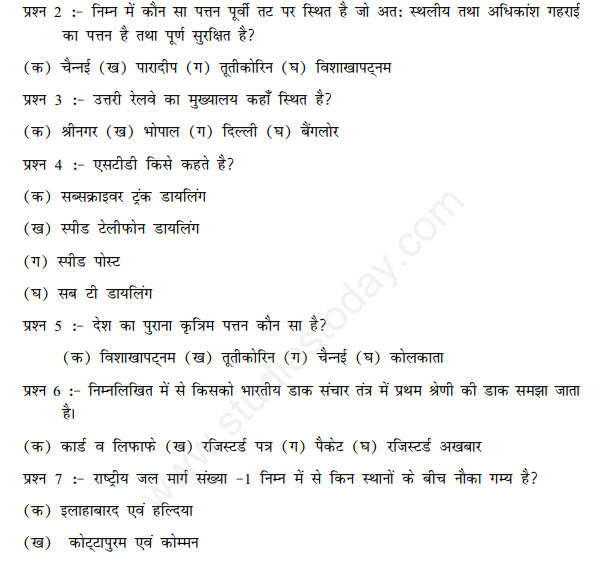
1. The Ganga river between Allahabad and Haldia (1620 km)-N.W. No.1
2. The Brahmaputra river between Sadiya and Dhubri (891 km)-N.W. No.2
3. The West-Coast Canal in Kerala (Kottapurma-Komman, Udyogamandal and Champakkara canals-205 km)-N.W. No.3
Major Sea Ports:
1. Kandla: It was the first port developed soon after Independence. It was developed to ease the volume of trade on the Mumbai port. Kandla is a tidal port.
2. Mumbai: It is the biggest port with a spacious natural and well-sheltered harbour.
3. The Jawaharlal Nehru port: It was planned with a view to decongest the Mumbai port and serve as a hub port for this region.
4. Martnagao port (Goa): It is the premier iron ore exporting port of the country. This port accounts for about fifty per cent of India’s iron ore export.
5. New Mangalore port: It export iron ore from Kudremukh mines. 6. Kochi: It is the located at the entrance of a lagoon with a natural harbour.
7. Tuticorin, in Tamil Nadu: This port has a natural harbour. It trades a large variety of cargoes to our neighbouring countries like Sri Lanka, Maldives, etc.
8. Chennai: It is one of the oldest artificial ports of the country. It is ranked next to Mumbai in terms of the volume of trade and cargo.
9. Vishakhapatnam: It is the deepest landlocked and well-protected port. This port was developed as a port for iron ore exports.
10. Paradip port: It is located in Odisha. It specialises in the export of iron ore.
11. Kolkata: It is an inland riverine port. This port serves a very large and rich hinterland of Ganga- Brahmaputra basin. Being a tidal port, it requires constant dredging of Floogly River.
12. Haldia port: It was developed as a subsidiary port, in order to relieve growing pressure on the Kolkata port.
Importance of Airways:
1.The air travel, today, is the fastest, most comfortable and prestigious mode of transport.
2. It can cover very difficult terrains like high mountains, dreary deserts, dense forests and also long oceanic stretches with great ease.
3. Air travel has made access easier in the north-eastern part of the country which has big rivers, dissected relief, dense forests and frequent floods and international frontiers.
Communication:
Two major means of communication in India:
● Personal communication including letter, email, telephone, etc.
● Mass communication including television, radio, press, films, etc.
Different types of mail handled by Indian postal department:
● First class mail: Cards and envelopes are airlifted between stations covering both land and air.
● Second class mail: includes book packets, registered newspapers and periodicals. They are carried by surface mail, covering land and water transport.
Importance of mass communication:
1.Mass communication provides entertainment.
2. They create awareness among people about various national programmes and policies. They provide variety of programmes in national, regional and local languages for various categories of people, spread over different parts of the country.
3. They strengthen democracy in the country by providing news and information to the masses.
4. It helps in agriculture sector by helping farmers by providing them information about new agricultural practices.
5. Doordarshan is the national television channel of India. It is one of the largest terrestrial networks in the world.
6. The largest numbers of newspapers published in the country are in Hindi, followed by English and Urdu. India is the largest producer of feature films in the world.
International Trade:
● International trade is defined as the exchange of goods and services between two or more countries.
● It is also considered as economic barometer because advancement of international trade of a country leads to economic prosperity. Income earned from international trade constitutes a major part in the net national income. Large international trade leads to revival of domestic economy.
Balance of trade:
● The difference between export and import is known as balance of trade.
● If the value of exports is more than the value of imports, it is called favorable balance of trade. And if the value of imports is greater than the value of exports it is known as unfavorable balance of trade.
● Favorable balance of trade is regarded good for the economic development where as unfavorable balance of trade is seen harmful for the domestic economy.
Importance of tourism as a trade:
● Tourism in India earns huge Foreign exchange,
● Over 2.6 million foreign tourists visit India every year.
● More than 15 million people are directly engaged in the tourism industry.
● Tourism also promotes national integration,
● It provides support to local handicrafts and cultural pursuits.
● It also helps in the development of international understanding about our culture and heritage.
● Foreign tourists visit India for heritage tourism, eco tourism, adventure tourism, cultural tourism, medical tourism and business tourism.
● Rajasthan, Goa, Jammu and Kashmir and temple towns of south India are important destinations of foreign tourists in India.
● There is vast potential of tourism development in the north-eastern states and the interior parts of Himalayas, but due to strategic reasons these have not been encouraged so far
CBSE Class 10 Geography Contemporary India Chapter 7 Lifelines Of National Economy Assignment
Access the latest Contemporary India Chapter 7 Lifelines Of National Economy assignments designed as per the current CBSE syllabus for Class 10. We have included all question types, including MCQs, short answer questions, and long-form problems relating to Contemporary India Chapter 7 Lifelines Of National Economy. You can easily download these assignments in PDF format for free. Our expert teachers have carefully looked at previous year exam patterns and have made sure that these questions help you prepare properly for your upcoming school tests.
Benefits of solving Assignments for Contemporary India Chapter 7 Lifelines Of National Economy
Practicing these Class 10 Geography assignments has many advantages for you:
- Better Exam Scores: Regular practice will help you to understand Contemporary India Chapter 7 Lifelines Of National Economy properly and you will be able to answer exam questions correctly.
- Latest Exam Pattern: All questions are aligned as per the latest CBSE sample papers and marking schemes.
- Huge Variety of Questions: These Contemporary India Chapter 7 Lifelines Of National Economy sets include Case Studies, objective questions, and various descriptive problems with answers.
- Time Management: Solving these Contemporary India Chapter 7 Lifelines Of National Economy test papers daily will improve your speed and accuracy.
How to solve Geography Contemporary India Chapter 7 Lifelines Of National Economy Assignments effectively?
- Read the Chapter First: Start with the NCERT book for Class 10 Geography before attempting the assignment.
- Self-Assessment: Try solving the Contemporary India Chapter 7 Lifelines Of National Economy questions by yourself and then check the solutions provided by us.
- Use Supporting Material: Refer to our Revision Notes and Class 10 worksheets if you get stuck on any topic.
- Track Mistakes: Maintain a notebook for tricky concepts and revise them using our online MCQ tests.
Best Practices for Class 10 Geography Preparation
For the best results, solve one assignment for Contemporary India Chapter 7 Lifelines Of National Economy on daily basis. Using a timer while practicing will further improve your problem-solving skills and prepare you for the actual CBSE exam.
FAQs
You can download free PDF assignments for Class 10 Geography Chapter Contemporary India Chapter 7 Lifelines Of National Economy from StudiesToday.com. These practice sheets have been updated for the 2026-27 session covering all concepts from latest NCERT textbook.
Yes, our teachers have given solutions for all questions in the Class 10 Geography Chapter Contemporary India Chapter 7 Lifelines Of National Economy assignments. This will help you to understand step-by-step methodology to get full marks in school tests and exams.
Yes. These assignments are designed as per the latest CBSE syllabus for 2026. We have included huge variety of question formats such as MCQs, Case-study based questions and important diagram-based problems found in Chapter Contemporary India Chapter 7 Lifelines Of National Economy.
Practicing topicw wise assignments will help Class 10 students understand every sub-topic of Chapter Contemporary India Chapter 7 Lifelines Of National Economy. Daily practice will improve speed, accuracy and answering competency-based questions.
Yes, all printable assignments for Class 10 Geography Chapter Contemporary India Chapter 7 Lifelines Of National Economy are available for free download in mobile-friendly PDF format.