

Download Class 12 Chemistry Concept Summaries: CBSE Class 12 Chemistry Solutions Chapter Notes
Explore reliable concept summaries and revision materials through the CBSE Class 12 Chemistry Solutions Chapter Notes. Tailored for Class 12 learners, utilizing these notes for Chemistry Unit 1 Solutions ensures thorough preparation and strengthens core academic definitions before final evaluations.
Access Unit 1 Solutions Notes and Study Material
Access the complete concept summary PDF for Unit 1 Solutions below. Regular review of these targeted notes builds familiarity with complex Class 12 Chemistry themes and helps secure higher marks in final school evaluations.
Ch. 2: Solutions
Chemistry
Top formulae
1. Mass percentage of a component =Mass of component in solution / Toal mass of solution *100
2. Volume percentage of a component = Volume of component/ 100 Total volume of solution *100
3. Mole fraction of a component (x) = Number ofmoles of component / Total number ofmoles of all components
4. ppm= Number of parts of component / Total number of parts of all components of solution *106
5. Molarity=Number of moles of solute / Volumeof solution in litres
6. Molarity=Number of moles of solute / Mass of solvent in kilograms
7. Normality=Number of gram equivalent of solute / Volumeof solution in litres
8. p10 - p1 /p10 =x2
9. ΔT = Tb- Tbo
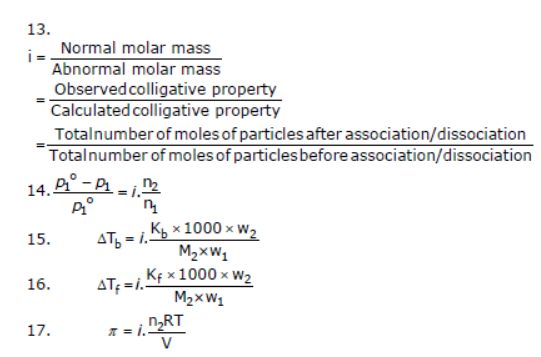
ΔTb = Kb*1000*W2 /M2* w1
10. ΔT =Tfo -Tf
ΔTf = Kf*1000*w2 /M2*w1
11∏ = CRT
12. M2 =w2 RT / ∏V
Key Learnings
1. Solutions are the homogeneous mixtures of two or more than two components.
2. Binary solution: A solution having two components is called a binary solution. Components of a binary solution are solute and solvent.
a. When the solvent is in solid state, solution is called solid solution.
b. When the solvent is in liquid state, solution is called liquid solution.
c. When the solvent is in gaseous state, solution is called gaseous solution.
3. Concentration is the amount of solute in given amount of solution.
4. Mass by volume percentage (w/v): Mass of the solute dissolved in 100 mL of solution.
5. Molality (m) is the number of moles of solute present in 1kg of solvent.
6. Molarity (M) is the number of moles of solute present in 1L of solution.
7. Normality is the number of gram equivalent of solute dissolved per litre of solution.
8. Solubility is its maximum amount that can be dissolved in a specified amount of solvent at a specified temperature.
9. A solution in which no more solute can be dissolved at the same temperature and pressure is called a saturated solution.
10. In a nearly saturated solution if dissolution process is an endothermic process, solubility increases with increase in temperature.
11. In a nearly saturated solution if dissolution process is an exothermic process, solubility decreases with increase in temperature.
12. Henry’s Law: The law states at a constant temperature the solubility of gas in a liquid is directly proportional to the pressure of gas. Henry’s law can also be stated as the partial pressure of gas in vapour phase is proportional to the mole fraction of the gas in the solution.
P = KH x
13. When a non-volatile solute is dissolved in a volatile solvent, the vapour pressure of solution is less than that of pure solvent.
14. According to Raoult’s law for a solution of volatile liquids the partial vapour pressure of each component in the solution is directly proportional to its mole fraction.
p1 = po1 x1 ; p2 = po2 x2
Using Dalton’s law of partial pressure the total pressure of solution is calculated.
15. On comparison of Raoult’ law and Henry’s law, it is observed that the partial pressure of volatile component or gas is directly proportional to its mole fraction in solution. In case of Henry’s Law the proportionality constant is KH and it is different from p10 which is partial pressure of pure component. Raoult’s Law becomes a special case of Henry’s Law when KH becomes equal to p10 in Henry’s law.
16. Liquid –liquid solutions can be classified into ideal and non-ideal solutions on basis of Raoult’s Law.

18. Azeotropes are binary mixtures having same composition in liquid and vapour phase and boil at constant temperature. Liquids forming azeotrope cannot be separated by fractional distillation.
19. There are two types of azeotropes called minimum boiling azeotrope and maximum boiling azeotrope.
20. The solutions which show a large positive deviation from Raoult’s law form minimum boiling azeotrope at a specific composition.
21. The solutions that show large negative deviation from Raoult’s law form maximum boiling azeotrope at a specific composition.
22. Properties of solution which depends on only the number of solute particles but not on the nature of solute are called colligative properties.
23. There are four colligative properties:
a. Relative lowering of vapour pressure
b. Eleveation of boiling point
c. Depression of freezing point
d. Osmotic pressure
24. Relative lowering of vapour pressure: Difference in the vapour pressure of pure solvent ( o1 p ) and solution ( 1 p ) represents lowering in vapour pressure ( o1 p - 1 p ). Dividing lowering in vapour pressure by vapour pressure of pure solvent is called relative lowering of vapour pressure
Please click the link below to download pdf file for CBSE Class 12 Chemistry - Solutions Chapter Notes.
Free study material for Chemistry
Download CBSE Revision Notes: Class 12 Chemistry Unit 1 Solutions
Download Chapter Summary: Class 12 Chemistry Unit 1 Solutions
Review targeted chapter notes for Class 12 Chemistry Unit 1 Solutions. Built according to official CBSE guidelines, these summaries highlight high-yield topics frequently tested in school evaluations.
Concept Clarification for Unit 1 Solutions
Cross-reference your comprehension with comprehensive NCERT solutions for Class 12 to ensure absolute clarity across all sub-topics in this chapter.
Additional Study Resources for Class 12 Chemistry
Wrap up your chapter revision by testing your knowledge against standard question formats. Everything on our platform is provided free of charge.
FAQs
You can download the teacher prepared revision notes for CBSE Class 12 Chemistry Solutions Chapter Notes from StudiesToday.com. These notes are designed as per 2026-27 academic session to help Class 12 students get the best study material for Chemistry.
Yes, our CBSE Class 12 Chemistry Solutions Chapter Notes include 50% competency-based questions with focus on core logic, keyword definitions, and the practical application of Chemistry principles which is important for getting more marks in 2026 CBSE exams.
Yes, our CBSE Class 12 Chemistry Solutions Chapter Notes provide a detailed, topic wise breakdown of the chapter. Fundamental definitions, complex numerical formulas and all topics of CBSE syllabus in Class 12 is covered.
These notes for Chemistry are organized into bullet points and easy-to-read charts. By using CBSE Class 12 Chemistry Solutions Chapter Notes, Class 12 students fast revise formulas, key definitions before the exams.
No, all study resources on StudiesToday, including CBSE Class 12 Chemistry Solutions Chapter Notes, are available for immediate free download. Class 12 Chemistry study material is available in PDF and can be downloaded on mobile.