

Revision Notes for Class 12 Chemistry: Unit 1 Solutions
Access comprehensive revision notes for Unit 1 Solutions using the CBSE Class 12 Chemistry Solutions Notes Set 06. Designed to align with the 2026-27 academic syllabus for Class 12 Chemistry, these concept summaries help students streamline their exam preparation and review complex topics efficiently.
Review Unit 1 Solutions for Class 12 Chemistry
Navigate directly to the revision notes for Unit 1 Solutions using the digital viewer below. Each summary is structured to highlight high-weightage sections, allowing students to instantly access critical definitions and focus on core exam topics.
SOLUTIONS
VSA QUESTIONS (1 - MARK QUESTIONS)
1. Give an example of ‘liquid in solid’ type solution.
2. Which type of solid solution will result by mixing two solid components with large difference in the sizes of their molecules?
3. What is meant by semimolar and decimolar solutions?
Ans. :[M /2, M/10]
4. What will be the mole fraction of water in C2H5OH solution containing equal number of moles of water and C2H5OH? [Ans. : 0.5]
5. Which of the following is a dimensionless quantity : molarity, molality or mole fraction? [Ans. : mole fraction]
6. 10 g glucose is dissolved in 400 g. of solution. Calculate percentage concentration of the solution. [Ans. : 2.5% w/w]
7. Gases tend to be less soluble in liquids as the temperature is raised. Why?
8. State the conditions which must be satisfied if an ideal solution is to be formed.
9. A mixture of chlorobenzene and bromobenzene forms nearly ideal solution but a mixture of chloroform and acetone does not. Why?
10. How is the concentration of a solute present in trace amount in a solution expressed?
*12. N2 and O2 gases have KH values 76.48 kbar and 34.86 kbar respectively at 293 K temperature. Which one of these will have more solubility in water?
*13. Under what condition molality and molarity of a solution are identical. Explain with suitable reason.
*14. Addition of HgI2 to KI (aq.) shows decrease in vapour pressure. Why?
15. What will happen to the boiling point of the solution formed on mixing two miscible liquids showing negative deviation from Raoult’s law?
16. Liquid ‘Y’ has higher vapour pressure than liquid ‘X’, which of them will have higher boiling point?
17. When 50 mL of ethanol and 50 mL of water are mixed, predict whether the volume of the solution is equal to, greater than or less than 100 mL. Justify.
18. Which type of deviation is shown by the solution formed by mixing cyclohexane and ethanol?
19. A and B liquids on mixing produce a warm solution. Which type of deviation from Raoult’s law is there?
20. Define cryoscopic constant (molal freezing point depression constant.)
21. Mention the unit of ebulioscopic constant (molal boiling point elevation constant.)
22. If kf for water is 1.86 K kg mol–1, what is the freezing point of 0.1 molal solution of a substance which undergoes no dissociation or association of solute? [Hint : Tf = iKf . m]
24. What is reverse osmosis? Give one large scale use of it.
*25. What is the maximum value of van’t Hoff factor (i) for Na2SO4 . 10H2O? [Ans. : i = 3]
26. What is the value of van’t Hoff factor (i) if solute molecules undergo dimerisation. [Ans. : i = 0.5]
27. Under what condition is van’t Hoff factor less than one? [Ans. : Association]
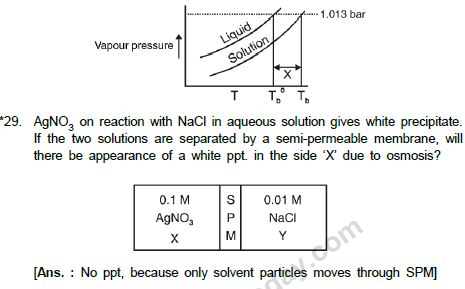
*28. The Phase Diagram for pure solvent and the solution containing nonvolatile solute are recorded below. The quantity indicated by ‘X’ in the figure is known as : [Ans. : ΔTb]
SA (I) - TYPE QUESTIONS (2 - MARK QUESTIONS)
1. Explain the following :
(a) Solubility of a solid in a liquid involves dynamic equilibrium.
(b) Ionic compounds are soluble in water but are insoluble in nonpolar solvents.
2. Give two examples each of a solution :
(a) showing positive deviation from Raoult’s Law.
(b) showing negative deviation from Raoult’s Law.
3. Draw vapour pressure vs composition (in terms of mole fraction) diagram for an ideal solution.
4. Define azeotropes with one example of each type.
5. Draw the total vapour pressure vs. mol fraction diagram for a binary solution exhibiting non-ideal behaviour with negative deviation.
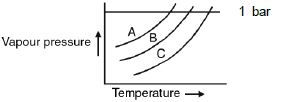
6. The vapour pressure curve for three solutions having the same nonvolatile solute in the same solvent are shown. The curves are parallel to each other and do not intersect. What is the correct order of the concentrations of the solutions
7. Show that the relative lowering of vapour pressure of a solvent is a colligative property.
8. Benzene and toluene form a nearly ideal solution. At a certain temperature, calculate the vapour pressure of solution containing equal moles of the two substances.
[Given : P°Benzene = 150 mm of Hg, P°Toluene = 55 mm of Hg]
9. What is meant by abnormal molecular mass? Illustrate it with suitable examples.
*10. When 1 mole of NaCl is added to 1 litre water, the boiling point increases?
When 1 mole of CH3OH is added to 1 litre water, the boiling point decreases? Suggest reasons.
11. Can we separate water completely from HNO3 solution by vapourisation?
Justify your answer.
*12. 1 gram each of two solutes ‘A’ and ‘B’ (molar mass of A > molar mass of B) are dissolved separately in 100 g each of the same solvent. Which solute will show greater elevation in boiling point and Why?
Solution
2 - MARK QUESTIONS
13. Examine the following illustrations and answer the following questions
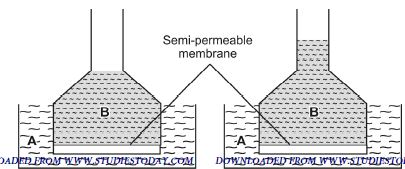
(a) Identify the liquid A and liquid B (pure water or sugar solution)
(b) Name the phenomenon involved in this experiment so that the level of liquid in this the funnel has risen after some time.
14. How relative lowering in vapour pressure is related with depression infreezing point and elevation in boiling point?
SA (II) TYPE QUESTIONS (3 - MARK QUESTIONS)
1. (a) State Henry’s Law.
(b) If O2 is bubbled through water at 393 K, how many millimoles of O2 gas would be dissolved in 1L of water? Assume that O2 exerts a pressure of 0.95 bar.
(Given KH for O2 = 46.82 bar at 393K).
2. Given reason for the following :–
(a) Aquatic species are more comfortable in cold waters than in warm waters.
(b) To avoid bends scuba divers use air diluted with helium.
(c) Cold drinks bottles are sealed under high pressure of CO2.
3. Why should a solution of a non-volatile and non-eletrolyte solute boil at a higher temperature? Explain with the help of a diagram. Derive the relationship between molar mass and elevation in boiling point.
4. Account for the following :–
(a) CaCl2 is used to clear snow from roads in hill stations.
(b) Ethylene glycol is used as antifreeze solution in radiators of vehicles in cold countries.
(c) The freezing point depression of 0.01 m NaCl is nearly twice that of 0.01 m glucose solution.
5. Why do colligative properties of solution of a given concentration are found to give abnormal molecular weight of solute. Explain with the help of suitable examples.
6. Give reasons for the following :–
(a) RBC swell up and finally burst when placed in 0.1% NaCl solution.
(b) When fruits and vegetables that have been dried are placed in water, they slowly swell and return to original form.
Please click the link below to download pdf file for CBSE Class 12 Chemistry notes and questions for Solutions Part C.
Free study material for Chemistry
Unit 1 Solutions Concepts and Summary for Class 12 Chemistry
Key Concepts and Summary for Class 12 Chemistry Unit 1 Solutions
Access structured revision notes for Unit 1 Solutions designed in alignment with the latest CBSE curriculum for Class 12 Chemistry. These summaries help clarify core themes and support effective daily study.
NCERT-Aligned Chapter Summary and Notes
Built using the official NCERT book for Class 12 Chemistry, these notes provide reliable academic guidance. Pair your summary review with our recommended NCERT solutions to master optimal problem-solving approaches.
Next Steps in Your Exam Preparation
Explore our broader library of printable assignments, chapter notes, and mock tests designed to support continuous revision and secure higher marks in CBSE assessments.
FAQs
You can download the teacher prepared revision notes for CBSE Class 12 Chemistry Solutions Notes Set 06 from StudiesToday.com. These notes are designed as per 2026-27 academic session to help Class 12 students get the best study material for Chemistry.
Yes, our CBSE Class 12 Chemistry Solutions Notes Set 06 include 50% competency-based questions with focus on core logic, keyword definitions, and the practical application of Chemistry principles which is important for getting more marks in 2026 CBSE exams.
Yes, our CBSE Class 12 Chemistry Solutions Notes Set 06 provide a detailed, topic wise breakdown of the chapter. Fundamental definitions, complex numerical formulas and all topics of CBSE syllabus in Class 12 is covered.
These notes for Chemistry are organized into bullet points and easy-to-read charts. By using CBSE Class 12 Chemistry Solutions Notes Set 06, Class 12 students fast revise formulas, key definitions before the exams.
No, all study resources on StudiesToday, including CBSE Class 12 Chemistry Solutions Notes Set 06, are available for immediate free download. Class 12 Chemistry study material is available in PDF and can be downloaded on mobile.