

Official Class 12 Chemistry Revision Material: CBSE Class 12 Chemistry Electrochemistry Board Exam Notes
Access comprehensive revision notes for Unit 2 Electrochemistry using the CBSE Class 12 Chemistry Electrochemistry Board Exam Notes. Designed to align with the 2026-27 academic syllabus for Class 12 Chemistry, these concept summaries help students streamline their exam preparation and review complex topics efficiently.
Chapter-wise Concept Summaries: Unit 2 Electrochemistry
Navigate directly to the revision notes for Unit 2 Electrochemistry using the digital viewer below. Each summary is structured to highlight high-weightage sections, allowing students to instantly access critical definitions and focus on core exam topics.

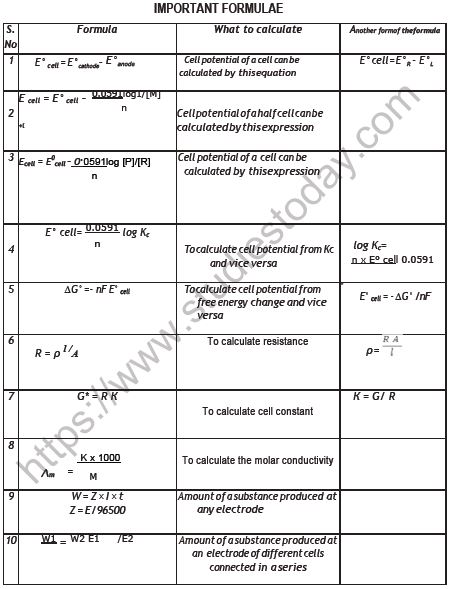
Frequently asked question
1 Mark
1).What is meant by limiting molar conductivity?
Ans Molar conductivity of an electrolyte at infinite dilution.
2.) Give the relationship between molar conductivity and specific conductivity ?
Ans. ᴧm = k (1000\M)
3.) What is meant by limiting molar conductivity ?
Ans. The molar conductivity of a solution at infinite dilution is called limiting molar conductivity
4.) What is the unit of molar conductivity?
Ans . ohm–1cm2mol–1
5.) What is the effect of dilution of concentration on specific conductance ?
Ans. Specific conductance decrease with dilution because it is the conduction power of ion present in unit volume of solution and number of ion in unit volume decreases on dilution. Specific conductance increases with concentration.
6.) What type of metals can be used in cathodic protection of iron against rusting?
Ans. A metal which is more electropositive than iron i.e. having lower reduction potential. Example- Zn, Mg etc.
7. Why mercury cell gives constant voltage throughout its life?
Ans. As the overall reaction does not involve any ion in solution whose conc. can change during its life.
A statement of assertion is followed by a statement of reason. Mark the correct choice from the options given below:
(a) Both assertion and reason are true and reason is the correct explanation of assertion.
(b) Both assertion and reason are true but reason is not the correct explanation of assertion.
(c) Assertion is true but reason is false.
(d) Both assertion and reason are false.
1. Assertion : Current stops flowing when Ecell = 0.
Reason : Equilibrium of the cell reaction is attained. ( Ans - a)
2. Assertion : A standard hydrogen electrode is also called reversible electrode.
Reason : It can act on both as anode as well as cathode in an electrochemical cell.
( Ans - a)
3. Assertion : Kohlrausch law helps to find the molar conductivity of weak electrolyte at infinite dilution.
Reason : Molar conductivity of a weak electrolyte at infinite dilution cannot be determined experimentally. ( Ans - a)
4. Assertion : When a copper wire is dipped in silver nitrate solution, there is no change in the colour of the solution.
Reason : Copper cannot displace silver from its salt solution. ( Ans - d)
5. Assertion : Fluorine is the best oxidising agent.
Reason : Fluorine has highest reduction potential. ( Ans - a)
One - word answer
1. How much electricity in terms of Faraday is required to produce 100g of Ca from molten CaCl2 ? ( 5F)
2. Name the solid substance produced, during the discharge of lead- storage battery.
( Ans - Lead sulphate)
2 marks
1. What is fuel cell ? Write two chemicals which can be used as fuel.
Ans . The cell which converts combustion energy of fuel into electricity .
Methane and hydrogen can be used as fuel 2H2(g) + 4OH–(aq) → 4H2O(l) + 4e– O2 + 2H2O (l) + 4e– →4OH–(aq)
2.) What type of battery is the lead storage battery? Write the anode and the cathode reaction and the overall reaction occurring when current is drawn from it ( reaction during discharge of it )
Ans. Lead storage battery is the secondary cell. So it can be recharged by passing direct current through it .
Discharge reaction –
At anode : Pb(s) + SO4
2–(aq) → PbSO4 (s) +2e–
At cathode: PbO2(s) + SO4
2–(aq) + 4H+(aq) + 2e– →2PbSO4 (aq) +2H2O(l) Overall solution :
Pb + PbO2+ 4H+ + SO4
2–(aq) → 2PbSO4 + 2H2O
3.) How many moles of mercury will be produced by electrolysing 1.0 M Hg (NO3)2 solution with a current of 2.00 A for three hours ?
Molar mass of Hg(NO3)2= 200.6 g/mol
Ans . Current = 2A
Time = 3h = 3(60)(60)s
w = ZIt
Z for Hg in compound =200.6/2F
w= 200.6x2x (3)(60)(60)/2(96500)
w= 22.45g
number of moles = 22.45\200.6 = 0.112 mol
4.) Represent the galvanic cell in which the following reactions take place
Zn(s) + 2Ag+(aq) → Zn2+(aq) + 2Ag(s)
i.) Which one of the electrodes is negatively charged ?
ii.) Write the reaction taking place at each of t he electrodes.
iii.) Name the carrier of current within the cell.
Ans .The cell is represented as
Zn(s) │Zn2+(aq) ││Ag+(aq) │Ag(s) │
i) Zn electrode is negatively charged
ii) At anode
Zn(s) → Zn2+ + 2e–
At cathode
Ag+(aq) + e– → Ag(s)
Free study material for Chemistry
Download CBSE Revision Notes: Class 12 Chemistry Unit 2 Electrochemistry
About Unit 2 Electrochemistry Revision Notes
Explore reliable chapter overviews for Unit 2 Electrochemistry tailored for Class 12 learners. Use these structured points to grasp difficult themes and ensure solid preparation for upcoming assessments.
How to Use These Revision Notes
Built using the official NCERT book for Class 12 Chemistry, these notes provide reliable academic guidance. Pair your summary review with our recommended NCERT solutions to master optimal problem-solving approaches.
Enhance Practice with MCQs and Worksheets
Wrap up your chapter revision by testing your knowledge against standard question formats. Everything on our platform is provided free of charge.
FAQs
You can download the teacher prepared revision notes for CBSE Class 12 Chemistry Electrochemistry Board Exam Notes from StudiesToday.com. These notes are designed as per 2026-27 academic session to help Class 12 students get the best study material for Chemistry.
Yes, our CBSE Class 12 Chemistry Electrochemistry Board Exam Notes include 50% competency-based questions with focus on core logic, keyword definitions, and the practical application of Chemistry principles which is important for getting more marks in 2026 CBSE exams.
Yes, our CBSE Class 12 Chemistry Electrochemistry Board Exam Notes provide a detailed, topic wise breakdown of the chapter. Fundamental definitions, complex numerical formulas and all topics of CBSE syllabus in Class 12 is covered.
These notes for Chemistry are organized into bullet points and easy-to-read charts. By using CBSE Class 12 Chemistry Electrochemistry Board Exam Notes, Class 12 students fast revise formulas, key definitions before the exams.
No, all study resources on StudiesToday, including CBSE Class 12 Chemistry Electrochemistry Board Exam Notes, are available for immediate free download. Class 12 Chemistry study material is available in PDF and can be downloaded on mobile.