

Chemistry Concept Notes for Class 12: Unit 7 Alcohols, Phenols and Ethers
Review targeted revision notes for Class 12 Chemistry with the CBSE Class 12 Chemistry Alcohols Phenols And Ethers Board Exam Notes. Built according to official educational guidelines for the 2026-27 academic year, these downloadable summaries for Unit 7 Alcohols, Phenols and Ethers support daily study and last-minute exam readiness.
Download Unit 7 Alcohols, Phenols and Ethers Revision Notes PDF
Access the complete concept summary PDF for Unit 7 Alcohols, Phenols and Ethers below. Regular review of these targeted notes builds familiarity with complex Class 12 Chemistry themes and helps secure higher marks in final school evaluations.


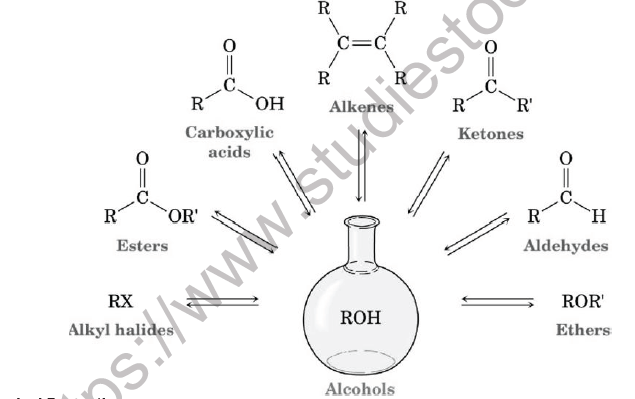

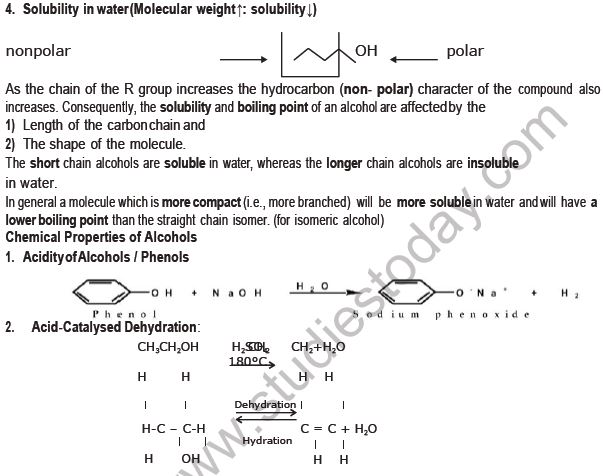
3. Oxidation of Alcohols: (1°), (2°) & (3°) Using p otassium d i chromate & sulphuric Acid as
catalysts In the oxidation [O] of a primary alcohol( 1°) , aldehyde is produced
Primary alcohol → aldehyde →carboxylic acid
On oxidation of 20 alcohols a ketone is formed. Secondary alcohol → ketone
Tertiary alcohols do not oxidize.
Tertiary alcohol → No reaction
CONCEPTUAL QUESTIONS
Q1) Preparation of ethers by acid dehydration of secondary or 30 alcohols is not a suitable method?
Ans. The formation of ethers by dehydration of alcohol is a bimolecular reaction (SN2) group is hindered. As a result elimination dominates substitution as 30 carbocation is more stable. Hence in place of ethers, alkenes are formed.
Q2) Phenols do not give protonation reactions readily. Why?
Ans. The lone pair on oxygen of O‐H in phenol is being shared with benzene ring through resonance.
Thus, lone pair is not fully present on oxygen and hence phenols do not undergo protonation reactions.
REASONING QUESTIONS
Q1. Explain why propanol has higher boiling point than that of the hydrocarbon, butane?
Ans. The molecules of butane are held together by weak van der Waal's forces of attraction while those of propanol are held together by stronger intermolecular hydrogen bonding.
Q2. Alcohols are comparatively more soluble in water than hydrocarbons of comparable molecular masses. Explain this fact.
Ans. Alcohols can form hydrogen bonds with water and break the hydrogen bonds already existing between water molecules Therefore they are soluble in water, whereas hydrocarbons cannot form hydrogen bonds with water and hence are insoluble in water.
Q3 While separating a mixture of ortho and para nitro phenols by steam distillation, name the isomer which will be steam volatile. Give reason.
Ans. O‐nitrophenol is steam volatile due to intramolecular hydrogen bonding and hence can be separated by steam distillation from p‐nitrophenol which is not steam volatile because of inter‐molecular hydrogen bonding.
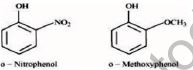
Q4. Explain why is ortho- nitro phenol more acidic than ortho -- methoxyphenol?
Ans. The nitro‐group is an electron‐withdrawing group. Therefore decreases the electron density of the ring as well as oxygen.. As a result, it is easier to lose a proton. Also, the o‐nitrophenoxide ion formed after the loss of proton is stabilized by resonance. Hence, o‐ nitro phenol is stronger acid. On the other hand, methoxy group is an electron‐releasing group. Thus, it increases the electron density of the oxygen atom and hence, the proton cannot be given out easily. Therefore, o‐nitrophenol is more acidic than o-methoxyphenol.
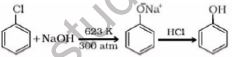
Q5. Write chemical reaction for the preparation of phenol from chlorobenzene.
Ans. Chlorobenzene is fused with NaOH at 623K and 320 atmospheric pressure. Phenol is obtained by acidification of sodium phenoxide so produced.
Free study material for Chemistry
Unit 7 Alcohols, Phenols and Ethers Concepts and Summary for Class 12 Chemistry
Quick Revision Notes: Unit 7 Alcohols, Phenols and Ethers (CBSE)
Explore reliable chapter overviews for Unit 7 Alcohols, Phenols and Ethers tailored for Class 12 learners. Use these structured points to grasp difficult themes and ensure solid preparation for upcoming assessments.
Expert Study Material for Class 12 Chemistry
Built using the official NCERT book for Class 12 Chemistry, these notes provide reliable academic guidance. Pair your summary review with our recommended NCERT solutions to master optimal problem-solving approaches.
Complete Your Chapter Revision
Follow up your revision by attempting the interactive online Chemistry MCQ test and practice worksheets for this chapter to verify your mastery. All platform resources are free to access.
FAQs
You can download the teacher prepared revision notes for CBSE Class 12 Chemistry Alcohols Phenols And Ethers Board Exam Notes from StudiesToday.com. These notes are designed as per 2026-27 academic session to help Class 12 students get the best study material for Chemistry.
Yes, our CBSE Class 12 Chemistry Alcohols Phenols And Ethers Board Exam Notes include 50% competency-based questions with focus on core logic, keyword definitions, and the practical application of Chemistry principles which is important for getting more marks in 2026 CBSE exams.
Yes, our CBSE Class 12 Chemistry Alcohols Phenols And Ethers Board Exam Notes provide a detailed, topic wise breakdown of the chapter. Fundamental definitions, complex numerical formulas and all topics of CBSE syllabus in Class 12 is covered.
These notes for Chemistry are organized into bullet points and easy-to-read charts. By using CBSE Class 12 Chemistry Alcohols Phenols And Ethers Board Exam Notes, Class 12 students fast revise formulas, key definitions before the exams.
No, all study resources on StudiesToday, including CBSE Class 12 Chemistry Alcohols Phenols And Ethers Board Exam Notes, are available for immediate free download. Class 12 Chemistry study material is available in PDF and can be downloaded on mobile.