

Download the latest CBSE Class 12 Chemistry The D And F Block Elements Notes Set 02 in PDF format. These Class 12 Chemistry revision notes are carefully designed by expert teachers to align with the 2026-27 syllabus. These notes are great daily learning and last minute exam preparation and they simplify complex topics and highlight important definitions for Class 12 students.
Revision Notes for Class 12 Chemistry Unit 4 The d- and f-Block Elements
To secure a higher rank, students should use these Class 12 Chemistry Unit 4 The d- and f-Block Elements notes for quick learning of important concepts. These exam-oriented summaries focus on difficult topics and high-weightage sections helpful in school tests and final examinations.
Unit 4 The d- and f-Block Elements Revision Notes for Class 12 Chemistry
POINTS TO BE REMEMBERED: ‐‐‐
1. The elements of periodic table belonging to group 3 to 12 are known as d‐Block elements.
2.The general electronic configuration of these elements is (n ‐1)d1‐10 ns 1‐2
3. d‐ Block elements are collectively known as Transition Elements because properties of these elements vary in between s‐Block and p‐Block elements.
4.A transition element should have partially filled (n‐1) d orbital.
5. Group 12 elements i.e. Zn, Cd, Hg have completely filled (n‐1) d‐orbital in atomic & ionic state & thus these elements are considered as Typical Transition Elements.
6. All these elements are metals. They are less electropositive than s‐block elements & more electropositive than p‐block elements.
7. The atomic radii decreases from group 3 to 6 (i.e. Sc to Cr) because of increase in effective nuclear charge gradually.
8. The atomic radii of group 7,8 9 &10 elements (i.e. Fe,Co,Ni) is almost same because pairing of electrons take place in (n‐1)d orbital causing repulsion i.e. shielding of (n‐1)d orbital.
9. Group 11 &12 elements i.e. Cu & Zn have bigger size due to strong shielding of completely filled (n‐1)d orbital.
10.The transition elements show variable oxidation state due to small energy difference between (n‐1)d &ns orbital as a result both (n‐1)d &ns electrons take part in bond formation.
11.The highest oxidation state of an element is equal to number of unpaired electrons present in (n‐1)d &ns orbital.
12.Transition elements have high enthalpy of atomization/ sublimation Because of large number of unpaired electrons in their atoms, they have stronger interatomic interaction and hence strong metallic bonding is present between atoms.
13.Most of transition elements are paramagnetic due to presence of unpaired electrons in (n‐1) d orbital.
14.Most of transition elements are used as catalyst. It is due to (i) partially filled (n‐1) d orbital (ii) Variable oxidation state (iii) Ability to change oxidation state frequently.
15.Most of transition elements form coloured compounds due to presence of unpaired electrons in (n‐1) d orbital & thus they can undergo d‐d transition.
16.Most of transition elements form complex compounds due to (i) small size (ii) high charge (iii) presence of vacant d‐orbital of suitable energy.
17.Transition elements have lower value of Reduction Potential due to high ionization potential, high heat of sublimation & low enthalpy of hydration.
18.Transition elements form interstitial compounds because size of interstitial voids is similar to size of non‐ metals C, N, O, H.
19. Transition elements form alloys due to similar ionic radii.
20.The oxides of transition metals in lower oxidation state are BASIC, intermediate oxidation state are AMPHOTERIC, highest oxidation state are ACIDIC.
LANTHANOIDS: ‐‐‐
1. The 14 elements after Lanthanum having atomic number 58 to 71 are collectively known as Lanthanoids.
2. The general electronic configuration of these elements is [Xe] 4f1‐14, 5d0‐1 ,6s2 .
3. Most common oxidation state of these elements is +3, but Ce shows +4, Eu +2, because they acquire stable configuration.
4. The size of Lanthanoids and its trivalent ion decreases from La to Lu due to poor shielding of 4f electrons. It is known as lanthanoids contraction.
ACTINOIDS:
1.The 14 elements after Actinium having atomic number 90 to 113 are collectively known as Actinoids.
2. The general electronic configuration of these elements is [Rn] 5f1‐14, 6d0‐1 ,7s2.
3. The size of actinoids and its trivalent ion decreases from Ac to Lw due to poor shielding of 5f electrons. It is known as actinoids contraction.
4. The elements after U (92) are man made known as transuranic elements.
POTASSIUM DICHROMATE:
Preparation: It takes place in three steps‐
(i) Conveorsion of chromite ore to sodium chromate.
(ii) Cnversion of sodium chromate to Sodium dichromate.
(iii) Conversion of sodium dichromate to potassium dichromate
Following reaction take place;-
4 FeCr2O4+ 4 Na2CO3 +7O2 —→ 2 Na2CrO4+ 2Fe2O3 +8 CO2
2Na2CrO4 + 2 H+ → Na2Cr2O7 + 2 Na+ + H2O
Na2Cr2O7 + 2 KCl → K2Cr2O7 + 2 NaCl
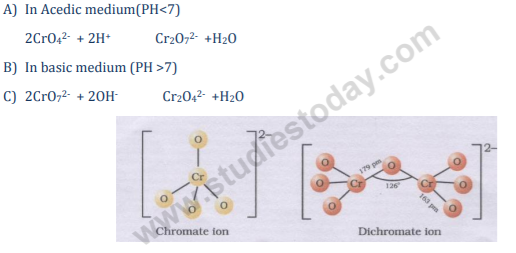
The chromates and dichromates are interconvertible in aqueous solution depending upon Ph of the solution.
POTASSIUM PERMANGNATE:
Preparation:‐‐
It takes place in two steps:‐
(i) Conversion of pyrolusite ore into potassium magnate
(ii) Conversio of potassium magnate to potassium permagante
Following reactions tak
2 MnO2 + 4 KOH + O2 → 2 K2MnO4 + 2H2O
3 MnO4 2‐ +4H+ → 2 MnO4‐ +MnO2 +2H2O
QUESTION ANSWERS
(TWO MARK QUESTIONS)
Q.1‐Explain briefly how +2 oxidation state becomes more and more stable in the first half of the first row transition elements with increasing atomic number.
A.1‐In M2+ ions, 3d‐orbitals get occupied gradually as the atomic number increases. Since, the number of empty d
Free study material for Chemistry
CBSE Class 12 Chemistry Unit 4 The d- and f-Block Elements Notes
Students can use these Revision Notes for Unit 4 The d- and f-Block Elements to quickly understand all the main concepts. This study material has been prepared as per the latest CBSE syllabus for Class 12. Our teachers always suggest that Class 12 students read these notes regularly as they are focused on the most important topics that usually appear in school tests and final exams.
NCERT Based Unit 4 The d- and f-Block Elements Summary
Our expert team has used the official NCERT book for Class 12 Chemistry to design these notes. These are the notes that definitely you for your current academic year. After reading the chapter summary, you should also refer to our NCERT solutions for Class 12. Always compare your understanding with our teacher prepared answers as they will help you build a very strong base in Chemistry.
Unit 4 The d- and f-Block Elements Complete Revision and Practice
To prepare very well for y our exams, students should also solve the MCQ questions and practice worksheets provided on this page. These extra solved questions will help you to check if you have understood all the concepts of Unit 4 The d- and f-Block Elements. All study material on studiestoday.com is free and updated according to the latest Chemistry exam patterns. Using these revision notes daily will help you feel more confident and get better marks in your exams.
FAQs
You can download the teacher prepared revision notes for CBSE Class 12 Chemistry The D And F Block Elements Notes Set 02 from StudiesToday.com. These notes are designed as per 2026-27 academic session to help Class 12 students get the best study material for Chemistry.
Yes, our CBSE Class 12 Chemistry The D And F Block Elements Notes Set 02 include 50% competency-based questions with focus on core logic, keyword definitions, and the practical application of Chemistry principles which is important for getting more marks in 2026 CBSE exams.
Yes, our CBSE Class 12 Chemistry The D And F Block Elements Notes Set 02 provide a detailed, topic wise breakdown of the chapter. Fundamental definitions, complex numerical formulas and all topics of CBSE syllabus in Class 12 is covered.
These notes for Chemistry are organized into bullet points and easy-to-read charts. By using CBSE Class 12 Chemistry The D And F Block Elements Notes Set 02, Class 12 students fast revise formulas, key definitions before the exams.
No, all study resources on StudiesToday, including CBSE Class 12 Chemistry The D And F Block Elements Notes Set 02, are available for immediate free download. Class 12 Chemistry study material is available in PDF and can be downloaded on mobile.