

Revision Notes for Class 12 Chemistry: Unit 3 Chemical Kinetics
Access comprehensive revision notes for Unit 3 Chemical Kinetics using the CBSE Class 12 Chemistry Chemical Kinetics Chapter Notes. Designed to align with the 2026-27 academic syllabus for Class 12 Chemistry, these concept summaries help students streamline their exam preparation and review complex topics efficiently.
Review Unit 3 Chemical Kinetics for Class 12 Chemistry
Navigate directly to the revision notes for Unit 3 Chemical Kinetics using the digital viewer below. Each summary is structured to highlight high-weightage sections, allowing students to instantly access critical definitions and focus on core exam topics.
Chemistry Ch. 4: Chemical Kinetics
Chapter Notes
Key learnings:
1. Chemical kinetics: The branch of chemistry that deals with the study of reaction rates and their mechanisms is called chemical kinetics.
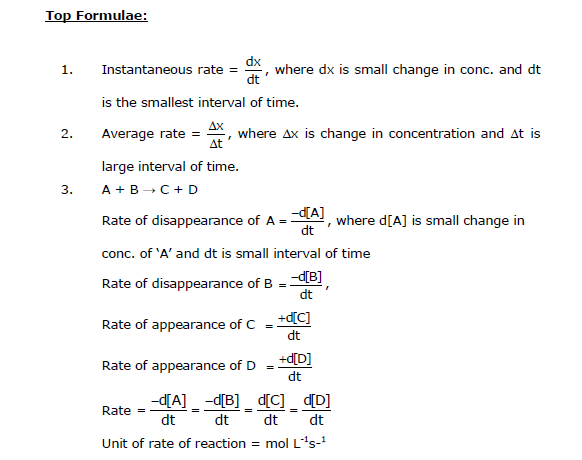
2. Rate of reaction: It is defined as the change in concentration of reactant (or product) in unit time. Unit of rate of reaction is mol L-1s-1.
3. Average rate: The rate of reaction measured over a long time interval is called average rate of reaction. It is equal to Δx/Δt.
4. Instantaneous rate: It is the rate of reaction when the average rate is taken over a particular moment of time. It is equal to dx/dt.
5. Rate law or rate equation: It is the expression which relates the rate of reaction with concentration of the reactants. The constant of proportionality ‘k’ is known as rate constant.
6. Rate constant: When the concentration of reactants is unity, then the rate of reaction is known as rate constant. It is also called specific reaction rate.
7. Molecularity of a reaction: Total number of atoms, ions or molecules of the reactants involved in the reaction is termed as its molecularity. It is always in whole number. It is never more than three. It cannot be zero.
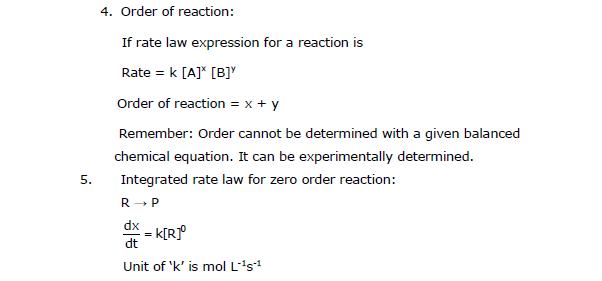
8. Order of a reaction: The sum of the exponents (power) of the concentration of reactants in the rate law is termed as order of the reaction. It can be in fraction. It can be zero also.
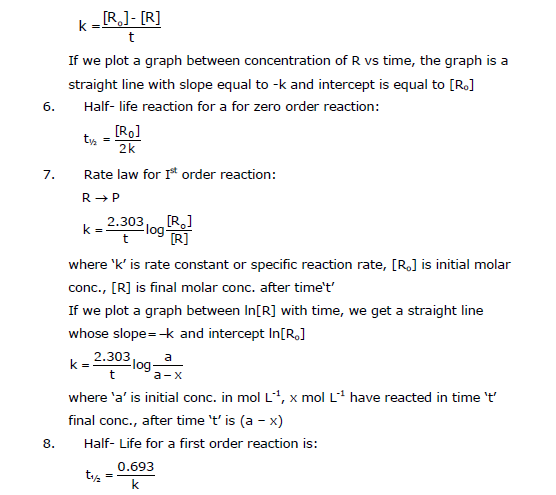
9. Half- life of a reaction: The time taken for a reaction, when half of the starting material has reacted is called half- life of a reaction. For first order reaction , where k is rate constant. t1/2 =0.693 / k
It is independent of initial concentration for first order reaction.
10. Pseudo first order reaction: The reaction which is bimolecular but order is one is called pseudo first order reaction. This happens when one of the reactants is in large excess. E.g., acidic hydrolysis of ester (ethyl acetate).
H+
CH3COOC2H5+H 2O → CH3COOH+C2H50H
11. Activation energy (Ea): It is extra energy which must be possessed by reactant molecules so that collision between reactant molecules is effective and leads to the formation of product molecules.
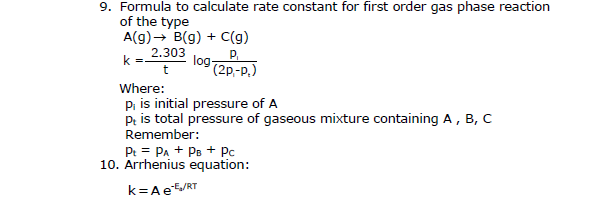
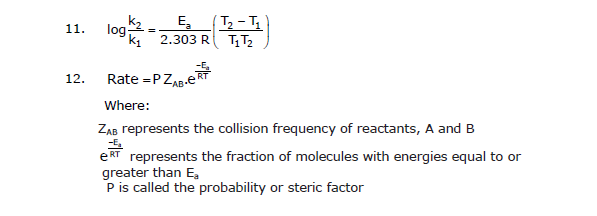
12. Arrhenius equation of reaction rate: It gives the relation between rate of reaction and temperature.
k =where k = rate constant, A = frequency factor, Ea = energy of activation R = gas constant, T = temperature in Kelvin, ln k = ln A - Ea/RT log k = log A - Ea/ 2.303RT
13. Mechanism of reaction: The sequence of elementary processes leading to the overall stoichiometry of a chemical reaction is known as mechanism of a reaction.
14. Activated complex: It is defined as unstable intermediate formed between reacting molecules. It is highly unstable and readily changes into product.
15. Rate determining step: The slowest step in the reaction mechanism is called rate determining step.
16. The number of collisions per second per unit volume of the reaction mixture is known as collision frequency (Z).
Please click the link below to download pdf file for CBSE Class 12 Chemistry - Chemical Kinetics Chapter Notes.
Free study material for Chemistry
Unit 3 Chemical Kinetics Concepts and Summary for Class 12 Chemistry
Key Concepts and Summary for Class 12 Chemistry Unit 3 Chemical Kinetics
Review targeted chapter notes for Class 12 Chemistry Unit 3 Chemical Kinetics. Built according to official CBSE guidelines, these summaries highlight high-yield topics frequently tested in school evaluations.
NCERT-Aligned Chapter Summary and Notes
Each chapter summary is structured around standard CBSE textbooks, allowing students to check their understanding and clarify complex ideas early in their revision.
Next Steps in Your Exam Preparation
Follow up your revision by attempting the interactive online Chemistry MCQ test and practice worksheets for this chapter to verify your mastery. All platform resources are free to access.
FAQs
You can download the teacher prepared revision notes for CBSE Class 12 Chemistry Chemical Kinetics Chapter Notes from StudiesToday.com. These notes are designed as per 2026-27 academic session to help Class 12 students get the best study material for Chemistry.
Yes, our CBSE Class 12 Chemistry Chemical Kinetics Chapter Notes include 50% competency-based questions with focus on core logic, keyword definitions, and the practical application of Chemistry principles which is important for getting more marks in 2026 CBSE exams.
Yes, our CBSE Class 12 Chemistry Chemical Kinetics Chapter Notes provide a detailed, topic wise breakdown of the chapter. Fundamental definitions, complex numerical formulas and all topics of CBSE syllabus in Class 12 is covered.
These notes for Chemistry are organized into bullet points and easy-to-read charts. By using CBSE Class 12 Chemistry Chemical Kinetics Chapter Notes, Class 12 students fast revise formulas, key definitions before the exams.
No, all study resources on StudiesToday, including CBSE Class 12 Chemistry Chemical Kinetics Chapter Notes, are available for immediate free download. Class 12 Chemistry study material is available in PDF and can be downloaded on mobile.