

Revision Notes for Class 12 Chemistry: Unit 3 Chemical Kinetics
Review targeted revision notes for Class 12 Chemistry with the CBSE Class 12 Chemistry Chemical Kinetics Board Exam Notes. Built according to official educational guidelines for the 2026-27 academic year, these downloadable summaries for Unit 3 Chemical Kinetics support daily study and last-minute exam readiness.
Review Unit 3 Chemical Kinetics for Class 12 Chemistry
Navigate directly to the revision notes for Unit 3 Chemical Kinetics using the digital viewer below. Each summary is structured to highlight high-weightage sections, allowing students to instantly access critical definitions and focus on core exam topics.
KEY CONCEPTS
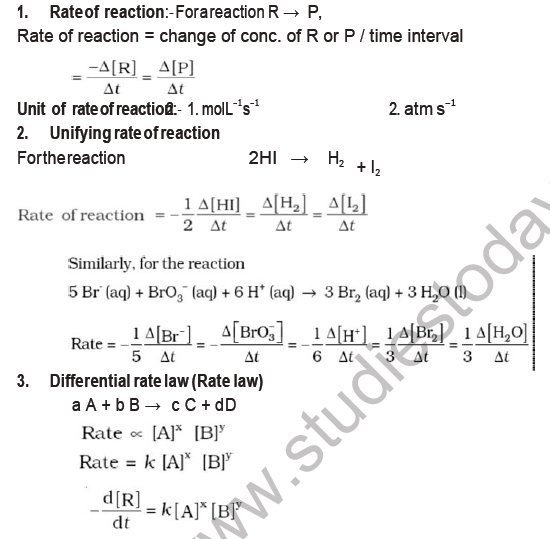
This is differential rate equation.
Order of reaction:‐ For the reaction a A + b B → c C + d D Rate = K[A]x [B]y
x + y = order of reaction (where x & y may or may not be equal to stoichiometric coefficient)
Note:‐
i. if x + y = 1, reaction is called I order reaction.
ii. if x + y = 2, reaction is called II order reaction.
iii. if x + y = 3, reaction is called III order reaction.
iv. if x + y = 0, reaction is called zero order reaction.
v. if x + y = fraction , reaction is called fractional order reaction.
5. Units of rate constants and graph between rate and conc. of reactant
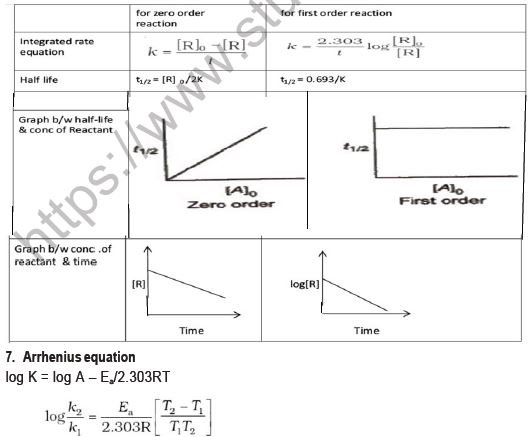
6. Integrated rate equation for zero order and first order reaction
Note:‐ 1. For zero order reaction t1/2 α conc. of reactant.
2. For I order reaction t1/2 is independent of conc of reactant.
3. t α [conc]1-n whe n = order of reaction.
IMPORTANT DEFINITIONS
1 Pseudo first order reaction:‐ A bimolecular reaction, in which one reactant is present in large excess and rate of reaction is independent of its concentration. Such a reaction is called pseudo first molecular reaction.
Eg. CH3COOC2H5 + H2O →CH3COOH + C2H5OH molecularity of reaction is two and order of reaction is one.
2. Molecularity of reaction:‐The number of reacting species (atoms, ions or molecules) taking part in an elementary reaction, which must collide simultaneously in order to bring about a chemical reaction is called molecularity of a reaction.
Types of reaction based on molecularity
This is differential rate equation.
Order of reaction:‐ For the reaction a A + b B → c C + d D Rate = K[A]x [B]y
x + y = order of reaction (where x & y may or may not be equal to stoichiometric coefficient)
Note:‐
i. if x + y = 1, reaction is called I order reaction.
ii. if x + y = 2, reaction is called II order reaction.
iii. if x + y = 3, reaction is called III order reaction.
iv. if x + y = 0, reaction is called zero order reaction.
v. if x + y = fraction , reaction is called fractional order reaction.
5. Units of rate constants and graph between rate and conc. of reactant
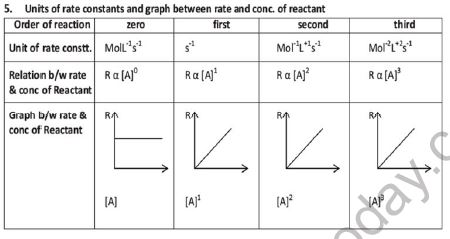
6. Integrated rate equation for zero order and first order reaction
Note:‐ 1. For zero order reaction t1/2 α conc. of reactant.
2. For I order reaction t1/2 is independent of conc of reactant.
3. t α [conc]1-n whe n = order of reaction.
IMPORTANT DEFINITIONS
1 Pseudo first order reaction:‐ A bimolecular reaction, in which one reactant is present in large excess and rate of reaction is independent of its concentration. Such a reaction is called pseudo first molecular reaction.
Eg. CH3COOC2H5 + H2O →CH3COOH + C2H5OH molecularity of reaction is two and order of reaction is one.
2. Molecularity of reaction:‐The number of reacting species (atoms, ions or molecules) taking part in an elementary reaction, which must collide simultaneously in order to bring about a chemical reaction is called molecularity of a reaction.
Types of reaction based on molecularity

NOTE:‐
i. It is theoretical value.
ii. It cannot be zero or a non integer.
iii. molecularity greater than three is not observed.
iv. molecularity is applicable only for elementary reactions. For complex reaction molecularity has no meaning.
3. Order of reaction:‐ the power to which conc. term of a reactant is raised in rate law expression is called order w.r.t. that reactant. The sum of powers of conc. of all reactants in rate law expression is called o v e r a l l order of reaction.
for the reaction a A + b B → c C + d D
Rate = K[A]x [B]y
x + y = order of reaction.
NOTE:‐
i. Order of a reaction is an experimental quantity
ii. It can be zero and even a fraction
iii. Order is applicable to elementary as well as complex reactions
4. Elementary step:‐ Many reactions complete in a number of steps. Each individual step of a reaction is called elementary step.
Please click the link below to download pdf file of CBSE Class 12 Chemistry Chemical Kinetics Board Exam Notes
Free study material for Chemistry
Unit 3 Chemical Kinetics Concepts and Summary for Class 12 Chemistry
Download Chapter Summary: Class 12 Chemistry Unit 3 Chemical Kinetics
Access structured revision notes for Unit 3 Chemical Kinetics designed in alignment with the latest CBSE curriculum for Class 12 Chemistry. These summaries help clarify core themes and support effective daily study.
Concept Clarification for Unit 3 Chemical Kinetics
Built using the official NCERT book for Class 12 Chemistry, these notes provide reliable academic guidance. Pair your summary review with our recommended NCERT solutions to master optimal problem-solving approaches.
Additional Study Resources for Class 12 Chemistry
Wrap up your chapter revision by testing your knowledge against standard question formats. Everything on our platform is provided free of charge.
FAQs
You can download the teacher prepared revision notes for CBSE Class 12 Chemistry Chemical Kinetics Board Exam Notes from StudiesToday.com. These notes are designed as per 2026-27 academic session to help Class 12 students get the best study material for Chemistry.
Yes, our CBSE Class 12 Chemistry Chemical Kinetics Board Exam Notes include 50% competency-based questions with focus on core logic, keyword definitions, and the practical application of Chemistry principles which is important for getting more marks in 2026 CBSE exams.
Yes, our CBSE Class 12 Chemistry Chemical Kinetics Board Exam Notes provide a detailed, topic wise breakdown of the chapter. Fundamental definitions, complex numerical formulas and all topics of CBSE syllabus in Class 12 is covered.
These notes for Chemistry are organized into bullet points and easy-to-read charts. By using CBSE Class 12 Chemistry Chemical Kinetics Board Exam Notes, Class 12 students fast revise formulas, key definitions before the exams.
No, all study resources on StudiesToday, including CBSE Class 12 Chemistry Chemical Kinetics Board Exam Notes, are available for immediate free download. Class 12 Chemistry study material is available in PDF and can be downloaded on mobile.