

Download Class 12 Chemistry Concept Summaries: CBSE Class 12 Chemistry Biomolecules Notes Set 04
Explore reliable concept summaries and revision materials through the CBSE Class 12 Chemistry Biomolecules Notes Set 04. Tailored for Class 12 learners, utilizing these notes for Chemistry Unit 10 Biomolecules ensures thorough preparation and strengthens core academic definitions before final evaluations.
Access Unit 10 Biomolecules Notes and Study Material
Navigate directly to the revision notes for Unit 10 Biomolecules using the digital viewer below. Each summary is structured to highlight high-weightage sections, allowing students to instantly access critical definitions and focus on core exam topics.
BIOMOLECULES
POINTS TO REMEMBER
1. Carbohydrates are optically active polyhydroxy aldehydes or ketones or molecules which provide such units on hydrolysis.
2. Corbohydrates are classified into three groups (i) monosaccharides,
(ii) oligosaccharides and (iii) polysaccharides.
3. Glucose, the most important source of energy for mammals, is obtained by the digestion of starch.
4. Monosaccharides are held together by glycosidic linkages to form disaccharides or polysaccharides.
5. Proteins are the polymers of about twenty different amino acids which are linked by peptide bonds. Ten amino acids are called essential amino acids because they can not be synthesised in our body, hence must be provided through diet.
6. Proteins perform various structural and dynamic functions in the organisms. Proteins which contain only amino acids, are called simple proteins.
7. The secondary or tertiary structure of proteins get disturbed on change of pH or temperature and they are not able to perform their functions. This is called denaturation of proteins.
8. Enzymes are biocatalysts which speed up the reactions in biosystems. They are very specific and selective and efficient in their actions and chemically all enzymes are proteins.
9. Vitamins are necessory food factors required in the diet. They are classified as fat soluble (A, D, E and K) and water soluble (B group and C).
10. Nucleic acid are responsible for the transfer of characters from parents to offsprings.
11. There are two types of nucleic acids DNA and RNA. DNA contains a five carbon sugar molecule called 2-deoxyribose and RNA contains ribose.
12. Both DNA and RNA contain adenine, guanine and cytosine. The fourth base is thymine in DNA and uracil in RNA. The structure of DNA is double stranded while that of RNA is a single stranded molecule.
13. DNA is the chemical basis of heredity and has the coded message for proteins to be synthesised.
14. There are three types of RNA, i.e., m-RNA, r-RNA and t-RNA which actually carry out the protein synthesis in the nucleus.
15. Human stomach does not have any enzyme capable of breaking cellulose molecules and thus we cannot digest cellulose.
QUESTIONS
VSA TYPE QUESTIONS (1 - MARK QUESTIONS)
1. Name polysaccharide which is stored in the liver of animals.
2. What structural feature is required for a carbohydrate to behave as reducing sugar? [Hint : The carbonyl group of any one monosaccharide present in carbohydrate should be free]
3. How many asymmetric carbon atoms are present in D (+) glucose?
4. Name the enantiomer of D-glucose. [Hint : L-glucose]
5. Give the significance of (+)-sign in the name D-(+)-glucose. [Hint : (+) sign indicates dextrorotatory nature of glucose].
6. Give the significance of prefix ‘D’ in the name D-(+)-glucose. [Hint : ‘D’ Signifies that –OH group on C-5 is on the right hand side]
7. Glucose is an aldose sugar but it does not react with sodium hydrogen sulphite. Give reason. [Hint : The –CHO group reacts with –OH group at C–5 to form a cyclic hemiacetal].
8. Why is sucrose called invert sugar? [Hint : When sucrose is hydrolysed by water, the optical rotation of solution changes from positive to negative.]
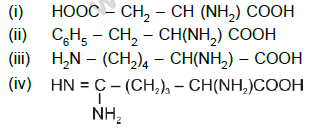
9. Name the building blocks of proteins.
10. Give the structure of simplest optically active amino acid.
11. Name the amino acid which is not optically active.
12. Write the Zwitter ionic form of aminoacetic acid. stranded while that of RNA is a single stranded molecule.
Please click the link below to download pdf file for CBSE Class 12 Chemistry notes and questions for Biomolecules Part C.
Free study material for Chemistry
Unit 10 Biomolecules Concepts and Summary for Class 12 Chemistry
Download Chapter Summary: Class 12 Chemistry Unit 10 Biomolecules
Review targeted chapter notes for Class 12 Chemistry Unit 10 Biomolecules. Built according to official CBSE guidelines, these summaries highlight high-yield topics frequently tested in school evaluations.
Concept Clarification for Unit 10 Biomolecules
Cross-reference your comprehension with comprehensive NCERT solutions for Class 12 to ensure absolute clarity across all sub-topics in this chapter.
Additional Study Resources for Class 12 Chemistry
Explore our broader library of printable assignments, chapter notes, and mock tests designed to support continuous revision and secure higher marks in CBSE assessments.
FAQs
You can download the teacher prepared revision notes for CBSE Class 12 Chemistry Biomolecules Notes Set 04 from StudiesToday.com. These notes are designed as per 2026-27 academic session to help Class 12 students get the best study material for Chemistry.
Yes, our CBSE Class 12 Chemistry Biomolecules Notes Set 04 include 50% competency-based questions with focus on core logic, keyword definitions, and the practical application of Chemistry principles which is important for getting more marks in 2026 CBSE exams.
Yes, our CBSE Class 12 Chemistry Biomolecules Notes Set 04 provide a detailed, topic wise breakdown of the chapter. Fundamental definitions, complex numerical formulas and all topics of CBSE syllabus in Class 12 is covered.
These notes for Chemistry are organized into bullet points and easy-to-read charts. By using CBSE Class 12 Chemistry Biomolecules Notes Set 04, Class 12 students fast revise formulas, key definitions before the exams.
No, all study resources on StudiesToday, including CBSE Class 12 Chemistry Biomolecules Notes Set 04, are available for immediate free download. Class 12 Chemistry study material is available in PDF and can be downloaded on mobile.