CBSE Class 12 Chemistry Processes Of Isolation Of Elements Notes Set B

Download the latest CBSE Class 12 Chemistry Processes Of Isolation Of Elements Notes Set B in PDF format. These Class 12 Chemistry revision notes are carefully designed by expert teachers to align with the 2025-26 syllabus. These notes are great daily learning and last minute exam preparation and they simplify complex topics and highlight important definitions for Class 12 students.

Chapter-wise Revision Notes for Class 12 Chemistry Unit 06 General Principles and Processes of Isolation of Elements

To secure a higher rank, students should use these Class 12 Chemistry Unit 06 General Principles and Processes of Isolation of Elements notes for quick learning of important concepts. These exam-oriented summaries focus on difficult topics and high-weightage sections helpful in school tests and final examinations.

Unit 06 General Principles and Processes of Isolation of Elements Revision Notes for Class 12 Chemistry


Chapter:6


General Principles & Process of Isolation of Elements


Important Points :


1. The chemical substances in the earth’s crust obtained by mining are called Minerals.


2. Minerals, which act as source for metal, are called Ore. From ore metal can be obtained economically .


3. The unwanted impurities present in ore are called Gangue.


4. The entire process of extraction of metal from its ore is called Metallurgy.


5. Removal of gangue from ore is called Concentration, Dressing or Benefaction of ore.


6. Concentration by Hydraulic washing is based on the difference in gravities of ore and gangue particles.


7. Concentration by Magnetic separation is based on differences in magnetic properties of ore components. If either of ore or gangue is capable of attracted by a magnet field, then such separation is carried out.


8. Concentration by Froth Flotation Process is based on the facts that sulphide ore is wetted by oil & gangue particles are wetted by water.


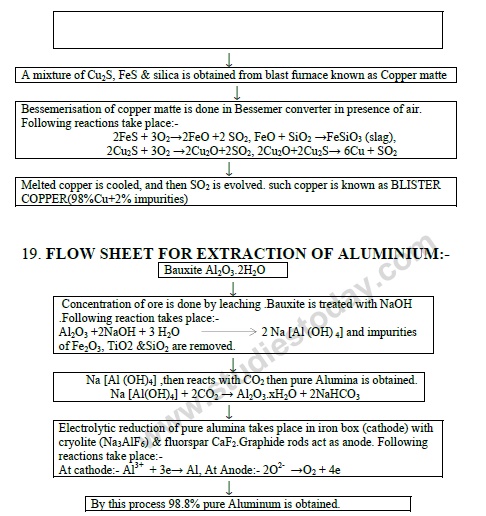
9. Concentration by Leaching is based on the facts that ore is soluble in some suitable reagent & gangue is insoluble in same reagent. e.g. Bauxite ore contains impurities of silica, iron oxide & TiO2 .The powdered ore is treated with NaOH which dissolve Al & impurities remains insoluble in it.

Al2O3 +2NaOH + 3 H2O —→ 2 Na [Al(OH)4].


10. Calcination involves heating of ore in absence of air below melting point of metal. In this process volatile impurities escapes leaving behind metal oxide.

Fe2O3.xH2O  —→Fe2O3 +xH2O

ZnCO3  —→ ZnO +CO2

CaCO3.MgCO—→ CaO + MgO + 2CO2


11. Roasting involves heating of ore in presence of air below melting point of metal in reverberatory furnace. In this process volatile impurities escapes leaving behind metal oxide and metal sulphide converts to metal oxide.

2 ZnS + 3 O2  —→2ZnO+2SO2

2PbS + 3 O2 2  —→ PbO +2 SO2

2 Cu2S + 3 O—→2Cu2O + 2 SO2


12. Reduction of metal oxide involves heating of metal in presence of suitable reagent Coke or CO2.


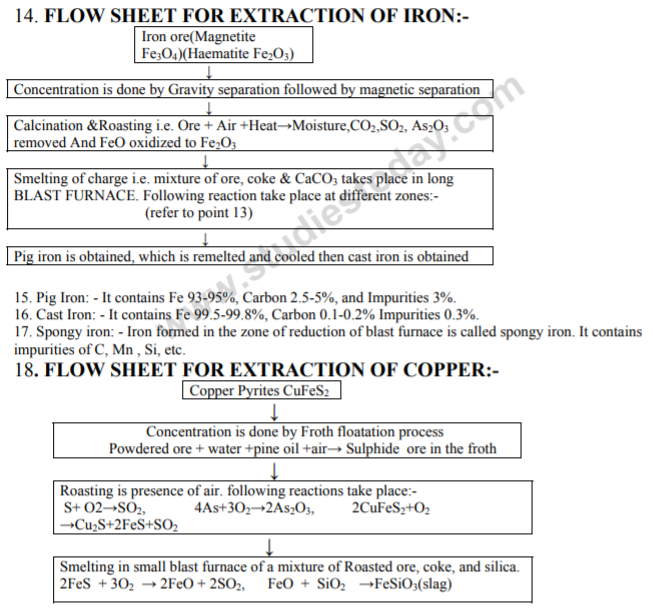
13. Reactions taking place at different zones of blast furnace in extraction of iron:-


(i) Zone of reduction:- Temperature range 250oC-700oC

3Fe2O3+CO  —→ 2Fe3O4+CO2

Fe3O4+CO  —→3FeO+ CO2

FeO +CO  —→ Fe+ CO2


(ii) Zone of slag formation:- Temperature range 800oC-1000oC

CaCO3  —→CaO+CO2

CaO+SiO—→ CaSiO3,           P4O10+10C —→ 4P+10CO,

SiO2+2C  —→ Si+2CO,            MnO2+2C —→ Mn+2CO


(iii) Zone of fusion: - Temperature range 1150oC-1350oC

CO2 + C —→2CO


(iv) Zone of fusion: - Temperature range 1450oC-1950oC
class_12_chemistry_concept_53

CBSE Class 12 Chemistry notes and questions for Processes of Isolation of Elements Part B 1


20. Vapour phase refining is used for extraction of Nickel (MOND PROCESS) and Zirconium &Titanium(VAN ARKEL PROCESS).


21. Zone refining is used for extraction of Si, Ge, Ga, etc.
 
22. Chromatography method is based on selective distribution of various constituents of a mixture between two phases, a stationary phase and a moving phase. The stationary phase can be either solid or liquid on solid support.
 
22. Column chromatography is based on adsorption phenomenon. This method is useful for those elements,which are available in small amounts and the impurities are not much different in chemical properties from the element to be purified.


VERY SHORT ANSWER TYPE QUESTION


Q.1- What is slag?
A.1- It is easily fusible material fusible material, which is formed when gangue still present in roasted ore combines with the flux.
e.g. CaO (flux) + SiO2 (gangue) →CaSiO3 (slag)
 
Q.2- Which is better reducing agent at 983K, carbon or CO?
A.2- CO, (above 983K CO being more stable & does not act as a good reducing agent but carbon does.)
 
Q.3- At which temperature carbon can be used as a reducing agent for Foe ?
A.3- Above 1123K, carbon can reduce FeO to Fe.
 
Q.4- What is the role of graphite rods in electrometallurgy of aluminium ?
A.4- Graphite rods act as anode, are attacked by oxygen to form CO2 and so to be replace time to time.
 
Q.5- What is the role of cryolite in electrometallurgy of aluminium?
A.5- alumina cannot be fused easily because of high melting point. Dissolving of alumina in cryolite furnishes Al3+ ions, which can be electrolyzed easily.
 
Q.6- What are depressants?
A.6- It is possible to separate two sulphide ore by adjusting proportion of oil to water in froth flotation process by using a substance known as depressant. e.g. NaCN is used to separate ZnS and PbS.


Q.7- Copper can be extracted by hydrometallurgy but not Zn. Why?
A.7- The E0 of Zn is lower than that of Cu thus Zn can displace Cu2+ ion from its solution. On other hand side to displace Zn from Zn2+ ion, we need a more reactive metal than it.


Q.8- Give name and formula of important ore of iron .
A.8- Haematite – Fe2O3, Magnetite –Fe3O4, Iron pyrites FeS2.
 
Q.9- Give name and formula of important ore of Copper .
A.9- Copper pyrites CuFeS2, Malachite CuCO3 . Cu (OH) 2, Cuprite Cu2O.
 
Q.10- Give name and formula of important ore of Zinc .
A.10- Zinc blende - ZnS, Calamine- ZnCO3, Zincite – ZnO .
 
SHORT ANSWER TYPE QUESTION
 
Q.1 Describe the method of refining of nickel.
A.1- In the Mond Process, Ni is heated in a stream of CO forming a volatile complex, which then decomposes at higher temperature to give Ni.


At 330-350K: - Ni + 4CO → Ni (CO) 4
At 450-470K Ni (CO)4 → Ni + 4 CO
 
Q.2- What is Zone Refining? Explain with example.
A.2- Zone refining is a method of obtaining a metal in very pure state. It is based on the principal that impurities are more soluble in molten state of metal than solidified state. In this method, a rod of impure metal is moved slowly over circular heater. The portion of the metal being heated melts & forms the molten zone. As this portion of the rod moves out of heater, it solidified while the impurities pass into molten zone. The process is repeated to obtain ultrapure metal and end of rod containing impure metal cutoff.


Please click the link below to download pdf file for CBSE Class 12 Chemistry notes and questions for Processes of Isolation of Elements Part B.

z More Study Material for Class 12 Chemistry
Class 12 Chemistry Full Study Material For Boards Revision
~ Class 12 Chemistry (Old Chapters)
CBSE Class 12 Chemistry Ammonia And Phosphine Notes
CBSE Class 12 Chemistry Chemistry In Everyday Life Board Exam Notes
CBSE Class 12 Chemistry Chemistry In Everyday Life Chapter Notes
CBSE Class 12 Chemistry Chemistry In Everyday Life Notes Set A
CBSE Class 12 Chemistry Chemistry In Everyday Life Notes Set B
CBSE Class 12 Chemistry Chemistry In Everyday Life Notes Set C
CBSE Class 12 Chemistry Chemistry In Everyday Life Notes Set D
CBSE Class 12 Chemistry Chemistry In Everyday Life Notes Set E
CBSE Class 12 Chemistry Chemistry In Everyday Life Notes Set F
CBSE Class 12 Chemistry General Principles And Process Of Isolation Of Elements Board Exam Notes
CBSE Class 12 Chemistry General Principles Notes
CBSE Class 12 Chemistry General Principles Process Of Isolation Of Elements Chapter Notes
CBSE Class 12 Chemistry General Principles Process Of Isolation Of Elements Notes
CBSE Class 12 Chemistry P Block Elements Board Exam Notes
CBSE Class 12 Chemistry P Block Elements Notes Set A
CBSE Class 12 Chemistry P Block Elements Notes Set B
CBSE Class 12 Chemistry Polymers Board Exam Notes
CBSE Class 12 Chemistry Polymers Chapter Notes
CBSE Class 12 Chemistry Polymers Notes Set A
CBSE Class 12 Chemistry Polymers Notes Set B
CBSE Class 12 Chemistry Polymers Notes Set C
CBSE Class 12 Chemistry Polymers Notes Set D
CBSE Class 12 Chemistry Polymers Notes Set E
CBSE Class 12 Chemistry Polymers Notes Set F
CBSE Class 12 Chemistry Processes Of Isolation Of Elements Notes Set A
CBSE Class 12 Chemistry Processes Of Isolation Of Elements Notes Set B
CBSE Class 12 Chemistry Processes Of Isolation Of Elements Notes Set C
CBSE Class 12 Chemistry Solid State Chapter Notes
CBSE Class 12 Chemistry Solid State Notes Set A
CBSE Class 12 Chemistry Solid State Notes Set B
CBSE Class 12 Chemistry Solid State Notes Set C
CBSE Class 12 Chemistry Surface Chemistry Board Exam Notes
CBSE Class 12 Chemistry Surface Chemistry Chapter Notes
CBSE Class 12 Chemistry Surface Chemistry Notes Set A
CBSE Class 12 Chemistry Surface Chemistry Notes Set B
CBSE Class 12 Chemistry Surface Chemistry Notes Set C
CBSE Class 12 Chemistry Surface Chemistry Notes Set D
CBSE Class 12 Chemistry Surface Chemistry Notes Set E
CBSE Class 12 Chemistry Surface Chemistry Notes Set F
CBSE Class 12 Chemistry The P Block Elements Chapter Notes
CBSE Class 12 Chemistry The P Block Elements Notes
CBSE Class 12 Chemistry The P Block Elements Notes Set A
CBSE Class 12 Chemistry The P Block Elements Notes Set B
CBSE Class 12 Chemistry The P Block Elements Notes Set C
CBSE Class 12 Chemistry The Solid State Notes Set A
CBSE Class 12 Chemistry The Solid State Notes Set B
CBSE Class 12 Chemistry The Solid State Notes Set C
CBSE Class 12 Chemistry Unit Cell Notes

CBSE Class 12 Chemistry Unit 06 General Principles and Processes of Isolation of Elements Notes

Students can use these Revision Notes for Unit 06 General Principles and Processes of Isolation of Elements to quickly understand all the main concepts. This study material has been prepared as per the latest CBSE syllabus for Class 12. Our teachers always suggest that Class 12 students read these notes regularly as they are focused on the most important topics that usually appear in school tests and final exams.

NCERT Based Unit 06 General Principles and Processes of Isolation of Elements Summary

Our expert team has used the official NCERT book for Class 12 Chemistry to design these notes. These are the notes that definitely you for your current academic year. After reading the chapter summary, you should also refer to our NCERT solutions for Class 12. Always compare your understanding with our teacher prepared answers as they will help you build a very strong base in Chemistry.

Unit 06 General Principles and Processes of Isolation of Elements Complete Revision and Practice

To prepare very well for y our exams, students should also solve the MCQ questions and practice worksheets provided on this page. These extra solved questions will help you to check if you have understood all the concepts of Unit 06 General Principles and Processes of Isolation of Elements. All study material on studiestoday.com is free and updated according to the latest Chemistry exam patterns. Using these revision notes daily will help you feel more confident and get better marks in your exams.

Where can I download the latest PDF for CBSE Class 12 Chemistry Processes Of Isolation Of Elements Notes Set B?

You can download the teacher prepared revision notes for CBSE Class 12 Chemistry Processes Of Isolation Of Elements Notes Set B from StudiesToday.com. These notes are designed as per 2025-26 academic session to help Class 12 students get the best study material for Chemistry.

Are these Chemistry notes for Class 12 based on the 2026 board exam pattern?

Yes, our CBSE Class 12 Chemistry Processes Of Isolation Of Elements Notes Set B include 50% competency-based questions with focus on core logic, keyword definitions, and the practical application of Chemistry principles which is important for getting more marks in 2026 CBSE exams.

Do these Class 12 notes cover all topic-wise concepts for Chemistry?

Yes, our CBSE Class 12 Chemistry Processes Of Isolation Of Elements Notes Set B provide a detailed, topic wise breakdown of the chapter. Fundamental definitions, complex numerical formulas and all topics of CBSE syllabus in Class 12 is covered.

How can I use CBSE Class 12 Chemistry Processes Of Isolation Of Elements Notes Set B for quick last-minute revision?

These notes for Chemistry are organized into bullet points and easy-to-read charts. By using CBSE Class 12 Chemistry Processes Of Isolation Of Elements Notes Set B, Class 12 students fast revise formulas, key definitions before the exams.

Is there any registration required to download Class 12 Chemistry notes?

No, all study resources on StudiesToday, including CBSE Class 12 Chemistry Processes Of Isolation Of Elements Notes Set B, are available for immediate free download. Class 12 Chemistry study material is available in PDF and can be downloaded on mobile.