

Revision Notes for Class 12 Chemistry: Unit 8 Aldehydes, Ketones and Carboxylic Acids
Review targeted revision notes for Class 12 Chemistry with the CBSE Class 12 Chemistry Aldehydes Ketones And Carboxylic Acids Board Exam Notes. Built according to official educational guidelines for the 2026-27 academic year, these downloadable summaries for Unit 8 Aldehydes, Ketones and Carboxylic Acids support daily study and last-minute exam readiness.
Review Unit 8 Aldehydes, Ketones and Carboxylic Acids for Class 12 Chemistry
View or download the dedicated Unit 8 Aldehydes, Ketones and Carboxylic Acids revision resource below. Engaging with these structured concept notes daily ensures continuous academic progress and mastery of the 2026-27 curriculum for Chemistry.
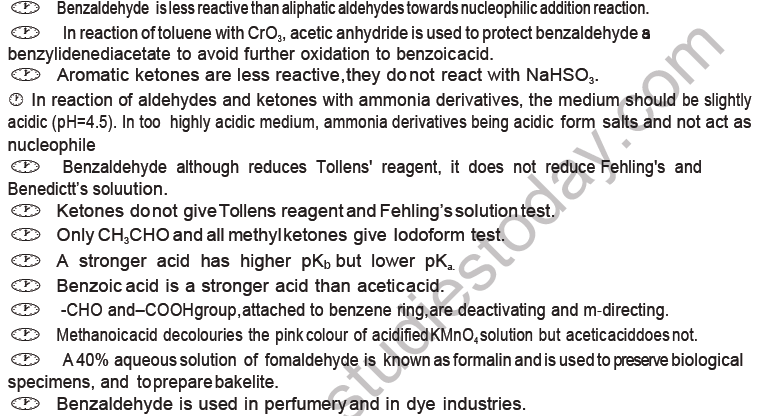


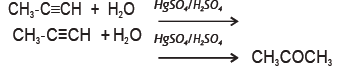
ASSERTION - REASON TYPE QUESTIONS
A statement of assertion is followed by a statement of reason. Mark the correct choice from the options given below.
(a) Both assertion and reason are true and reason is the correct explanation of assertion.
(b) Both assertion and reason are true but reason is not the correct explanation of assertion.
(c) Assertion is true but reason is false.
(d) Both assertion and reason are false.
1. Assertion : Carbonyl compounds take part in nucleophilic addition reactions.
Reason : These reactions are initiated by nucleophilic attack at the electron deficient carbon atom. ( Ans - a)
2. Assertion : All aldehydes do not take part in aldol condensation.
Reason : In the aldol condensation, cabanion is generated by the abstraction of α - H atom by base. (Ans - b)
3. Assertion : Acetone is less reactive towards nucleophilic addition than acetaldehyde.
Reason : The alkyl groups hinder the nucleophilic attack on carbonyl carbon atom. ( Ans - a)
4. Assertion : The α - H atom in carbonyl compounds is less acidic.
Reason : The anion formed after the loss of α - H atom is not resonance stabilized. ( Ans - d)
5. Assertion : Aldehydes and ketones both react with Tollen’s reagent to form silver mirror.
Reason : Both aldehydes and ketones contain a carboxylic group. ( Ans - d)
One - word answer
1. Name the reagent used to distinguish between methanoic acid and ethanoic acid.
( Ans - Tollen’ s reagent)
2. Name the product obtained by reaction of hydroxylamine with carbonyl compound?
( Ans - Oxime)
SHORT ANSWER TYPE QUESTIONS (2‐ MARKS)
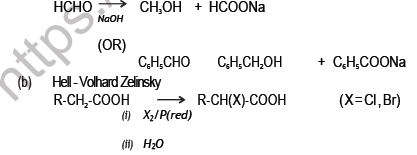
Q1. Write chemical equation to illustrate following name reactions:‐
(a) Cannizzaro's reaction
(b) Hell‐Volhard‐ Zelinsky reaction
Ans. (a) Cannizzaro's reaction
Q2. Givea chemical test to distinguish between thefollowing pairs:‐
(i) Phenol and benzoic acid
(ii) Benzaldehyde and Acetophenone
Ans. (i) Benzoic acid reacts with NaHCO3 giving CO2 gas with effervescence where as phenol does not . C6H5 COOH + NaHCO3 →C6H5COONa + H2O + CO2
(ii) Acetophenone on reacting with hot NaOH / I2 gives yellow ppt of CHI3while Benzophenone does not .CH3COC6H5 NaOH/I2 CHI3 + C6H5COONa
Q3. Account for the following :‐
(i) Chloroacetic acid Cl‐CH2COOH is a stronger acid than acetic acid CH3COOH.
(ii) Carboxylic acids do not give the reaction of carbonyl group.
Ans. (i) The –I effect of Cl atom in ClCH2 COOH stabiles the ClCH COOO ion while +I e ffect of CH ‐ group in CH3 COOH destabilizes the CH3COO0.
(ii) In the resonating structures of carboxylic acid and carbonyls, the carbonyl carbon of carboxylic acid is less electro‐positive (less electrophile) than carbonyl carbon in aldehydes and ketones. Therefore carboxylic acids do not give the reaction of carbonyl group
Q4. Arrange the following.
(i) C6H5COOH, FCH2COOH, NO2CH2COOH( decreasing order of their acidic character)
(ii) Ethanal, Propanal, Propanone, Butanone reaction (increasing order of their nucleophilic addition reaction)
Ans. (i) NO2‐CH2‐COOH> F‐CH2‐COOH >C6H5‐COOH
(ii) Butanone < Propanone < Propanal < Ethanal
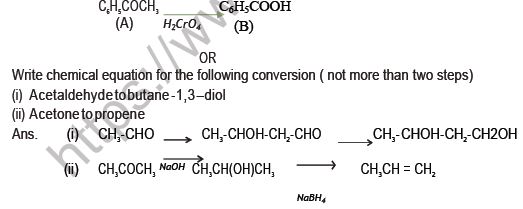
Q5. An organic compound 'A' with molecular formula C8H8O gives positive DNP and iododorm test. It does not reduce Tollens' or Fehling's reagent and does not decolourise bromine water also . On oxidation with chromic acid, it gives a carboxylic acid 'B' with molecular formula C7H6O2. Deduce the structures A and B.
Ans. Since A does not give Fehling's or Tollen‘s test but gives iodoform test and 2,4‐ DNP test so it has CH3 CO‐ group. Hence:
Please click the link below to download pdf file of CBSE Class 12 Chemistry Aldehydes Ketones and Carboxylic Acids Board Exam Notes
Free study material for Chemistry
Study Material and Revision Notes for Class 12 Chemistry Unit 8 Aldehydes, Ketones and Carboxylic Acids
Quick Revision Notes: Unit 8 Aldehydes, Ketones and Carboxylic Acids (CBSE)
Explore reliable chapter overviews for Unit 8 Aldehydes, Ketones and Carboxylic Acids tailored for Class 12 learners. Use these structured points to grasp difficult themes and ensure solid preparation for upcoming assessments.
Expert Study Material for Class 12 Chemistry
Cross-reference your comprehension with comprehensive NCERT solutions for Class 12 to ensure absolute clarity across all sub-topics in this chapter.
Complete Your Chapter Revision
Explore our broader library of printable assignments, chapter notes, and mock tests designed to support continuous revision and secure higher marks in CBSE assessments.
FAQs
You can download the teacher prepared revision notes for CBSE Class 12 Chemistry Aldehydes Ketones And Carboxylic Acids Board Exam Notes from StudiesToday.com. These notes are designed as per 2026-27 academic session to help Class 12 students get the best study material for Chemistry.
Yes, our CBSE Class 12 Chemistry Aldehydes Ketones And Carboxylic Acids Board Exam Notes include 50% competency-based questions with focus on core logic, keyword definitions, and the practical application of Chemistry principles which is important for getting more marks in 2026 CBSE exams.
Yes, our CBSE Class 12 Chemistry Aldehydes Ketones And Carboxylic Acids Board Exam Notes provide a detailed, topic wise breakdown of the chapter. Fundamental definitions, complex numerical formulas and all topics of CBSE syllabus in Class 12 is covered.
These notes for Chemistry are organized into bullet points and easy-to-read charts. By using CBSE Class 12 Chemistry Aldehydes Ketones And Carboxylic Acids Board Exam Notes, Class 12 students fast revise formulas, key definitions before the exams.
No, all study resources on StudiesToday, including CBSE Class 12 Chemistry Aldehydes Ketones And Carboxylic Acids Board Exam Notes, are available for immediate free download. Class 12 Chemistry study material is available in PDF and can be downloaded on mobile.