CBSE Class 12 Chemistry Coordination Compounds Notes Set B

Download the latest CBSE Class 12 Chemistry Coordination Compounds Notes Set B in PDF format. These Class 12 Chemistry revision notes are carefully designed by expert teachers to align with the 2025-26 syllabus. These notes are great daily learning and last minute exam preparation and they simplify complex topics and highlight important definitions for Class 12 students.

Chapter-wise Revision Notes for Class 12 Chemistry Unit 5 Coordination Compounds

To secure a higher rank, students should use these Class 12 Chemistry Unit 5 Coordination Compounds notes for quick learning of important concepts. These exam-oriented summaries focus on difficult topics and high-weightage sections helpful in school tests and final examinations.

Unit 5 Coordination Compounds Revision Notes for Class 12 Chemistry


COORDINATION COMPOUNDS

IMPORTANT POINTS

Definitions with examples

Coordination compounds

The compounds which contain dative bonds between metal atom and surrounding species is called co-ordination compounds.

Examples- K4[Fe(CN)6]; [ Cu(NH3)4]SO4; Ni(CO)4

Coordination complex: A structure containing a metal (usually a metal ion) bonded (coordinated) to a group of surrounding

molecules or ions. They retain their identities even when dissolved in water.

Double Salts-

The addition compounds which are stable in solid state but are broken down into individual constituents ions when dissolved in

water eg: mohr’s salt,potash alum etc.

Central metal atom or ion

the metal ion surrounded by number of ions or molecules.

eg:- K4[Fe(CN)6] , Fe2+ is central metal ion.

Ligands

a molecule,ion or group that coordinates to the central metal atom or ion bound in a definite geometrical arrangement in a complex .

e.g.- H2O, NH3, CO, CN־ etc.

Types:-

a)Monodentate/Unidentate: Ligands bound to the central metal atom/ion through a single donor atom. e.g.- Cl-; H2O ; NH3; NO2-.

b) Bidentate: Ligates through two donor atoms. e.g.- C2O4 2- (ox); H2NCH2CH2NH2(en)

c) Polydentate: which ligates through two or more donor atoms present in a single ligand. e.g.- (EDTA)4-

d) Chelating ligands: Di- or polydentateligands that usestwo or more donor atoms to bind to a single metal ion to form ring- like complexes.  e.g.- (Ox); (edta)

e) Ambidentate ligand: A ligand that can ligate through twodifferent atoms, one at a time. e.g.- NO2- ; SCN-

Coordination number- The number of coordinating units/ligands around the metal ion. The no. of ligand donor atoms to which the metal is directly bonded through sigma bonds only. It is commonly 4 or 6.

Ionisation Isomerism: This form of isomerism arises when the counter ion in a complex salt is itself a potential ligand and can displace a ligand which can then become the counter ion. Example: [Co(NH3)5Br] SO4 and [Co(NH3)5 SO4] Br

Linkage Isomerism:Arises due to the presence of ambidentate ligand In the isomerism, a ligand can form linkage with metal through

different atoms. Example: [Co(NH3)5ONO]Cl2 and [Co(NH3)5NO2]Cl2

Solvate isomerism: This is also known as hydrate isomerism if water is involved as a solvent. Compounds that have the same composition, but differ by whether (or) not solvent molecules are present as ligands in the coordination sphere (or) are merely present as free solvent molecules outside the coordination sphere are known as solvateisomers.

Ex: CrCl3.6H2O

CBSE Class 12 Chemistry-Coordination Compounds 1

Coordination isomerism:
This type of isomerism arises when both the positive and negative ions are complex ions. It may be caused by an interchange of ligands between the anion and the cation.
 
Stereo isomerism:
Compounds with the same chemical formula and chemical bonds, but different arrangement of atoms (or) groups in space are called stereo isomers. Stereo isomerism can be subdivided into geometrical isomerism and optical isomerism. Geometrical isomerism is also known as cis-trans isomerism.The isomer in which the two identical groups are adjacent to each other is known as a cis-isomer while the isomer in which the two identical groups are diagonally opposite to each other is known as a trans isomer.
 
Optical isomerism:
When the solutions of certain coordination compounds are placed in the path of plane polarised light they rotate its plane through a certain angle that may be either to the left (or) to the right.
This property of a complex, of rotating the plane of polarised light is called its optical activity. A complex that possesses this property is said to be optically active.
 
Complexes that rotate the plane of polarised light towards right are said to be dextro rotatory (or) d-form while complexes that rotate it towards the left are called leavo rotatory (or) l-form.
 
The d- and l- forms are mirror images and cannot be superimposed on each other.
Such molecules or ions that cannot be superimposed are called chiral.
Since these forms are related to each other as mirror images they are commonly called enantiomers.
 
NAMING OF CO-ORDINATION COMPOUNDS
 
[Cr(NH3)3(H2O)3]Cl3 is named as: triamminetriaquachromium(III)
chloride
 
[Co(H2NCH2CH2NH2)3]2(SO4)3 : tris(ethane-1,2-diammine)cobalt(III)
sulphate
Hybridisation
 
Magnetic Properties, μ= √n(n+2)
where
μ is Magnetic moment
n is number of unpaired electrons.
 
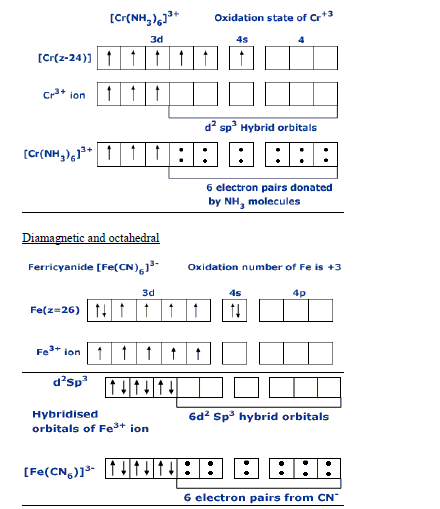
VALENCE BOND THEORY
 
Paramagnetic and octahedral
CBSE Class 12 Chemistry-Coordination Compounds 2
 

Please click the link below to download CBSE Class 12 Chemistry-Coordination Compounds.

z More Study Material for Class 12 Chemistry
Class 12 Chemistry Full Study Material For Boards Revision
~ Class 12 Chemistry (Old Chapters)
CBSE Class 12 Chemistry Ammonia And Phosphine Notes
CBSE Class 12 Chemistry Chemistry In Everyday Life Board Exam Notes
CBSE Class 12 Chemistry Chemistry In Everyday Life Chapter Notes
CBSE Class 12 Chemistry Chemistry In Everyday Life Notes Set A
CBSE Class 12 Chemistry Chemistry In Everyday Life Notes Set B
CBSE Class 12 Chemistry Chemistry In Everyday Life Notes Set C
CBSE Class 12 Chemistry Chemistry In Everyday Life Notes Set D
CBSE Class 12 Chemistry Chemistry In Everyday Life Notes Set E
CBSE Class 12 Chemistry Chemistry In Everyday Life Notes Set F
CBSE Class 12 Chemistry General Principles Notes
CBSE Class 12 Chemistry General Principles And Process Of Isolation Of Elements Board Exam Notes
CBSE Class 12 Chemistry General Principles Process Of Isolation Of Elements Chapter Notes
CBSE Class 12 Chemistry General Principles Process Of Isolation Of Elements Notes
CBSE Class 12 Chemistry P Block Elements Board Exam Notes
CBSE Class 12 Chemistry P Block Elements Notes Set A
CBSE Class 12 Chemistry P Block Elements Notes Set B
CBSE Class 12 Chemistry Polymers Board Exam Notes
CBSE Class 12 Chemistry Polymers Chapter Notes
CBSE Class 12 Chemistry Polymers Notes Set A
CBSE Class 12 Chemistry Polymers Notes Set B
CBSE Class 12 Chemistry Polymers Notes Set C
CBSE Class 12 Chemistry Polymers Notes Set D
CBSE Class 12 Chemistry Polymers Notes Set E
CBSE Class 12 Chemistry Polymers Notes Set F
CBSE Class 12 Chemistry Processes Of Isolation Of Elements Notes Set A
CBSE Class 12 Chemistry Processes Of Isolation Of Elements Notes Set B
CBSE Class 12 Chemistry Processes Of Isolation Of Elements Notes Set C
CBSE Class 12 Chemistry Solid State Chapter Notes
CBSE Class 12 Chemistry Solid State Notes Set A
CBSE Class 12 Chemistry Solid State Notes Set B
CBSE Class 12 Chemistry Solid State Notes Set C
CBSE Class 12 Chemistry Surface Chemistry Board Exam Notes
CBSE Class 12 Chemistry Surface Chemistry Chapter Notes
CBSE Class 12 Chemistry Surface Chemistry Notes Set A
CBSE Class 12 Chemistry Surface Chemistry Notes Set B
CBSE Class 12 Chemistry Surface Chemistry Notes Set C
CBSE Class 12 Chemistry Surface Chemistry Notes Set D
CBSE Class 12 Chemistry Surface Chemistry Notes Set E
CBSE Class 12 Chemistry Surface Chemistry Notes Set F
CBSE Class 12 Chemistry The P Block Elements Chapter Notes
CBSE Class 12 Chemistry The P Block Elements Notes
CBSE Class 12 Chemistry The P Block Elements Notes Set A
CBSE Class 12 Chemistry The P Block Elements Notes Set B
CBSE Class 12 Chemistry The P Block Elements Notes Set C
CBSE Class 12 Chemistry The Solid State Notes Set A
CBSE Class 12 Chemistry The Solid State Notes Set B
CBSE Class 12 Chemistry The Solid State Notes Set C
CBSE Class 12 Chemistry Unit Cell Notes

CBSE Class 12 Chemistry Unit 5 Coordination Compounds Notes

Students can use these Revision Notes for Unit 5 Coordination Compounds to quickly understand all the main concepts. This study material has been prepared as per the latest CBSE syllabus for Class 12. Our teachers always suggest that Class 12 students read these notes regularly as they are focused on the most important topics that usually appear in school tests and final exams.

NCERT Based Unit 5 Coordination Compounds Summary

Our expert team has used the official NCERT book for Class 12 Chemistry to design these notes. These are the notes that definitely you for your current academic year. After reading the chapter summary, you should also refer to our NCERT solutions for Class 12. Always compare your understanding with our teacher prepared answers as they will help you build a very strong base in Chemistry.

Unit 5 Coordination Compounds Complete Revision and Practice

To prepare very well for y our exams, students should also solve the MCQ questions and practice worksheets provided on this page. These extra solved questions will help you to check if you have understood all the concepts of Unit 5 Coordination Compounds. All study material on studiestoday.com is free and updated according to the latest Chemistry exam patterns. Using these revision notes daily will help you feel more confident and get better marks in your exams.

Where can I download latest CBSE Class 12 Chemistry Unit 5 Coordination Compounds notes

You can download notes for Class 12 Chemistry Unit 5 Coordination Compounds for latest academic session from StudiesToday.com

Are the revision notes available for Unit 5 Coordination Compounds Class 12 Chemistry for the latest CBSE academic session

Yes, the notes issued for Class 12 Chemistry Unit 5 Coordination Compounds have been made available here for latest CBSE session

Is there any charge for the Class 12 Chemistry Unit 5 Coordination Compounds notes

There is no charge for the notes for CBSE Class 12 Chemistry Unit 5 Coordination Compounds, you can download everything free of charge

Which is the best online platform to find notes for Unit 5 Coordination Compounds Class 12 Chemistry

www.studiestoday.com is the best website from which you can download latest notes for Unit 5 Coordination Compounds Chemistry Class 12

Where can I find topic-wise notes for Class 12 Chemistry Unit 5 Coordination Compounds

Come to StudiesToday.com to get best quality topic wise notes for Class 12 Chemistry Unit 5 Coordination Compounds