
CBSE Class 12 Chemistry Chemistry In Everyday Life Notes Set F

Download the latest CBSE Class 12 Chemistry Chemistry In Everyday Life Notes Set F in PDF format. These Class 12 Chemistry revision notes are carefully designed by expert teachers to align with the 2025-26 syllabus. These notes are great daily learning and last minute exam preparation and they simplify complex topics and highlight important definitions for Class 12 students.

Chapter-wise Revision Notes for Class 12 Chemistry Unit 16 Chemistry in Everyday Life

To secure a higher rank, students should use these Class 12 Chemistry Unit 16 Chemistry in Everyday Life notes for quick learning of important concepts. These exam-oriented summaries focus on difficult topics and high-weightage sections helpful in school tests and final examinations.

Unit 16 Chemistry in Everyday Life Revision Notes for Class 12 Chemistry


VSA QUESTIONS (1 - MARK QUESTIONS)

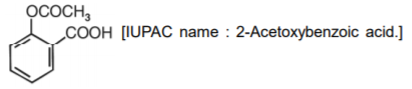
1. Write the formula and IUPAC name of aspirin. [Hint : [IUPAC name : 2-Acetoxybenzoic acid.]
class_12_chemistry_concept_44

2. Name two types of the drugs classified on the basis of pharmacological effect.

3. What is the role of Bithional in toilet soaps?

4. Why is sodium benzoate added to packed containers of jams and pickles?

5. Name the type of drugs having following structural formula : [Hint : Sulpha Drugs].

class_12_chemistry_concept_45


6. Why the receptors embedded in cell membrances show selectivity for one chemical messenger over the other? 

[Hint : The active site of receptor has specific shape and specific functional groups which can bind only specific messenger which fits in.] 

7. With reference to which classification has the statement ‘ranitidine is an antacid’ been given?                  [Hint : Classification based on pharmacological effect.] 

8. Give the name of medicine used for the treatment of syphilis. [Hint : Salvarsan]. 

9. Give the composition of tincture of iodine. 

10. How does aspirin act as analgesic? [Hint : Aspirin inhibits the synthesis of prostaglandins which cause pain.] 

11. Name the antiseptic agents present in dettol. [Hint : Chloroxylenol and Terpineol]. 

12. What precaution should be taken before administrating penicillin to a patient? [Hint : To confirm, beforehand that the patient is not allergic to penicilin.] 

13. Explain why aspirin finds use in prevention of heart attacks? [Hint : Due to anti blood clotting activity.] 

14. Mention one use of drug meprobamate. [Hint : Antidepressant drug.]

15. Name the derivative of sucrose which tastes like sugar and can be safely used by weight conscious people. 

16. Why synthetic detergents are preferred over soaps for use in washing machines? [Hint : They work well even with hard water and not form any scum.] 

17. How is acidity cured with cimetidine? 

[Hint. : Cimetidine prevents the interaction of histamines with the receptors present in stomach wall.] 

*18. While antacids and antiallergic drugs interfere with the function of histamines, why do these not interfere with the function of each other? 

[Hint. : Antacids and antiallergic drugs bind to the different receptor sites. Therefore, they do not interfere with the function of each other). 

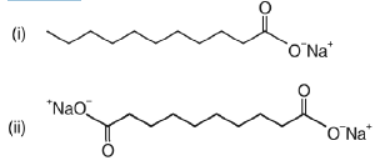
19. Which of the following two compounds can be used as a surface agent and why? 

[Hint : Compound (i) acts as a surface agent because its one end is hydrophobic while the other end is hydrophillic in nature.]
 

class_12_chemistry_concept_46

20. What type of drug is chloramphenicol?

21. Name a chemical used as an antiseptic as well as disinfectant.

22. Give two examples of antidepressants. 

SA (I) TYPE QUESTIONS (2 - MARK QUESTIONS)


1. What are antihistamines. Give two examples. 
 
2. What are narcotic and non-narcotic analgesics? Give one example of each.
 
3. Explain the following terms as used in medicinal chemistry : 
(i) Target molecules (ii) Enzyme inhibitors. 
 
4. Give one important use of each of following : 
(i) Equanil (ii) Morphine 
 
5. What are neurologically active drugs. Give two examples. 
 
6. (i) What are antibiotics? 
(ii) What is meant by the term broad spectrum antibiotic? 
 
7. From the given examples ciprofloxacin, phenelzine, morphine, ranitidine. 
Choose the drug used for 
(i) treating allergic conditions (ii) to get relief from pain 
 
8. Why a drug should not be taken without consulting a doctor? Give two  reasons. 
 
9. State the main difference between bacteriostatic and bacteriocidal antibiotics. Give one example of each. 
 
10. What are antifertility drugs? Name the constituents of an oral contraceptive. 
 
11. What do you mean by non-biodegradable detergents? How can we make biodegradable detergents? 
 
12. If water contains dissolved calcium hydrogencarbonate, which out of soap and detergent, will you prefer to use? Why? 
[Hint : We will use detergent because it will not form insoluble precipitate with Ca2+
 
13. What are barbiturates? What is the action of barbiturates on human body? 
[Hint : Barbaturic acid derivatives are called barbiturates. They are highly effective pain relieving agents.] 
 
14. Write the structures of soaps obtained by the hydrolysis of following fats: 
(i) (C15H31 COO)3 C3H5 Glyceryl palmitate 
(ii) (C17H33 COO)3 C3H5 Glyceryl oleate.
[Hint : (i) C15H31COONa+ (ii) C17H33COONa+]
 
SA (II) TYPE QUESTIONS (3 - MARK QUESTIONS)
 
1. (i) Why are artificial sweeting agents harmless when taken?
(ii) Name one such artificial sweeting agent.
(iii) Why is the use of aspartame as an artificial sweetener limited to cold foods?
 
2. Pick out the odd one amongst the following on the basis of their medicinal properties. Give suitable reason.
(i) Luminal, seconal, terfenadine, equanil.
(ii) Chloroxylenol, phenol, chloamphenicol, bithional.
(iii) Sucralose, aspartame, alitame, sodium benzoate.
[Hint :
(i) Terfenadine is antihistamine other three are used as tranquilisers.
(ii) Chloramphenicol is a broad spectrum antibiotic. Other three have antiseptic properties.
(iii) Sodium benzoate is a food preservative. Other three are artificial sweetners.]
 
3. Give the main function of following in the body of human beings.
(i) Enzymes
(ii) Receptor proteins
(iii) Neurotransmitter
 
4. Identify the class of drug :
(i) Phenelzine (Nardin)
(ii) Aspirin
(iii) Cimetidine
 
5. Give the pharmacological function of the following type of drugs:
(i) Analgesics
(ii) Tranquilizers
(iii) Antifertility drugs
6. Give the name of medicine used in the treatments of following diseases:
(i) Typhoid
(ii) Joint pain (in Arthritis)
(iii) Hypertension
 
7. Give the class of drugs to which these substances belong :
(i) Bithional
(ii) Amoxycillin
(iii) Salvarsan
 
8. How are antiseptics different from disinfectants? How does an antibiotic different from these two? Give one example of each of them.
 
9. Explain the following terms with suitable examples :
(i) Cationic detergents
(ii) Anionic detergents
(iii) Nonionic detergents
 
 
Please click the link below to download pdf file for CBSE Class 12 Chemistry notes and questions for Chemistry in Everyday Life Part C.


z More Study Material for Class 12 Chemistry
Class 12 Chemistry Full Study Material For Boards Revision
~ Class 12 Chemistry (Old Chapters)
CBSE Class 12 Chemistry Ammonia And Phosphine Notes
CBSE Class 12 Chemistry Chemistry In Everyday Life Board Exam Notes
CBSE Class 12 Chemistry Chemistry In Everyday Life Chapter Notes
CBSE Class 12 Chemistry Chemistry In Everyday Life Notes Set A
CBSE Class 12 Chemistry Chemistry In Everyday Life Notes Set B
CBSE Class 12 Chemistry Chemistry In Everyday Life Notes Set C
CBSE Class 12 Chemistry Chemistry In Everyday Life Notes Set D
CBSE Class 12 Chemistry Chemistry In Everyday Life Notes Set E
CBSE Class 12 Chemistry Chemistry In Everyday Life Notes Set F
CBSE Class 12 Chemistry General Principles And Process Of Isolation Of Elements Board Exam Notes
CBSE Class 12 Chemistry General Principles Notes
CBSE Class 12 Chemistry General Principles Process Of Isolation Of Elements Chapter Notes
CBSE Class 12 Chemistry General Principles Process Of Isolation Of Elements Notes
CBSE Class 12 Chemistry P Block Elements Board Exam Notes
CBSE Class 12 Chemistry P Block Elements Notes Set A
CBSE Class 12 Chemistry P Block Elements Notes Set B
CBSE Class 12 Chemistry Polymers Board Exam Notes
CBSE Class 12 Chemistry Polymers Chapter Notes
CBSE Class 12 Chemistry Polymers Notes Set A
CBSE Class 12 Chemistry Polymers Notes Set B
CBSE Class 12 Chemistry Polymers Notes Set C
CBSE Class 12 Chemistry Polymers Notes Set D
CBSE Class 12 Chemistry Polymers Notes Set E
CBSE Class 12 Chemistry Polymers Notes Set F
CBSE Class 12 Chemistry Processes Of Isolation Of Elements Notes Set A
CBSE Class 12 Chemistry Processes Of Isolation Of Elements Notes Set B
CBSE Class 12 Chemistry Processes Of Isolation Of Elements Notes Set C
CBSE Class 12 Chemistry Solid State Chapter Notes
CBSE Class 12 Chemistry Solid State Notes Set A
CBSE Class 12 Chemistry Solid State Notes Set B
CBSE Class 12 Chemistry Solid State Notes Set C
CBSE Class 12 Chemistry Surface Chemistry Board Exam Notes
CBSE Class 12 Chemistry Surface Chemistry Chapter Notes
CBSE Class 12 Chemistry Surface Chemistry Notes Set A
CBSE Class 12 Chemistry Surface Chemistry Notes Set B
CBSE Class 12 Chemistry Surface Chemistry Notes Set C
CBSE Class 12 Chemistry Surface Chemistry Notes Set D
CBSE Class 12 Chemistry Surface Chemistry Notes Set E
CBSE Class 12 Chemistry Surface Chemistry Notes Set F
CBSE Class 12 Chemistry The P Block Elements Chapter Notes
CBSE Class 12 Chemistry The P Block Elements Notes
CBSE Class 12 Chemistry The P Block Elements Notes Set A
CBSE Class 12 Chemistry The P Block Elements Notes Set B
CBSE Class 12 Chemistry The P Block Elements Notes Set C
CBSE Class 12 Chemistry The Solid State Notes Set A
CBSE Class 12 Chemistry The Solid State Notes Set B
CBSE Class 12 Chemistry The Solid State Notes Set C
CBSE Class 12 Chemistry Unit Cell Notes

CBSE Class 12 Chemistry Unit 16 Chemistry in Everyday Life Notes

Students can use these Revision Notes for Unit 16 Chemistry in Everyday Life to quickly understand all the main concepts. This study material has been prepared as per the latest CBSE syllabus for Class 12. Our teachers always suggest that Class 12 students read these notes regularly as they are focused on the most important topics that usually appear in school tests and final exams.

NCERT Based Unit 16 Chemistry in Everyday Life Summary

Our expert team has used the official NCERT book for Class 12 Chemistry to design these notes. These are the notes that definitely you for your current academic year. After reading the chapter summary, you should also refer to our NCERT solutions for Class 12. Always compare your understanding with our teacher prepared answers as they will help you build a very strong base in Chemistry.

Unit 16 Chemistry in Everyday Life Complete Revision and Practice

To prepare very well for y our exams, students should also solve the MCQ questions and practice worksheets provided on this page. These extra solved questions will help you to check if you have understood all the concepts of Unit 16 Chemistry in Everyday Life. All study material on studiestoday.com is free and updated according to the latest Chemistry exam patterns. Using these revision notes daily will help you feel more confident and get better marks in your exams.

Where can I download the latest PDF for CBSE Class 12 Chemistry Chemistry In Everyday Life Notes Set F?

You can download the teacher prepared revision notes for CBSE Class 12 Chemistry Chemistry In Everyday Life Notes Set F from StudiesToday.com. These notes are designed as per 2025-26 academic session to help Class 12 students get the best study material for Chemistry.

Are these Chemistry notes for Class 12 based on the 2026 board exam pattern?

Yes, our CBSE Class 12 Chemistry Chemistry In Everyday Life Notes Set F include 50% competency-based questions with focus on core logic, keyword definitions, and the practical application of Chemistry principles which is important for getting more marks in 2026 CBSE exams.

Do these Class 12 notes cover all topic-wise concepts for Chemistry?

Yes, our CBSE Class 12 Chemistry Chemistry In Everyday Life Notes Set F provide a detailed, topic wise breakdown of the chapter. Fundamental definitions, complex numerical formulas and all topics of CBSE syllabus in Class 12 is covered.

How can I use CBSE Class 12 Chemistry Chemistry In Everyday Life Notes Set F for quick last-minute revision?

These notes for Chemistry are organized into bullet points and easy-to-read charts. By using CBSE Class 12 Chemistry Chemistry In Everyday Life Notes Set F, Class 12 students fast revise formulas, key definitions before the exams.

Is there any registration required to download Class 12 Chemistry notes?

No, all study resources on StudiesToday, including CBSE Class 12 Chemistry Chemistry In Everyday Life Notes Set F, are available for immediate free download. Class 12 Chemistry study material is available in PDF and can be downloaded on mobile.