CBSE Class 12 Chemistry General Principles Process Of Isolation Of Elements Chapter Notes

Download the latest CBSE Class 12 Chemistry General Principles Process Of Isolation Of Elements Chapter Notes in PDF format. These Class 12 Chemistry revision notes are carefully designed by expert teachers to align with the 2025-26 syllabus. These notes are great daily learning and last minute exam preparation and they simplify complex topics and highlight important definitions for Class 12 students.

Chapter-wise Revision Notes for Class 12 Chemistry Unit 06 General Principles and Processes of Isolation of Elements

To secure a higher rank, students should use these Class 12 Chemistry Unit 06 General Principles and Processes of Isolation of Elements notes for quick learning of important concepts. These exam-oriented summaries focus on difficult topics and high-weightage sections helpful in school tests and final examinations.

Unit 06 General Principles and Processes of Isolation of Elements Revision Notes for Class 12 Chemistry


                                                           Chemistry Ch 6: General Principles & Processes  Of Isolation of Elements Top concepts:

1. Minerals: The naturally occurring chemical substances in the earth’s crust which are obtained by mining are known as minerals. Metals may or may not be extracted profitably from them.

2. Ores: The rocky materials which contain sufficient quantity of mineral so that the metal can be extracted profitably or economically are known as ores.

3. Gangue: The earthy or undesirable materials present in ore are known as gangue.

4. Metallurgy: The entire scientific and technological process used for isolation of the metal from its ores is known as metallurgy.

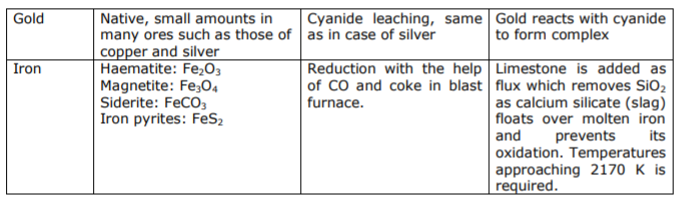
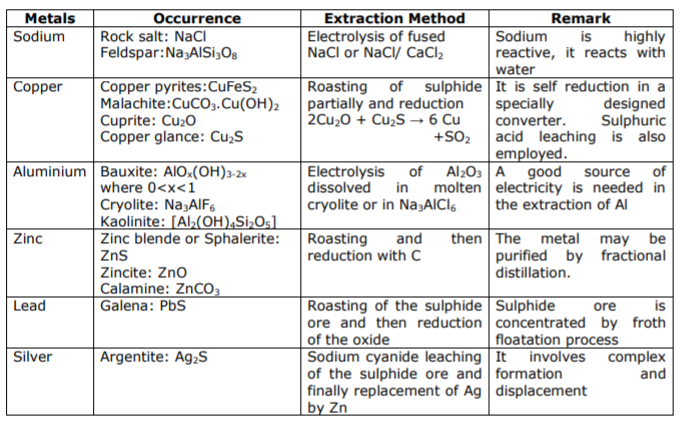
5. Chief Ores and Methods of Extraction of Some Common Metals:                          
class_12-chemistry_concept_101

class_12-chemistry_concept_102

6. Steps of metallurgy:

   a. Concentration of ore

   b. Conversion of concentrated ore to oxide

  c. Reduction of oxide to metal

   d. Refining of metal

7. Concentration of ore: The process of removal unwanted materials like sand, clay, rocks etc from the ore is known as concentration, ore – dressing or benefaction. It involves several steps which depend upon physical properties of metal compound and impurity (gangue). The type of metal, available facilities and environmental factors are also taken into consideration.

8. Hydraulic washing (or gravity separation): It is based on difference in densities of ore and gangue particles. Ore is washed with a stream of water under pressure so that lighter impurities are washed away whereas heavy ores are left behind.

9. Magnetic separation: This method is based on the difference in magnetic and non – magnetic properties of two components of ore (pure and impure). This method is used to remove tungsten ore particles from cassiterite (SnO2). It is also used to concentrate magnetite (Fe3O4), chromite (FeCr2O4) and pyrolusite (MnO2) from unwanted gangue.

10. Froth Floatation Process: The principle of froth floatation process is that sulphide ores are preferentially wetted by the pine oil, whereas the gangue particles are wetted by the water. Collectors are added to enhance the non-wettability of the mineral particles. Examples are pine oil, fatty acids and xanthates are added to it. Froth stabilizers are added to stabilize the froth. Examples are cresols, aniline. If two sulphide ores are present, it is possible to separate the two sulphide ores by adjusting proportion of oil to water or by adding depressants.For example- In the case of an ore containing ZnS and PbS, the depressant used is NaCN. It selectively prevents ZnS from coming to froth but allows PbS to come with the froth.

11. Leaching (Chemical separation): It is a process in which ore is treated with suitable solvent which dissolves the ore but not the impurities.

12. Purification of Bauxite by Leaching: Baeyer’s process:
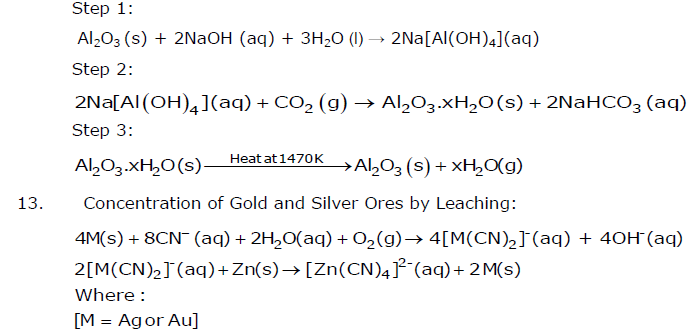
CBSE Class 12 Chemistry - General Principles _ Process of Isolation of Elements Chapter Notes 1

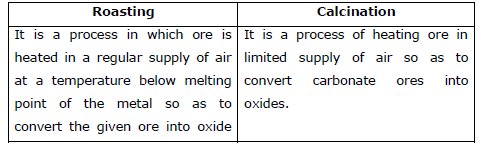
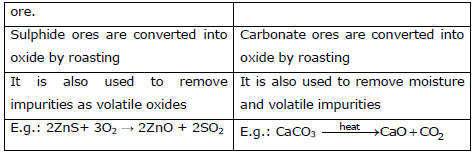
14. Conversion of ore into oxide: It is easier to reduce oxide than sulphide or carbonate ore. Therefore, the given ore should be converted into oxide by suitable method:

CBSE Class 12 Chemistry - General Principles _ Process of Isolation of Elements Chapter Notes 2

CBSE Class 12 Chemistry - General Principles _ Process of Isolation of Elements Chapter Notes 3


15. Reduction of oxide to metal: The process of converting metal oxide into metal is called reduction. It needs a suitable reducing agent depending upon the reactivity or reducing power of metal. The common reducing agents used are carbon or carbon monoxide or any other metals like Al, Mg etc. 
 
16. Thermodynamic principles of metallurgy: Some basic concepts of thermodynamics help in understanding the conditions of temperature and selecting suitable reducing agent in metallurgical processes: 
 
a. Gibbs free energy change at any temperature is given by ΔG =ΔH – TΔS where ΔG is free energy change, ΔH is enthalpy change and ΔS is entropy change.
b. The relationship between ΔGӨ and K is ΔGӨ = –2.303 RT log K where K is equilibrium constant. R = 8.314 JK-¹ mol-1, T is temperature in Kelvin. 
c. A negative ΔG means +ve value of K i.e., products are formed more than the reactants. The reaction will proceed in forward direction. 
d. If ΔS is +ve, on increasing temperature the value of TΔS increases so that TΔS > ΔH and ΔG will become negative. 
 
17. Coupled reactions: If reactants and products of two reactions are put together in a system and the net ΔG of two possible reactions is –ve the overall reaction will take place. These reactions are called coupled reactions.
 
18. Ellingham diagrams: The plots between ΔfGӨ of formation of oxides of elements vs. temperature are called Ellingham diagrams. It provides a sound idea about selecting a reducing agent in reduction of oxides. Such diagrams help in predicting the feasibility of a thermal reduction of an ore. ΔG must be negative at a given temperature for a reaction to be feasible.
 
19. Limitations of Ellingham Diagrams: It does not take kinetics of reduction into consideration, i.e., how fast reduction will take place cannot be determined.


Please click the link below to download pdf file for CBSE Class 12 Chemistry - General Principles _ Process of Isolation of Elements Chapter Notes.
z More Study Material for Class 12 Chemistry
Class 12 Chemistry Full Study Material For Boards Revision
~ Class 12 Chemistry (Old Chapters)
CBSE Class 12 Chemistry Ammonia And Phosphine Notes
CBSE Class 12 Chemistry Chemistry In Everyday Life Board Exam Notes
CBSE Class 12 Chemistry Chemistry In Everyday Life Chapter Notes
CBSE Class 12 Chemistry Chemistry In Everyday Life Notes Set A
CBSE Class 12 Chemistry Chemistry In Everyday Life Notes Set B
CBSE Class 12 Chemistry Chemistry In Everyday Life Notes Set C
CBSE Class 12 Chemistry Chemistry In Everyday Life Notes Set D
CBSE Class 12 Chemistry Chemistry In Everyday Life Notes Set E
CBSE Class 12 Chemistry Chemistry In Everyday Life Notes Set F
CBSE Class 12 Chemistry General Principles Notes
CBSE Class 12 Chemistry General Principles And Process Of Isolation Of Elements Board Exam Notes
CBSE Class 12 Chemistry General Principles Process Of Isolation Of Elements Chapter Notes
CBSE Class 12 Chemistry General Principles Process Of Isolation Of Elements Notes
CBSE Class 12 Chemistry P Block Elements Board Exam Notes
CBSE Class 12 Chemistry P Block Elements Notes Set A
CBSE Class 12 Chemistry P Block Elements Notes Set B
CBSE Class 12 Chemistry Polymers Board Exam Notes
CBSE Class 12 Chemistry Polymers Chapter Notes
CBSE Class 12 Chemistry Polymers Notes Set A
CBSE Class 12 Chemistry Polymers Notes Set B
CBSE Class 12 Chemistry Polymers Notes Set C
CBSE Class 12 Chemistry Polymers Notes Set D
CBSE Class 12 Chemistry Polymers Notes Set E
CBSE Class 12 Chemistry Polymers Notes Set F
CBSE Class 12 Chemistry Processes Of Isolation Of Elements Notes Set A
CBSE Class 12 Chemistry Processes Of Isolation Of Elements Notes Set B
CBSE Class 12 Chemistry Processes Of Isolation Of Elements Notes Set C
CBSE Class 12 Chemistry Solid State Chapter Notes
CBSE Class 12 Chemistry Solid State Notes Set A
CBSE Class 12 Chemistry Solid State Notes Set B
CBSE Class 12 Chemistry Solid State Notes Set C
CBSE Class 12 Chemistry Surface Chemistry Board Exam Notes
CBSE Class 12 Chemistry Surface Chemistry Chapter Notes
CBSE Class 12 Chemistry Surface Chemistry Notes Set A
CBSE Class 12 Chemistry Surface Chemistry Notes Set B
CBSE Class 12 Chemistry Surface Chemistry Notes Set C
CBSE Class 12 Chemistry Surface Chemistry Notes Set D
CBSE Class 12 Chemistry Surface Chemistry Notes Set E
CBSE Class 12 Chemistry Surface Chemistry Notes Set F
CBSE Class 12 Chemistry The P Block Elements Chapter Notes
CBSE Class 12 Chemistry The P Block Elements Notes
CBSE Class 12 Chemistry The P Block Elements Notes Set A
CBSE Class 12 Chemistry The P Block Elements Notes Set B
CBSE Class 12 Chemistry The P Block Elements Notes Set C
CBSE Class 12 Chemistry The Solid State Notes Set A
CBSE Class 12 Chemistry The Solid State Notes Set B
CBSE Class 12 Chemistry The Solid State Notes Set C
CBSE Class 12 Chemistry Unit Cell Notes

CBSE Class 12 Chemistry Unit 06 General Principles and Processes of Isolation of Elements Notes

Students can use these Revision Notes for Unit 06 General Principles and Processes of Isolation of Elements to quickly understand all the main concepts. This study material has been prepared as per the latest CBSE syllabus for Class 12. Our teachers always suggest that Class 12 students read these notes regularly as they are focused on the most important topics that usually appear in school tests and final exams.

NCERT Based Unit 06 General Principles and Processes of Isolation of Elements Summary

Our expert team has used the official NCERT book for Class 12 Chemistry to design these notes. These are the notes that definitely you for your current academic year. After reading the chapter summary, you should also refer to our NCERT solutions for Class 12. Always compare your understanding with our teacher prepared answers as they will help you build a very strong base in Chemistry.

Unit 06 General Principles and Processes of Isolation of Elements Complete Revision and Practice

To prepare very well for y our exams, students should also solve the MCQ questions and practice worksheets provided on this page. These extra solved questions will help you to check if you have understood all the concepts of Unit 06 General Principles and Processes of Isolation of Elements. All study material on studiestoday.com is free and updated according to the latest Chemistry exam patterns. Using these revision notes daily will help you feel more confident and get better marks in your exams.

Where can I download latest CBSE Class 12 Chemistry Unit 06 General Principles and Processes of Isolation of Elements notes

You can download notes for Class 12 Chemistry Unit 06 General Principles and Processes of Isolation of Elements for latest academic session from StudiesToday.com

Are the revision notes available for Unit 06 General Principles and Processes of Isolation of Elements Class 12 Chemistry for the latest CBSE academic session

Yes, the notes issued for Class 12 Chemistry Unit 06 General Principles and Processes of Isolation of Elements have been made available here for latest CBSE session

Is there any charge for the Class 12 Chemistry Unit 06 General Principles and Processes of Isolation of Elements notes

There is no charge for the notes for CBSE Class 12 Chemistry Unit 06 General Principles and Processes of Isolation of Elements, you can download everything free of charge

Which is the best online platform to find notes for Unit 06 General Principles and Processes of Isolation of Elements Class 12 Chemistry

www.studiestoday.com is the best website from which you can download latest notes for Unit 06 General Principles and Processes of Isolation of Elements Chemistry Class 12

Where can I find topic-wise notes for Class 12 Chemistry Unit 06 General Principles and Processes of Isolation of Elements

Come to StudiesToday.com to get best quality topic wise notes for Class 12 Chemistry Unit 06 General Principles and Processes of Isolation of Elements