

Official Class 12 Chemistry Revision Material: CBSE Class 12 Chemistry The P Block Elements Chapter Notes
Explore reliable concept summaries and revision materials through the CBSE Class 12 Chemistry The P Block Elements Chapter Notes. Tailored for Class 12 learners, utilizing these notes for Chemistry Unit 07 The p-Block Elements ensures thorough preparation and strengthens core academic definitions before final evaluations.
Chapter-wise Concept Summaries: Unit 07 The p-Block Elements
Navigate directly to the revision notes for Unit 07 The p-Block Elements using the digital viewer below. Each summary is structured to highlight high-weightage sections, allowing students to instantly access critical definitions and focus on core exam topics.
The p-Block Elements
Top concepts:
1. p-Block elements: Elements belonging to groups 13 to 18 of the periodic table are called p-block elements.
2. General electronic configuration of p-block elements: The p-block elements are characterized by the ns2np1-6 valence shell electronic configuration.
3. Representative elements: Elements belonging to the s and p-blocks in the periodic table are called the representative elements or main group elements.
4. Inert pair effect: The tendency of ns2 electron pair to participate in bond formation decreases with the increase in atomic size. Within a group the higher oxidation state becomes less stable with respect to the lower oxidation state as the atomic number increases. This trend is called ‘inert pair effect’. In other words, the energy required to unpair the electrons is more than energy released in the formation of two additional bonds.
5. Nitrogen family: The elements of group 15 – nitrogen (N), phosphorus (P), arsenic (As), antimony (Sb) and bismuth (Bi) belong to configuration is ns2np3.
6. Oxygen family: Group 16 of periodic table consists of five elements – oxygen (O), sulphur (S), selenium (Se), tellurium (Te) and polonium (Po). Their general electronic configuration is ns2np4.
7. The halogen family: Group 17 elements, fluorine (F), chlorine (Cl), bromine (Br), iodine (I) and astatine (At), belong to halogen family. Their general electronic configuration is ns2np5.
8. Group 18 elements: Helium (He), neon (Ne), argon (Ar), krypton (Kr), xenon (Xe), and radon (Rn) are Group 18 elements. They are also called noble gases. Their general electronic configuration is ns2np6 except helium which has electronic configuration 1s2. They are called noble gases because they show very low chemical reactivity.
GROUP 15 ELEMENTS
9. Atomic and ionic radii: Covalent and ionic radii increase down the group. There is appreciable increase in covalent radii from N to P.
There is small increase from As to Bi due to presence of completely filled d or f orbitals in heavy elements.
10. Ionisation energy: It goes on decreasing down the group due to increase in atomic size. Group 15 elements have higher ionisation energy than group 14 elements due to smaller size of group 15 elements. Group 15 elements have higher ionization energy than group 16 elements because they have stable electronic configuration i.e., half filled p-orbitals.
11. Allotropy: All elements of Group 15 except nitrogen show allotropy.
12. Catenation: Nitrogen shows catenation to some extent due to triple bond but phosphorus shows catenation to maximum extent. The tendency to show catenation decreases down the group.
13. Oxidation states: The common oxidation states are +3, +5, –3. The tendency to show –3 oxidation state decreases down the group due to decrease in electronegativity which is due to increase in atomic size.
The stability of +5 oxidation state decreases whereas stability of +3 oxidation state increases due to inert pair effect. Nitrogen shows oxidation states from –3 to +5. Nitrogen and phosphorus with oxidation states from +1 to +4 undergo oxidation as well as reduction in acidic medium. This process is called disproportionation. 3 HNO2 → HNO3 + H2O + 2 NO
14. Reactivity towards hydrogen: All group 15 elements from trihydrides, MH3. Hybridisation - sp3
The stability of hydrides decrease down the group due to decrease in bond dissociation energy down the group. NH3 > PH3 > AsH3 > SbH3 > BiH3
Boiling point: PH3 < AsH3 < NH3 < SbH3 < BiH3 Boiling point increases with increase in size due to increase in van der Waals forces. Boiling point of NH3 is more because of hydrogen bonding. Bond angle: NH3 (107.8°) > PH3 (99.5°) > AsH3 (91.8°) ≈ SbH3 (91.3°) > BiH3 (90°) Electronegativity of N is highest. Therefore, the lone pairs will be towards nitrogen and hence more repulsion between bond pairs. Therefore bond angle is the highest. After nitrogen, the electronegativity decreases down the group.
Basicity decreases as NH3 > PH3 > AsH3 > SbH3 < BiH3.
This is because the lone pair of electrons are concentrated more on nitrogen and hence the basicity will be maximum in the case of NH3. It will decrease down the group as the electronegativity decreases down the group.
The reducing power of hydrides increases down the group due to decrease in bond dissociation energy down the group.
15. Reactivity towards oxygen: All group 15 elements from trioxides (M2O3) and pentoxides (M2O5).
Acidic character of oxides decreases and basicity increases down the group. This is because the size of nitrogen is very small. It has a strong positive field in a very small area. Therefore, it attracts the electrons of water’s O-H bond to itself and release H+ ions easily. As we move down the group, the atomic size increases and hence the acidic character of oxides decreases and basicity increases down the group.
16. Reactivity towards halogen: Group 15 elements form trihalides and pentahalides.
Trihalides – covalent compounds and become ionic down the group.
sp3 hybridisation , pyramidal shape Pentahalides - sp3d hybridisation, TBP shape They are lewis acids because of the presence of vacant d – orbitals.
PCl5 + Cl-→ [PCl6]-
PCl5 is ionic in solid state and exist as [PCl4]+ [PCl6]-
In PCl5, there are three equatorial bonds and two axial bonds. The axial bonds are longer than equatorial bonds because of greater repulsion from equatorial bonds.
Nitrogen does not form pentahalides due to absence of d- orbitals.
17. Reactivity towards metals: All elements react with metals to form binary compounds in –3 oxidation state.
18. Anomalous behaviour of nitrogen: The behaviour of nitrogen differs from rest of the elements.
Reason:
i. It has a small size.
ii. It does not have d – orbitals
iii. It has high electronegativity
iv. It has high ionization enthalpy
19. Dinitrogen:
Preparation:
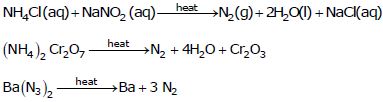
Properties:
It is a colouless, odourless, tasteless and non – toxic gas. It is chemically un-reactive at ordinary temperature due to triple bond in N ≡ N which has high bond dissociation energy.
20. Ammonia: Ammonia molecule is trigonal pyramidal with nitrogen atom at the apex. It has 3 bond pairs and 1 lone pair. N is sp3 hybridised.
Preparation:
Haber’s process:

Pr essure 200x10 Pa
Temperature 773 K
Catalyst is FeO with small amounts of K O and Al O
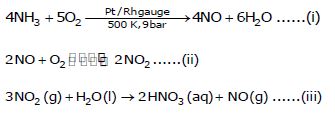
21. Nitric Acid:
a. Ostwald Process:
Please click the link below to download pdf file for CBSE Class 12 Chemistry - The p Block Elements Chapter Notes.
Free study material for Chemistry
Unit 07 The p-Block Elements Concepts and Summary for Class 12 Chemistry
Download Chapter Summary: Class 12 Chemistry Unit 07 The p-Block Elements
Access structured revision notes for Unit 07 The p-Block Elements designed in alignment with the latest CBSE curriculum for Class 12 Chemistry. These summaries help clarify core themes and support effective daily study.
Concept Clarification for Unit 07 The p-Block Elements
Each chapter summary is structured around standard CBSE textbooks, allowing students to check their understanding and clarify complex ideas early in their revision.
Additional Study Resources for Class 12 Chemistry
Wrap up your chapter revision by testing your knowledge against standard question formats. Everything on our platform is provided free of charge.
FAQs
You can download the teacher prepared revision notes for CBSE Class 12 Chemistry The P Block Elements Chapter Notes from StudiesToday.com. These notes are designed as per 2026-27 academic session to help Class 12 students get the best study material for Chemistry.
Yes, our CBSE Class 12 Chemistry The P Block Elements Chapter Notes include 50% competency-based questions with focus on core logic, keyword definitions, and the practical application of Chemistry principles which is important for getting more marks in 2026 CBSE exams.
Yes, our CBSE Class 12 Chemistry The P Block Elements Chapter Notes provide a detailed, topic wise breakdown of the chapter. Fundamental definitions, complex numerical formulas and all topics of CBSE syllabus in Class 12 is covered.
These notes for Chemistry are organized into bullet points and easy-to-read charts. By using CBSE Class 12 Chemistry The P Block Elements Chapter Notes, Class 12 students fast revise formulas, key definitions before the exams.
No, all study resources on StudiesToday, including CBSE Class 12 Chemistry The P Block Elements Chapter Notes, are available for immediate free download. Class 12 Chemistry study material is available in PDF and can be downloaded on mobile.