CBSE Class 12 Chemistry Chemistry In Everyday Life Chapter Notes

Download the latest CBSE Class 12 Chemistry Chemistry In Everyday Life Chapter Notes in PDF format. These Class 12 Chemistry revision notes are carefully designed by expert teachers to align with the 2025-26 syllabus. These notes are great daily learning and last minute exam preparation and they simplify complex topics and highlight important definitions for Class 12 students.

Chapter-wise Revision Notes for Class 12 Chemistry Unit 16 Chemistry in Everyday Life

To secure a higher rank, students should use these Class 12 Chemistry Unit 16 Chemistry in Everyday Life notes for quick learning of important concepts. These exam-oriented summaries focus on difficult topics and high-weightage sections helpful in school tests and final examinations.

Unit 16 Chemistry in Everyday Life Revision Notes for Class 12 Chemistry


Chapter : Chemistry in Everyday Life

Top concepts

1. Drugs are low molecular mass ( 100-500 u) substances which interact with targets in the body and produce a biological response 

2. Medicines are chemicals that are useful in diagnosis, prevention and treatment of diseases

3. Desirable or beneficial effect of a drug like treatment of symptoms and cure of a disease on a living body is known as therapeutic effect

4. Proteins which perform the role of biological catalysts in the body are called enzymes

5. Functions of enzymes:
 

 class_12-chemistry_concept_91

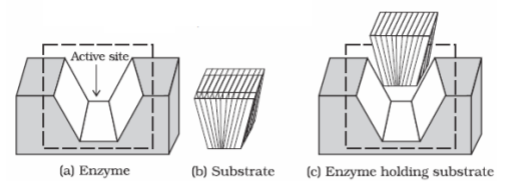
 (i) The first function of an enzyme is to hold the substrate for a chemical reaction. Active sites of enzymes hold the substrate molecule in a suitable position, so that it can be attacked by the reagent effectively

(ii) The second function of an enzyme is to provide functional groups that will attack the substrate and carry out chemical reaction

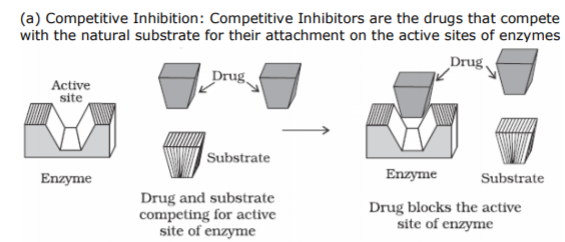
6. Main role of drugs is to either increase or decrease role of enzyme catalysed reactions. Inhibition of enzymes is a common role of drug action. Enzyme inhibitor is drug which inhibits catalytic activity of enzymes or blocks the binding site of the enzyme and eventually prevents the binding of substrate with enzyme. Drug can inhibit attachment of substrate on active site of enzymes in following ways. 

(a)   Competitive Inhibition: Competitive Inhibitors are the drugs that compete with the natural substrate for their attachment on the active sites of enzymes
class_12-chemistry_concept_92

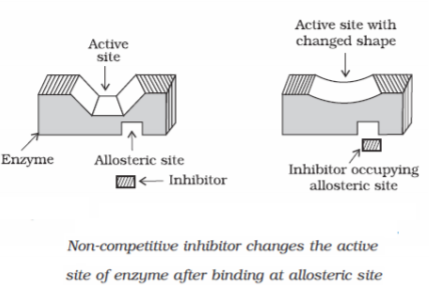
(b) Non-Competitive Inhibition: Some drugs do not bind to the enzyme’s active site, instead bind to a different site of enzyme called allosteric site. This binding of inhibitor at allosteric site changes the shape of the active site in such a way that substrate cannot recognise it. If the bond formed between an enzyme and an inhibitor is a strong covalent bond and cannot be broken easily, then the enzyme is blocked permanently. The body then degrades the enzyme-inhibitor complex and synthesizes the new enzyme
class_12-chemistry_concept_93


7. Receptors as Drug Targets: 
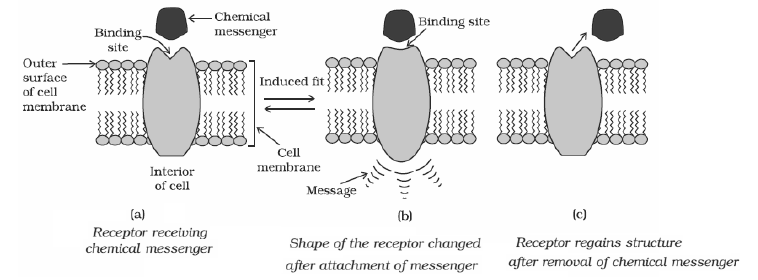
Proteins which are vital for communication system in the body are called receptors. In the body, message between two neurons and that between neurons to muscles is communicated through chemical messengers. They are received at the binding sites of receptor proteins. To accommodate a messenger, shape of the receptor site changes which brings about the transfer of message into the cell. Chemical messenger gives message to the cell without entering the cell


CBSE Class 12 Chemistry - Chemistry in Everyday Life Chapter Notes 1
Receptors show selectivity for one chemical messenger over the other because their binding sites have different shape, structure and amino acid composition. 
Drugs that bind to the receptor site and inhibit its natural function are called antagonists. These are useful when blocking of message is required. Drugs that mimic the natural messenger by switching on the receptor are called agonists. These are useful when there is lack of natural chemical messenger. 
 
8. Therapeutic action of different classes of drugs 
 
(i) Antacid: Chemical substances which neutralize excess acid in the gastric juices and give relief from acid indigestion, acidity, heart burns and gastric ulcers 
Examples: Eno, gelusil, digene etc. 
 
(ii) Antihistamines: Chemical substances which diminish or abolish the effects of histamine released in body and hence prevent allergic reactions 
Examples: Brompheniramine (Dimetapp) and terfenadine (Seldane)
 
(iii) Neurologically Active Drugs: Drugs which have a neurological effect i.e. affects the message transfer mechanism from nerve to receptor 
 
(a) Tranquilizers: Chemical substances used for the treatment of stress and mild or severe mental diseases
Examples: Derivatives of barbituric acids like veronal, amytal, nembutal, luminal, seconal 
 
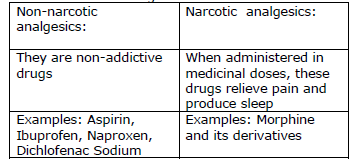
(b) Analgesics: Chemical substances used to relieve pain without causing any disturbances in the nervous system like impairment of consciousness, mental confusion, incoordination or paralysis etc. 
Classification of Analgesics:
CBSE Class 12 Chemistry - Chemistry in Everyday Life Chapter Notes 2
(iv) Antimicrobials: Drugs that tends to destroy/prevent development or inhibit the pathogenic action of microbes such as bacteria (antibacterial drugs), fungi (antifungal agents), virus (antiviral agents), or other parasites (antiparasitic drugs) selectively 
 
Types of antimicrobial drugs
(a) Antibiotics: Chemical substances produced by microorganisms that kill or prevent the growth of other microbes
 
Classification of antibiotics on basis of mode of control of microbial diseases:
CBSE Class 12 Chemistry - Chemistry in Everyday Life Chapter Notes 3
Classification of antibiotics on basis of its spectrum of action:


PPlease click the link below to download pdf file for CBSE Class 12 Chemistry - Chemistry in Everyday Life Chapter Notes.

z More Study Material for Class 12 Chemistry
Class 12 Chemistry Full Study Material For Boards Revision
~ Class 12 Chemistry (Old Chapters)
CBSE Class 12 Chemistry Ammonia And Phosphine Notes
CBSE Class 12 Chemistry Chemistry In Everyday Life Board Exam Notes
CBSE Class 12 Chemistry Chemistry In Everyday Life Chapter Notes
CBSE Class 12 Chemistry Chemistry In Everyday Life Notes Set A
CBSE Class 12 Chemistry Chemistry In Everyday Life Notes Set B
CBSE Class 12 Chemistry Chemistry In Everyday Life Notes Set C
CBSE Class 12 Chemistry Chemistry In Everyday Life Notes Set D
CBSE Class 12 Chemistry Chemistry In Everyday Life Notes Set E
CBSE Class 12 Chemistry Chemistry In Everyday Life Notes Set F
CBSE Class 12 Chemistry General Principles And Process Of Isolation Of Elements Board Exam Notes
CBSE Class 12 Chemistry General Principles Notes
CBSE Class 12 Chemistry General Principles Process Of Isolation Of Elements Chapter Notes
CBSE Class 12 Chemistry General Principles Process Of Isolation Of Elements Notes
CBSE Class 12 Chemistry P Block Elements Board Exam Notes
CBSE Class 12 Chemistry P Block Elements Notes Set A
CBSE Class 12 Chemistry P Block Elements Notes Set B
CBSE Class 12 Chemistry Polymers Board Exam Notes
CBSE Class 12 Chemistry Polymers Chapter Notes
CBSE Class 12 Chemistry Polymers Notes Set A
CBSE Class 12 Chemistry Polymers Notes Set B
CBSE Class 12 Chemistry Polymers Notes Set C
CBSE Class 12 Chemistry Polymers Notes Set D
CBSE Class 12 Chemistry Polymers Notes Set E
CBSE Class 12 Chemistry Polymers Notes Set F
CBSE Class 12 Chemistry Processes Of Isolation Of Elements Notes Set A
CBSE Class 12 Chemistry Processes Of Isolation Of Elements Notes Set B
CBSE Class 12 Chemistry Processes Of Isolation Of Elements Notes Set C
CBSE Class 12 Chemistry Solid State Chapter Notes
CBSE Class 12 Chemistry Solid State Notes Set A
CBSE Class 12 Chemistry Solid State Notes Set B
CBSE Class 12 Chemistry Solid State Notes Set C
CBSE Class 12 Chemistry Surface Chemistry Board Exam Notes
CBSE Class 12 Chemistry Surface Chemistry Chapter Notes
CBSE Class 12 Chemistry Surface Chemistry Notes Set A
CBSE Class 12 Chemistry Surface Chemistry Notes Set B
CBSE Class 12 Chemistry Surface Chemistry Notes Set C
CBSE Class 12 Chemistry Surface Chemistry Notes Set D
CBSE Class 12 Chemistry Surface Chemistry Notes Set E
CBSE Class 12 Chemistry Surface Chemistry Notes Set F
CBSE Class 12 Chemistry The P Block Elements Chapter Notes
CBSE Class 12 Chemistry The P Block Elements Notes
CBSE Class 12 Chemistry The P Block Elements Notes Set A
CBSE Class 12 Chemistry The P Block Elements Notes Set B
CBSE Class 12 Chemistry The P Block Elements Notes Set C
CBSE Class 12 Chemistry The Solid State Notes Set A
CBSE Class 12 Chemistry The Solid State Notes Set B
CBSE Class 12 Chemistry The Solid State Notes Set C
CBSE Class 12 Chemistry Unit Cell Notes

CBSE Class 12 Chemistry Unit 16 Chemistry in Everyday Life Notes

Students can use these Revision Notes for Unit 16 Chemistry in Everyday Life to quickly understand all the main concepts. This study material has been prepared as per the latest CBSE syllabus for Class 12. Our teachers always suggest that Class 12 students read these notes regularly as they are focused on the most important topics that usually appear in school tests and final exams.

NCERT Based Unit 16 Chemistry in Everyday Life Summary

Our expert team has used the official NCERT book for Class 12 Chemistry to design these notes. These are the notes that definitely you for your current academic year. After reading the chapter summary, you should also refer to our NCERT solutions for Class 12. Always compare your understanding with our teacher prepared answers as they will help you build a very strong base in Chemistry.

Unit 16 Chemistry in Everyday Life Complete Revision and Practice

To prepare very well for y our exams, students should also solve the MCQ questions and practice worksheets provided on this page. These extra solved questions will help you to check if you have understood all the concepts of Unit 16 Chemistry in Everyday Life. All study material on studiestoday.com is free and updated according to the latest Chemistry exam patterns. Using these revision notes daily will help you feel more confident and get better marks in your exams.

Where can I download the latest PDF for CBSE Class 12 Chemistry Chemistry In Everyday Life Chapter Notes?

You can download the teacher prepared revision notes for CBSE Class 12 Chemistry Chemistry In Everyday Life Chapter Notes from StudiesToday.com. These notes are designed as per 2025-26 academic session to help Class 12 students get the best study material for Chemistry.

Are these Chemistry notes for Class 12 based on the 2026 board exam pattern?

Yes, our CBSE Class 12 Chemistry Chemistry In Everyday Life Chapter Notes include 50% competency-based questions with focus on core logic, keyword definitions, and the practical application of Chemistry principles which is important for getting more marks in 2026 CBSE exams.

Do these Class 12 notes cover all topic-wise concepts for Chemistry?

Yes, our CBSE Class 12 Chemistry Chemistry In Everyday Life Chapter Notes provide a detailed, topic wise breakdown of the chapter. Fundamental definitions, complex numerical formulas and all topics of CBSE syllabus in Class 12 is covered.

How can I use CBSE Class 12 Chemistry Chemistry In Everyday Life Chapter Notes for quick last-minute revision?

These notes for Chemistry are organized into bullet points and easy-to-read charts. By using CBSE Class 12 Chemistry Chemistry In Everyday Life Chapter Notes, Class 12 students fast revise formulas, key definitions before the exams.

Is there any registration required to download Class 12 Chemistry notes?

No, all study resources on StudiesToday, including CBSE Class 12 Chemistry Chemistry In Everyday Life Chapter Notes, are available for immediate free download. Class 12 Chemistry study material is available in PDF and can be downloaded on mobile.