CBSE Class 12 Chemistry Solid State Notes Set B

Download the latest CBSE Class 12 Chemistry Solid State Notes Set B in PDF format. These Class 12 Chemistry revision notes are carefully designed by expert teachers to align with the 2025-26 syllabus. These notes are great daily learning and last minute exam preparation and they simplify complex topics and highlight important definitions for Class 12 students.

Chapter-wise Revision Notes for Class 12 Chemistry Unit 01 The Solid State

To secure a higher rank, students should use these Class 12 Chemistry Unit 01 The Solid State notes for quick learning of important concepts. These exam-oriented summaries focus on difficult topics and high-weightage sections helpful in school tests and final examinations.

Unit 01 The Solid State Revision Notes for Class 12 Chemistry


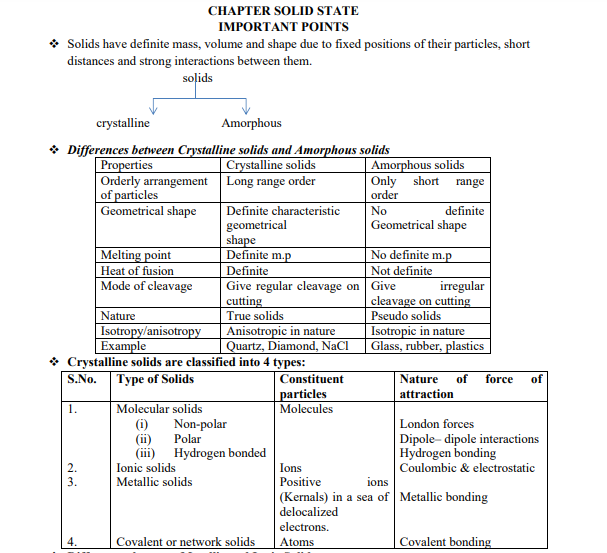
 Class 12 Chemistry-Solid State

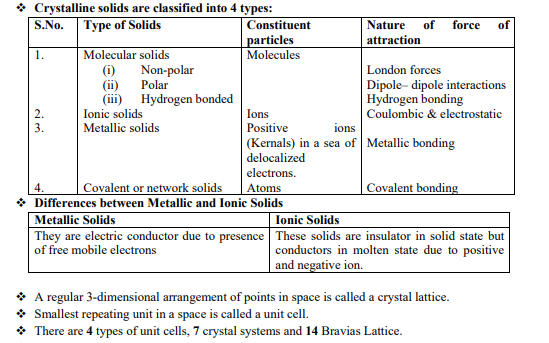
Class 12 Chemistry-Solid State

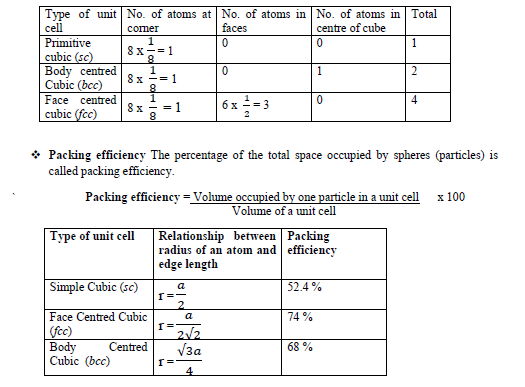
UNIT CELLS

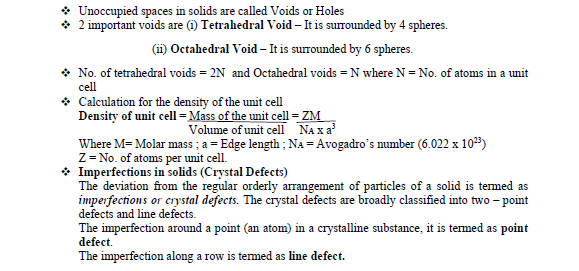
CBSE Class 12 Chemistry-Solid State 1

CBSE Class 12 Chemistry-Solid State 2

CBSE Class 12 Chemistry-Solid State 3

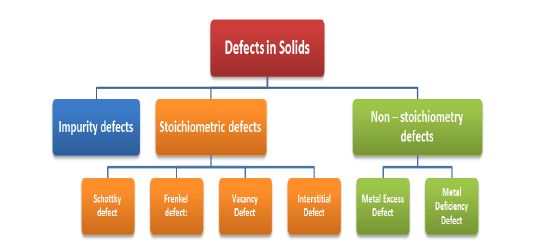
• Vacancy defect decreases the density while interstitial defect increases the density of the substance.
 
• F-centres are the anonic sites occupied by unpaired electrons. They impart colour to the crystal.
 
• Diamagnetic substances – have all paired electrons and weakly repelled by the magnetic field.Eg. TiO2 , NaCl
 
• Paramagnetic substances – have unpaired electrons and attracted by the magnetic field.Eg. O2 , Cu2+ , Fe2+
 
• Ferromagnetic substances – have permanent magnetism. In it, dipoles are aligned in the same direction. Eg. Ni, Co
 
• Antiferromagnetic substances – have net dipole alignment zero. Eg. MnO, FeO.
 
• Ferrimagnetic substances – have net dipole. Eg. Fe3O4, MgFe2O4
 
• Solids are classified into three groups on the basis of their electrical properties;
 
• Conductors - generally includes metals having conductivity of the range 104–107 ohm-1m-1
 
• Semi-conductors – Have intermediate conductivities of the range 10-6–104 ohm-1m-1 As temperature increases there is the rise in conductivity as electrons from the valence band jump to the conduction band.
 
• Insulators -solids which have very low conductivity of the range 10-10–10-20ohm-1m-1
 
• Doping is the introduction of small amount of impurity in the crystal.
 
• n-type semi-conductor: When silicon or germanium is doped with a group 15 element like P or As, the dopant atom forms four covalent bonds like a Si or Ge atom but the fifth electron not used in bonding, becomes delocalized and contributes its share towards electrical conduction. Thus, Si or Ge doped with P or As is called a n-type semi-conductor.
 
• p-type semi-conductor: : When silicon or germanium is doped with a group 13 element like B or Al, the dopant atom forms three covalent bonds but at the position of fourth electron a hole is created. This hole moves through the crystal like a positive charge giving rise to electrical conduction. Thus, Si or Ge doped with B or Al is called a p-type semiconductor.


Please click the link below to download CBSE Class 12 Chemistry-Solid State.

z More Study Material for Class 12 Chemistry
Class 12 Chemistry Full Study Material For Boards Revision
~ Class 12 Chemistry (Old Chapters)
CBSE Class 12 Chemistry Ammonia And Phosphine Notes
CBSE Class 12 Chemistry Chemistry In Everyday Life Board Exam Notes
CBSE Class 12 Chemistry Chemistry In Everyday Life Chapter Notes
CBSE Class 12 Chemistry Chemistry In Everyday Life Notes Set A
CBSE Class 12 Chemistry Chemistry In Everyday Life Notes Set B
CBSE Class 12 Chemistry Chemistry In Everyday Life Notes Set C
CBSE Class 12 Chemistry Chemistry In Everyday Life Notes Set D
CBSE Class 12 Chemistry Chemistry In Everyday Life Notes Set E
CBSE Class 12 Chemistry Chemistry In Everyday Life Notes Set F
CBSE Class 12 Chemistry General Principles And Process Of Isolation Of Elements Board Exam Notes
CBSE Class 12 Chemistry General Principles Notes
CBSE Class 12 Chemistry General Principles Process Of Isolation Of Elements Chapter Notes
CBSE Class 12 Chemistry General Principles Process Of Isolation Of Elements Notes
CBSE Class 12 Chemistry P Block Elements Board Exam Notes
CBSE Class 12 Chemistry P Block Elements Notes Set A
CBSE Class 12 Chemistry P Block Elements Notes Set B
CBSE Class 12 Chemistry Polymers Board Exam Notes
CBSE Class 12 Chemistry Polymers Chapter Notes
CBSE Class 12 Chemistry Polymers Notes Set A
CBSE Class 12 Chemistry Polymers Notes Set B
CBSE Class 12 Chemistry Polymers Notes Set C
CBSE Class 12 Chemistry Polymers Notes Set D
CBSE Class 12 Chemistry Polymers Notes Set E
CBSE Class 12 Chemistry Polymers Notes Set F
CBSE Class 12 Chemistry Processes Of Isolation Of Elements Notes Set A
CBSE Class 12 Chemistry Processes Of Isolation Of Elements Notes Set B
CBSE Class 12 Chemistry Processes Of Isolation Of Elements Notes Set C
CBSE Class 12 Chemistry Solid State Chapter Notes
CBSE Class 12 Chemistry Solid State Notes Set A
CBSE Class 12 Chemistry Solid State Notes Set B
CBSE Class 12 Chemistry Solid State Notes Set C
CBSE Class 12 Chemistry Surface Chemistry Board Exam Notes
CBSE Class 12 Chemistry Surface Chemistry Chapter Notes
CBSE Class 12 Chemistry Surface Chemistry Notes Set A
CBSE Class 12 Chemistry Surface Chemistry Notes Set B
CBSE Class 12 Chemistry Surface Chemistry Notes Set C
CBSE Class 12 Chemistry Surface Chemistry Notes Set D
CBSE Class 12 Chemistry Surface Chemistry Notes Set E
CBSE Class 12 Chemistry Surface Chemistry Notes Set F
CBSE Class 12 Chemistry The P Block Elements Chapter Notes
CBSE Class 12 Chemistry The P Block Elements Notes
CBSE Class 12 Chemistry The P Block Elements Notes Set A
CBSE Class 12 Chemistry The P Block Elements Notes Set B
CBSE Class 12 Chemistry The P Block Elements Notes Set C
CBSE Class 12 Chemistry The Solid State Notes Set A
CBSE Class 12 Chemistry The Solid State Notes Set B
CBSE Class 12 Chemistry The Solid State Notes Set C
CBSE Class 12 Chemistry Unit Cell Notes

CBSE Class 12 Chemistry Unit 01 The Solid State Notes

Students can use these Revision Notes for Unit 01 The Solid State to quickly understand all the main concepts. This study material has been prepared as per the latest CBSE syllabus for Class 12. Our teachers always suggest that Class 12 students read these notes regularly as they are focused on the most important topics that usually appear in school tests and final exams.

NCERT Based Unit 01 The Solid State Summary

Our expert team has used the official NCERT book for Class 12 Chemistry to design these notes. These are the notes that definitely you for your current academic year. After reading the chapter summary, you should also refer to our NCERT solutions for Class 12. Always compare your understanding with our teacher prepared answers as they will help you build a very strong base in Chemistry.

Unit 01 The Solid State Complete Revision and Practice

To prepare very well for y our exams, students should also solve the MCQ questions and practice worksheets provided on this page. These extra solved questions will help you to check if you have understood all the concepts of Unit 01 The Solid State. All study material on studiestoday.com is free and updated according to the latest Chemistry exam patterns. Using these revision notes daily will help you feel more confident and get better marks in your exams.

Where can I download the latest PDF for CBSE Class 12 Chemistry Solid State Notes Set B?

You can download the teacher prepared revision notes for CBSE Class 12 Chemistry Solid State Notes Set B from StudiesToday.com. These notes are designed as per 2025-26 academic session to help Class 12 students get the best study material for Chemistry.

Are these Chemistry notes for Class 12 based on the 2026 board exam pattern?

Yes, our CBSE Class 12 Chemistry Solid State Notes Set B include 50% competency-based questions with focus on core logic, keyword definitions, and the practical application of Chemistry principles which is important for getting more marks in 2026 CBSE exams.

Do these Class 12 notes cover all topic-wise concepts for Chemistry?

Yes, our CBSE Class 12 Chemistry Solid State Notes Set B provide a detailed, topic wise breakdown of the chapter. Fundamental definitions, complex numerical formulas and all topics of CBSE syllabus in Class 12 is covered.

How can I use CBSE Class 12 Chemistry Solid State Notes Set B for quick last-minute revision?

These notes for Chemistry are organized into bullet points and easy-to-read charts. By using CBSE Class 12 Chemistry Solid State Notes Set B, Class 12 students fast revise formulas, key definitions before the exams.

Is there any registration required to download Class 12 Chemistry notes?

No, all study resources on StudiesToday, including CBSE Class 12 Chemistry Solid State Notes Set B, are available for immediate free download. Class 12 Chemistry study material is available in PDF and can be downloaded on mobile.