

Official Class 12 Chemistry Revision Material: CBSE Class 12 Chemistry Coordination Compounds Board Exam Notes
Explore reliable concept summaries and revision materials through the CBSE Class 12 Chemistry Coordination Compounds Board Exam Notes. Tailored for Class 12 learners, utilizing these notes for Chemistry Unit 5 Coordination Compounds ensures thorough preparation and strengthens core academic definitions before final evaluations.
Chapter-wise Concept Summaries: Unit 5 Coordination Compounds
View or download the dedicated Unit 5 Coordination Compounds revision resource below. Engaging with these structured concept notes daily ensures continuous academic progress and mastery of the 2026-27 curriculum for Chemistry.
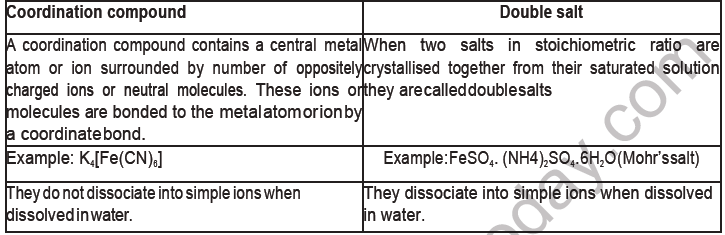
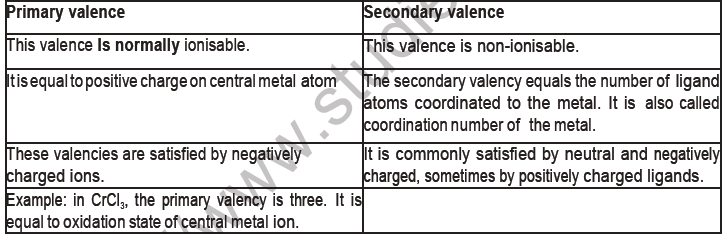
Difference between coordination compound and double salt:
compounds. Structural isomerism, or constitutional isomerism, is a form of isomerism in which molecules with the same molecular formula have atorns bonded together in different orders.
a. Ionisation isomerism: This form of isomerism arises when the counter ion in a complex salt is itself a potential ligand and can displace a ligand which can then become the counter ion.
Example: [Co(NH3) 5Br]SO4 and [Co(NH3)5 SO4]Br
b. Solvate isomerism: It is isomerism in which solvent is involved as ligand. If solvent is water it is called hydrate isomerism.
e.g. [Cr(H2O)3Cl3] and [CrCl2(H2O)4Cl2.2H2O
c. Linkage isomerism: Linkage isomerism arises in a coordination compound containing ambidentate ligand. In this isomerism, a Iigand can form linkage with metal through different atoms.
Example: [Co(NH3)5ONO]Cl2 and [Co(NH3)5NO2]CI2
d. Coordination isomerism: This type of isomerism arises from the interchange of ligands between cationic and anionic entities of different metal ions present in a complex.
Example: [Co(NH3)6][Cr(C2O4)3] and [Cr(NH3)6][Co(C2O4)3]
Stereoisomerism: This type of isomerism arises because of different spatial arrangement.
a. Geometrical isomerism: It arises in heteroleptic complexes due to different possible geometrical arrangements of ligands.
b. Optical isomerism: .Optical isomers are non superimposable mirror images of each other.
VALENCE BOND THEORY
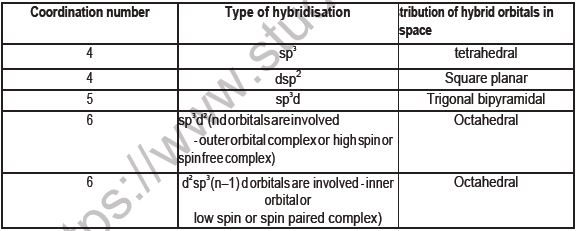
Magnetic properties of coordination compounds: A coordination compound is paramagnetic in nature, if it has unpaired electrons and diamagnetic if all the electrons in the coordination compound are paired.
Magnetic moment = [n (n + 2)]1/2 where n is number of unpaired electrons.
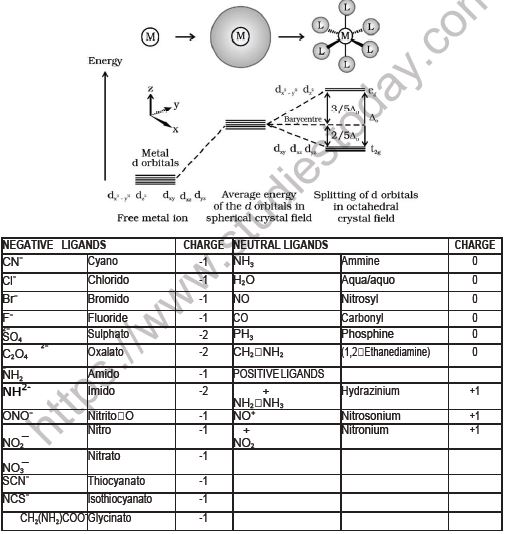
Crystal Field Theory: It assumes the ligands to be point charges and there is electrostatic force of attraction between ligands and metal atom or ion. It is theoretical assumption.
Crystal field splitting in octahedral coordination complexes:
1 Mark- Questions
Q.1 The spin only magnetic moment of [MnBr]2– is 5.9 BM. Predict the geometry of the complex ion.
Ans. Mn2+ in the complex has Co-ordination No. 4, so it has a tetrahedral geometry.
Q.2 CusO4 5H2O is blue in color white CuSO4 is colorless Why?
Ans. d‐d Transition is possible in CuSO4 5H2O , so it shows Color. CuSO4 due to the absence of water (ligand) CFT is not – possible, it is so colored.
3. Write the state of hybridisation of the Compound[Cr(NH3 )6 ]3+
Ans. d² sp³ geometry octahedral
Q.4 Give the formula of the given Co‐ordination compound Ni ion is bound to two water molecules and two oxalate ions.
Ans. [Ni(H O) (OX) ]2– Diaquadioxalato nickelate (II)
ASSERTION -REASON TYPE
A statement of assertion is followed by a statement of reason. Mark the correct choice from the options given below.
(a) Both assertion and reason are true and reason is the correct explanation of assertion.
(b) Both assertion and reason are true but reason is not the correct explanation of assertion.
(c) Assertion is true but reason is false.
(d) Both assertion and reason are false.
1. Assertion : [Co(NH3)Br]SO4 gives white precipitate with barium chloride.
Reason : The complex dissociates in the solution to give Br - and SO4
2- . (Ans - c)
2. Assertion : According to crystal field theory during complex formation, the d - orbitals split and form two sets of orbitals t2g and eg.
Reason : Splitting of d - orbitals occurs only in case of strong field ligands. (Ans - c)
3. Assertion : [Fe(H2O)6]2+ is sp3d2 hybridised and paramagnetic complex ion.
Reason : It has four unpaired electrons. ( Ans - a)
4. Assertion : Low spin tetrahedral complexes are not formed.
Reason : For tetrahedral complexes, CFSE is lower than pairing energy. ( Ans - a)
5. Assertion : [FeF6]3- is paramagnetic.
Reason : F- is a weak field ligand, hence does not cause pairing of electrons. ( Ans - a)
Please click the link below to download pdf file of CBSE Class 12 Chemistry Coordination Compounds Board Exam Notes
Free study material for Chemistry
Unit 5 Coordination Compounds Concepts and Summary for Class 12 Chemistry
Download Chapter Summary: Class 12 Chemistry Unit 5 Coordination Compounds
Access structured revision notes for Unit 5 Coordination Compounds designed in alignment with the latest CBSE curriculum for Class 12 Chemistry. These summaries help clarify core themes and support effective daily study.
Concept Clarification for Unit 5 Coordination Compounds
Each chapter summary is structured around standard CBSE textbooks, allowing students to check their understanding and clarify complex ideas early in their revision.
Additional Study Resources for Class 12 Chemistry
Follow up your revision by attempting the interactive online Chemistry MCQ test and practice worksheets for this chapter to verify your mastery. All platform resources are free to access.
FAQs
You can download the teacher prepared revision notes for CBSE Class 12 Chemistry Coordination Compounds Board Exam Notes from StudiesToday.com. These notes are designed as per 2026-27 academic session to help Class 12 students get the best study material for Chemistry.
Yes, our CBSE Class 12 Chemistry Coordination Compounds Board Exam Notes include 50% competency-based questions with focus on core logic, keyword definitions, and the practical application of Chemistry principles which is important for getting more marks in 2026 CBSE exams.
Yes, our CBSE Class 12 Chemistry Coordination Compounds Board Exam Notes provide a detailed, topic wise breakdown of the chapter. Fundamental definitions, complex numerical formulas and all topics of CBSE syllabus in Class 12 is covered.
These notes for Chemistry are organized into bullet points and easy-to-read charts. By using CBSE Class 12 Chemistry Coordination Compounds Board Exam Notes, Class 12 students fast revise formulas, key definitions before the exams.
No, all study resources on StudiesToday, including CBSE Class 12 Chemistry Coordination Compounds Board Exam Notes, are available for immediate free download. Class 12 Chemistry study material is available in PDF and can be downloaded on mobile.