

Revision Notes for Class 12 Chemistry: Unit 05 Surface Chemistry
Access comprehensive revision notes for Unit 05 Surface Chemistry using the CBSE Class 12 Chemistry Surface Chemistry Notes Set 06. Designed to align with the 2026-27 academic syllabus for Class 12 Chemistry, these concept summaries help students streamline their exam preparation and review complex topics efficiently.
Review Unit 05 Surface Chemistry for Class 12 Chemistry
Access the complete concept summary PDF for Unit 05 Surface Chemistry below. Regular review of these targeted notes builds familiarity with complex Class 12 Chemistry themes and helps secure higher marks in final school evaluations.
SURFACE CHEMISTRY
VSA QUESTIONS (1 - MARK QUESTIONS)
1. Why does a gas mixed with another gas not form a colloidal system?
2. Why are adsorbate particles attracted and retained on the surface of adsorbent?
3. Explain the terms sorption and desorption.
4. “Chemisorption is highly specific.” Illustrate with an example.
5. “Adsorbents in finely divided form are more effective.” Why?
6. Name two compounds used as adsorbent for controlling humidity.
[Ans. : Silica gel, Alumina gel]
7. Mention one shape selective catalyst used to convert alcohol directly into gasoline.
8. ‘Generally high temperature is favourable for chemisorption.’ Why?
9. Name the catalyst used in the following process :
(a) Haber’s process for the manufacture of NH3 gas.
(b) Ostwald process for the manufacture of nitric acid.
10. Explain the relationship given by Freundlich in adsorption isotherm.
11. Which group elements show maximum catalytic activity for hydrogenation reactions?
[Hint : 7–9 group elements]
12. Why gas masks are used by miners in coal mines while working?
13. Write the chemical reaction involved in the preparation of sulphur sol.
14. Name the enzyme which converts milk into curd. [Ans. : lactobacilli]
15. What are the optimum temperature and pH at which enzymes are highly active
. [Ans. : Temperature 298–310K and pH 5 to 7]
16. What are the physical states of dispersed phase and dispersion medium in foam rubber.
18. What is the composition of colloidion solution?
19. Why do colloidal particles show Brownian movement?
[Hint : Due to unbalanced bombardment of the particles by the molecules of the dispersion medium]
21. State the sign of entropy change involved when the molecules of a substances get adsorbed on a solid surface. [Ans. : S = –ve]
22. Why does sky appear blue to us?
23. What happens when hydrated ferric oxide and arsenious sulphide sols are mixed in almost equal proportions?
24. Gelatin is generally added to ice-cream. Why?
[Hint : Ice-cream is water in oil type emulsion and gelatin acts as emulsifier].
25. How is lake test for aluminium ion based upon adsorption?
[Hint : Al2O3.xH2O has the capacity to adsorb the colour of blue litmus from the solution]
26. What is saturation pressure in Freundlich’s isotherm?
27. Mention the two conditions for the formation of micelles.
[Hint. : CMC and Tk]
28. How is Brownian movement responsible for the stability of sols?
[Hint : Stirring effect due to Brownian movement does not allow the particles to settle down.]
29. Which of the following is more effective in coagulating positively charged hydrated ferric oxide sol : (i) KCl (ii) CaSO4 (iii) K3 [Fe(CN)6].
30. State the purpose of impregnating the filter paper with colloidion solution.
31. Mention one use of ZSM–5 catalyst.
SA (I) TYPE QUESTIONS (2 - MARK QUESTIONS)
35. Explain the effect of temperature on the extent of physical and chemical adsorption.
36. Define the term peptization and mention its cause.
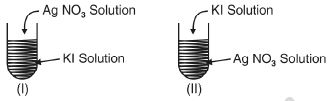
37. What will be the charge on colloidal solutions in the following cases Give reasons for the origin of charge.
38. Write the factors upon which the catalytic reaction of shape-selective catalyst depends?
[Hint : (a) Pore structure of the catalyst; (b) Size and shape of the reactant and product molecules.]
39. Mention two examples of emulsifying agents for o/w emulsions and w/o emulsions.
40. Suggest a mechanism of enzyme catalysed reaction.
41. A small amount of silica gel and a small amount of anhydrous calcium chloride are placed separately in two beakers containing water vapour.
Name of phenomenon that takes place in both the beakers.
[Hint : Silica gel – Adsorption, Anhydrous CaCl2–Absorption, as it forms CaCl2. 2H2O)
42. Write the differences between adsorption and absorption?
43. How can physisorption be distinguished from chemisorption?
44. Classify the following reactions as homogeneous and heterogeneous catalysis :

45. In what way these are different : (a) a sol and a gel (b) a gel and an emulsion.
46. State “Hardy Schulze Rule” with one example.
47. What is an emulsifying agent? What role does it play in forming an emulsion?
48. Define the terms :
(a) Helmholtz electrical double layer.
(b) Zeta potential.
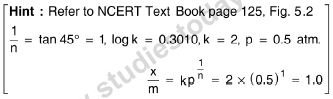
49. A graph between x/m and log p is a straight line at an angle of 45° with intercept on the y-axis i.e. (log k) equal to 0.3010. Calculate the amount of the gas absorbed per gram of the adsorbent under a pressure of 0.5 atmosphere.
50. Mention the two necessary conditions for the observation of Tyndall Effect.
51. Account for the following :
(a) Artificial rain can be caused by spraying electrified sand on the clouds.
(b) Electrical precipitation of smoke.
52. Write chemical equations for the preparation of sols :
(a) Gold sol by reduction.
(b) hydrated ferric oxide sol by hydrolysis.
53. How can the two emulsions can be distinguished :
(a) oil in water type (O/W) and
(b) water in oil type (W/O)
Please click the link below to download pdf file for CBSE Class 12 Chemistry notes and questions for Surface Chemistry Part C.
Free study material for Chemistry
Study Material and Revision Notes for Class 12 Chemistry Unit 05 Surface Chemistry
Key Concepts and Summary for Class 12 Chemistry Unit 05 Surface Chemistry
Access structured revision notes for Unit 05 Surface Chemistry designed in alignment with the latest CBSE curriculum for Class 12 Chemistry. These summaries help clarify core themes and support effective daily study.
NCERT-Aligned Chapter Summary and Notes
Each chapter summary is structured around standard CBSE textbooks, allowing students to check their understanding and clarify complex ideas early in their revision.
Next Steps in Your Exam Preparation
Wrap up your chapter revision by testing your knowledge against standard question formats. Everything on our platform is provided free of charge.
FAQs
You can download the teacher prepared revision notes for CBSE Class 12 Chemistry Surface Chemistry Notes Set 06 from StudiesToday.com. These notes are designed as per 2026-27 academic session to help Class 12 students get the best study material for Chemistry.
Yes, our CBSE Class 12 Chemistry Surface Chemistry Notes Set 06 include 50% competency-based questions with focus on core logic, keyword definitions, and the practical application of Chemistry principles which is important for getting more marks in 2026 CBSE exams.
Yes, our CBSE Class 12 Chemistry Surface Chemistry Notes Set 06 provide a detailed, topic wise breakdown of the chapter. Fundamental definitions, complex numerical formulas and all topics of CBSE syllabus in Class 12 is covered.
These notes for Chemistry are organized into bullet points and easy-to-read charts. By using CBSE Class 12 Chemistry Surface Chemistry Notes Set 06, Class 12 students fast revise formulas, key definitions before the exams.
No, all study resources on StudiesToday, including CBSE Class 12 Chemistry Surface Chemistry Notes Set 06, are available for immediate free download. Class 12 Chemistry study material is available in PDF and can be downloaded on mobile.