

Chemistry Concept Notes for Class 12: Unit 6 Haloalkanes and Haloarenes
Explore reliable concept summaries and revision materials through the CBSE Class 12 Chemistry Haloalkanes And Haloarenes Board Exam Notes. Tailored for Class 12 learners, utilizing these notes for Chemistry Unit 6 Haloalkanes and Haloarenes ensures thorough preparation and strengthens core academic definitions before final evaluations.
Download Unit 6 Haloalkanes and Haloarenes Revision Notes PDF
Navigate directly to the revision notes for Unit 6 Haloalkanes and Haloarenes using the digital viewer below. Each summary is structured to highlight high-weightage sections, allowing students to instantly access critical definitions and focus on core exam topics.

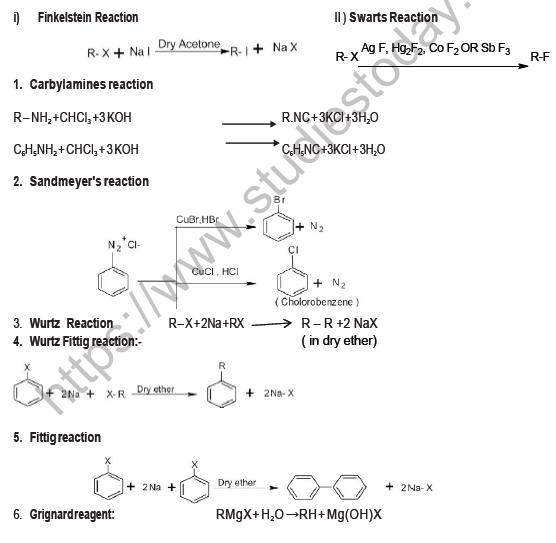
(B) IMPORTANT MECHANISM
i) Nucleophilic Substitution ii) Elimination reaction iii) Electrophilic substitution
i) Nucleophilic Substitution :‐ it involves the replacement of an atom or group of atoms by a nucleophile (electron rich species)
A‐B + Nu →A‐ Nu +B
It is of two types:‐
a) Unimolecular nucleophi lic substitution reaction (SN1)
b) Bimolecular nucleophilic substitution reaction (SN22)
a) Unimolecular substitution reaction (SN1)
(i) it involves two steps
(ii) in this retention/Racemization of configuration take place.
(iii) unimolecular and all are first order.
Mechanism (step 1) formation of carbocation.
Step 2 Attack of nucleophile on carbocation
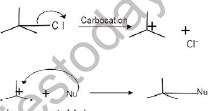
Order of reactivity: 30> 20>10 ( Because 30 carbocation is more stable)
(b) Bimolecular Nucleophilic Substitution SN2(i) it involves one step. (ii) in this inversion of configuration takes place.(iii) bimolecular mechanism: . in this nucleophile attacks from the back side Where halogen atom is attached.
It facilitates the departure of leaving halide group.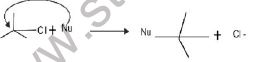
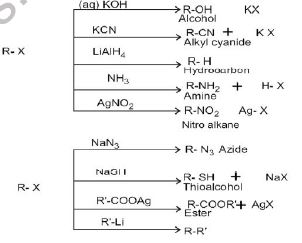
R‐X + AgCN → RNC + AgX
R‐X + Na‐C ≡C‐R → R‐C≡ C‐R + Na‐X
R-X + KNO2 → R-O-N=O + KX
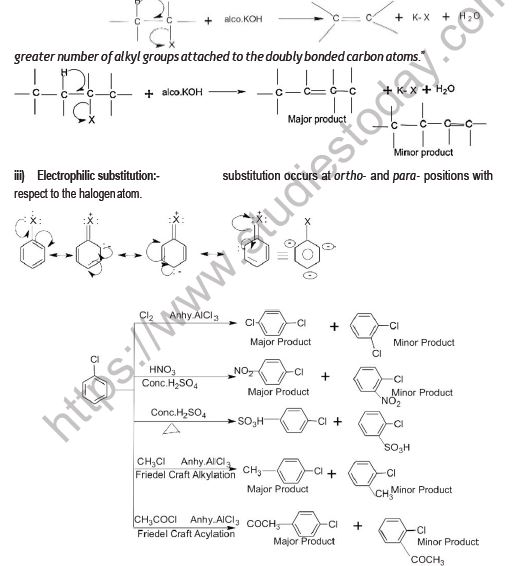
ii) Elimination reaction : Haloalkanes having hydrogen atom, when heated with alcoholic KOH, there is elimination of hydrogen atom from β‐carbon and a halogen atom from the α‐ carbon atom & alkene is formed.
Saytzeff rule “in dehydrohalogenation reactions, the preferred product is that alkene which has the
Q. 1 What are ambident nucleophiles? (1 Mark)
Ans. Nucleophiles which can attack through two different sites are called ambident nucleophiles.
Example: ‐ Cyanide ion :CN–: & C=N:–
Q. 2 Which is a better nucleophile, a bromide ion or iodide ion? (1 Mark)
Ans. Iodide ion because it has lower electronegativity and larger size.
Q. 3 Arrange the compounds of each set in order of reactivity towards SN2 displacement:
2‐ Bromo‐2‐methylbutane, 1‐Bromopentane, 2‐Bromopentane. (1 Mark)
Ans. The reactivity in SN2 reactions depend upon steric hindrance; more the steric hindrance slower the reaction.The order of reactivity in SN2 reactions follows the order : 10> 20> 30. 1‐ Bromopentane>
2‐Bromopentane> 2‐Bromo‐2‐methylbutane .
Q. 4 Arrange the following in increasing order of boiling point.
CH3CH2CH2CH2Br, (CH3)3CBr, (CH3)2CHCH2Br. (1Mark)
Ans. The boiling point increases as the branching decreases, so the increasing order of boiling pointis:‐(CH3)3CBr < (CH3)2CHCH2Br < CH3CH2CH2CH2Br
Q. 5 Define optical activity? (1Mark)
Ans. The compounds which rotate the plane of polarized light when it is passed through their solutions are
called optically active compounds and this property is known as optical activity.
Q. 6 What is racemic mixture or racemic modification? (1 Mark)
Ans. A mixture containing two enantiomers in equal proportions will have zero optical rotation, As the rotation due to one isomer will be cancelled by the rotation due to other isomer. Such a mixture is known as racemic mixture or racemic modification.
Q. 7 What are enantiomers? (1 Mark)
Ans. The stereo isomers related to each other as non-superimposable mirror images are called enantiomers.
Please click the link below to download pdf file of CBSE Class 12 Chemistry Haloalkanes and Haloarenes Board Exam Notes
Free study material for Chemistry
Study Material and Revision Notes for Class 12 Chemistry Unit 6 Haloalkanes and Haloarenes
About Unit 6 Haloalkanes and Haloarenes Revision Notes
Explore reliable chapter overviews for Unit 6 Haloalkanes and Haloarenes tailored for Class 12 learners. Use these structured points to grasp difficult themes and ensure solid preparation for upcoming assessments.
How to Use These Revision Notes
Built using the official NCERT book for Class 12 Chemistry, these notes provide reliable academic guidance. Pair your summary review with our recommended NCERT solutions to master optimal problem-solving approaches.
Enhance Practice with MCQs and Worksheets
Explore our broader library of printable assignments, chapter notes, and mock tests designed to support continuous revision and secure higher marks in CBSE assessments.
FAQs
You can download the teacher prepared revision notes for CBSE Class 12 Chemistry Haloalkanes And Haloarenes Board Exam Notes from StudiesToday.com. These notes are designed as per 2026-27 academic session to help Class 12 students get the best study material for Chemistry.
Yes, our CBSE Class 12 Chemistry Haloalkanes And Haloarenes Board Exam Notes include 50% competency-based questions with focus on core logic, keyword definitions, and the practical application of Chemistry principles which is important for getting more marks in 2026 CBSE exams.
Yes, our CBSE Class 12 Chemistry Haloalkanes And Haloarenes Board Exam Notes provide a detailed, topic wise breakdown of the chapter. Fundamental definitions, complex numerical formulas and all topics of CBSE syllabus in Class 12 is covered.
These notes for Chemistry are organized into bullet points and easy-to-read charts. By using CBSE Class 12 Chemistry Haloalkanes And Haloarenes Board Exam Notes, Class 12 students fast revise formulas, key definitions before the exams.
No, all study resources on StudiesToday, including CBSE Class 12 Chemistry Haloalkanes And Haloarenes Board Exam Notes, are available for immediate free download. Class 12 Chemistry study material is available in PDF and can be downloaded on mobile.